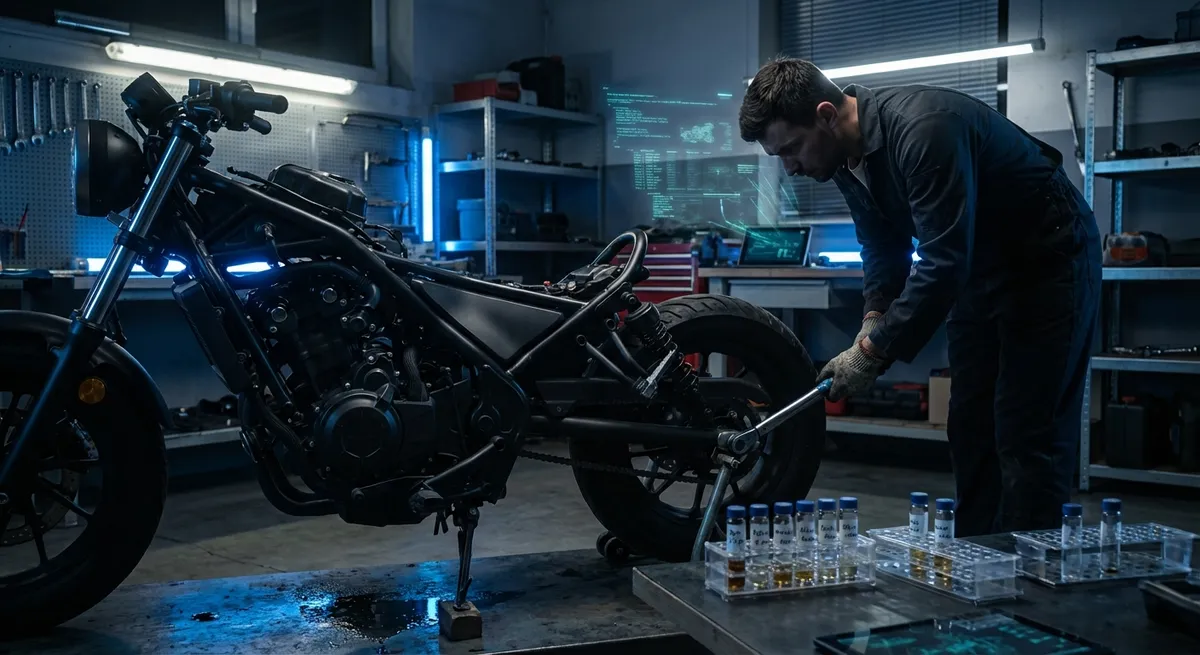
Motorcycle maintenance isn’t just “keeping the bike running.” It’s applied engineering with a torque wrench in your hand and feedback coming through the bars, pegs, and seat. When you maintain a motorcycle with mechanical precision, you’re not only extending component life—you’re tuning the dynamic behavior of a rolling, vibrating, heat-generating system that lives at the edge of friction, combustion, and structural limits.
This isn’t another “check your oil, lube your chain” checklist. This is a deep dive into the underlying mechanics of five maintenance domains that serious riders can use to make their bikes feel tighter, sharper, and more predictable—mile after mile.
1. Torque Discipline: Fasteners as a Structural System
Fasteners on a motorcycle are not just “tight or loose”—they’re engineered to operate within a specific clamping force window. Exceed it and you risk stretching threads, distorting components, or inducing stress risers. Undershoot it and you allow micro-movement, fretting, and fatigue.
When a service manual lists 40 N·m for a caliper mounting bolt, that number isn’t arbitrary. It’s tuned to the bolt’s material, diameter, thread pitch, and the mating materials. The torque value is a proxy for target bolt tension—the actual clamping load that holds parts together. The correct torque keeps those parts engaged in their designed load paths under braking, cornering, and thermal cycling.
A serious maintenance routine should treat torque like a spec, not a guess:
- Use a calibrated torque wrench for any safety-critical or structurally important fastener (brakes, axle pinch bolts, triple clamps, handlebar clamps, rear sets, engine mounts).
- Clean threads before torqueing; dirt, corrosion, or old threadlocker change friction, which skews actual clamping force even at the same torque value.
- Respect dry vs lubricated torque specs. If the manual calls for dry threads and you oil them, you’ll over-tension the bolt at the same torque setting due to reduced friction.
- Follow the tightening sequences for multi-bolt joints (e.g., cylinder heads, triple-clamp pinch bolts). Uneven tightening can warp components and preload them in undesirable ways.
- Replace critical bolts that show signs of stretching (necking), thread damage, or repeated torque cycles beyond their intended service life.
Ridden hard, a motorcycle is a vibration and shock environment. Treating torque specs as non-negotiable engineering constraints is one of the most direct ways to preserve chassis geometry, brake consistency, and structural integrity over time.
2. Fuel System Cleanliness: Atomization, Deposits, and Combustion Quality
Modern engines—carbureted or fuel-injected—depend on precise fuel metering and atomization. The maintenance you do (or don’t do) on the fuel system shows up as throttle response, idle stability, part-throttle smoothness, and even long-term valve and piston crown health.
On carbureted bikes, tiny orifices in pilot and main jets are vulnerable to varnish, oxidized fuel, and microscopic rust particles from tanks. On fuel-injected systems, injectors rely on a clean, stable fuel supply to maintain spray pattern and flow rate.
Key technical maintenance considerations:
- Fuel stability: Pump gasoline begins to degrade in a few weeks. Volatile components evaporate, and oxygen exposure promotes gum and varnish formation. Using a fuel stabilizer for seasonal storage significantly slows this process and protects jets, injectors, and pumps.
- Filter efficiency: Fuel filters aren’t just sieves—they’re engineered for specific micron ratings and flow rates. Overdue filter replacement can restrict fuel flow at high RPM/load, leading to lean running, detonation risk, and erratic power delivery.
- Injector pattern health: A clean injector produces a fine, conical mist. Deposits distort this cone, creating larger droplets that don’t fully vaporize, especially at low load. Result: rough idle, reduced efficiency, and localized rich spots that can carbon up intake valves or plugs.
- Tank corrosion control: Condensation in partially filled tanks can promote rust. Microscopic rust particles are abrasive and can erode pump internals or partially clog fine passages. Keeping the tank fuller during long sits and using quality fuel can help mitigate this.
- Carb synchronization and balancing: Multi-cylinder carbureted engines absolutely depend on synchronized throttle plates and matched fuel circuits. A vacuum sync after carb cleaning or cable replacement directly affects smoothness, vibration behavior, and low-speed control.
A bike with a clean, well-maintained fuel system feels like it’s reading your right hand with zero translation errors: crisp response, clean pickup off idle, and consistent behavior under changing loads and temperatures.
3. Electrical Integrity: Voltage, Grounding, and Heat Management
The electrical system on a modern motorcycle is a tightly coupled ecosystem: stator, regulator/rectifier, battery, wiring harness, sensors, and ECU. Maintenance here is less about replacing random parts and more about understanding how voltage, resistance, and heat interact over time.
When connections degrade, resistance goes up. Increased resistance at a joint means localized heating and voltage drop. In a low-mass, vibration-prone environment like a bike, that’s a recipe for intermittent faults, dim lights, weak spark, and eventually component failure.
Smart electrical maintenance practices:
- Measure, don’t guess: Use a multimeter to check static battery voltage, cranking voltage drop, and charging voltage at the battery terminals at different RPMs. Deviations from spec are early warning signs of stator or regulator/rectifier issues.
- Inspect connector health: Look for greenish oxidation, overheated/browned plastic, or loose terminal fit. High-current connectors (stator to R/R, main fuse block, starter relay) are especially critical. Cleaning and re-tensioning terminals can prevent overheating and meltdown.
- Ground path integrity: The return path matters as much as the positive feed. Corroded frame grounds can cause weird electrical gremlins and sensor misreads. Removing, cleaning, and properly re-tightening ground points—ideally with a light protective coating—can stabilize system behavior.
- Heat and placement: The regulator/rectifier converts AC to DC and shunts excess power as heat. Mounting it in a hot, stagnant air pocket shortens life dramatically. Ensuring it has adequate airflow and that any factory heat sinks are clean improves thermal margins.
- Load awareness: Adding high-draw accessories (aux lights, heated gear, big audio systems) without understanding the stator output and system design can push components beyond their thermal envelope. Periodic checks of charging voltage after adding accessories are a must.
A well-maintained electrical system rewards you with instant starts, consistent fueling behavior (since the ECU and sensors see stable voltage), bright lighting, and fewer “bike just died for no reason” stories.
4. Mechanical Clearances: From Valve Lash to Wheel Bearings
Clearances are where machinery lives: too tight and you get binding, heat, and premature wear; too loose and you get noise, misalignment, and impact loading. Maintenance is the act of re-centering these clearances within their engineered windows.
Valve clearances (“valve lash”) are a particularly stark example. As valves and seats wear, clearances typically tighten. Insufficient clearance can hold valves slightly open at temperature, preventing proper sealing, dropping compression, overheating the valve face, and in extreme cases, leading to valve burning.
Key clearance-related maintenance domains:
- Valve lash: Following the manufacturer’s inspection interval is non-negotiable on high-revving engines. Checking lash with feeler gauges at the correct engine position and temperature ensures that valve timing and seating pressures remain within spec. Shim replacements are not just ritual—they’re restoring the breathing system’s geometry.
- Steering head bearings: Play here translates into vague steering, headshake, and inconsistent feedback. Overly tight bearings cause heavy steering and potential notchiness. Periodic adjustment and proper greasing maintain a smooth, precise steering axis.
- Wheel bearings: Lateral and radial play change how the tire contacts the road under load and may cause oscillations at certain speeds. Spinning wheels by hand and checking for roughness or play during wheel removal are simple, high-value inspections.
- Swingarm and linkage pivots: These are load-bearing rotational joints. Dry, worn, or contaminated bearings and bushings induce stiction in the rear suspension. That shows up as poor compliance over small bumps and unpredictable traction at the contact patch.
- Clutch actuation system: Proper free play in a cable or hydraulic clutch ensures full engagement and full disengagement. Too little free play can cause constant partial slip, generating heat and glazing friction plates. Too much causes incomplete disengagement and notchy shifting.
Treating clearances as a core part of your maintenance routine keeps your motorcycle operating where its chassis and engine designers intended: in a window where every control input produces a clean, proportional mechanical response.
5. Lubrication Strategy: Film Strength, Shear Stability, and Contamination Control
Oil on a motorcycle isn’t just about the right viscosity grade—it’s about managing film strength, shear, and contamination in a compact, high-stress environment that often shares oil between engine, clutch, and gearbox.
Unlike many cars, a lot of bikes use a shared sump: the same oil must lubricate plain bearings, cool pistons, survive gear mesh shear, and provide the right friction characteristics for a wet clutch. That’s a tall order.
Technical considerations for intelligent lubrication maintenance:
- Shear stability: Multi-grade oils rely on viscosity index improvers that can shear down under the brutal mechanical action of gear sets. Overextended oil change intervals may leave you with a lower effective viscosity than printed on the bottle.
- Additive packages: Motorcycle-specific oils (e.g., those meeting JASO MA/MA2) are formulated to avoid friction modifiers that can cause wet-clutch slip. Using automotive energy-conserving oils with friction modifiers in a shared-sump bike can directly impact clutch performance.
- Thermal behavior: Frequent high-load, high-RPM riding raises oil temperature and oxidation rate. If you ride aggressively or in hot environments, staying at the conservative end of change intervals is not “overkill”—it’s operating within the design assumptions.
- Contamination monitoring: Metallic debris on magnetic drain plugs or trapped in oil filters tells a story. Light, consistent fuzz is normal; sharp flakes, non-ferrous particles, or sudden increases are early indicators of abnormal wear (e.g., gearsets, bearings, cam lobes).
- Component-specific lubrication: Chains, cables (where applicable), and pivot points need targeted lubrication. Chain maintenance isn’t just about corrosion; the right lube and regular cleaning reduce roller and sprocket wear, stabilize chain tension over time, and maintain consistent driveline behavior under load transitions.
Viewing lubrication as an engineered system—oil chemistry, change interval, and specific lube points—turns “just an oil change” into a deliberate act of preserving mechanical integrity and dynamic consistency.
Conclusion
Advanced motorcycle maintenance is not a collection of chores—it’s a continuous calibration of a complex mechanical system. When you respect torque specs, keep the fuel system surgically clean, manage electrical integrity, maintain precise mechanical clearances, and run a smart lubrication strategy, the bike pays you back with something you can feel: stability at the limit, trust under braking, clarity in feedback, and an engine that feels eager instead of reluctant.
This is where riders cross the line from “owner” to “operator-engineer.” Every inspection, adjustment, and measured turn of a wrench is a small engineering decision. Stack enough of those decisions in the right direction, and your motorcycle stops feeling like a machine you manage and starts feeling like an extension of your intent.
Sources
- [Yamaha Motor – Importance of Proper Torque](https://global.yamaha-motor.com/business/mc/tech_craft/torque/) – Technical overview from a major manufacturer on why correct torque values matter to reliability and safety
- [U.S. Department of Energy – Alternative Fuels Data Center: Fuel Properties](https://afdc.energy.gov/fuels/properties) – Detailed information on fuel stability and properties relevant to understanding varnish and deposits
- [Motorcycle Safety Foundation – Basic Bike Maintenance Tips](https://www.msf-usa.org/downloads/Maintenance_Tips.pdf) – Practical maintenance guidance that aligns with many of the safety-critical concepts discussed
- [Penn State – Tribology and Lubrication Basics](https://www.me.psu.edu/cimbala/me433/Links/Tribology_Basics.pdf) – Engineering-level explanation of lubrication, film strength, and wear mechanisms
- [California State University, Northridge – Fundamentals of Electrical Power](https://www.csun.edu/~lcaretto/ME370/370-electrical-fundamentals.pdf) – Background on electrical principles that apply to diagnosing and maintaining motorcycle charging systems
Key Takeaway
The most important thing to remember from this article is that this information can change how you think about Maintenance.