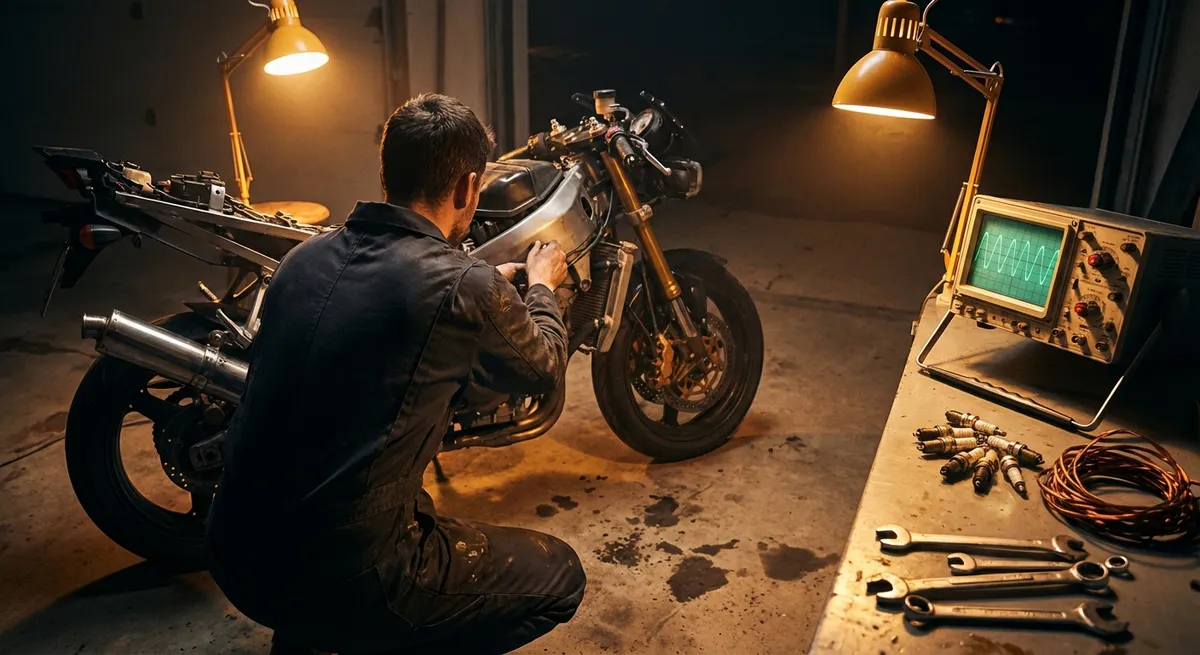
Reliability isn’t luck. It’s the byproduct of understanding your motorcycle the way an engineer sees a circuit: loads, paths, tolerances, and failure modes. Every fastener, seal, and bearing is part of a system that either resonates in harmony… or tears itself apart over time.
This isn’t about washing your bike and checking the oil. This is about treating your motorcycle like a precision machine and using maintenance as a way to extract maximum performance, longevity, and confidence from every ride.
Thinking in Systems: How Loads Travel Through Your Bike
A motorcycle is a dynamic structure. Every acceleration, braking event, and bump is a force input. Maintenance makes sense when you understand where those forces go.
When you brake hard, load transfers from the rear to the front. That load doesn’t “just happen” at the tire; it travels through the contact patch into the wheel, bearings, axle, fork lowers, fork tubes, triple clamps, steering head bearings, and frame. Anywhere along that chain, wear or play changes the behavior of the entire system.
This is why seemingly “small” issues—like a slightly notchy steering head bearing or a loose axle pinch bolt—have outsized effects. They change the stiffness and damping of the structural loop, which alters how the front end responds to inputs. High-speed instability, vague turn-in, or mid-corner chatter often trace back to mechanical looseness, not just suspension settings.
A system-level inspection mindset means you don’t just “check the wheel bearings.” You evaluate the whole path: wheel bearings, spacers, axle torque, pinch bolts, steering head play, and fork alignment. If the bike feels vague, you follow the load path, not just the obvious part.
Technical Point 1: Torque as a Design Parameter, Not a Guess
Torque specs are not bureaucratic trivia; they are engineering instructions that define clamping force, friction, and stress distribution.
Every threaded joint on your bike is designed to operate in a specific preload window. Too loose, and the joint can move, fretting and wearing surfaces, or allow components to shift under load. Too tight, and you overstretch the fastener, distort mating parts, or crush delicate surfaces like aluminum threads or bearing races.
Key torque-related practices that separate casual wrenching from disciplined maintenance:
- Use a calibrated torque wrench for critical fasteners: axle nuts, pinch bolts, brake caliper bolts, handlebar clamps, triple clamp pinch bolts, and engine mounting bolts. Over-torqued fork pinch bolts can distort fork tubes and increase stiction, degrading suspension performance.
- Clean threads and use the specified lubricant or threadlocker (dry, oiled, Loctite, anti-seize) as defined by the service manual. Torque values assume a certain friction coefficient; change that, and your actual preload may be wildly off.
- Tighten in stages and in sequence for multi-bolt patterns (triple clamps, engine cases, brake rotors). This prevents warping and uneven clamping.
- Re-torque structural joints after initial use when recommended (e.g., new handlebars, rearsets, some engine mounts). Fasteners and interfaces can settle under load and vibration.
Treat torque specs like RPM limits: they’re not suggestions, they’re boundaries that keep the hardware operating in its designed range.
Technical Point 2: Oil as a Wear-Rate Controller, Not Just Engine “Blood”
Oil is not just lubrication; it’s a carrier of heat, contaminants, and chemical reactions. Its condition is a direct indicator of how violent the inside of your engine’s world really is.
Three core truths about oil from a technical lens:
- Viscosity is about film strength under real temperature, not just the jug label. A 10W-40 from two different brands can behave differently at high shear rates and operating temperature. Your goal is maintaining a stable oil film between moving parts (cam lobes, bearings, piston skirts) under load and heat.
- Oil shears and oxidizes over time. High RPM, frequent short trips, and extreme heat cycles degrade additives and break down viscosity. This changes how well it can maintain film thickness and neutralize acids from combustion byproducts.
- Contaminants are unavoidable—but manageable. Fuel dilution, moisture, combustion soot, clutch material (in wet clutches), and microscopic metal particles will accumulate. Maintenance is about proactively removing those before they reach harmful concentrations.
Actionable, enthusiast-level oil practices:
- Follow time or mileage intervals, whichever comes first, with an honest assessment of your riding profile. Short urban trips and heavy traffic often justify shorter change intervals than gentle highway cruising.
- Use motorcycle-specific oil if you run a wet clutch (JASO MA/MA2), as friction modifiers in some automotive oils can cause clutch slip.
- Cut open and inspect your oil filter occasionally (especially on high-performance or track-used bikes). Visible metal flakes, non-magnetic debris, or unusual sludge patterns provide early warnings of top-end or bearing wear.
- Monitor oil temperature where possible. Excessive oil temps accelerate oxidation and shear; frequent track days or hot climates may justify more frequent changes or upgraded cooling.
You’re not “just changing oil.” You’re resetting the wear-rate curve of the most stressed components in your engine.
Technical Point 3: Chain and Sprockets as a Precision Power Transmission System
A chain drive is a high-speed, high-load mechanical interface, not a farm gate hinge. The quality of your chain and sprocket maintenance directly affects power delivery, driveline lash, and long-term cost.
From a mechanical engineering point of view, the chain is a series of pivot joints under cyclic tensile loading. Every acceleration, deceleration, and bump creates dynamic tension fluctuations. Wear doesn’t just “stretch” the chain; it increases the pitch of each link as pins and bushings wear, changing how the chain meshes with the sprocket teeth.
Technically sound chain practices:
- Measure chain stretch by link count, not just by eyeballing slack. Many service manuals specify a maximum length over a set number of links (e.g., 20 or 21 pins). If you’re beyond that, the chain pitch no longer matches the sprockets and both wear rapidly.
- Maintain correct slack at the tightest point, with the suspension loaded. Chains often don’t wear perfectly uniformly; rotate the wheel, find the tightest spot, and set slack there. Also consider your typical riding load—solo, two-up, with luggage—as that changes swingarm angle and effective chain tension.
- Lubricate appropriately for your environment. O-ring/X-ring chains are internally lubricated, but the external lubrication reduces friction between rollers and sprocket teeth and protects against corrosion. Wet, salty, or dusty conditions require more frequent cleaning and lubing.
- Replace chain and sprockets as a set. A worn sprocket will rapidly destroy a new chain and vice versa. Look for hooked teeth, sharp points, or a “shark fin” profile as indicators of sprocket wear.
Treat the final drive like a high-speed geartrain, because that’s exactly what it is.
Technical Point 4: Brake Systems as Energy Management Devices
Brakes don’t “stop the bike”; they convert kinetic energy into heat. Maintenance is about ensuring that conversion process happens efficiently, consistently, and predictably—every single time.
Engineers think of brake systems as a chain of subsystems: lever/pedal mechanics, master cylinder hydraulics, fluid characteristics, line expansion, caliper piston movement, pad friction behavior, disc thermal properties, and wheel/tire traction. Any weakness in this chain degrades braking performance.
High-value brake maintenance practices:
- Flush brake fluid on a time basis, not just mileage. Brake fluid is hygroscopic; it absorbs moisture over time, which lowers its boiling point and increases internal corrosion. Even low-mileage bikes can have compromised brake fluid after 2–3 years.
- Inspect pad thickness and condition, not just remaining material. Look for taper wear (one end thinner than the other), glazing (shiny pad surfaces), and uneven wear between inner and outer pads. These signal caliper alignment or piston movement issues.
- Check disc runout and thickness according to the service manual. Warped or excessively thin rotors change pad contact, heat capacity, and lever feel.
- Evaluate lever feel as data. A soft or spongy lever suggests air in the system or hose expansion. A gradually sinking lever at constant pressure can indicate internal master cylinder seal issues. A “grabby” initial bite may point to contamination on the rotor or pads.
You’re not just “bleeding brakes.” You’re ensuring your energy dissipation system can handle worst-case scenarios on the street.
Technical Point 5: Suspension as a Wear Item, Not a Static Component
Suspension is not set-and-forget hardware. Inside your fork and shock are moving pistons, shims, seals, and oil that degrade over time. Performance quietly decays long before dramatic leaks or failures show up.
Fork oil breaks down due to mechanical shearing and contamination (wear particles, moisture, air entrainment). As viscosity changes, so does damping behavior. Shock oil suffers similarly, often with greater consequences because shocks typically run hotter and have smaller oil volumes.
Technically informed suspension maintenance:
- Service intervals are typically based on time and usage intensity, not just miles. Aggressive riding, rough roads, or track use can justify much shorter fork and shock service intervals than the factory manual recommends.
- Monitor changes in dynamic behavior. Increased dive under braking, wallowing mid-corner, harshness over small bumps, or a bouncy ride after large impacts all indicate altered damping or spring performance.
- Check sag periodically. Sag (static and rider) changes as springs fatigue, preload adjusters move, or ride height alters after other maintenance (like chain adjustment or tire changes). Suspension setup is not a one-time event.
- Inspect fork tubes for micro-pitting or corrosion that will quickly destroy new seals. A pristine tube surface is critical for seal longevity and consistent damping.
Suspension maintenance isn’t cosmetic; it’s about keeping your tire’s contact patch loaded in a controlled, predictable way under real-world chaos.
Conclusion
Serious maintenance is not about being paranoid; it’s about being precise.
When you start seeing your motorcycle as an interconnected mechanical system—where torque, oil condition, chain pitch, brake hydraulics, and damping characteristics all interact—you stop “fixing problems” and start engineering reliability.
Every time you torque a fastener correctly, flush brake fluid on schedule, measure chain stretch properly, inspect oil intelligently, or rebuild suspension before it’s obviously gone, you’re performing applied engineering. The payoff is simple: a bike that feels tighter, responds more cleanly, and gives you more confidence every time you lean on it.
You’re not just keeping a machine alive. You’re tuning a mechanical circuit to resonate with how you ride.
Sources
- Motorcycle Maintenance – NHTSA – U.S. National Highway Traffic Safety Administration guidance on core motorcycle maintenance and safety-critical systems
- Motorcycle Operator Manual – Motorcycle Safety Foundation – Includes foundational technical information on motorcycle systems and maintenance basics
- Shell Technical: Engine Oil Basics – Explains viscosity, shear, and degradation mechanisms of lubricants
- Brembo Technical Area – Brake Systems – In-depth discussion of motorcycle braking components and performance factors
- Öhlins Motorcycle Suspension Technical Info – Official documentation covering suspension servicing, damping principles, and maintenance intervals
Key Takeaway
The most important thing to remember from this article is that this information can change how you think about Maintenance.