Motorcycle control isn’t magic—it’s repeatable physics you can feel through the bars, the pegs, and the seat. When you understand how radius, speed, weight transfer, and throttle shape your line, cornering stops being guesswork and becomes a deliberate craft. This article breaks down five highly technical, real-world riding concepts that transform “I hope this works” into “I know what the bike will do next.”
Building a Corner in Three Phases, Not One Panic Moment
Most riders treat a corner as one continuous event: lean and hope. Precision riding breaks it into three functional phases, each with a specific job: entry, apex, and exit. Thinking in phases forces you to assign a purpose to every control input instead of making blended, vague corrections halfway through the turn.
On entry, your priority is stability. That means completing the majority of your braking before you introduce real lean angle. This “set-up” phase is about getting to a speed that gives you margin for mid-corner corrections, not about slowing down as much as possible. Your front tire load should feel firm but not nervous—if the fork is pogoing or the front feels vague, your braking is either choppy or mistimed.
At the apex, your job is line confirmation, not heroics. You should arrive at an apex speed that lets you slightly adjust your line with subtle bar input or body weight shift, not full corrections. If you’re fighting the bike here, you mismanaged either entry speed or your initial turn-in point. The apex is where you stabilize, not where you gamble.
On exit, your primary task is controlled drive, not WOT glory. As you open the throttle, you’re not just accelerating—you’re rebalancing the motorcycle, unloading some of the fork compression, and extending your line out of the corner. Done well, exit should feel like the bike “grows” out of the turn, standing up with gentle authority as your speed builds, not snapping upright in a panic.
Breaking the corner into these phases lets you diagnose mistakes: blew wide on exit? Look at entry speed and turn-in timing. Had mid-corner line drama? Check your earlier commitments, not just what your hands did in the last five meters.
Turn-In Geometry: Entry Point, Steering Rate, and Final Radius
Precision cornering starts before you lean—specifically with where you choose to begin your turn and how quickly you steer the bike. Two riders at the same speed can get completely different outcomes simply from their chosen turn-in point and steering rate.
Your turn-in point is your line’s anchor. Turn too early, and you’ll either run wide on exit or be forced to scrub mid-corner speed with additional lean and bar pressure. Turn too late, and you may overshoot the available lane or run out of lean trying to “catch” the corner. On unfamiliar roads, start with a conservative, slightly later turn-in, then gradually adjust inward (earlier) as you learn the corner’s actual radius and sightlines.
The rate of steering input—how quickly you countersteer to your chosen lean angle—is just as critical. Slow, lazy steering inputs force you to carry lean angle for longer, exposing you to more mid-corner risk and reducing how much adjustment time you have before the apex. A decisive, clean steering input results in a more compact arc: you get to your chosen lean angle earlier in the corner and stabilize sooner, giving you longer to manage line and throttle.
Technically, your final path is the outcome of three things: entry speed, turn-in point, and steering intensity. If the bike is drifting wide even though your throttle is stable, you entered with too much speed for that chosen turn-in point and steering rate. Instead of blaming “not enough grip,” refine the geometry: slightly later turn-in, firmer steering, or marginally reduced entry speed.
Practice this deliberately on a known corner: on separate passes, vary only one variable—entry speed, then turn-in point, then steering rate—while holding the others constant. This “single-variable” approach lets you feel how each change reshapes your line.
Throttle as a Chassis Tool, Not Just a Speed Command
On a motorcycle, the throttle is not just a speed control—it's a weight-distribution tool that reshapes your contact patches and chassis attitude. Once leaned over, your wrist might be the single most powerful geometry adjustment you’ve got.
When you roll off the throttle abruptly mid-corner, you pitch more weight onto the front tire, increasing front grip but simultaneously reducing rear grip and shortening the bike’s effective wheelbase as the front dives. This can make the bike feel like it wants to tighten its line—until the rear starts to feel light or skittish. If you roll off too hard, the bike can feel like it’s “falling inward,” which panics riders into adding bar input and destabilizing things further.
Conversely, a progressive roll-on of throttle after turn-in does three important things: it slightly extends the fork, reallocates some weight rearward, and lengthens the effective wheelbase. The combined result is a natural, predictable line extension—the bike gently wants to run a bit wider and stand a bit taller. Done correctly, this makes your path smoother and your grip more evenly distributed.
The critical phrase is progressive roll-on. You want to avoid the “off–on” binary that yanks weight around. Aim for a controlled, continuous increase in throttle from just past turn-in to corner exit—micro-adjustable, not jerky. If you need to tighten the line mid-corner, first stop increasing throttle rather than chopping it; this stabilizes the platform before you choose whether to slightly reduce speed or add more lean.
Think of throttle as painting your line: a steady, precise brushstroke builds a clean arc; abrupt changes splatter weight forward and back, stressing both tires and suspension.
Using Body Position as a Fine-Tuning Instrument, Not a Showpiece
Hanging off is not a stunt; it’s a tool for managing lean angle and tire load. On real roads, with imperfect surfaces and unknown grip, small, disciplined body adjustments can give you margin without inflating risk. The goal isn’t “track-style extreme” but targeted, purposeful offset of your mass.
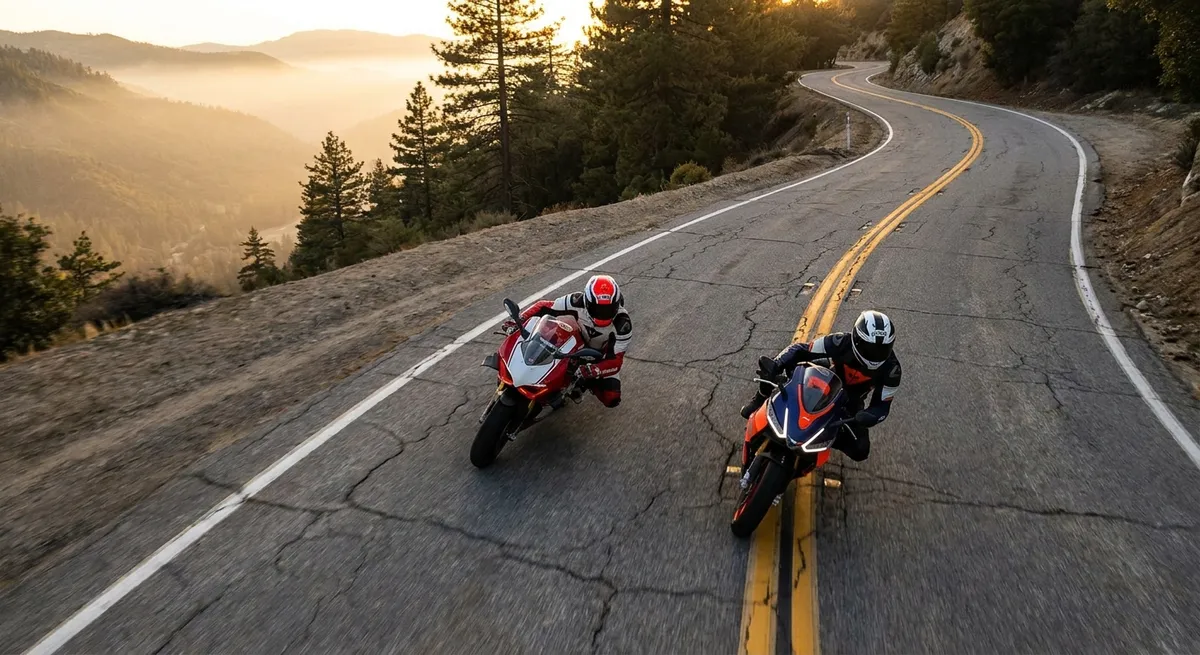
When you move your torso slightly to the inside of the corner, you effectively shift the combined center of mass inward. That allows the bike to achieve the same cornering force with slightly less lean angle, preserving a bit more tire sidewall for bumps, gravel, or unexpected radius tightening. Even a modest shift—1/3 to 1/2 a butt-cheek off the seat, with your chest leading toward the mirror—can translate into meaningful extra safety margin.
Your lower body should lock you to the bike so your arms stay free. That means inside knee lightly against the tank, outside knee clamped more firmly, and weight biased through the balls of your feet, not your heels. If your arms are carrying your bodyweight, your bar inputs will be contaminated by every bump and every micro-correction your core tries to make.
Head position is a massively underrated control input. Where your head goes, your upper body mass and your eyes follow. Aim to keep your helmet slightly to the inside of the mirror line and your eyes looking through the turn, not at the patch of tarmac in front of your wheel. That slight head offset improves both your balance and your visual timing, which in turn stabilizes your steering.
Treat body position like fine adjustment, not a substitute for bad speed judgment. Get entry speed right first, then use body position to buy lean-angle margin and composure, not to “save” a blown corner.
Reading Imperfect Roads: Surface, Camber, and Load Management
Real roads are not racetracks. They’re crowned, patched, rippled, and contaminated. Technical riding is less about ignoring these realities and more about anticipating how they change load on the tires.
Start with camber. A positive camber (road banked into the corner) enhances available grip by aligning gravity and cornering forces more favorably. Negative camber (road drops away from the turn) does the opposite, effectively asking your tire to do more with less. If a decreasing-radius corner also has negative camber, you need to factor that in before committing: slightly lower entry speed, slightly later turn-in, and smoother steering inputs to avoid sudden load spikes.
Patches, tar snakes, and ripples all share a common danger: load spikes. Hitting them while heavily on the brakes or at maximum lean amplifies the stress on the contact patch. Where possible, finish heavy braking before the most damaged surface, then transition to a more neutral throttle so the tire can roll over problems without also handling aggressive load shifts.
Road crown (the center higher than the edges) means your outside tire in a corner often has slightly less vertical load if you’re near the center line versus the outer edge. On a right-hand corner in right-side traffic countries, that means the lane position nearer the center can subtly change how the bike loads mid-corner compared to a path closer to the shoulder. Use lane position consciously, not habitually: adjust not only for visibility and hazard avoidance, but also for how the road shape will load your tires once you’re leaned over.
Wet, dusty, or leaf-covered roads demand earlier, more conservative decisions. Reduce peak lean and rely more on smooth, deliberate control changes—no sudden throttle chops, no emergency mid-corner braking unless absolutely necessary. On low-grip surfaces, micro-smoothness in your inputs is worth more than any “advanced” technique; your job is to keep the tire’s workload predictable, not heroic.
Conclusion
Precise, confident riding is the product of repeatable decisions, not luck. When you understand how corner phases, turn-in geometry, throttle-driven chassis changes, body position, and real-world surface quirks all interact, you stop reacting to corners and start building them—intentionally, piece by piece.
The payoff is enormous: less mid-corner panic, more available grip when you need it, and a bike that feels like it’s working with you instead of trying to surprise you. Take these concepts to a safe environment, work on one at a time, and let your feel for the machine catch up to the physics you now understand. That’s where real riding satisfaction lives—right at the intersection of passion and engineering.
Sources
- Motorcycle Safety Foundation – Cornering Tips - Practical guidance on cornering strategy and control inputs from a foundational training organization
- UK Government – DVSA: Riding and Driving Standards - Official recommendations on positioning, cornering, and hazard awareness for motorcyclists
- BMW Motorrad – Riding Tips: Safe Cornering - Manufacturer-backed explanations of cornering dynamics and riding technique
- Kawasaki Rider Training – Advanced Techniques - OEM perspective on advanced riding skills, including body position and control use
- National Highway Traffic Safety Administration (NHTSA) – Motorcycle Safety - Data-driven safety context and risk factors relevant to real-world riding conditions
Key Takeaway
The most important thing to remember from this article is that this information can change how you think about Riding Tips.