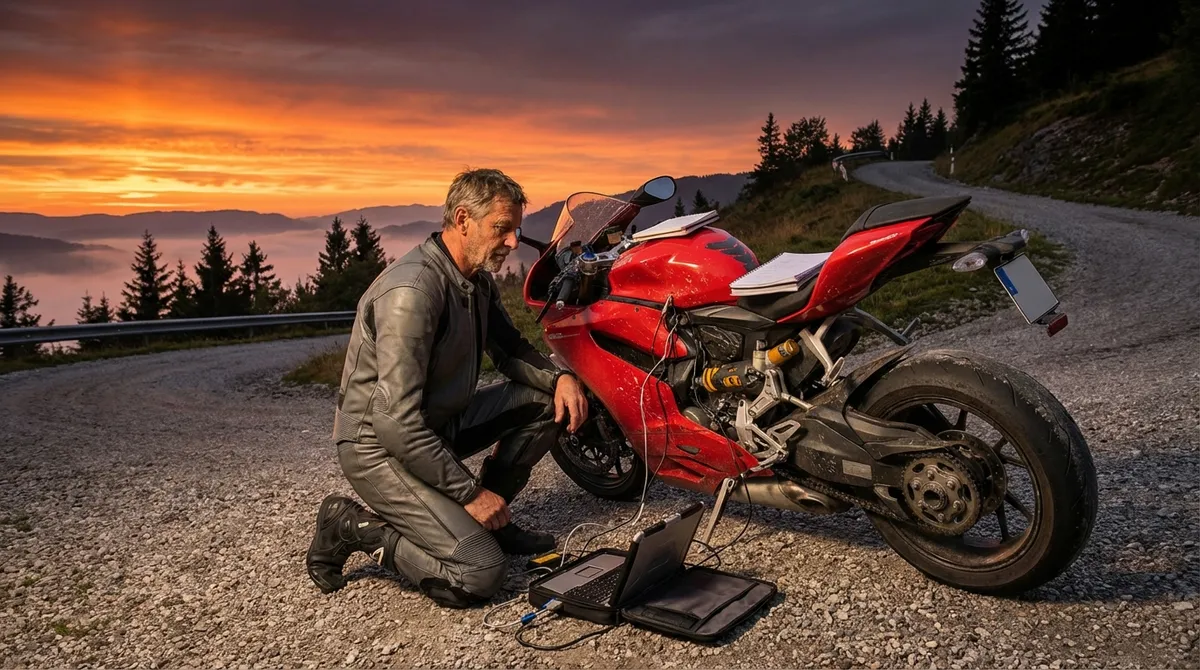
Most “motorcycle reviews” stop at vibes and verdicts: fast, comfy, cool, done. That’s not Moto Ready. When you throw a leg over a bike, you’re not just sampling a product—you’re interrogating a dynamic system. Chassis stiffness, fueling logic, brake thermal behavior, aero stability: these are the things that decide whether a machine feels magical at 60 mph and terrifying at 120, or trustworthy everywhere.
This guide is a framework for riders who want to review motorcycles with an engineer’s mindset, not just a journalist’s adjectives. Use it to structure your own test rides, decode professional reviews, and separate marketing gloss from mechanical truth.
1. Power Delivery: Mapping Torque to Real-World Throttle
Forget peak horsepower for a moment. What matters on the road is how the engine delivers torque at the rpm and throttle positions you actually use.
On a serious test ride, you’re not just asking “is it fast?”—you’re evaluating the shape and control of the power curve:
Low-RPM behavior (idle to ~3,000–4,000 rpm)
- Does the engine lug smoothly in higher gears, or does it shudder and protest? - Is there abrupt on/off behavior when you crack the throttle from closed (especially in Sport modes)? - Fueling here exposes how well the ECU is tuned for partial load, not just emissions compliance.
Midrange thrust (the usable zone)
- Roll on from 3,000–7,000 rpm (varies by engine type) in 3rd and 4th gear. - Are you getting a linear push, or a dead zone followed by a sudden hit? - Good midrange feels like a predictable ramp, not a switch.
Top-end power and breathability
- Run a full-throttle pull (where safe) and feel whether the engine keeps building or hits a “soft wall.” - Short-geared bikes may feel exciting but run out of breath quickly; note if the character changes above a certain rpm.
Throttle strategy and ride modes
- Compare throttle response across modes (Rain/Road/Sport/Track). Are they just limiting power, or actually remapping throttle sensitivity? - A well-engineered throttle-by-wire system feels consistent mode to mode: different intensity, but the same logic.
Drivetrain smoothness
- Check for driveline lash and surging at steady throttle in each gear. - Smooth, elastic drive is a sign that fueling, engine inertia, and final drive ratios are working together instead of fighting you.
A serious review translates this into usable info: “torquey but choppy below 3,000,” “silk-smooth roll-on from 4–8k,” “aggressive initial throttle in Sport that demands precision,” etc. That’s what helps riders match bikes to their roads and riding style.
2. Chassis Dynamics: Feeling the Frame, Not Just the Suspension
Most reviews blur suspension and chassis into one generic “handling” comment. But the frame, swingarm, and geometry define the bike’s core behavior long before you touch a clicker.
When you assess a motorcycle’s dynamics, break it down like this:
Initial turn-in and steering weight
- From upright to first lean, is the bike eager, neutral, or reluctant? - Light steering with minimal input suggests steep rake, short trail, or light wheels. - Heavier steering might indicate conservative geometry, longer wheelbase, or budget rubber.
- Mid-corner stability vs. agility
- Hold a constant-radius corner at a steady throttle.
- Does the bike “hold a line” or need steering corrections?
- A well-engineered chassis will sit into the corner and stay there without nervous adjustments.
Chassis flex behavior
- On rough or bumpy corners, pay attention to whether the bike feels vague, harsh, or communicative. - Too-stiff frames can skip and transmit harshness; too-flexible frames can feel rubbery and imprecise. - You want elastic stability: tiny flex that communicates grip without wobble.
Weight transfer and pitch
- Hard braking, then hard acceleration, both while slightly leaned, will expose weight transfer behavior. - Excessive front dive or rear squat suggests soft springing/damping or poor setup, which affects geometry in motion. - A composed bike changes attitude smoothly, not like a hobby horse.
High-speed stability
- At highway speeds and beyond, test light bar inputs and quick lane changes. - Any weave or wobble under power or over pavement seams is a critical chassis characteristic, not just “a quirk.”
A technical review doesn’t settle for “handles great.” It explains how and where: “neutral, predictable steering with solid mid-corner stability; a hint of chassis flex over rough surfaces that actually boosts feedback rather than blurring it.”
3. Suspension Assessment: Damping, Support, and Real Adjustability
Suspension is how the road speaks to you. The job isn’t “soft” or “hard”—it’s to manage energy: bumps, braking, acceleration, cornering loads. A technical test ride should deliberately probe this system.
Key suspension points to evaluate:
Static attitude and sag (if you can check briefly)
- Sit on the bike and note how much it settles front vs rear. - Excess rear squat = vague front feel; excessive front dive = nervous turn-in and mid-corner instability. - Even without tools, you can feel if the bike is “rear low” or “nose down” just from balance.
Small-bump compliance
- Ride over patchy surfaces, painted lines, and mild ripples at low and medium speeds. - Is the fork chattering or skipping over small impacts? That’s poor low-speed compression or stiction. - Good suspension erases chatter while still letting you feel texture.
Big-hit control and bottoming
- Find a known bump, manhole, or dip at moderate speed. - Does the suspension blow through its travel and crash into the bump stop, or absorb and recover in one clean motion? - Proper high-speed damping will control big hits without kicking you out of the seat.
Brake dive and recovery
- Do a strong but controlled stop from 40–60 mph. - Watch how quickly the fork compresses and how it comes back. - Too little compression damping = fork dumps travel instantly; too little rebound = pogo-stick return.
Adjuster effectiveness (if equipped)
- If you have a longer test ride, make a small, deliberate change (e.g., 2 clicks rebound) at one end and re-ride the same road. - If you can’t feel any difference, the adjusters may be more marketing than meaningful engineering. - A real review mentions that: “Rear shock rebound adjuster has minimal perceptible effect.”
When you interpret other reviews, look for this level of specificity; when you write or talk about a bike, give riders these clues so they know whether they’re buying a magic carpet, a track scalpel, or something that only pretends to be both.
4. Braking System Behavior: From Initial Bite to Thermal Fade
Brakes aren’t just about stopping distance—they’re about control bandwidth. A powerful system that’s hard to modulate is worse than a softer system with predictable feel.
Here’s how to evaluate motorcycle brakes properly:
Initial bite and lever feel
- Gently apply the front brake at low speeds. Does it engage smoothly or grab suddenly? - A well-tuned system gives a small dead-band followed by a linear rise in braking force as lever pressure increases. - Vague or wooden feel often points to rubber hoses, old fluid, or entry-level calipers.
Progression under increasing force
- Do several progressively harder stops. - Does the brake force ramp smoothly with lever travel, or does it spike suddenly at some point? - Good brakes feel like a volume knob, not an on/off switch.
Rear brake tuning
- Test rear brake alone at low and mid speeds. - Overly strong rear brakes will lock or trigger ABS too easily; too weak and they’re useless for mid-corner corrections. - For street use, a well-tuned rear brake is a subtle steering and stability tool.
ABS calibration and intervention
- On a clean, straight stretch, do a controlled near-panic stop to trigger ABS. - Is the pulsing smooth or violent? Does the system maintain composure, or does the chassis pitch and wiggle? - Advanced systems (especially with IMUs) can maintain shorter stopping distances with greater control, and that’s worth calling out.
Thermal performance and fade
- On a spirited downhill or repeater stops, check lever travel and consistency. - If the lever creeps closer to the bar or bite weakens, that’s heat-induced fade in pads, fluid, or both. - A technical review should distinguish: “Pads glazed under aggressive use” vs. “No noticeable fade after multiple high-speed stops.”
That’s the difference between “brakes are good” and a genuinely useful evaluation that tells riders whether this system is track-capable, road-focused, or under-specced for its performance envelope.
5. Electronics, Ergonomics, and Thermal Management: The Rider Integration Layer
Modern motorcycles are software-defined machines. Electronics, interface, and heat management are as crucial as engine and chassis if you actually plan to live with the bike.
When you review or decode a review, scrutinize this integration layer:
Rider modes and traction control logic
- Test multiple modes on the same stretch of road. - In lower-grip conditions (cold tires, damp pavement), lightly provoke traction control on acceleration. - Well-calibrated systems intervene early but smoothly, controlling slip instead of nuking power.
ABS/TC cornering intelligence (if IMU-equipped)
- If the bike has a 6-axis IMU, it should modulate intervention based on lean angle and pitch. - You want guardrails, not handcuffs: intervention should feel like a stabilizing hand, not an abrupt shutdown.
Dashboard and UI design
- Can you read the dash in full sun and at night—without hunting for critical info like gear position, rpm, and speed? - Mode switching should be doable with gloved hands without diving through four layers of menus. - Laggy, cluttered TFTs are fatiguing over time and a real functional downside.
Ergonomics and control layout
- Standing, sitting, and moving around the bike should feel natural—not defined by tank bulges and awkward bar angles. - Check reach to the bars, peg position relative to seat, and the ability to “lock in” with your lower body when braking and cornering. - Switchgear should be logically placed and tactile; a horn button you can’t hit under stress is a design failure, not a minor complaint.
Heat management and long-ride comfort
- After 20–30 minutes, pay attention to engine heat flow at knees, inner thighs, and feet. - High-compression engines and compact packaging can roast riders if the airflow and shielding aren’t engineered properly. - A legitimate review will say: “Left leg toasty at city speeds, fine at highway,” rather than burying it in a footnote.
All of these “soft” factors are actually hard engineering problems. When a review digests them properly, you learn whether the motorcycle is not only fast or capable, but livable in real conditions.
Conclusion
A meaningful motorcycle review doesn’t worship spec sheets or rely on one-word adjectives. It dissects how the machine behaves as a dynamic system: how the powertrain delivers torque, how the chassis and suspension translate inputs into motion, how brakes manage energy, and how electronics, ergonomics, and heat shape your real riding life.
Ride like an engineer and review like a test rider. When you evaluate bikes—or read other people’s reviews—look for these technical signals. That’s how you separate a bike that feels impressive in a 20-minute demo from one that will still feel precise, coherent, and confidence-inspiring on the thousandth mile.
Sources
- [SAE International – Motorcycle Dynamics and Design](https://www.sae.org/publications/books/content/r-384/) – Technical reference on motorcycle dynamics, chassis behavior, and performance engineering
- [KTM – Ride Modes & Rider Aids Explained](https://www.ktm.com/en-int/ktm-world/ride-modes-and-rider-aids-explained.html) – Official overview of how modern ride modes, traction control, and electronic aids are implemented
- [Yamaha Motor – Motorcycle Brake Systems](https://global.yamaha-motor.com/business/mc/tech/safety/brake/) – Technical breakdown of braking systems, ABS function, and safety-focused design
- [Öhlins – Suspension Technology & Setup Guide](https://www.ohlins.com/support/owners-manuals/motorcycle/) – Detailed documentation on motorcycle suspension behavior, adjustment, and tuning principles
- [NHTSA – Motorcycle Safety & Braking Research](https://www.nhtsa.gov/motorcycle-safety) – U.S. government data and research on motorcycle safety, braking performance, and control systems
Key Takeaway
The most important thing to remember from this article is that following these steps can lead to great results.