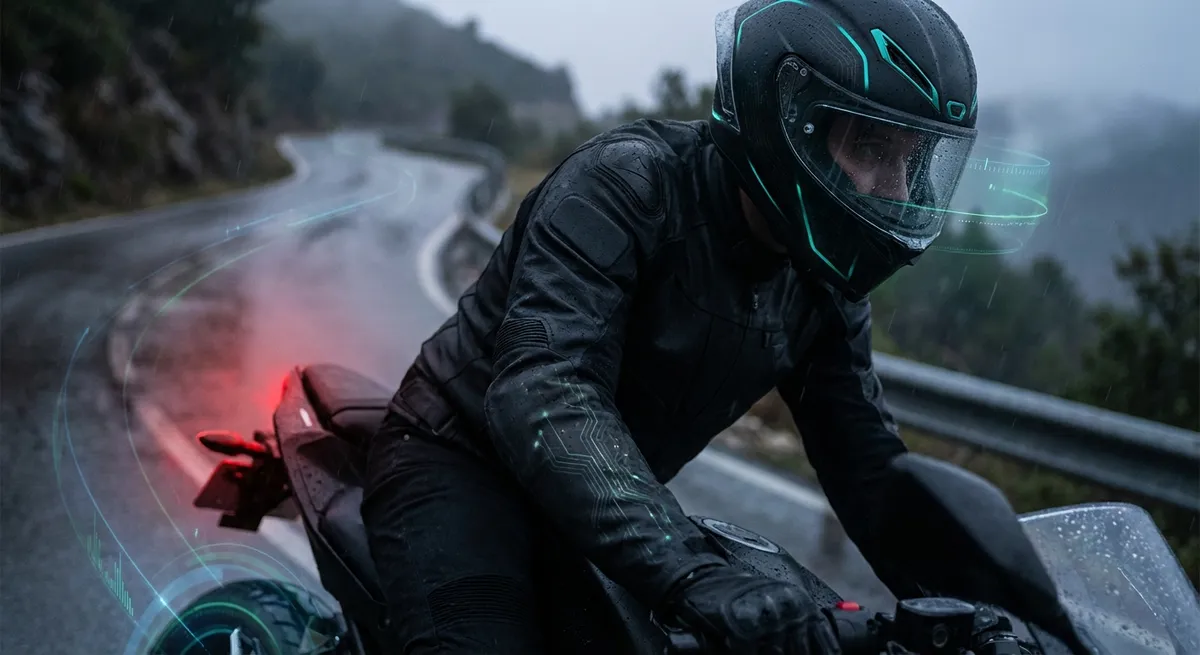
Motorcycle gear is no longer just leather, foam, and zippers—it’s a layered, data-driven system that can be engineered to match how you ride, where you ride, and how hard you push the bike. When you start treating your equipment as a performance platform instead of a fashion decision, everything sharpens: control inputs feel cleaner, fatigue drops, and your safety margin gets a measurable bump. This isn’t about buying the most expensive jacket; it’s about understanding the technical stack inside your gear and tuning it like you’d tune suspension.
Below, we’ll break gear down as an integrated system, then dive into five technical points that matter to riders who care about real-world performance: impact attenuation, friction behavior, thermal management, biomechanical support, and data integration.
Gear as a System: Matching Materials to Riding Physics
Think of your gear as a set of subsystems designed to handle different types of energy transfer: impact, abrasion, heat, moisture, and torque through your joints. Every textile choice, seam layout, and armor pocket is a design decision about where those energies will go when things get dynamic—either at speed or in a crash.
Modern riding gear typically combines:
- Abrasion shell: Leather (often 1.1–1.3 mm cowhide or kangaroo) or advanced textiles like high-denier nylon, Cordura, or blended fibers with aramid reinforcements.
- Impact layer: CE-rated armor (Level 1 or Level 2) at shoulders, elbows, back, hips, knees, sometimes chest; occasionally airbag systems.
- Comfort/fit layer: Stretch panels, accordion zones, and micro-adjust systems to keep armor in the correct position at all times.
- Climate layer: Insulation, vents, and membranes (e.g., laminated vs drop-liner) to control heat and moisture flux through the system.
The goal is not maximum of everything; it’s correct allocation. Track-biased leather suits prioritize abrasion and impact control at triple-digit speeds, often sacrificing ventilation and off-bike comfort. Touring gear leans hard into climate control and fatigue reduction. Understanding these tradeoffs lets you build a gear system that’s mechanically coherent with your riding mission instead of a random collection of “premium” parts.
Impact Attenuation: Reading CE Ratings Like a Data Sheet
Most riders see a “CE Level 2” label, nod, and move on. If you care about the engineering, that’s leaving information on the table. CE impact protectors are tested by dropping a mass onto the armor and measuring how much force is transmitted through it. The lower the transmitted force, the better the attenuation.
Key data points:
- CE EN 1621-1 (limbs):
- Level 1: Average transmitted force ≤ 35 kN, no single impact > 50 kN
- Level 2: Average transmitted force ≤ 20 kN, no single impact > 30 kN
- CE EN 1621-2 (back):
- Level 1: Average ≤ 18 kN
- Level 2: Average ≤ 9 kN
- CE EN 1621-3 (chest): Similar structure, with specified thresholds for chest impact.
What matters in practice:
- Coverage geometry: A Level 2 protector that floats 3 cm off your spine because of poor fit is a downgrade. Check that impact zones actually overlap anatomical risk zones (shoulder head, elbow tip, knee cap, hip bone, spine column).
- Curvature and articulation: Multi-segment or pre-curved protectors maintain contact during real-world positions (tucked, leaned, standing on pegs). Flat panels in a curved back pocket can create force concentration instead of distribution.
- Temperature performance: Some viscoelastic foams stiffen in cold conditions. If you ride in sub-10°C (50°F) weather, test mobility and comfort cold. The armor should still flex and conform rather than becoming a hard plate.
- Armor pocket placement: Adjustable pockets (Velcro height and lateral adjustment) are not a gimmick—they’re a tuning interface. Spend time calibrating position exactly like you would dial in lever reach or brake pedal height.
- Airbag interaction: If you’re running an airbag vest or integrated airbag suit, ensure your underlying hard or Level 2 armor is compatible. Some systems are designed to replace traditional back/chest protectors; doubling up can actually shift deployment behavior or create pressure points.
When you treat armor as a measurable system—coverage, force attenuation, thermal behavior, and kinematic tracking with your joints—you transform “wearing pads” into managing an energy budget.
Friction Engineering: Abrasion, Slide Behavior, and Surface Interaction
Crashes are about energy management over time and distance. Your outer shell’s job is to extend the “time and distance” part of the equation while controlling friction behavior so you slide, not tumble.
Technical aspects to analyze:
Material abrasion resistance:
- Quality 1.2–1.3 mm leather can withstand several seconds of asphalt contact at highway speeds before wearing through. - Single-layer textile without high-abrasion reinforcements can fail dramatically quicker. - Look for materials tested to standards like EN 17092 (A, AA, AAA ratings). AAA is the most protective within that framework, especially relevant for high-speed riding.
Multi-panel shell design:
- High-risk zones: shoulders, elbows, knees, hips, seat, and outer thighs. These should use the highest abrasion and tear-resistant materials. - Low-risk zones: inner arms, inner thighs, torso sides can use stretch textile or lower bulk materials for mobility, as long as key seams stay out of primary slide paths.
Seam engineering:
- Critical seams should be double or triple-stitched, ideally with safety (hidden) stitching so that if external stitches are abraded, the structural seam remains. - Rolled or external seams in primary impact zones are a red flag—they can burst early in a slide.
Friction coefficient tuning:
- Smooth leather and some advanced textiles are chosen specifically for their slide-friendly characteristics. This reduces the risk of catching and tumbling, which multiplies impact events. - Added overlays (rubberized logos, bulky external pockets, exposed zippers) in high-risk zones can act as “trip hooks” on rough surfaces.
Boot and glove interaction with controls:
- Sole compound and tread shape must balance grip on pegs with predictable sliding behavior if your foot contacts the ground at speed. - Glove palms should resist tearing while still allowing micro-slips on the grip, so your hands don’t lock and transfer all torsional force into wrist and finger joints during a fall.
The right friction profile on your gear doesn’t just prevent road rash; it shapes the entire kinematic profile of a crash—from sliding distance to how your body rotates and where forces concentrate.
Thermal Management: Designing a Body-Climate Control System
Fatigue is often thermally driven. As core temperature drifts away from optimal, cognitive reaction time and fine motor control degrade. If you’re serious about handling and decision-making, you should think of your gear as a dynamic heat and moisture management system, not just “vented vs non-vented.”
Key technical elements:
Venting architecture:
- Intake and exhaust pairing: Chest or bicep vents without matched exhaust ports (back, shoulders) create pressurization, not flow. You want a defined path: high-pressure front → low-pressure rear. - Ram air vs passive vents: Upper-chest, shoulder, and thigh vents have strong dynamic pressure at speed; underarm and rear vents rely more on pressure differentials.
Membrane construction:
- Laminated (3-layer) shells: The waterproof membrane is bonded to the outer fabric. Pros: reduced water absorption (less “soggy suit” effect), faster drying, more consistent airflow behavior. Cons: typically stiffer, costlier. - Drop liner: A floating waterproof membrane inside. Warmer, often more comfortable off the bike, but can trap heat and water between shell and membrane.
Base layer strategy:
- Synthetic or merino base layers that manage moisture transfer away from the skin are non-negotiable for performance in both hot and cold environments. Cotton traps moisture and collapses the system. - Compression-style base layers can reduce micro-movement, mitigating chafing and hot spots during long rides.
Zonal insulation:
- Insulation should be higher in non-vented, low-mobility zones (core, upper thighs) and minimal in high-mobility, high-output zones (shoulders, arms) where your musculature generates more heat. - Removable liners are useful only if you can easily stow them on the bike without compromising the rest of your kit.
Helmet integration:
- Your jacket’s collar height and stiffness interact directly with helmet airflow. A tall, stiff collar can choke off chin bar ventilation or create turbulence that degrades your helmet’s carefully tuned vent pathways. - Ideally, you pair a helmet with a well-mapped vent system and a collar design that doesn’t block primary intake zones.
When you dial thermal management correctly, you’re not just more comfortable—you’re protecting reaction times, visual focus, and smoothness on the controls, especially late in long rides when mistakes typically happen.
Biomechanical Support: Gear as a Chassis for Your Body
Your motorcycle has a frame, triple clamps, swingarm, and suspension to manage loads. Your body deserves something analogous. Good gear doesn’t just “fit”; it supports joints, manages repetitive loads, and stabilizes critical structures (neck, lower back, wrists, knees).
Mechanical considerations:
Pre-curved ergonomics:
- Suits and gloves that are pattern-cut in a riding position minimize continuous muscle tension required to hold that posture. Less static load = less long-term fatigue. - For aggressive sport riding, look for pronounced pre-curve in elbows and knees; for touring, a slightly more neutral cut that supports both seated and standing-on-pegs positions.
Stretch panel placement:
- Accordion leather or high-stretch textile in the right locations (above knees, behind shoulders, lower back) allows range of motion without pulling armor out of position. - Overuse of stretch panels in impact or abrasion zones is a structural compromise; they should be carefully zoned, not scattered arbitrarily.
Boot and ankle bracing:
- Look for lateral bracing systems (internal braces, exoskeleton frames, hinge systems) that restrict excessive inversion/eversion (ankle rolling) while still allowing plantar/dorsiflexion (for shifting and braking). - A stiffer sole with defined torsional rigidity reduces foot and ankle fatigue when standing on pegs and protects against peg or debris intrusion.
Glove structure and finger articulation:
- External seams, pre-curved fingers, and knuckle-to-wrist bridge systems can reduce grip fatigue and improve precise lever control. - Wrist closures should sit away from the wrist joint flexion crease to avoid interfering with full extension during hard braking.
Spinal and core support:
- A properly fitted back protector or suit with integrated back support can reduce micro-instabilities in the lumbar region, which accumulate into pain on long rides. - Some riders benefit from light lumbar belts, but these should supplement—not replace—protective back armor.
When fit, panel layout, and articulation are engineered like a suspension system for your body, your riding becomes smoother and more repeatable. You waste less energy just “wearing” the gear and more on actually controlling the bike.
Data-Driven Gear: Integrating Sensors, Comms, and Smart Protection
We’re now in the era where your gear can actively sense, communicate, and intervene. The tech is far beyond just Bluetooth headsets.
Here’s how to think about it as a technical stack:
Smart airbags:
- Inertial Measurement Units (IMUs) embedded in vests or suits monitor acceleration, rotation, and algorithmic patterns of “normal” vs crash behavior. - Some systems are standalone (self-contained) while others integrate with the bike’s own IMU via CAN bus on certain models. - Pay attention to: deployment time (milliseconds), coverage zones (neck, chest, back, collarbones), and re-arming method (electronic reset vs physical tether replacement).
Headset and comms architecture:
- Mesh vs Bluetooth networks influence how stable group comms are at speed or in RF-noisy environments. - Audio processing (noise cancellation, EQ, mic beamforming) directly affects how effectively you can receive navigation or hazard information without cranking volume to damaging levels.
HUDs and visual overlays (emerging tech):
- Heads-Up Display helmets and add-on units are beginning to integrate navigation, speed, and alert overlays. The key technical concern is cognitive load: overlays must be glance-based and low latency without flooding your visual channel. - Always prioritize optical clarity, distortion-free visor design, and verified impact performance over flashy display features.
Telemetry and ride logging:
- Gear-mounted sensors (e.g., in boots or gloves) are starting to provide richer data for braking pressure surrogates, lean, or body position trends. - If you track or aggressively canyon ride, post-ride analytics can expose patterns—late body movement, inconsistent corner entries—that your subjective memory glosses over.
Power and integration:
- Every sensor and comms device creates a power problem. Look for consolidated charging (USB-C ideally), realistic battery life at cold temperatures, and secure cable routing if you’re tapping into bike power. - Consider how added electronics affect weight distribution on your head (helmet-mounted gear) or upper body. A few extra grams in the wrong place can increase neck fatigue over long rides.
Used intelligently, electronics in your gear become an extension of your situational awareness and safety envelope—not just a gadget layer.
Conclusion
When you stop treating motorcycle gear as “something you have to wear” and start reading it like a mechanical and data system, the upgrade path becomes obvious—and far more strategic. You begin to see how impact attenuation, shell friction behavior, thermal regulation, biomechanical support, and integrated electronics all interact to support the way you ride.
The result is not just “safer” riding in an abstract sense. It’s more precise control inputs, a bigger cognitive buffer when things go wrong, and a deeper sense of confidence because you know exactly what your gear is engineered to do at each layer. That’s the point where your equipment stops being an obligation and becomes part of your performance toolkit.
Sources
- [European Commission – Protective Equipment for Motorcycles](https://road-safety.transport.ec.europa.eu/stay-safe/vehicle-safety/protective-equipment-motorcycles_en) - Overview of standards and technical considerations for motorcycle protective gear in the EU
- [Rev’it – Guide to CE Certification for Motorcycle Clothing](https://www.revitsport.com/en_en/blog/ce-certification-explained) - Detailed breakdown of CE standards (EN 17092, EN 1621) and what the ratings actually mean for riders
- [Dainese D-Air Technology](https://www.dainese.com/us/en/technology/d-air/) - Technical explanation of motorcycle airbag systems, sensor inputs, and deployment characteristics
- [NHTSA – Motorcycle Safety](https://www.nhtsa.gov/road-safety/motorcycle-safety) - U.S. government analysis on motorcycle safety, the role of protective gear, and crash injury patterns
- [MIT Medical – Heat Illness and Dehydration](https://medical.mit.edu/community/sports-medicine/heat-illness) - Medical perspective on heat stress and dehydration, relevant to thermal management in riding gear
Key Takeaway
The most important thing to remember from this article is that this information can change how you think about Gear & Equipment.