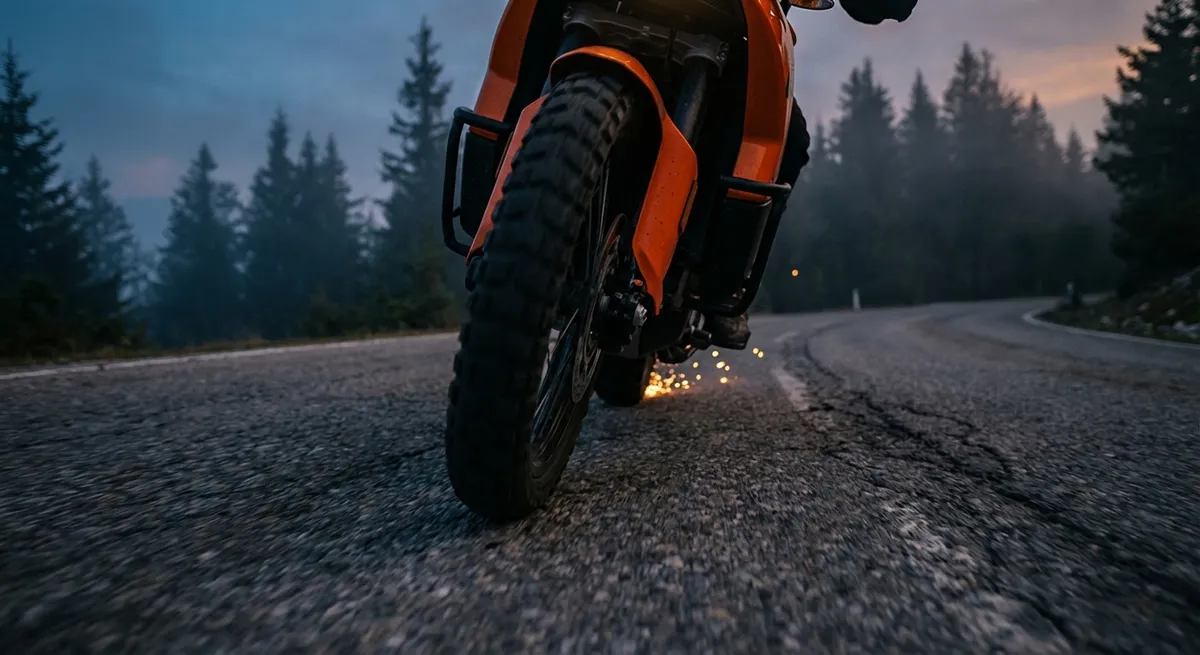
Motorcycle spec sheets are loud. Marketing is louder. But the real truth of a bike isn’t in the brochures—it's in what happens at the tire contact patch when you trail the brake into a decreasing-radius corner or drive hard over a broken surface at lean. This review philosophy is about cutting through catalog hype and asking one question: how does this machine behave when rubber is loaded, unloaded, and stressed the way real riders actually ride?
This isn’t a list of “best bikes.” It’s a framework: five technical lenses you can use to read, write, or think about motorcycle reviews like an engineer who rides hard and a rider who thinks mechanically.
1. Chassis Communication: What the Frame Is Telling Your Hands and Hips
Forget “it handles well.” That phrase is meaningless without describing how the chassis speaks to you.
A serious motorcycle review should decode chassis behavior in concrete, testable terms:
- Initial turn-in character: Does the bike roll into lean with a light nudge, or does it need a deliberate countersteer input? On a fast S-bend, can you flick it quickly without feeling like you’re waiting on the bike to catch up, or does it overshoot and need correction?
- Mid-corner support: Once leaned over and loaded, pay attention to how the bike holds a line. A well-sorted chassis with a balanced geometry (rake, trail, wheelbase, and swingarm angle working together) will feel like it “locks in” at lean. If you feel constant micro-corrections at the bars or hips to stay on line, mention that—it's a sign of geometry, tire profile, or damping mismatch.
- Feedback through the contact patches: An honest review describes what you feel when grip is near its limit. Do you sense the front tire lightly squirming and talking to your fingertips, or does it go from static to sliding with little warning? Back-to-back rides on different surfaces (smooth asphalt vs. patched chip-seal) reveal how much information the chassis transmits vs. filters.
- Flex vs. rigidity balance: Modern frames are designed to flex in specific planes. An overly rigid frame with harsh suspension can feel nervous and skittish over mid-corner bumps. A slightly more compliant chassis may move under you—but predictably. A technical review doesn’t just say “stable” or “unstable”—it explains where in the corner the stability (or lack of it) shows up.
When you read or write a review, look for concrete cornering scenarios and specific rider inputs, not vague adjectives. That’s how you move from “it feels planted” to “it resists line changes once fully loaded but rewards committed, early steering inputs.”
2. Throttle as a Torque Tool, Not an On/Off Switch
Engine power numbers are clickbait. How the motorcycle delivers that power is what matters on real roads, especially at partial throttle where we live 90% of the time.
A technically serious review should break torque delivery down like this:
- Off-idle and low-rpm response: Does a tiny movement of the throttle in first or second gear produce a predictable, small increase in drive, or does the engine lurch? This is a combination of throttle body size, fueling maps, and drivetrain lash. On bumpy roads, ride at 3–4k rpm in a tall gear and feel if the bike “kangaroos” as your wrist moves or suspension travels.
- Midrange vs. top-end character: Don’t just quote a dyno number—describe where the engine feels happiest. Does it pull cleanly from 3k to 8k with a flat, usable plateau, or is there a distinct hit at, say, 7k where it suddenly charges harder? A road-focused engine with a broad torque spread is more useful than a spec-sheet hero that only wakes up near redline.
- Fueling precision and mapping: At steady throttle, does the bike hold speed without surging? Roll on from a closed throttle at lean, mid-corner—does power come back gently or as a step? Mention specific ride modes and their mapping traits: a “Sport” mode might give aggressive initial response that’s brilliant on a track but too jumpy on wet city streets. Good reviews call this out, not just list mode names.
- Engine braking behavior: Closing the throttle is as important as opening it. Strong, abrupt engine braking can unsettle the chassis at lean if not managed by slipper clutches or engine-braking control maps. Test it deliberately: drop two gears into a downhill corner, release the clutch, and feel whether the rear stays neutral, light, or starts to chatter.
A review that cares about riders doesn’t just scream “fast!” It explains how well the torque curve, mapping, and engine braking let you place the bike precisely: on corner entry, at mid-corner, and as you roll out toward the exit.
3. Suspension Behavior in Real Deflection, Not Just Clicker Count
Suspension isn’t about how many adjusters you get. It’s about how the fork and shock behave when they’re actually moving—under braking, in mid-corner bumps, and during full-throttle squat.
To evaluate and describe suspension like an engineer on public roads:
- Brake dive and pitch control: Hard-stop from speed while staying relaxed in your upper body. If the fork blows through its travel and the rear goes vague, geometry changes so dramatically that the bike becomes nervous at the very moment you need stability. Describe how progressive the dive feels and whether the chassis settles quickly or continues to oscillate (poor rebound control).
- Mid-stroke support: Most real-world riding lives in the mid-stroke, not at the last 10 mm of travel. On a flowing road, brake, turn in, maintain a light throttle, and feel whether the bike sits in a calm, supported zone or wallows when asked to change direction. “Mid-stroke wallow” vs. “consistent support” are critical review points.
- High-speed vs. low-speed damping:
- Low-speed damping governs chassis motion due to rider inputs—braking, accelerating, gentle direction changes.
- High-speed damping deals with fast hits—potholes, sharp bumps, expansion joints.
A good review will distinguish: “Firm but controlled over big G-outs” vs. “sharp and jarring over small, sharp bumps” instead of just “stiff” or “soft.”
- Adjustability that actually works: If clickers are present, test them meaningfully. Make a 4–6 click change and describe: did it sharpen steering but increase harshness? Did additional rebound stop repeated bouncing after a bump? Report what effective tuning range riders actually have, especially for common use cases (commuting vs. canyon riding vs. luggage/passenger).
- Static vs. dynamic balance: Test with and without luggage or a passenger. A well-designed chassis maintains similar steering character with extra weight once preload is dialed in. If the bike becomes vague, pushes the front, or needs constant bar input with load, that’s important real-world information.
Suspension isn’t about comfort alone; it’s about keeping the tire loaded correctly so grip is predictable. Serious reviews always connect comfort comments back to tire loading and chassis stability.
4. Brakes and Stability: From First Bite to Fade Point
Braking is where hardware, hydraulics, and geometry collide. A technical review doesn’t just note “radial calipers” and move on—it describes the full braking system in action.
Key aspects to cover:
- Initial bite vs. progressive power: Does the first squeeze of the lever give a sharp, aggressive bite that suits track riding but punishes ham-fisted inputs on the street? Or does it ramp up gently, rewarding riders who trail brake deep into corners? A well-tuned system provides a linear, predictable relationship between lever travel and deceleration.
- Lever feel and consistency: On back-to-back hard stops, does the lever stay firm and in the same position, or does it come closer to the bar (early fade or fluid/line issues)? Modulation matters: can you finely control braking force just before ABS intervention, or does the lever feel wooden, with nothing happening… until suddenly everything happens?
- ABS behavior and tuning: Modern ABS is not binary. Review how early it intervenes, whether it cycles smoothly or with harsh pulsing, and how it behaves at lean. Try braking hard on rough pavement: does ABS overreact and lengthen stopping distance, or does it allow enough slip for effective deceleration? Cornering ABS (IMU-based) should be mentioned with examples, not just as a spec bullet.
- Rear brake usefulness: Many reviews ignore the rear pedal, but skilled riders use it constantly—for settling the chassis, tightening lines, and low-speed control. Test for feel, power, and heat resistance (e.g., slow descents using mostly rear brake). A good rear system is easy to modulate, not just an ABS-triggering on/off switch.
- Stability under maximum decel: Hard braking is a violent geometry change: weight rushes forward, rake steepens, trail shortens. Evaluate whether the bike stays arrow-stable or weaves/lightens in the rear. Note any tendency to rear-wheel lift or bars twitch at high decel rates.
When a review connects braking hardware to how it behaves at the edge of traction, riders get information they can trust when things go wrong in the real world.
5. Ergonomics, Human Factors, and High-Speed Usability
Specs won’t tell you if your wrists will scream after 45 minutes or if the wind blast at 140 km/h will make the bike feel twice its weight. Good reviews translate human factors into technical insights:
- Rider triangle (bars–seat–pegs): Don’t just say “comfortable” or “sporty.” Specify:
- Are the bars below, level with, or above the top triple?
- Are the pegs rearset and high (track bias) or forward and low (comfort bias)?
- How much weight ends up on your wrists at a steady highway cruise?
Riders of different heights (e.g., 5'7" vs 6'1") will experience very different body angles; quality reviews mention this.
- Weight distribution and low-speed manners: A 220 kg bike can feel lighter than a 190 kg one if the mass is low and central. Test U-turns, walking the bike backwards, and slow filtering through traffic. Describe where you feel the mass: high tank, tall seat, wide bars, or compact and centralized around the engine.
- Wind management and aero stability: At highway speed and above, evaluate how air hits your helmet, chest, and shoulders. Clean, consistent airflow is better than noisy, turbulent partial protection. Note whether the bike feels aerodynamically stable in crosswinds and over crests, not just “planted” from the suspension.
- Thermal environment for the rider: Modern emissions-choked engines run hot. Describe heat on the legs and torso in slow traffic, hot days, and extended high-load runs. Is it a manageable warmth or a blast furnace by your right thigh? This affects real-world usability more than another 5 hp on a dyno chart.
- Control layout and precision: Are the clutch and brake levers adjustable enough for different hand sizes? Is the quickshifter clean at partial load or only at full-throttle, upper-rpm use? Are the ride-mode, TC, and ABS settings accessible while moving, with gloves, or buried in submenus? Electronic sophistication is meaningless if riders can’t intuitively use it at speed.
A technical review that respects riders turns “comfortable and fast” into “after 2 hours at 130 km/h, wind hits mid-chest, helmet airflow stays clean, and knees remain relaxed—this is a bike you can genuinely cover distance on and still ride aggressively at the destination.”
Conclusion
Motorcycle reviews can be more than opinion pieces and horsepower brag sheets. When you evaluate a bike through its chassis communication, torque delivery, suspension behavior, braking system, and real-world ergonomics, you’re essentially reviewing how it manages the relationship between mass, grip, and rider input.
For Moto Ready, that’s the whole point: judge a motorcycle not by its brochure, but by how honestly it reports what’s happening at the contact patch—and how precisely it lets you respond. Next time you read or write a review, look for these five technical dimensions. If they’re present, you’re not just being entertained—you’re getting data you can ride hard and safely with.
Sources
- Motorcycle Safety Foundation – Advanced Riding Tips - Practical guidance on braking, cornering, and rider inputs that aligns with evaluating real-world behavior of bikes
- Öhlins Motorcycle Suspension Tech - Technical background on damping, spring rates, and chassis dynamics relevant to interpreting suspension behavior in reviews
- Brembo Motorcycle Braking Systems - Detailed information on caliper design, braking performance, and ABS integration that informs brake system evaluation
- SAE International – Motorcycle Dynamics Papers - Engineering research on stability, handling, and tire behavior that underpins contact-patch-focused reviewing
- Honda Powersports – IMU & Electronic Aids Overview - Explains how modern electronics (ABS, traction control, engine braking) shape real-world riding and should be discussed in modern reviews
Key Takeaway
The most important thing to remember from this article is that this information can change how you think about Motorcycle Reviews.