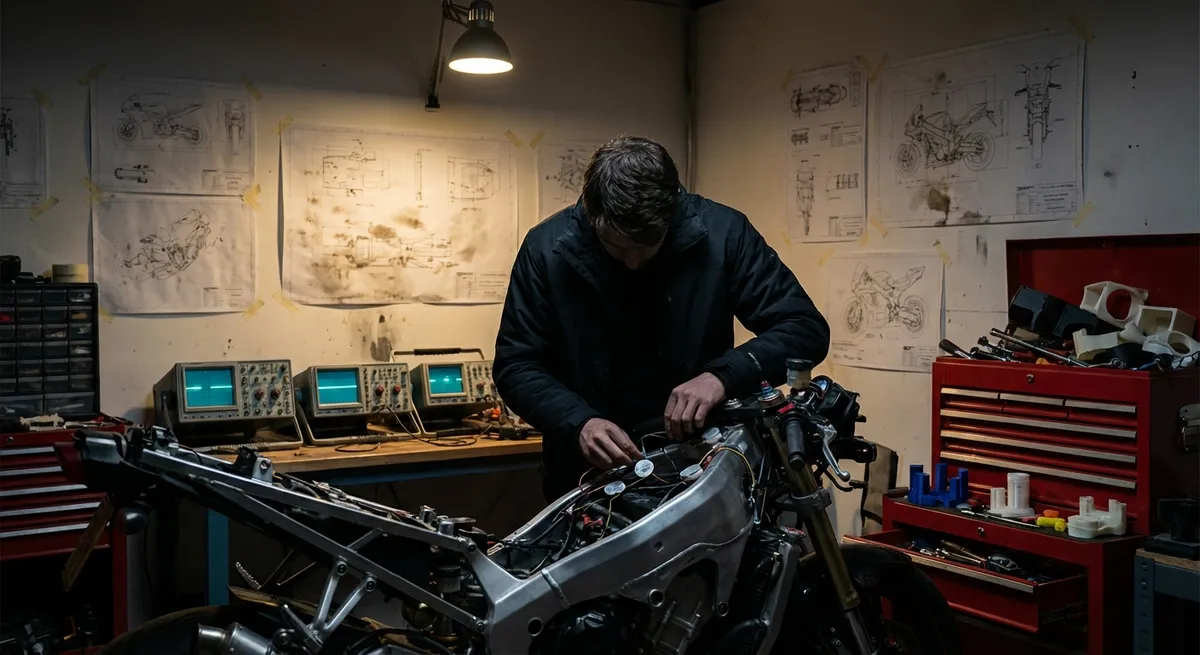
Modern riding gear isn’t just leather, foam, and plastic anymore—it’s a distributed sensor array wrapped around a human engine. If you’re still choosing equipment only by brand, looks, and CE badge, you’re leaving performance and protection on the table. The best gear now can talk to satellites, measure forces, predict crashes, and adapt in milliseconds.
This is about engineering a data-ready riding kit: understanding not just what to buy, but why it works, at the level of materials, sensors, and real-world loads. If your bike has traction control, IMU-based ABS, and ride modes, your gear should be evolving at the same pace.
Building a Protective Shell Around Real-World Impact Data
When you crash, the ground doesn’t care about marketing terms. It cares about energy, direction, speed, and friction. Your gear’s job is to manage those variables with ruthless efficiency.
Modern standards like EN 1621-1 (limb protectors) and EN 1621-2 (back protectors) specify maximum transmitted impact forces, typically in kilonewtons (kN). For reference, Level 1 armor allows up to 18 kN average transmitted force, while Level 2 cuts that to 9 kN. That’s a 50% reduction in force reaching your bones and organs. Don’t just look for “CE approved”—look for the level and the test results.
The most effective setups pair multiple layers: a low-friction outer shell, an abrasion-resistant base (like high-denier nylon or leather), viscoelastic armor that stiffens under load, and a backing layer that spreads and slows the energy. Think of it as a four-stage crash absorber, similar to crumple zones in cars but wrapped around your joints and spine.
Slide time is another critical metric. On a typical road crash at 60–70 km/h, your gear may need to withstand 4–7 seconds of sliding without wearing through. Premium leather and high-performance textiles (like aramid blends) can handle this; cheap textiles often fail in under a second in lab tests. When comparing gear, look for abrasion testing references (Darmstadt or Cambridge machine tests) or EN 17092 class ratings (AAA, AA, A) that correlate to real-world slide durability.
The takeaway: treat armor ratings, abrasion classes, and lab data like you treat torque curves and dyno charts. Numbers tell you how this system behaves under load.
Dynamic Armor: Understanding Airbag and Passive Protector Behavior
Impact protection has split into two main architectures: passive armor and active (airbag) systems. Both can be engineered into your kit, and they behave very differently.
Passive armor—usually polyurethane or viscoelastic foam—works by deforming under impact, converting kinetic energy into heat and spreading force over time and area. Good armor has three key parameters: thickness, coverage area, and energy attenuation (measured during standard test drops). Many popular viscoelastic materials significantly increase stiffness within milliseconds of impact, which is why they feel soft when you move slowly but firm up in a crash.
Airbag systems add an active layer. They monitor acceleration, rotation, and sometimes even GPS and wheel speed to detect crash patterns. Once triggered, they deploy CO₂ or argon-inflated bladders that surround high-value zones: neck, upper spine, ribs, collarbones, sometimes hips. The best electronic vests can deploy in 40–60 ms—fast enough to be fully inflated before you have your first major impact with the ground in a typical road low-side or high-side.
Integration matters. An airbag vest must have room to expand correctly, which means sizing your jacket with the inflated volume in mind or choosing a jacket designed for internal airbags. Overly tight outer shells can restrict expansion, reducing effective protection. Similarly, doubling up on stiff armor and an airbag over the same area can create unintended pressure points; many high-end systems recommend softer or thinner armor in overlapping zones.
From a systems-engineering perspective, the ideal setup uses Level 2 armor for hips, knees, elbows, shoulders, and a high-coverage back protector, combined with an airbag that protects ribs, sternum, clavicles, and cervical spine. Redundancy should be complementary, not just stacked mass.
Thermal Management: Treating Your Gear Like a Cooling System
Your body generates heat like a small engine. While cruising in warm weather, a rider can produce 300–400 W of metabolic heat, spiking much higher under stress. If your kit can’t manage that thermal load, your brain and reaction times degrade long before your tires give up.
Think of your gear as a three-part thermal system:
Base layer = wick and distribute
High-wicking synthetics or merino pull sweat away from skin and spread it across a larger surface area. Cotton fails here—instead of moving moisture, it stores it, defeating evaporative cooling and increasing chafing.
Mid/outer layer = regulate and protect
Textiles with zoned ventilation (mesh in low-abrasion areas, solid panels in high-risk zones) act like variable-geometry aerodynamics for your body. Key is not “more mesh” everywhere, but targeted airflow paths across high-sweat regions: chest, back, underarms, groin, behind the knees.
Outer membrane = manage pressure differential
Waterproof-breathable membranes (ePTFE, PU, etc.) work by maintaining a vapor pressure gradient. Under heavy rain, high humidity and low temperature reduce their effectiveness. That’s why vent placement—direct to body vs. shell-only—is critical. Direct-to-body vents bypass the membrane and can restore effective evaporative cooling even in challenging conditions.
From a performance standpoint, the goal is to avoid heat-induced cognitive drift. Studies show that even mild dehydration and elevated core temperature can significantly slow reaction time and degrade fine motor control—exactly what you need for precise throttle, brake, and body inputs. Your gear’s ventilation and layering strategy isn’t about comfort; it’s about preserving control bandwidth over a long ride.
Grip, Feedback, and the Contact Patch of Your Hands and Feet
Your tires aren’t the only contact patches that matter. Gloves and boots are the primary interfaces between your nervous system and the machine—and small changes in stiffness, material, and construction radically alter feedback.
Gloves as Sensors and Brakes
Technically, a glove should deliver three things:
- Adequate abrasion resistance (palm, outer wrist, pinky side)
- Hard or semi-rigid protection over knuckles and scaphoid area
- Tuned stiffness for lever feel and bar feedback
Palm sliders (usually hard plastic or composite) aren’t just fashion—they reduce friction and prevent your palm from grabbing the asphalt, which can cause wrist and scaphoid fractures. In a slide, you want to skim, not anchor.
At the same time, the glove’s thickness and materials at the index and middle fingers control how much “signal” you get from the lever. GP-level race gloves often use kangaroo leather palms for high tensile strength at low thickness, maintaining feel without sacrificing protection.
Boots as Structural Members
Boots act like short exoskeletons. The best designs manage three axes of motion:
- Flexion/extension: enough to operate controls naturally
- Torsion: limited to prevent spiral fractures
- Lateral deflection: restricted to protect ankles and lower tibia
Look for external bracing systems, hinged ankle structures, and documented CE levels for boots (EN 13634). Reinforced toe boxes and heel cups are your last line of defense in crush scenarios. A thin, flexible sole feels nice off the bike but may fold under weight shifting on pegs or during impacts—downgrading your control and safety.
From a control-systems view, gloves and boots are damping and filtering elements between you and the bike. You want them to filter catastrophic loads while transmitting fine-grain feedback. Overly soft commuter gear often acts like a sponge—comfortable, but it dulls the signals you need to ride at a high level.
Integrating Electronics: Power, Positioning, and Signal Integrity
Smart gear is only as good as its engineering integration. Action cams, comms, GPS trackers, smart helmets, and airbag vests all add sensors, batteries, and wireless signals to the system. You can treat this like building a small distributed network on your chassis: your body.
Power management comes first. Multiple independent batteries (camera, intercom, airbag, phone) create a maintenance burden. The more devices you have, the more critical it is to define a charging routine—either centralized (multi-USB charging dock at home) or semi-centralized (tank bag with power pass-through, USB hub, and short leads to each device). If your airbag or comms die mid-ride because you forgot to charge, that’s a systems failure, not a coincidence.
Mounting is about both aerodynamics and data accuracy. An IMU in an airbag vest expects a known orientation to your spine; putting that same sensor in a chest pocket or under a loosely fitting jacket compromises its algorithms. Cameras mounted on the helmet change rotational inertia—small changes become significant at high speeds or during rapid head checks. Side-mount setups induce asymmetric drag; top-mounts may increase buffeting. Consider this when you tune your windscreen and riding position.
Communication systems must also co-exist without interference. High-powered Bluetooth and Wi-Fi from cameras can occasionally degrade intercom quality, especially in mesh networks. Thoughtful channel selection, device pairing order, and firmware updates are part of keeping this network stable.
Finally, smart helmets and HUDs introduce an information bandwidth problem. More data is not automatically better. Prioritize low-latency, high-value data: navigation prompts, speed, hazard alerts. Overlaying unnecessary information in your visual field can eat into your cognitive budget at exactly the wrong moment. Design your electronic kit like a race dash, not a gadget showcase.
Conclusion
Your gear is a parallel performance platform to your motorcycle: an integrated system of materials, mechanics, sensors, and thermal management. When you evaluate equipment with the same rigor you use for suspension setups or tire compounds, you stop being just a “customer” and become the engineer of your own protective envelope.
Look past brand slogans and surface features. Read the standards, study the materials, understand deployment times, slide durations, stiffness curves, vent paths, and signal flow. Build a kit that doesn’t just look fast, but behaves predictably at the edge—where milliseconds, millimeters, and kilonewtons decide outcomes.
Your motorcycle is already a rolling laboratory. It’s time your gear matched it.
Sources
- [European Commission – Motorcycle Protective Equipment](https://road-safety.transport.ec.europa.eu/system/files/2021-10/motorcycle_protective_clothing_en.pdf) - Technical overview of motorcycle PPE performance, standards, and injury reduction
- [Dainese D-Air Technology](https://www.dainese.com/us/en/d-air/technology/) - Detailed description of electronic airbag system behavior, deployment times, and protection zones
- [CE Standards for Motorcycle PPE (EN 17092, EN 1621)](https://eur-lex.europa.eu/legal-content/EN/TXT/?uri=CELEX%3A32016R0425) - Official EU regulation outlining PPE requirements and references to relevant impact and abrasion standards
- [NHTSA Motorcycle Safety Research](https://www.nhtsa.gov/road-safety/motorcycle-safety) - U.S. government data and analysis on motorcycle crashes, injury mechanisms, and protective gear implications
- [MIT – Heat Stress and Human Performance](https://web.mit.edu/wnelson/www/heatstress/index.html) - Technical discussion of thermal stress, dehydration, and their impact on cognitive and motor performance
Key Takeaway
The most important thing to remember from this article is that this information can change how you think about Gear & Equipment.