Most riders obsess over horsepower, tire profiles, and brake feel—but a shocking number treat visibility like a sticker pack: bolt on a bright light, add a hi-viz vest, and hope drivers suddenly evolve better attention spans. That’s not how this works. Real visibility is engineered, not accessorized. It’s about contrast, conspicuity, and signal clarity under real-world conditions—rain, glare, night, chaos. This is not about looking “bright”; it’s about being unavoidably obvious at the exact moment another road user is about to ruin your day.
This article breaks down visibility as a technical system: lighting, conspicuity patterns, reflective strategy, brake signaling logic, and human-factor realities. If your gear strategy isn’t tied to what the human brain actually notices on the road, you’re leaving performance on the table.
Visibility as a System, Not a Gadget
Throwing more lumens at the problem doesn’t guarantee you’ll be seen. The human eye and brain are wired for change, contrast, and pattern, not raw brightness. Real-world visibility requires designing your gear and bike so your presence and intentions are unmistakable from every angle.
Think in terms of layers:
- Daytime conspicuity (color, contrast, movement)
- Nighttime conspicuity (retroreflective geometry, lighting)
- Signal clarity (braking, lane changes, deceleration)
- Positional awareness (where you sit in traffic relative to other vehicles)
- Environmental adaptation (fog, rain, dusk, urban light clutter)
Your gear is part of a visibility architecture that includes your helmet, jacket, gloves, bike lighting, lane position, and even your riding style. The goal is not to be “visible enough.” The goal is to make it easy for other road users to process you correctly and early—before they make the decision that cuts across your line.
Technical Point 1: High-Contrast Gear Beats Pure Hi-Viz Hype
Hi-viz yellow/green isn’t a magic solution. It works under many conditions, but not all. At sunset or under sodium vapor streetlights, that hi-viz textile can turn muddy and lose contrast against the background. What actually matters is luminance contrast and pattern contrast versus your environment.
Key principles for gear selection:
- Color contrast:
- In urban environments full of gray, black, and dark vehicles, high-saturation colors (fluorescent yellow, orange, red) are powerful.
- In nature-heavy environments (forest, rural, green/brown backgrounds), consider white + dark combinations or hi-viz with strong dark blocking to maintain edge definition.
- Block patterning:
A solid hi-viz jacket can visually “flatten” at distance, especially in bad light. Jackets and helmets that combine hi-viz + black or dark panels create a silhouette with sharp edges. The brain locks onto edges and boundaries faster than uniform color.
- Helmet as primary conspicuity device:
The helmet is one of the highest points on the bike-rider system and moves dynamically relative to traffic. A white, hi-viz, or strongly contrasted helmet is one of the most cost-effective visibility upgrades you can buy. Add reflective elements to rear and side surfaces, not just the back.
- Biomechanical motion cues:
Visible gloves with light or hi-viz sections amplify hand signals and subtle movements. A driver’s brain is wired to notice hands and faces; using gloves that “pop” against your jacket color gives you a dynamic visibility advantage in close quarters.
The technical takeaway: you’re designing a high-contrast, high-recognition silhouette, not just picking a loud color.
Technical Point 2: Lighting Geometry and Beam Discipline
Auxiliary lighting is usually installed like a fashion statement—symmetrical, bright, and blinding. That’s not engineering, that’s noise. To actually improve visibility without becoming part of the problem, you need to understand beam pattern, aim, and geometry.
Core principles:
- Triangulation of light sources:
Two auxiliary lights mounted lower and wider than the main headlight form a visual “triangle.” The human visual system uses triangle geometry to estimate distance and object size more quickly. This can reduce the time it takes a driver to register you as a real, approaching vehicle rather than a single ambiguous point of light.
- Vertical beam cutoff and aim:
- Your low beam and any always-on auxiliary lights must be aimed so the highest point of the pattern stays below oncoming drivers’ eyes at typical distances.
- Overly high or scattered beams cause glare, which leads drivers to avert gaze or misjudge distance—exactly the opposite of what you want.
- Daytime running lights vs. high beam abuse:
Running your high beam in the day doesn’t guarantee visibility; it may just train oncoming traffic to look away. Purpose-built DRLs (Daytime Running Lights) have a defined pattern and intensity that grabs attention without saturating the retina.
- Color temperature and contrast:
- Typical stock headlights are ~3200–4300K (warm to neutral white). Many aftermarket LEDs push into 6000K+ (blue-white).
- In rain, fog, and wet surfaces, extremely cool (blue) light can increase back-scatter and glare. A neutral white (~4500K) often balances contrast and penetration better than blue-tinted “colder” lights.
- Modulation with restraint:
- Limited to daylight
- Within legal frequency and duty cycle
- Strictly aimed to avoid weaponized glare
Headlight modulators (where legal) can be effective when correctly set up and compliant with local regulations. But modulation should be:
You’re not building a lighthouse. You’re building a controlled, information-rich light signature that other road users can interpret quickly and accurately.
Technical Point 3: Retroreflective Strategy for 360° Night Conspicuity
Reflective elements are often treated like decals—random placement, no system. Retroreflection works when the returning light goes back to its source (headlights), so the geometry matters. You’re building a 3D visibility model for night conditions.
Systematic approach:
- Ankles and knees: critical motion points
Small reflective bands at the ankles and lower legs create highly visible, cyclical motion. The human brain instantly recognizes the pattern of walking or pedaling limbs; this “biological motion” recognition is powerful, and it translates to moving feet on pegs and legs on a bike.
- Lateral reflective coverage:
Most riders focus on front and rear, but side impacts at intersections and driveways are common. Ensure your gear has reflective panels or piping on the outer arms, shoulders, and hips, not just the chest and back. Side-mounted reflective stickers on panniers or crash bars also help.
- Structured patterning vs. random patches:
Clean bands and consistent shapes are easier to process than random blob patterns. Reflective stripes that outline your shoulders, torso, and helmet edges give drivers a fast read on your orientation and lean angle.
- Retroreflective material quality:
- High-grade prismatic or glass bead materials from reputable manufacturers maintain brightness longer and at wider entrance angles.
- Cheap reflective piping can degrade quickly from UV and washing. Treat high-grade reflectivity as performance gear, not decoration.
- Bike-based reflectivity:
Not all reflective material is equal:
Use spoke reflectors, wheel rim tape, or reflective elements on luggage and cases to give your motorcycle its own luminous signature independent of your body position.
Retroreflection is passive, but when intelligently placed, it converts every car’s headlight into your personal spotlight without consuming a watt of your battery.
Technical Point 4: Brake Light Logic and Deceleration Signaling
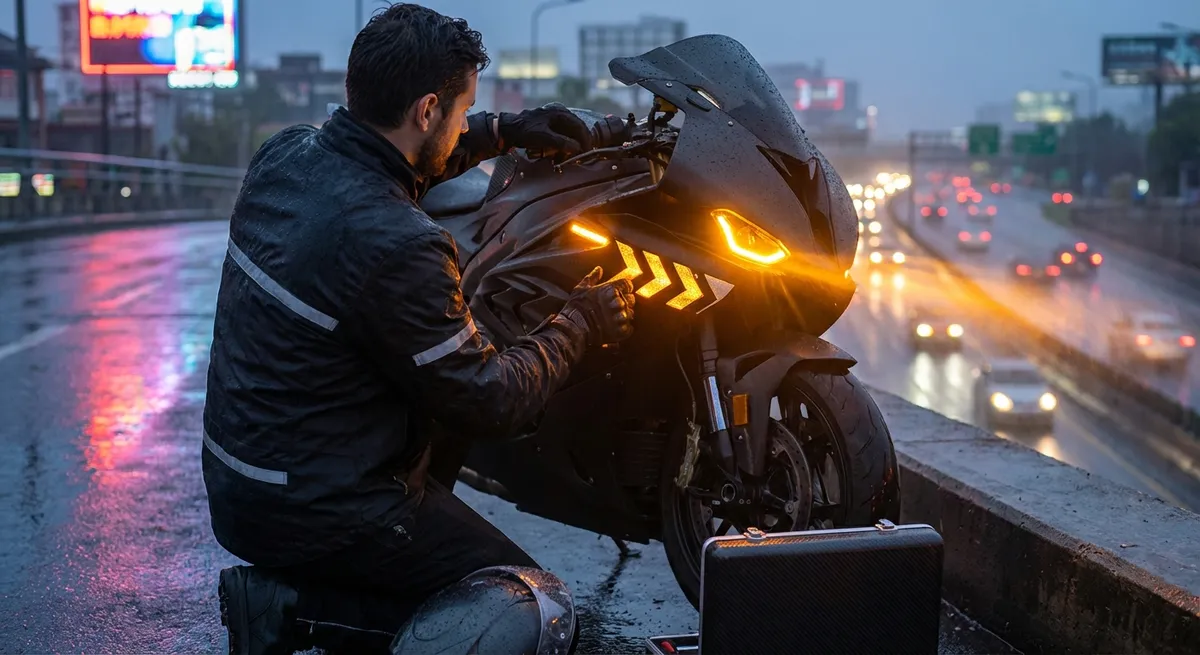
Most motorcycles ship with brutally simple brake signaling: brake on, brake off. Modern traffic deserves better. With quick acceleration and strong engine braking, riders often slow dramatically without touching the brake lever—giving zero visual cues to the driver behind.
To engineer better rearward communication:
- Engine braking and “dark deceleration”:
When you roll off the throttle aggressively in a lower gear, you can decelerate like a light brake application but display no change in your rear light. Drivers behind you aren’t measuring your speed; they’re watching for change in luminance. No change = assumed constant speed.
- Auxiliary brake light modules:
- Add a rapid but brief flash pattern on first brake application (often configurable to remain legal in your region)
- Increase intensity for the first second of hard braking
- Integrate with accelerometers to trigger brake flashing during strong engine braking and abrupt deceleration
- Vertical brake light stacking:
High-quality modules can:
Adding a high-mounted auxiliary brake light (e.g., on a top case or rack) creates a vertical spread of brake signals. This helps in heavy traffic where your stock tail light might be partially obscured by SUVs or vans.
- Separation of running and brake light levels:
If your tail light and brake light intensities are too similar, drivers may not notice when you brake. Good systems ensure a significant intensity delta between running and braking states.
- Turn vs. brake priority:
- Clear, bright, and temporally distinct brake activation
- Turn signals that are obvious and not drowned out by the brake intensity on that side
Integrated turn-signal/brake units look clean, but poor programming can muddy the signal. You want:
This is all about visual communication bandwidth. Your rear lighting should broadcast not just “I exist,” but “I am slowing now,” in a way that is unmistakable and immediate.
Technical Point 5: Human Factors and Cognitive Load in Real Traffic
All the gear in the world doesn’t help if it doesn’t align with how human attention actually works. Crashes often happen not because riders were invisible, but because they were not prioritized by a driver’s limited attention field.
Key human-factor realities:
- Motion camouflage and constant bearing:
A vehicle on a constant collision course can appear stationary in the visual field until it’s dangerously close. A single point of light (like a motorcycle headlight) on a constant bearing may not trigger the brain’s motion-detection systems. Triangulated lighting and subtle lane-position adjustments introduce enough relative motion to break that camouflage.
- Attention competition in cluttered environments:
- Avoid blending into common visual themes—dark gear in a world of dark cars, or all-red rear lighting that disappears among brake light clusters.
- Use distinctive but not chaotic patterns: clear triangle in front, crisp brake signature in back, and consistent conspicuity from the side.
- Predictability as a form of visibility:
In city traffic, drivers are processing signals, storefronts, pedestrians, screens, road signs, and other vehicles. For your gear and lighting to win this attention battle:
Your riding line and lane position are part of your signal package. Smooth, predictable arcs and clear early positioning before turns or lane changes help drivers correctly predict your path. Gear and lighting amplify this, but they can’t fix erratic behavior.
- Glare fatigue and defensive lighting:
Overly aggressive lighting can create avoidance behavior—drivers look away from or mentally “block out” the source of discomfort. You want to be a clearly visible, non-threatening information source, not a punishment beam.
- Cognitive offloading with gear choices:
Gear that’s easy to maintain (clean visor with anti-fog, integrated lighting, simple switchology) reduces your own cognitive load. The less you’re fiddling with gear, the more bandwidth you have to position yourself in visible, low-risk parts of traffic.
Design your gear and visibility strategy around how attention and perception really work, not around marketing buzzwords.
Conclusion
Being seen is not a slogan; it’s a design problem. The solution is not a single hi-viz jacket or an overpowered LED bar—it’s a deliberate visibility architecture built from high-contrast gear, intelligent lighting geometry, engineered retroreflection, clear brake signaling, and an understanding of how humans actually perceive risk and motion.
When you approach visibility like any other performance system on your motorcycle, it stops being cosmetic and starts being functional. The goal is simple: when a driver glances up, your presence and intentions should be so structurally obvious that recognizing and avoiding you requires almost no effort.
Build your visibility like you build your braking system: with intent, with data, and with respect for the physics and biology that govern the real world.
Sources
- [U.S. National Highway Traffic Safety Administration (NHTSA) – Motorcycle Safety](https://www.nhtsa.gov/road-safety/motorcycles) - Data and guidance on motorcycle crashes, conspicuity, and safety factors in traffic.
- [World Health Organization – Road Safety: Motorcycle Helmets and Visibility](https://www.who.int/roadsafety/projects/manuals/motorcycle/en/) - Covers helmet visibility, conspicuity strategies, and human-factor considerations for riders.
- [3M Transportation Safety – Retroreflective Technology Overview](https://www.3m.com/3M/en_US/road-safety-us/applications/vehicle-marking/retroreflective-technology/) - Technical background on retroreflective materials, performance, and application best practices.
- [SAE International – Vehicle Lighting Standards Overview](https://www.sae.org/standards/development/vehicle-lighting/) - Information on engineering practices and standards for automotive and motorcycle lighting systems.
- [Transport for London – Motorcycle Safety and Conspicuity Research](https://content.tfl.gov.uk/motorcycle-safety.pdf) - Research-based insights into motorcycle conspicuity, collision patterns, and the effectiveness of visibility measures in dense urban traffic.
Key Takeaway
The most important thing to remember from this article is that this information can change how you think about Gear & Equipment.