Modern helmets aren’t just shells and EPS anymore—they’re turning into rider hubs. But most “smart helmet” talk is shallow: Bluetooth, a bit of music, call it a day. If you ride hard, ride far, or ride in unpredictable environments, you need a helmet system that’s engineered, not accessorized.
This isn’t about chasing gimmicks. It’s about integrating communication, awareness, and impact management into one coherent, rider-first package. Let’s break down how to build a smart helmet system that actually works—and what technical details you should care about before dropping serious money on gear.
Start With the Shell: Impact Management Before Electronics
If your “smart” upgrades compromise impact performance, you’ve already lost. The helmet’s job, first and always, is to manage energy in a crash.
A proper smart system starts with understanding how the helmet actually protects you:
Shell construction and flex profile
Composite shells (fiberglass, carbon, aramid blends) are designed to flex and delaminate under impact, spreading force across a larger area. Polycarbonate shells are usually more impact-absorbent via deformation but often need thicker walls to pass the same standards. If you’re adding comms or cameras, you want a shell with a known test pedigree (DOT + ECE 22.06 at minimum, ideally Snell or FIM for track use) because any added mass will change how that shell behaves during impact.
EPS density zoning and sensor placement
High-end helmets use multi-density EPS (expanded polystyrene) to handle different impact loads—softer foam for low-speed, stiffer for high-speed hits. If you’re installing speakers or internal wiring, you never want to carve into or compress EPS channels. If you’re adding integrated crash or impact sensors (like fall-detection units), they should mount where they do not interfere with crush paths—typically in designed recesses or along existing harness channels.
Rotational energy management
Systems like MIPS or similar slip-plane technologies are engineered to reduce rotational acceleration to the brain by allowing controlled movement between the shell and liner. Any smart add-ons—sticky mounts, rigid camera brackets, or bulky comms units—can increase rotational torque on the neck and brain in an off-axis impact. That small action cam on the side? It’s also a potential moment arm. If you add hardware, keep it as low profile and centrally located as possible (top-front or chin bar, depending on helmet design).
Technical takeaway: Buy the helmet first for impact performance, certifications, and fit. Then choose smart systems that conform to the helmet—not the other way around.
Integrated Communication: Audio Engineering Inside a Resonant Shell
A helmet is essentially a resonant cavity wrapped around your head. Treat it like an acoustic chamber, not just a place to stick speakers.
To build a comms setup that works at speed:
- Speaker placement vs. ear canal alignment
Most riders slap speakers behind the cheek pads wherever they fit. That kills clarity and forces you to crank volume. For best intelligibility at highway speeds, the speaker center should align directly with your ear canal, not just “near your ear.” Use the helmet’s factory speaker recesses if present; if not, you may need low-profile spacers to bring the driver closer without touching your ear. A 3–5 mm difference in offset can be the line between crisp audio and muddy noise at 80 mph.
Frequency tuning for speech, not just music
Helmets have heavy low- and mid-frequency road noise: engine, wind, traffic. What you need is speech intelligibility—primarily 1–4 kHz. A good comms unit with a decent DSP (digital signal processing) profile will emphasize vocal ranges and suppress lower-frequency roar. If your system allows EQ presets, prioritize “voice” or “intercom” modes over “bass boost” or “music” when you’re in traffic or group rides.
Directional microphone and noise gating
Modern systems use beamforming or highly directional boom mics plus noise gates to reject wind and engine noise. Proper mic placement is critical: - Position the mic close to your lips, aimed directly at your mouth. - Use the supplied foam and optional windscreen. - Keep it behind the chin curtain or inside the sealed airflow zone if available. If callers say they hear “wind” more than “you,” your mic is likely sitting in a turbulent airflow path, not a calm air pocket.
BT chipsets and multi-device priority
If you run GPS + phone + intercom, you want a comms unit that allows priority stacking. For example: - Intercom > Navigation > Phone calls > Media This ensures critical instructions or warnings come through even if you’re streaming music. Check whether the unit supports Bluetooth 5.0 or later—improved bandwidth and power efficiency matter when you’re managing multiple connections on long rides.
Technical takeaway: A well-engineered comms setup is about positioning and tuning, not raw volume. Your goal is clear signal in a noisy, fast-moving acoustic environment.
Visual Intelligence: Visors, Photochromics, and HUDs That Don’t Get You Hurt
Smart helmets often promise HUDs, head-up displays, or AR overlays. The real question: do they improve your situational awareness or clutter it?
Before you even think about HUDs, dial in the optical system:
Optically correct visors and distortion
A quality visor is not just “clear plastic.” Premium shields are optically correct in the primary field of view—minimizing distortion that can mess with depth perception during quick transitions (like flicking through a chicane or lane splitting). Distortion plus digital overlays is a bad combination if you ride aggressively.
- Photochromic vs. internal sun visors
- Photochromic (transitions-style): Lens darkens with UV exposure. Advantage: no moving parts or drop-down mechanisms, lighter and mechanically simpler. Disadvantage: slow reaction to sudden lighting changes (tunnels, heavy shade), and reduced darkening behind UV-blocking windscreens.
- Internal sun visors: Mechanically deployed tinted inner layer. Advantage: instant response to changing conditions, independent of UV exposure. Disadvantage: slightly more weight, more moving parts, potential weak points in helmet structure depending on design.
For fast-paced mixed-condition riding, a well-designed internal sun visor often wins in real-world usability; for consistent open-sun touring, photochromic can be exceptionally convenient.
Anti-fog and anti-scratch systems
Pinlock or equivalent dual-pane systems significantly reduce fogging by creating an insulating air gap—critical when you’re running internal electronics that add a bit of heat and moisture. Riders who run comms and talk a lot in cold or damp conditions will notice fog much sooner; a good anti-fog system is effectively part of your smart setup.
HUDs and information discipline
A head-up display sounds futuristic until it buries you in data. The only HUD information that belongs in your primary vision when riding dynamically: - Speed (for legal awareness and quick reference) - Navigational prompts (simple arrows or next-turn indications) - Critical alerts (collision warning, brake light alert from a paired bike, etc.)
Tachometers, RPM graphs, gear indicators, music tracks, and message notifications belong in a “glance only” or secondary information layer—if at all. Latency and refresh rate also matter; a laggy HUD that misrepresents your speed or turn instructions is worse than none.
Technical takeaway: Visual tech should clarify your view, not compete with it. start with optics and only then add minimal, high-value information overlays.
Electronic Architecture: Power, Weather Sealing, and Failure Modes
Once you start integrating comms, lights, sensors, and possibly cameras, your helmet becomes a small, distributed electronic system. That means you need to care about how it behaves when something goes wrong.
Here’s the technical backbone of a reliable smart setup:
Power budget and battery strategy
Every device adds current draw. A realistic all-day touring use case might include: - Comms + intercom (continuous) - Occasional phone calls - Navigation audio - Optional rear helmet brake light or visibility beacon Check: - Battery capacity (mAh) and claimed runtime at realistic usage. - Whether your devices support pass-through charging while in use. - Charge connector type (USB-C is now standard and more robust than micro-USB). Ideally, you want your system to last a full riding day (8–10 hours) at medium use without mid-day panic charging.
Ingress protection and connector quality
Helmet-mounted gear lives in rain, vibration, dust, and UV exposure. Look for: - Rated water resistance (IPX4–IPX7 depending on use). - Covered ports or fully sealed connectors. - Strain-relieved cables that don’t yank out of their housings over time. Unsealed wiring routed along the shell edge is a corrosion and intermittent-connection nightmare waiting to happen.
Mount points and shear safety
Every external module—comms, cameras, lights—adds protrusions that can catch on the tarmac in a slide. Smart design dictates: - Low-profile mounts that sit close to the shell. - Adhesive mounts designed to shear off under sufficient force, not act as hooks. - Avoiding sharp or angular housings in high-contact regions (sides and rear of the helmet).
Some manufacturers now design integrated channels or mounting plates specifically for their devices, which is preferable to universal clamp-on hardware.
Fail-safe behavior
Ask a simple question: if the system fails mid-ride, does it: - Distract you (loud sudden tones, constant reconnect attempts, HUD errors)? - Obstruct vision or movement? - Lock up controls that you rely on (e.g., no manual visor release)? A good smart system should fail quietly and non-destructively—power loss should be an inconvenience, not a hazard.
Technical takeaway: Treat every electronic add-on like a subsystem on a race bike—power, heat, vibration, and failure modes all matter. Rider focus is the non-negotiable priority.
Sensory Enhancement: Lighting, Brake Signaling, and Environmental Feedback
The best smart helmet systems don’t just entertain you—they help other road users see you and help you understand your environment more clearly.
Here’s where the next level of tech earns its keep:
Active rear lighting and brake signaling
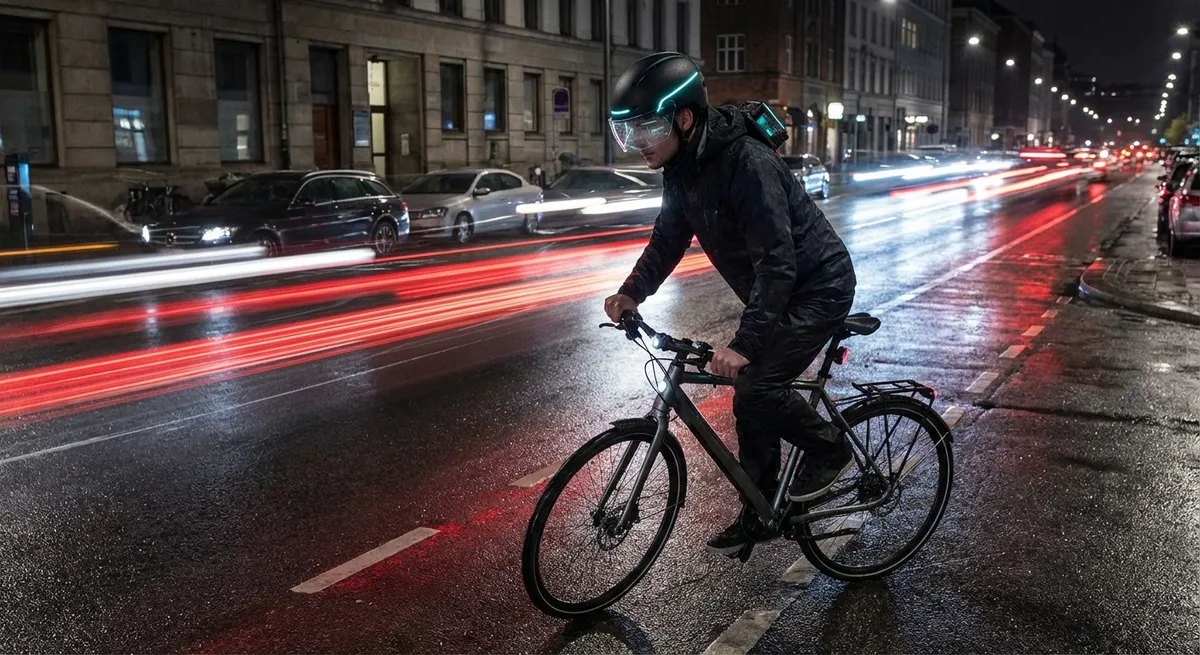
Helmet-mounted LEDs tied to your bike’s brake light or deceleration sensors can lift your signal into driver eye-level. The key technical features to look for: - Low-latency response when tied into the bike’s brake circuit or via a reliable wireless link. - Clear distinction between running light, braking, and hazard patterns. - Wide angle of visibility—helmet lights should be seen from offset angles, not just directly behind.
Overly complex or flashy patterns are counterproductive: you want “brake” and “hazard” to be instantly recognized, not decoded.
Ambient light and noise awareness
Advanced systems can measure ambient noise and auto-adjust volume so you’re not constantly fiddling with buttons at speed. Some setup profiles let you: - Cap maximum volume to retain environmental awareness. - Shape noise cancellation so it reduces fatigue without fully blocking critical sounds like horns and emergency vehicles.
Completely isolating yourself from outside sound is not an upgrade; it’s a safety downgrade.
Impact and motion sensing
Some helmets and add-on modules now integrate: - Crash detection via accelerometers + gyros. - Automatic SOS messaging through your paired phone if a crash is detected and you fail to respond.
The technical nuance is in calibration: you don’t want false positives from aggressive but controlled riding—wheelies, hard braking, track use. Look for systems that allow sensitivity adjustments or specific “track mode” disabling when needed.
Environmental data integration
Smart systems can feed you: - Weather alerts (rain or storm warnings on-route). - Traffic congestion or collision notifications via navigation apps. - Road hazard warnings from connected platforms where available.
This data should be filtered and surfaced sparingly—preferably as short audio cues or minimal HUD prompts. The point is actionable information, not another data firehose.
Technical takeaway: Sensory tech should extend your awareness externally (how visible you are, what the environment is doing) and only secondarily internally (your comfort and entertainment).
Conclusion
A truly smart helmet system isn’t defined by how many features are crammed into the shell—it’s defined by how well those features respect the fundamentals of riding and protection.
Start with an uncompromising helmet: shell design, EPS, fit, and optical quality. Then layer on comms, lighting, and sensing in a way that preserves impact performance, minimizes distraction, and enhances your connection to the bike and environment—not your phone.
For the serious rider, “smart” isn’t about gimmicks. It’s about signal over noise, engineering over marketing, and a helmet system that’s as focused and purposeful as the way you ride.
Sources
- [Snell Memorial Foundation – Helmet Safety Standards](https://smf.org/standards) – Technical details on impact testing, rotational energy, and certification criteria for motorcycle helmets.
- [NHTSA Motorcycle Helmet Use and Effectiveness](https://www.nhtsa.gov/motorcycle-safety/choose-right-motorcycle-helmet) – U.S. government guidance on helmet construction, safety performance, and what to look for in a protective shell.
- [ECE 22.06 Regulation (United Nations)](https://unece.org/transport/standards/transport/vehicle-regulations-wp29/ece-regulations-r0-r99) – Official documentation and technical framework for modern motorcycle helmet homologation in Europe.
- [RevZilla – Motorcycle Bluetooth Communication Guides](https://www.revzilla.com/common-tread/motorcycle-bluetooth-intercom-buying-guide) – Practical breakdowns of intercom features, audio performance, and integration considerations.
- [Shoei Official Website – Helmet Technology](https://shoei-helmets.com/technology/) – Manufacturer-level insight into shell design, EPS zoning, visor optics, and integrated system design.
Key Takeaway
The most important thing to remember from this article is that this information can change how you think about Gear & Equipment.