Most riders obsess over horsepower, lean angle, and tire compounds—but get lazy about the one variable that keeps all of that relevant: being seen. Visibility isn’t just “wear bright colors and add a loud pipe.” It’s a full system problem: material science, electrical load, human vision, and real-world traffic behavior all crashing together at 70 mph. If your gear isn’t engineered with signal performance in mind, you’re leaving free safety on the table.
This is about building a signal-first kit—helmet, jacket, lighting, and auxiliary tech—optimized not for fashion, but for being unmissable in the worst conditions. Let’s treat visibility like performance hardware, not an afterthought.
1. Retroreflective Geometry: Not Just “More Tape”
Most riders think reflectivity is binary: your gear has reflective panels or it doesn’t. In reality, retroreflective performance is a geometry and angle-of-incidence problem.
High-performance moto gear uses microprismatic or glass bead retroreflective materials that return light back toward its source, but effectiveness falls off fast as the angle changes. That’s why a single giant reflective block on your back is less effective than distributed elements across the body.
Technical considerations:
Multi-axis placement
- Put reflective elements on moving joints: wrists, elbows, ankles, knees. - The brain of a driver is tuned to detect biological motion; small moving reflective markers on your limbs punch above their visual weight.
Height staggering
- Aim for three vertical planes: ankles/shins, torso, helmet. - This creates a stacked, human-recognizable signature at distance, especially at night or in rain.
Angular coverage
- Look for garments rated or tested with wide observation angles (often documented in EN ISO 20471 or EN 17353 standards for high-visibility materials). - Panels that only pop when hit dead-on by a headlight are nearly useless in complex urban traffic where cars see you off-axis.
Surface contamination
- Road film, chain lube mist, and bug residue can cut retroreflective output dramatically. - Build a maintenance loop: wipe reflective areas with mild soap every time you clean your visor. Treat them like optical surfaces, not decoration.
Helmet integration
- A matte black helmet with no reflective geometry is a signal dead zone. - Either choose a helmet with integrated reflective accents or apply engineered reflective decal kits—not random tape segments. Symmetry and clean edges matter for recognizability.
Treat reflectivity as a visible skeleton you’re building around your body—dynamic, layered, and deliberately placed.
2. Lumen Discipline: Building a Lighting Stack That Works Together
“Just get brighter LEDs” is how riders end up with bulb swaps that blind drivers but don’t actually improve conspicuity (how easily others notice you). The goal isn’t max lumens; it’s structured light and perceptual contrast.
Headlight & DRL Strategy
- Beam pattern first, lumens second
- Prioritize ECE / DOT compliant complete housings or OEM LED systems over raw lumen swaps.
- A sharp cutoff and dense hotspot are more valuable than a big, sloppy flood.
- Vertical Aim
- A mis-aimed headlight by even 1–2 degrees can either blind oncoming traffic or waste light in the trees.
- Re-check aim after suspension changes, sag adjustment, or luggage additions.
An LED or HID retrofit in a halogen reflector housing often destroys the beam pattern, creating glare and foreground washout.
Auxiliary Lighting: Triangulation, Not Chaos
- Triangle effect
- This helps drivers estimate your distance and speed more accurately, especially in peripheral vision.
- Selective spectrum
- The human eye is strongly tuned to color contrast; two-tone light signatures stand out in a sea of generic white LEDs.
- Modulation with discipline
- They are FMVSS 108 compliant (in the U.S.) or legal in your region.
- Frequency is selected to be noticeable but not seizure-triggering or obnoxious (commonly around 4 ± 1 Hz).
Add aux lights lower and wider than your headlight to form a visual triangle.
Consider slightly warmer or selective yellow aux lights (within legal limits) against a white main beam.
Headlight modulators and pulsed running lights can massively improve conspicuity—but only when:
Think of your lighting as a coherent optical system, not a Christmas tree. Every emitter should have a defined role: distance penetration, close-in fill, lateral presence, or braking intent.
3. Color Science: Why Hi-Vis Isn’t All Created Equal
Not all “neon” gear is the same. There’s physics and physiology behind what stands out in complex urban backgrounds.
Spectral Placement vs. Real-World Clutter
- Hi-vis yellow-green (around 555 nm) aligns closely with the peak sensitivity of the human photopic vision system.
- This wavelength range also contrasts strongly against typical road backgrounds (asphalt, vehicles, signage) in most daylight conditions.
However:
- In some environments (dense urban, heavy construction zones), hi-vis yellow can get visually mixed with road safety signage and worker apparel, reducing uniqueness.
- Adding secondary contrast colors (black panel breaks, white highlights, or even hi-vis orange in smaller blocks) helps define your silhouette rather than turning you into a glowing blob.
Gear Color vs. Bike Color
Don’t color-match your bike.
- If your motorcycle is black or dark, a hi-vis upper body creates figure-ground segregation—the rider stands out from the machine.
- If your motorcycle is a bright color, using a different hi-vis spectrum (e.g., bright orange gear with a highlighter-yellow bike, or vice versa) helps prevent visual fusion into a single indistinct shape.
Day/Night Tradeoffs
- Highly fluorescent materials are optimized for daylight and UV exposure. At night, they behave more like dull pastels unless they also incorporate retroreflective components.
- The ideal setup:
- Daylight conspicuity from fluorescent fabric colors.
- Night conspicuity from correctly placed retroreflectives and lighting.
Color is not about fashion—it’s about signal bandwidth. You’re designing a visual waveform that remains distinct under sun, clouds, sodium-vapor streetlights, and oncoming LED glare.
4. Brake Signaling: From “Lights Work” to “Intent Is Obvious”
Stock brake lights meet minimum regulatory requirements, not optimal cognitive performance. You’re trying to encode two things into your lighting: “I’m here” and “I’m changing speed, now.”
Adding Signal Channels
- High-mount brake lighting
- A secondary brake light integrated into a top case or mounted higher on the tail exponentially increases recognition distance.
- High-mounted lights line up closer to the typical driver’s eye line, especially for SUVs and trucks.
- Deceleration-aware modules
- Some aftermarket controllers or factory systems monitor deceleration (via IMU or rate-of-change in wheel speed) and trigger auto-flash under hard braking, even before you reach for the lever.
- When tuned correctly, this buys you precious tenths of a second in reaction time from drivers behind.
Flash Patterns: Engineering for Human Vision
- Wild strobe patterns are more likely to annoy and desensitize drivers than protect you.
- Use short, front-loaded burst patterns (e.g., 3–5 rapid flashes) that settle into a steady burn.
- This exploits the brain’s “novelty detector” while still providing a stable reference point.
- Keep flash rate in a range that’s noticeable but not aggressive—often in the 3–5 Hz range for the initial burst.
For technical effectiveness:
Turn Signals as Visibility Multipliers
- Swapping tiny, dim OEM indicators for brighter, properly aimed LED units with defined cutoffs makes your lane changes communicate, not just comply.
- Integrated tail/turn units can look clean but often reduce separation between brake and turn signals. Consider auxiliary or relocated indicators that preserve spatial separation so drivers can decode your intent faster.
You want your rear lighting package to behave like a language system: clear, limited vocabulary, zero ambiguity.
5. Smart Tech & Wearables: Visibility That Thinks With You
Gear is no longer passive. Riders now have access to electronics that augment your visual footprint and adapt to motion, lean, and deceleration.
Active LED Gear
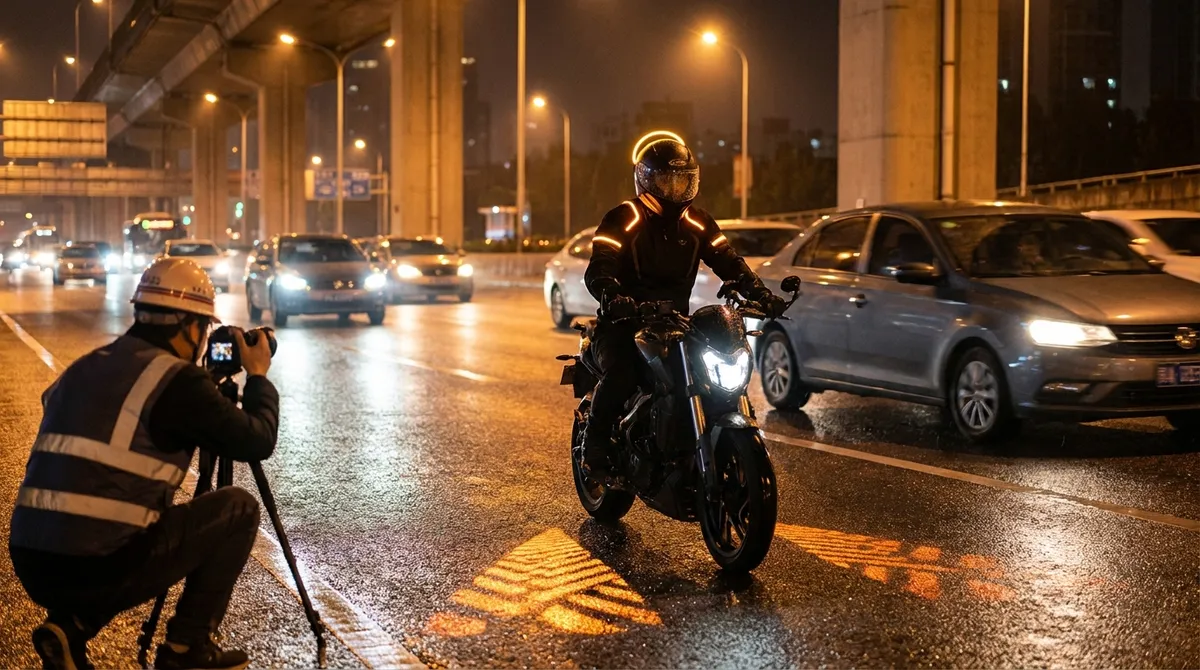
- LED-equipped vests and jackets synchronized with your bike’s brake and turn circuits create a body-mounted signal array.
- The advantage: the light source moves with your core mass, making your intentions intuitively legible.
- Some systems use accelerometers or IMUs to trigger brake-light behavior even when you’re engine braking or downshifting aggressively—no wiring into the bike required.
Helmet Integration
- Helmets with rear light bars or integrated brake indicators raise your signal to driver eye height.
- Look for:
- At least basic water ingress protection (IPX4 or better).
- Long-term vibration resistance.
- Replaceable or updatable battery modules.
Connectivity & Redundancy
- If you go for Bluetooth-linked systems (helmet lights triggered by a module on the bike, for instance), treat them like fly-by-wire:
- Ensure there is fail-safe behavior (e.g., default to steady running light if signal is lost).
- Regularly verify operation during your pre-ride check, just like brake and headlight function.
Power Management
Every electrical upgrade is part of a power budget:
- Know your bike’s stator output and existing load (heated grips, GPS, heated gear).
- LED-based visibility systems are usually low draw, but on smaller bikes or older charging systems, everything adds up.
- Use relays or CAN-bus-friendly modules where appropriate, and avoid bodged wiring that can introduce voltage drops or intermittent failures—especially in safety-critical circuits.
The goal is a visibility stack that behaves like avionics: layered, partially redundant, and still functional if one component fails.
Conclusion
You can’t out-brake a distracted driver who never saw you. But you can radically shift the odds in your favor by treating visibility as a technical platform, not a color choice.
Build your kit like this:
- Retroreflective geometry mapped to human motion, not random tape.
- Lighting that’s beam-pattern engineered, not lumen-obsessed.
- Color contrast selected for perceptual dominance, not brand matching.
- Brake and turn signals tuned to convey intent, not just existence.
- Smart gear that extends your bike’s signaling up onto your body and helmet.
Every piece of gear you buy or mod you install should answer one question: Does this measurably increase how early and how clearly other road users can see—and understand—me? If the answer is anything less than a hard yes, keep iterating. Visibility is your most underrated performance upgrade.
Sources
- NHTSA – Motorcycle Safety: A National Agenda for Motorcycle Safety - U.S. traffic safety research on motorcycle conspicuity, crash factors, and rider visibility considerations.
- U.S. Department of Transportation – FMVSS No. 108: Lamps, Reflective Devices, and Associated Equipment - Official U.S. regulatory standard for vehicle lighting and reflectors, relevant for headlamps, brake lights, and auxiliary lighting legality.
- 3M – Retroreflective Materials Technical Guide - Engineering-level overview of retroreflective technologies, performance factors, and angular behavior used in safety garments.
- EN ISO 20471: High Visibility Clothing Standard (European Committee for Standardization) - Details on requirements for high-visibility clothing, including color and retroreflective material specifications.
- Insurance Institute for Highway Safety (IIHS) – Headlight Ratings and Research - Independent testing and analysis of automotive headlight performance, beam patterns, and their impact on visibility and safety.
Key Takeaway
The most important thing to remember from this article is that this information can change how you think about Gear & Equipment.