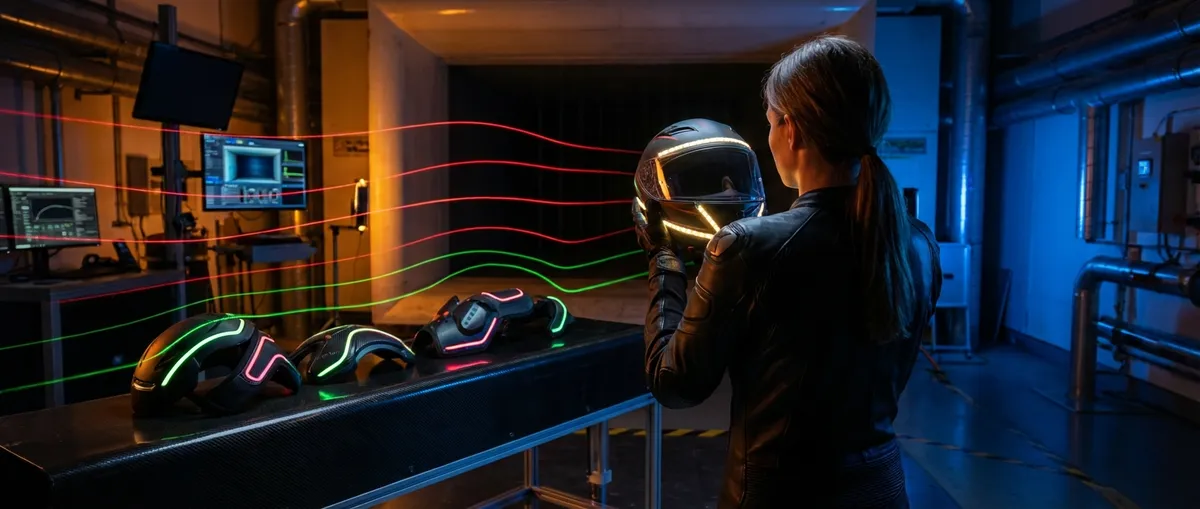
Every piece of motorcycle gear is a component in a safety system. Not fashion. Not “comfort stuff.” A system. When things go wrong at 60 mph, physics calls the shots—and your gear either manages energy and information flow, or it becomes decorative trash. If you think in terms of materials, impact paths, heat transfer, and human factors, your kit stops being random purchases and starts acting like a tuned package. This is where we turn jackets, helmets, and gloves into engineered solutions instead of wishful thinking.
The Physics Under Your Skin: Impact, Slide, and Energy Pathways
When you hit the ground, three time domains matter: milliseconds (impact), seconds (slide/abrasion), and minutes (heat, blood loss, shock). Good gear is designed around all three.
Impact first: modern helmets use EPS (expanded polystyrene) liners with different densities to manage linear acceleration by crushing in a controlled way. Some add low-friction slip layers (MIPS, SHARP-rated multi-layer designs, similar concepts) to reduce rotational forces by allowing the helmet shell to move slightly relative to your head during an oblique impact. That rotation control is a big deal—brain tissue hates shear.
On your body, CE-rated armor (EN 1621-1 for limbs, EN 1621-2 for back, EN 1621-3 for chest) is about energy management, not just “hardness.” Level 1 armor allows a maximum transmitted force of 35 kN; Level 2 cuts that down to 20 kN. Translate that: Level 2 means less force into bone and organs during that initial hit. Viscoelastic materials (D3O, SAS-TEC, etc.) stiffen dynamically under impact, spreading force over time and area.
Sliding is a different game. Your outer shell is managing friction and temperature. Leather, especially 1.2–1.4 mm cowhide or kangaroo, can resist abrasion for several seconds at highway speeds. Textile systems—high-denier nylon, Cordura, SuperFabric, Armacor, or Dyneema blends—use fiber strength and sometimes ceramic or polymer armor plates to approximate leather’s performance with less weight and better weather resistance. CE EN 17092 garment ratings (A, AA, AAA) essentially test how long and how well materials and construction hold up during simulated crashes and slides.
The point: you’re not buying “a jacket.” You’re buying an impact-energy and abrasion-time management device. Think like that, and spec sheets suddenly matter a lot.
The Fit Envelope: Why Tolerance and Positioning Beat “Comfortable Enough”
“Fits fine” is not a technical spec. Fit is geometry under dynamic load. Your armor, shell, and closures have to stay in the right place while you crash, not just while you stand in a mirror.
Armor that rotates 5–7 cm during a tumble can completely miss the point of contact. Elbow and shoulder protectors need to be snug enough that you can’t easily twist them out of position with your other hand. Knee armor should cup the patella when you’re in a riding stance, not when you’re standing straight. That means you must evaluate fit on the bike—bars in hand, knees bent, head slightly tilted.
Helmets work the same way. A correct fit requires:
- Firm, even pressure around your crown with no isolated hotspots
- Cheek pads that compress your cheeks slightly (you should not be able to easily twist the helmet on your head)
- A stable position under simulated “tug tests” (grab the chin bar and try to rotate and lift the helmet; it shouldn’t roll off or shift dramatically)
Loose gear increases impact distance and rotational leverage. That slop translates directly into higher accelerations at the skull and joints. Good fit slightly annoys you when new; bad fit fails silently until physics audits your choices.
Treat sizing charts as a starting point, not gospel. Measure head circumference, chest, waist, and inseam; then test real-world riding posture. If armor floats or shifts more than a centimeter or two under light force, it’s not “a little loose”—it’s functionally de-tuned.
Materials and Membranes: Managing Heat, Water, and Cognitive Load
Riding comfort isn’t a luxury; it’s a concentration tool. Overheating, getting soaked, or freezing directly degrades reaction times and decision-making. Your gear is a climate-control system for your nervous system.
Waterproof-breathable membranes (Gore-Tex, eVent, proprietary PU membranes) depend on a pressure and humidity gradient to move moisture vapor outward while blocking liquid water. That means:
- In cool, wet weather, they shine—your sweat vapor exits, rain stays out.
- In hot, humid conditions, the gradient collapses; nothing wants to move. Ventilation and direct airflow suddenly matter more than membrane magic.
Laminated constructions (where the membrane is bonded directly to the outer shell) resist saturation and avoid “waterlogged jacket shell” syndrome, reducing evaporative cooling after the rain stops. Drop-in liners (floating membranes behind the shell) can be cheaper and flexible, but the outer can soak, adding weight and conductive heat loss.
Insulation is about trapping air, not “thickness.” Modern synthetics retain loft when damp and pack small, but they still need a well-managed shell to prevent convective heat loss at speed. On the opposite extreme, hot-weather mesh must balance airflow with abrasion resistance. Coarse, open mesh that flows tons of air can explode under sliding load; look for armored panels and strategic high-denier overlays in impact zones.
Technically, what you’re doing with gear is balancing three competing variables: airflow (convective cooling), weather protection (blocking water and wind), and slide durability (abrasion resistance). High-performance setups use modularity—base layers, mid layers, shells, panels—to tune that triad by season and mission.
Visibility as a System: How Light, Contrast, and Signal Paths Keep You Seen
High-vis isn’t about fashion; it’s about hacking human visual processing. Drivers don’t “see” you as an object; they perceive motion, contrast, and light points inside their visual field. Your job is to present a signature that jumps out of cluttered backgrounds.
Retroreflective materials (3M Scotchlite and similar) return light almost directly to its source, which is why they pop so hard under headlights. Their placement matters: think about how you appear from all four quadrants—front, rear, and both diagonals. Strategic zones include:
- Helmet sides and rear
- Upper back and shoulders
- Outer thighs and calves
- Gloves or wrist areas (movement of hands draws attention)
Color is equally important in daylight. Fluorescent yellows, oranges, and greens effectively convert UV light to visible wavelengths, making them appear “glowing” in many conditions. But high contrast can also mean pairing a bright element with dark segments to create strong edges that stand out against road and foliage.
Lighting upgrades—auxiliary LEDs, improved brake lights, and indicators—extend your visual footprint. However, glare and scatter can backfire if poorly aimed. Fog and auxiliary lights should create a low, wide pattern, not blind oncoming traffic. Think in terms of “light architecture”: a low wide spread to outline your lane position, and a strong central headlight to stake your claim in the visual field.
Finally, movement is a signal amplifier. Reflective and bright elements on moving parts—helmet, gloves, boots—improve biological motion detection. It’s not just “be brighter”; it’s “be brighter in ways the human brain cannot ignore.”
Failure Modes and Redundancy: Building a Gear Stack That Degrades Gracefully
Nothing in engineering is perfect; everything has a failure mode. Smart gear choices accept that and build redundancy into the system.
Zippers can blow. Snaps can pop. Stitching can rip. That’s why critical seams (especially in impact and slide zones) should use multiple rows of stitching and, ideally, safety seams that keep the garment closed even if a top row fails. When you inspect gear, flip it inside out and look for:
- Double or triple stitching in high-stress zones
- Hidden or “safety” seams that back up the visible seam
- Bartacks or bar-tack stitching at high-tension start/stop points (pocket corners, strap anchors)
Armor coverage should overlap, not leave gaps. Back protectors should reach from just below C7 (base of the neck) to near the tailbone. Hip armor should bridge the space between thigh and waist impact zones. Think through common crash modes—low-side on the street, high-side on track, rear-end at a stop—and visualize where you actually hit.
Redundancy also means layers that can still function if one element fails. If your outer shell tears, are you wearing abrasion-capable base layers or armored undergarments? If your waterproof system gives up, do you have emergency over-suits or compact rain shells? If gloves open at the cuff, do they still have wrist retention to keep them from flying off?
In motorcycle gear, “overbuilt” isn’t a dirty word. It’s the difference between a single-point failure and a system that degrades gracefully while still protecting the rider.
Conclusion
High-performance motorcycle gear is applied physics wrapped around human factors. Helmets, jackets, pants, gloves, and boots aren’t checkboxes; they’re interconnected components in a crash-energy, climate-control, and visibility system. When you start evaluating equipment by impact attenuation, abrasion time, fit geometry, ventilation pathways, and redundancy, your kit stops being random purchases and becomes a tuned safety package.
The real payoff isn’t only walking away from a crash—it’s riding harder, longer, and with more focus because you trust the system you’ve engineered around yourself. Build your gear like a race team builds a bike: understand the loads, anticipate the failure modes, and design for the moment everything goes wrong.
Sources
- [NHTSA Motorcycle Safety Resources](https://www.nhtsa.gov/road-safety/motorcycles) - U.S. government data and guidance on motorcycle safety, including helmet information and crash statistics
- [Snell Memorial Foundation – Helmet Standards](https://smf.org/standards) - Technical details on advanced helmet testing protocols, impact criteria, and certification standards
- [Gore-Tex Technology Overview](https://www.gore-tex.com/technology) - In-depth explanation of waterproof-breathable membrane construction and performance characteristics
- [European Commission – Protective Equipment for Motorcyclists](https://road-safety-charter.ec.europa.eu/content/protective-equipment-motorcyclists_en) - Overview of protective gear effectiveness and considerations for riders
- [Transport Research Laboratory – Effectiveness of Motorcycle Protective Clothing](https://trl.co.uk/reports/ppr841) - Research report analyzing real-world crash outcomes relative to motorcycle clothing performance
Key Takeaway
The most important thing to remember from this article is that this information can change how you think about Gear & Equipment.