Motorcycle lighting is not decoration—it’s survival hardware. On a bike, you are small, fast, and often invisible until it’s too late. Stock systems are built to a price point, regulations are a lowest-common-denominator safety net, and a lot of “aftermarket upgrades” are visual noise with worse performance than OEM. If you care about being seen and seeing clearly, you need to treat lighting like a critical performance system, not an accessory rack.
This is your technical roadmap to building a lighting package that cuts through rain, glare, and traffic clutter—and keeps doing it season after season.
Lumens vs. Reality: Understanding Headlight Performance
The spec sheet war around headlight “lumens” is mostly marketing theater. What matters is usable beam pattern, not raw brightness. A 6,000-lumen LED blasting light everywhere is worse than a properly focused, 2,000-lumen beam that puts photons exactly where your front tire is going.
A proper motorcycle headlight system is defined by:
- Luminous flux (lumens): Total light output. Good to know, easy to fake.
- Illuminance (lux): Light intensity on a target surface at a given distance (e.g., 1 lux at 100 m). This tells you how far you can actually see.
- Beam pattern: How that light is shaped—cutoff line, foreground fill, reach, and width. This is controlled primarily by the reflector, lens, and LED or filament position.
- Color temperature (CCT): Usually between 3,000K (warm) and 6,500K (cool). Cooler often looks “brighter” but isn’t always better for visibility in adverse weather.
If you retrofit LEDs into a halogen housing without proper optics, you usually destroy beam control. Light that should be focused into the lane ahead gets sprayed into trees, signs, and oncoming drivers’ eyeballs. That’s lost range for you and extra risk for everyone else.
Serious upgrades should be homologated units (DOT, ECE, or both) with engineered optics, not “plug-in LED bulbs” with no beam-tested certification. When evaluating, look for published photometric data (lux at distance and beam diagrams), not just lumens and Kelvin.
For riders who regularly push into unlit backroads, pairing a high-integrity main headlight with auxiliary driving lights aimed to extend reach (not flood the foreground) gives you the best mix of near-field awareness and distance vision without whitewashing the road.
Conspicuity Engineering: How to Actually Be Seen, Not Just Bright
Being visible to drivers is not about being the brightest object—it’s about being the most legible object in their visual field. Humans are wired to detect contrast, motion, and pattern, not just light level.
You can engineer conspicuity into your gear and bike with a few key principles:
- Negative space and outline: A single point of light can look like a distant car or background artifact. A lighting layout that creates a recognizable shape—headlight plus position lights plus auxiliary running lights—helps drivers parse you as a motorcycle at a glance.
- Vertical separation: Spacing lights vertically (e.g., headlight plus lower-mounted auxiliary lights) creates a tall visual signature. This makes it easier for drivers to judge your closing speed and distance.
- Color differentiation: White forward, red rear, amber for turn/hazard is non-negotiable. But within those constraints, an amber forward conspicuity light (where legal) can help you stand out from the sea of white LED DRLs on modern cars.
- Dynamic cues: Modulated headlights or pulsing auxiliary conspicuity lights (properly legal and not strobe-like) can amplify your presence in dense traffic. The key is slow, rhythmic modulation, not seizure-inducing flashing.
- Gear integration: High-viz gear isn’t just about neon fabric. Strategic retroreflective panels on your shoulders, helmet, and calves create “biomotion” cues—drivers recognize the human pattern, not just a random reflective blob.
Think of conspicuity like building a visual “signature” for your bike/rider system: a consistent, instantly recognizable light outline plus reflective elements that make you readable from multiple angles, even when your lights are partially obscured by traffic.
Thermal Discipline in LEDs: Keeping Output Stable Over Time
Modern bike lighting is dominated by LEDs, and that’s good—if they’re engineered properly. The weak link is almost never the LED die itself, but thermal management and driver electronics. Cheap LED lights die or degrade because they can’t get heat out of the junction and into the air.
A technically sound LED lighting unit will show its engineering in:
- Mass and material of the housing: Heavier, finned aluminum housings with real surface area indicate honest heat-sinking. Plastic-heavy housings with token metal plates are a bad sign for sustained output.
- Thermal path continuity: The LED sits on a metal-core PCB, which must be tightly coupled (with thermal paste or pads) to the housing. Any gap or poor contact becomes a thermal bottleneck.
- Driver design: Quality drivers regulate current and often include thermal rollback to protect the LED from overheating. In real terms, that means your light can run at rated brightness without cooking itself when idling in summer traffic.
- Ingress protection (IP) rating: IP67 or better means dust-tight and temporarily submersible. Moisture intrusion is a thermal and electrical killer over time; fogged housings often signal compromised sealing and eventual failure.
Technically-minded riders should treat LED auxiliary lights like any other performance component: look for continuous-output testing, thermal imaging in reviews, or long-term endurance feedback. If a light is advertised at 40–60W with a tiny, almost un-finned housing, the physics don’t add up—either it will run hot and dim early, or it will never reach its claimed output in the first place.
Stable, thermally honest lighting isn’t just about brightness—it’s about beam consistency on long night rides. A light that slowly browns out as it overheats quietly shortens your reaction time without you consciously noticing.
Electrical Integrity: Wiring, Connectors, and Noise Control
A high-performance lighting system running through bargain wiring is like race tires mounted on cracked wheels. You may not see the failure coming, but when it arrives, it will be catastrophic and probably at the worst possible time.
For lighting reliability, focus on a few technical fundamentals:
- Dedicated relays and fused circuits: High-draw or aftermarket lights should not be piggybacked off fragile OEM circuits. Use a relay harness with an appropriately sized fuse and dedicated feed from the battery, triggered by an ignition-switched source.
- Wire gauge and insulation: Select wire gauge based on actual current draw and run length, not just “it came in the kit.” Undersized wire runs hotter, increases voltage drop, and can compromise brightness and driver stability over time.
- Connector quality: Weatherproof connectors (like OEM-style sealed plugs or quality Deutsch connectors) are critical. Crimp quality matters—use a proper crimping tool, not pliers. Poor crimps create micro-resistance points that heat up, corrode, and intermittently fail.
- Grounding strategy: Avoid daisy-chained grounds over long distances. Use star-grounding back to frame or battery negative, and ensure painted or powder-coated surfaces are properly scraped/treated at contact points.
- Electromagnetic interference (EMI): Cheap LED drivers can inject noise into the bike’s electrical system, which can desensitize or glitch sensitive electronics like ABS, TPMS, or radios. If adding lights causes any weird behavior in other systems, don’t ignore it—properly shielded, filtered drivers don’t do that.
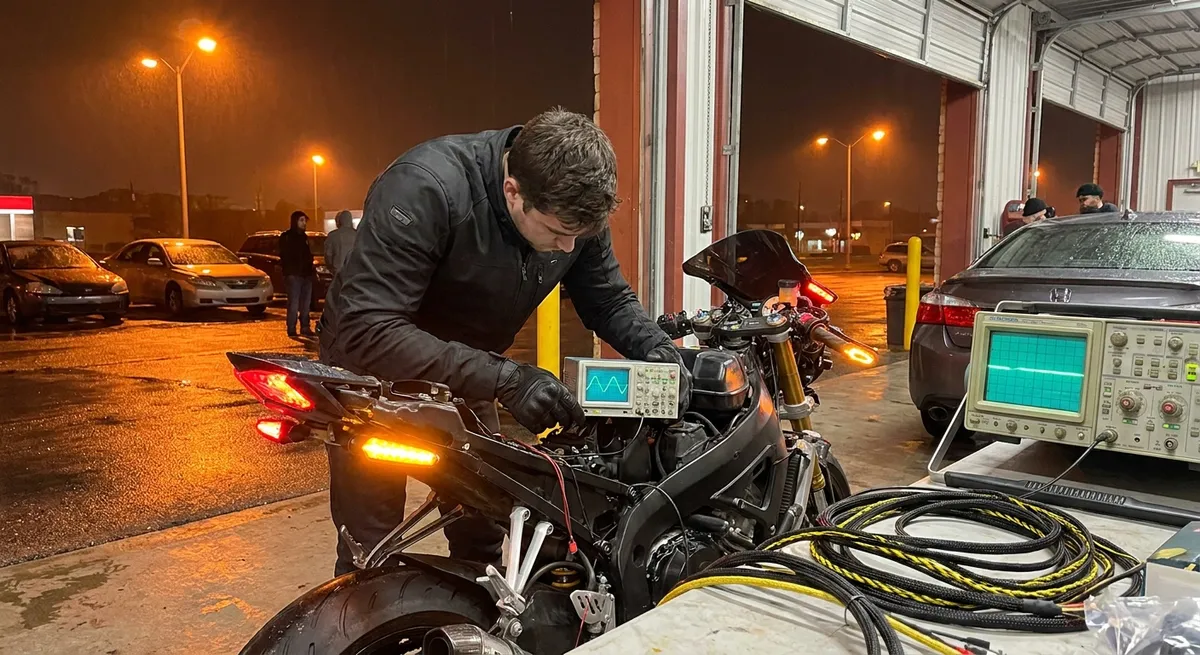
Use a multimeter to verify voltage at the light under load; if you see significant drop from battery to light (more than about 0.5V at operating current), your wiring or connections are leaving performance on the table and inviting failure down the road.
Rear-Side Signaling: Brake and Turn Systems That Command Attention
The rear of the bike is where a lot of riders run “cool” but technically poor solutions: smoked lenses, tiny under-tail indicators, or integrated turn signals barely larger than a thumbnail. At closing speeds of 70+ mph, a vague glow is not a safety system—it’s an aesthetic decision with a downside.
A technically credible rear lighting strategy pays attention to:
- Luminous area: Larger illuminated surface area gives drivers more to lock onto, especially in rain or with dirty windshields. A high-intensity but tiny point of light is much easier to lose in background noise.
- Brake light dynamics: A brief, high-frequency flash pattern at initial brake application (where legal) can dramatically increase initial detection, but the pattern must quickly settle to a solid light. Overly “dancy” patterns become background clutter.
- Redundancy: Multiple rear lamps (main brake/tail plus auxiliary strips or pods) spaced horizontally widen your visual footprint. If one fails, you’re not suddenly invisible under hard braking.
- Turn signal separation: Integrated brake/turn units reduce visual clarity. Dedicated amber turn signals spaced away from the center brake light make your intent more readable in milliseconds, especially at night or in fog.
- Mounting height and angle: A low, tucked-under tail light looks clean but can be physically occluded by traffic or even your own luggage. A slightly higher or more rearward lens can buy you more visible real estate in complex traffic stacks.
For night and bad-weather commuting, a high-mounted additional brake light (on a top box or rack) at car eye-level often does more for your actual safety than any cosmetic mod. It interfaces directly with typical driver sightlines and mirrors, cutting through the visual chaos of urban traffic.
Conclusion
Your motorcycle’s lighting isn’t a styling footnote—it’s a performance system that defines how you interact with the world at speed. When you think beyond lumens and catalog photos, you start to see lighting as a chain: optics, thermal management, electronics, wiring, and biomechanical conspicuity all linked together.
Build that chain with technical honesty—beam control, thermal stability, electrical integrity, and smart visual signatures—and you get a bike that talks clearly to the road ahead and to every driver around you. Not just brighter. Sharper, more legible, and relentlessly reliable when the weather closes in and the road goes dark.
Engineering your lighting with this mindset isn’t about being paranoid—it’s about claiming every millisecond of reaction time and every extra meter of visibility the physics will give you.
Sources
- NHTSA – Motorcycle Safety: The Importance of Visibility - U.S. government overview on motorcycle conspicuity and strategies to be seen in traffic
- IIHS – Headlight Ratings and Testing Methodology - Explains how headlight performance is evaluated in terms of beam pattern, intensity, and real-world visibility
- OSRAM Automotive – LED Headlights Technical Guide - Technical background on LED automotive lighting, beam formation, and thermal management
- SAE International – Lighting Standards Overview - Professional standards body listing relevant performance and safety standards for vehicle lighting systems
- Harvard Medical School – How the Human Eye Sees in Low Light - Explains how human night vision and contrast perception work, relevant to understanding visibility and conspicuity
Key Takeaway
The most important thing to remember from this article is that this information can change how you think about Gear & Equipment.