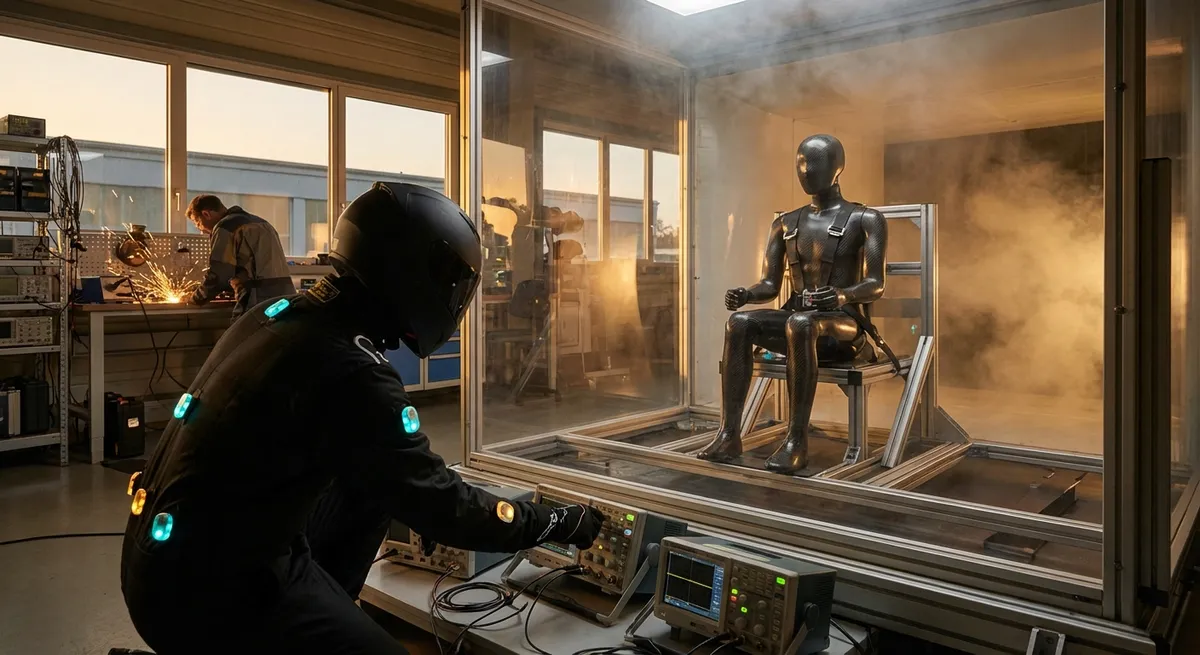
The fastest upgrade most riders ignore isn’t horsepower—it’s information flow. Your helmet, comms, visor, and interior setup form a signal-processing system: taking in data (vision, sound, vibration), filtering noise, and feeding your brain clean, timely inputs. Build that system right, and you ride smoother, earlier on the brakes, more precise on the throttle. Build it wrong, and you’re burning mental bandwidth fighting buffeting, fog, glare, and wind roar instead of reading the road. This is how to engineer your helmet setup like a performance component, not just a piece of required gear.
Aerodynamics: Stabilizing Your Head at Real-World Speeds
Helmet aerodynamics isn’t marketing fluff; it’s about reducing torque on your neck and stabilizing your vision window at speed.
At 70–80 mph, your head and helmet form a bluff body in a turbulent boundary layer behind the windscreen. A poorly shaped lid can create alternating vortices (von Kármán vortex street) that show up as buffeting—micro head shakes that blur your vision and fatigue your neck over time.
Look for:
- Shell profiling tuned for your riding position. Aggressive-lean track lids have different spoiler geometry and eyeport angles than upright touring helmets. On a naked bike, a race-replica lid can sit in the wrong airflow, causing lift or pressure spikes.
- Pressure-managed ventilation. High-end helmets use vent shapes and exhaust ports to create low-pressure zones that pull air through the EPS channels. That maintains cooling without punching massive inlets that increase drag and noise.
- Integrated, not add-on, spoilers. Clip-on spoilers and action camera mounts disrupt designed flow, often creating turbulent wakes right at the top or back of your helmet. If you must mount something, keep it in line with the flow (side-mounted cams often perform better than top mounts on modern shells).
- Chin curtain and neck roll fit. A properly sealed lower edge reduces air intrusion, which not only cuts noise but stabilizes the lid by preventing internal pressure fluctuations at speed.
Technical takeaway: at highway speed, aerodynamic stability is more important than raw drag reduction. A helmet that doesn’t lift, shake, or twist under crosswinds keeps your visual field locked in and your neck fresh on long rides.
Acoustic Management: Tuning Your Sound Environment, Not Just “Quieter”
Riding with unprotected ears at freeway speeds can exceed 100 dB of noise exposure—enough to risk permanent hearing damage over time. But targeting “absolute quiet” is the wrong goal. You want to tune your acoustic environment so critical sounds (sirens, horns, engine note) remain distinct while broadband noise is suppressed.
Key technical elements:
- Shell and EPS density. Multi-density EPS and composite shells don’t just address impact; they also shift resonant frequencies, reducing specific “booming” ranges that lead to fatigue.
- Neck seal integrity. Most wind roar enters from the bottom. A snug neck roll and chin curtain can reduce noise more effectively than a thicker shell alone, especially on naked bikes or bikes with turbulent windscreen flow.
- Earplugs with flat attenuation. Instead of cheap foam that kills all high frequencies and muddies sound, choose plugs with relatively flat attenuation (e.g., musician-style filters). These maintain frequency balance while reducing intensity—so you still hear traffic cues and engine revs but at safer, less fatiguing levels.
- Comms speaker placement. Misaligned speakers force you to crank volume, which can counteract the benefit of earplugs. Speakers should sit directly over your ear canal, often requiring velcro spacers to get proper distance and alignment.
Measured goal: aim to bring continuous noise into the 70–85 dB range inside the helmet at cruising speed. That’s quiet enough for long-term comfort but loud enough to preserve critical auditory feedback.
Optical Performance: Treating Your Visor Like a Racing Windscreen
Your visor is your HUD. Scratches, poor coatings, and bad optics create micro-distortions that your brain is constantly correcting for—especially at night or in the rain.
Optimize your visual pipeline:
- Optically correct shields. High-quality visors are injection-molded with consistent thickness and curvature to reduce distortion. Cheap or worn visors can slightly “bend” straight lines, which becomes a problem when you’re judging apexes, lane edges, or gaps at speed.
- Appropriate tint strategy. Relying on dark exterior shields only works if your riding schedule is predictable. For variable conditions, a clear shield with a high-quality photochromic insert or internal sun visor gives you better control with less compromise at dawn/dusk.
- Anti-fog systems that actually work. Pinlock-style inserts create a double-pane effect with a sealed air gap, dramatically reducing condensation. Cheaper “anti-fog coatings” degrade quickly and lose effectiveness. If you’re riding in cold or humid climates, a properly installed Pinlock (no gaps, correct tension) is a performance mod, not a luxury.
- Hydrophobic coatings for wet riding. A quality hydrophobic treatment on the outer visor helps water bead and slide off, maintaining clarity at speed. Combine that with a consistent head turn-and-shake technique in the rain so you’re not relying on wipers or your glove every few seconds.
- Night-optimized optics. Avoid running scratched or hazed visors at night—oncoming headlights will explode into starbursts, masking detail and degrading depth perception. Treat your clear visor as a consumable: if it’s visibly scratched in the primary sight arc, replace it.
Result: a stable, high-contrast visual field reduces reaction time and mental load, especially in complex environments like night rain, urban traffic, or twisty forest roads with heavy shade transitions.
Internal Fitment & Impact Efficiency: Building a Stable Sensor Platform
A helmet is both an impact-management device and a sensor mount for your eyes, ears, and inner ear. If it moves independently from your skull, it degrades both functions.
Dial-in fitment with a technical mindset:
- Cranial shape matching. Brands tune shell and liner shapes for intermediate oval, long oval, or round heads. If you’re forcing a round head into an intermediate-oval interior, you’ll either get hot spots or loosen the fit to reduce pressure, which compromises stability and safety.
- Cheek pad tension as a tuning parameter. Cheek pads should lightly compress your face so that when you grab the chin bar and shake, your skin moves with the helmet. Many brands offer multiple pad thicknesses; swapping to a thicker pad set can transform stability without changing shell size.
- Vertical and horizontal line-of-sight alignment. A properly fitted helmet positions the eyeport so your natural gaze falls into the upper third of the opening, leaving room to look through the top of the visor when tucked without craning your neck. If you’re constantly tilting your head to “find” the right angle, the fit or model choice is off.
- EPS coverage and liner condition. EPS (the impact-absorbing foam) doesn’t “bounce back” after significant compression. Even if the shell looks fine after a hard drop or crash, internal structure can be compromised. Likewise, liner materials that are broken down or permanently compacted won’t position the EPS correctly on your skull in an impact.
- Weight vs. inertia tradeoffs. Ultra-light carbon shells reduce static load on your neck, but overall stability and balance matter more than raw grams. A slightly heavier, better-balanced helmet with strong aero stability can feel less fatiguing than a lighter one that lifts or yaws in crosswinds.
Think of your head and helmet as a single rigid body in space: any relative motion between them is wasted energy and degraded feedback.
Integration: Comms, Cameras, and Power Without Compromising Safety
Electronics can turn your helmet into a high-bandwidth control center—but only if they’re integrated without destroying the engineering that went into the shell and EPS.
Critical integration principles:
- Respect the shell structure. Never drill into the shell or carve out EPS for wires or batteries. Modern helmets are carefully tuned systems; altering them can create stress risers and unpredictable impact behavior.
- Use designed mounting zones. Many current lids have comms-ready pockets and cable channels in the liner. Use those before resorting to adhesive mounts. If you must mount externally, keep devices as close to the shell as possible and aligned with the airflow (e.g., low-profile side mounts behind the pivot point of the visor).
- Mass centralization. Every gram you add far from your neck’s rotation axis increases perceived weight and fatigue. Heavy cameras or large battery packs on top of the helmet amplify leverage on your neck, especially in turbulence. Side or rear-low mounting tends to be better than top-forward “unicorn” setups.
- Cable and control hygiene. Internal cable slack should be minimized and routed in designated channels so it doesn’t interfere with EPS contact or padding. External cables flapping in the wind add noise, drag, and distraction—and can become a snag hazard in a crash.
- RF and audio tuning. Strong Bluetooth or mesh comms are only useful if they’re paired with good acoustic management. Combine properly placed speakers with earplugs and moderate volume; avoid cranking levels to overcome wind noise, which accelerates hearing loss even if overall outside noise is lower.
Treat every gram and every protrusion as you would on the bike itself: a potential penalty to aero, fatigue, or failure, unless intentionally engineered into the system.
Conclusion
Your helmet setup is not “just gear”; it’s a real-time data interface between the world and your brain. Aerodynamics stabilize your view. Acoustic control preserves your hearing and focus. Optics keep your visual feed clean and high contrast. Fitment locks the whole system to your skull for both safety and precision. Integration lets you add comms and cameras without turning a safety device into a compromised gadget mount.
When you treat your helmet like a performance platform instead of a passive requirement, your riding changes. Less noise, less strain, less micro-correction—and more bandwidth available for reading traffic, choosing lines, and actually enjoying the ride. Horsepower is optional. A properly engineered helmet system is not.
Sources
- Snell Memorial Foundation – Helmet Standards & Tech Info – Detailed information on motorcycle helmet standards, impact management, and testing protocols.
- [U.S. Centers for Disease Control and Prevention – Noise-Induced Hearing Loss](https://www.cdc.gov/nceh/hearing_loss/what_nois induced_hearing_loss.html) – Data on noise levels, exposure limits, and long-term effects relevant to motorcycle wind noise.
- SHARP – Safety Helmet Assessment and Rating Programme – UK Department for Transport program with objective test data and safety ratings for many motorcycle helmet models.
- Shoei Technical Information – Helmet Aerodynamics & Ventilation – Manufacturer explanations of shell design, aero tuning, and ventilation engineering.
- Pinlock – How Pinlock Anti-Fog Systems Work – Technical overview of double-pane anti-fog visor inserts and their performance in real-world riding conditions.
Key Takeaway
The most important thing to remember from this article is that this information can change how you think about Gear & Equipment.