Motorcycle gear isn’t just armor and comfort—it’s a signaling system. Every piece you wear either amplifies or kills your conspicuity, thermal stability, and cognitive bandwidth on the bike. Too many riders obsess over jackets and helmets as isolated products instead of designing a complete visibility kit: a system that actively manipulates light, heat, and impact energy in your favor. This isn’t about fluorescent fashion; it’s about treating gear like a performance package that directly changes your risk profile and endurance on every ride.
Below, we’ll break down five technical points that matter if you want your gear to work as hard as your engine: light management, impact engineering, thermal regulation, biomechanical support, and sensory clarity.
Light Management: How Your Gear Interacts with Headlights and Sunlight
Good visibility gear is not just “bright”—it’s optically engineered. At highway speeds, the question is simple: how efficiently does your kit transform ambient light and opposing headlights into visual information for other road users?
There are three different light behaviors your gear can leverage:
Diffuse color (fluorescents)
Fluorescent textiles convert invisible UV light into visible wavelengths, making them appear brighter in daylight and low-angle sun. Hi-vis yellow/green sits near the peak sensitivity of the human eye under photopic (daylight) vision, which is why it outperforms red or blue for daytime conspicuity. However, fluorescence does not help at night when UV is minimal and headlamps dominate.
Retroreflection (prismatic and glass-bead tape)
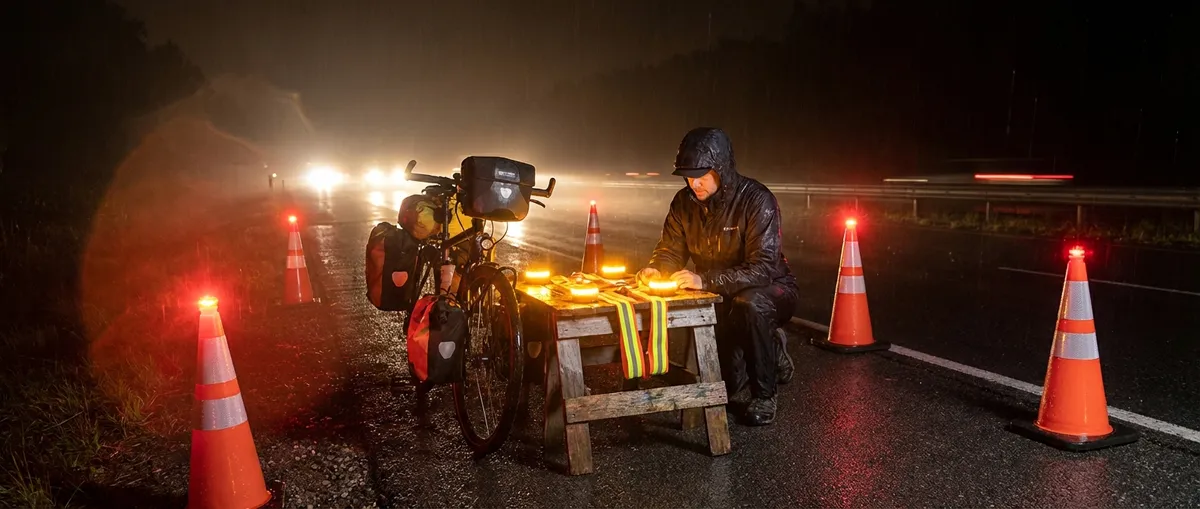
Retroreflective materials send light back toward the source rather than scattering it. High-grade retroreflective panels (often based on microprismatic technology) can spike your apparent brightness by orders of magnitude in car headlights. Placement is critical: you want reflective bands in a “biomotion pattern” that mimics human limb movement—ankles, wrists, shoulders, and helmet edges—so drivers don’t just see a bright blob, they see a moving human form.
Specular reflection (gloss surfaces)
Shiny materials reflect light like a mirror. This can cause glare but also sharp flashes that grab attention. A gloss helmet with strong color contrast (e.g., white with black or hi-vis panels) can create high-frequency visual edges that are easier for the brain to detect than a flat matte black dome.
Technical points for optimizing light behavior:
- Prioritize hi-vis for daytime, retroreflective for night. A hi-vis jacket with minimal reflectors is incomplete; a dark jacket with solid retroreflective biomotion panels can outperform it at night.
- Use motion to your advantage. Reflective patches at your wrists and ankles create a clear walking or riding silhouette; drivers subconsciously decode “human” and react faster.
- Don’t rely on one piece. Helmet, jacket, gloves, pants, and boots should each contribute to your overall light signature—especially in traffic and urban riding.
- Expect degradation. UV exposure, washing, and abrasion reduce fluorescent and reflective efficiency over time. If your hi-vis looks dull in bright sun or your reflectors look cloudy, it’s past its prime.
Impact Engineering: Understanding the Physics Inside Your Armor
Most riders know “CE Level 1” or “CE Level 2,” but very few understand what those labels actually mean in real numbers. If you’re going to trust foam and plastic with your bone structure, you should know the data behind them.
How modern armor works
Impact protectors are essentially energy management devices. They convert kinetic energy (your moving body hitting the ground or obstacle) into:
- Heat (internal friction within the material)
- Controlled deformation (crumpling or compression)
- Extended time of deceleration (stretching the impact over milliseconds)
Common materials:
- Viscoelastic armor (D3O-type): Soft and flexible at rest, molecular structures stiffen under rapid load, providing high impact attenuation with good comfort.
- PU or EVA foam: Traditional foams absorb impact through compression and cell collapse; cheaper but bulkier for the same protection.
- Hybrid systems: Hard outer shells to spread load + soft energy-absorbing backing.
What CE levels actually mean
Under EN 1621 standards (for motorcycle impact protectors):
- Level 1: Average transmitted force ≤ 35 kN, with no single impact over 50 kN.
- Level 2: Average transmitted force ≤ 20 kN, with no single impact over 30 kN.
In practice:
- Level 2 transmits significantly less energy to your body than Level 1.
- Protection gaps (missing chest or hip armor) can matter more than upgrading one pad from L1 to L2.
Technical recommendations:
- Aim for full coverage before upgrading levels. Back, shoulders, elbows, hips, knees, and ideally chest. A Level 2 back protector is excellent, but not if you’re riding with zero chest or hip impact protection.
- Check coverage area, not just rating. Some L2 pads are small and leave large unprotected zones; a larger L1 pad may cover more critical anatomy.
- Confirm positioning. Armor that rotates out of place in a slide or tumble might as well not exist. Check fit in riding position, not just standing in a mirror.
- Evaluate temperature performance. Some materials stiffen excessively in cold weather, reducing comfort and possibly performance. Good armor should remain flexible enough to stay correctly positioned across your typical climate range.
Thermal Regulation: Building a Temperature-Stable Riding System
Most riders think of warmth or cooling as “comfort features.” In reality, thermal stability is a safety-critical system. Overheating or freezing doesn’t just feel bad; it degrades reaction time, focus, and fine motor control. Your gear should function as a dynamic thermal circuit that you can tune, not a static jacket-pants combo.
Key thermal variables:
Insulation (R-value)
The job of insulation is to trap air. More trapped air = more thermal resistance. Lofted synthetics, down, and multi-layer fleece behave differently under wind pressure and compression from straps or tight armor. Once you compress insulation (tight sleeves, overly snug mid-layer), you cut its effective R-value dramatically.
Vapor management (MVTR and breathability)
Moisture Vapor Transmission Rate (MVTR) indicates how well a membrane or fabric lets water vapor escape. If your base layer and shell trap sweat, evaporative cooling will spike when you stop, leaving you freezing after a spirited ride.
Convective control (wind blocking)
At 60 mph, even mild ambient wind chill can be severe. A highly breathable mesh jacket without a properly sealed wind-blocking layer underneath turns your torso into a heat exchanger.
Technical layering strategy:
- Base layer: Synthetic or merino, high wicking, form-fitting. Its job is to move sweat away from skin and regulate microclimate humidity.
- Mid-layer: Modular. Fleece or synthetic insulation for cold, mesh or ultra-light for mild. This is your “gain knob” for warmth.
- Shell: Abrasion and impact + selective venting. Look for well-placed, controllable vents that don’t bypass armor and blast cold air directly onto sweat-soaked areas.
Performance tactics:
- Treat vents like a throttle. Fully open at speed in dry heat? You’ll dehydrate and cook. Slightly open, with high-MVTR layers underneath, can keep you in the thermal sweet spot.
- Align your kit to your engine’s heat pattern. On bikes with high engine heat, focus on more breathable inner thigh and torso venting with good outer shin and boot insulation.
- Plan for speed, not just ambient temp. An outfit that’s perfect at 30 mph in the city can be dangerously cold at 80 mph on the highway.
Biomechanical Support: How Gear Shapes Your Control Inputs
Your gear doesn’t just sit on you—it modulates how your muscles fire and how precisely you can deliver control inputs. If you ride hard or long, you should think of your kit as external biomechanical scaffolding.
Key interface zones:
Gloves and lever feel
Too much padding in the palms or fingers can blunt your sensory feedback. You want a glove that:
- Maintains tactile acuity at the lever (thin leather or technical textiles in the fingertips).
- Provides shear protection (sliders or double layers in likely abrasion zones) without bulking the control areas.
- Preserves neutral wrist angle on your specific bike (bar height + grip diameter + glove cuff length matter).
- Street/sport boots: Often prioritize feel at the shifter and peg with moderate torsional stability.
- ADV / off-road boots: More rigid, with higher resistance to twisting and lateral crushing, at the cost of some pedal sensitivity.
Boots and ankle mechanics
Advanced boots now use hinge systems, dynamic bracing, and controlled flex zones to allow shifting and braking while limiting hyperflexion, torsion, and crushing forces.
Jacket and pants articulation
Pre-curved sleeves, accordion stretch panels, and strategically placed stretch textiles allow you to maintain a stable riding posture without fighting your gear. Excess resistance at the shoulders, hips, or knees slowly fatigues you, undermining reaction times and fine motor control.
Technical considerations:
- Match articulation to riding position. Aggressive sport posture demands heavily pre-curved sleeves and low-torso mobility; upright ADV or touring needs hip and lower-back flexibility.
- Evaluate grip-surface synergy. Boots and gloves must interface with your bike (pegs, grips, levers) in a way that gives firm traction without “sticking” when you need to re-position.
- Treat ergonomic fatigue as a failure mode. If your shoulders or lower back are shot after 90 minutes, your gear system is mis-specified for that bike or that riding style.
Sensory Clarity: Optics, Acoustics, and Cognitive Load
Your gear drastically shapes what you see and hear, and how hard your brain must work to filter that data. High-performance kits aim to optimize signal-to-noise ratio: maximum useful information, minimum distraction.
Visual engineering
Helmet visor optics
High-quality visors use better base materials and manufacturing tolerances to reduce distortion, especially in the periphery. Subtle warping can force your eyes to micro-correct constantly, increasing fatigue.
- Look for visors with clear optical ratings and minimal rainbowing at steep angles.
- Anti-fog coatings or pinlock systems keep the visual channel open under humidity and cold.
Tint strategy and light adaptation
Swapping visors constantly is impractical. Using photochromic visors or internal sun visors allows your eyes to stay closer to their optimal adaptation state, reducing reaction time loss from glare or over-darkening.
Field of view
The vertical and horizontal aperture of your helmet determines how much you must move your head versus just your eyes. Broader FOV reduces the effort to check mirrors, corner entries, and cross traffic.
Acoustic engineering
Wind and engine noise at highway speeds can exceed 95–100 dB, enough to cause hearing damage over time and increase fatigue in a single ride. Your target is not silence—it’s intelligible, filtered sound.
- Helmet aerodynamics and padding: Properly designed helmets create smoother airflow around the shell and neck seal, reducing turbulence that generates high-frequency noise.
- Earplugs: High-fidelity plugs attenuate damaging frequencies while preserving enough sound for engine and traffic awareness.
- Buffeting control: Screen height, helmet shape, and rider height all interact. Even a premium quiet helmet can become loud behind a poorly tuned windscreen.
Technical outcomes of better sensory clarity:
- Lower cognitive load: Less energy spent fighting glare, distortion, or noise means more bandwidth for hazard detection, line choice, and traction sensing.
- More accurate feedback loop: You more clearly hear engine note changes, tire noise on different surfaces, and environmental audio cues (horns, sirens, cross-traffic).
- Extended performance window: You can ride longer with less degradation in reaction time and decision quality.
Conclusion
Gear is not just fabric and plastic—it’s a system that shapes how the world sees you, how forces move through your body, how your temperature and muscles behave, and how cleanly your senses interface with the environment. When you treat visibility, impact management, thermal regulation, biomechanics, and sensory clarity as integrated engineering problems, your kit stops being “what you wear” and becomes a performance platform.
On Moto Ready, the mission is simple: build riders who spec their gear with the same ruthless intentionality they bring to suspension settings or brake upgrades. Stop buying isolated products. Start architecting a visibility and protection system that works as precisely as a well-tuned chassis—because every ride is a live test, and the road doesn’t care about marketing copy, only physics.
Sources
- [NHTSA Motorcycle Safety: Traffic Safety Facts](https://www.nhtsa.gov/road-safety/motorcycles) - U.S. government crash and safety data, including visibility and protective equipment insights.
- [CDC: Workplace Safety & Health – Noise and Hearing Loss Prevention](https://www.cdc.gov/niosh/topics/noise/default.html) - Technical information on noise levels, hearing damage, and the importance of hearing protection.
- [CDC: Effect of Helmet Use on Motorcycle Injuries](https://www.cdc.gov/motorvehiclesafety/mc/index.html) - Research-based summary of helmet effectiveness and injury reduction.
- [Oxford Academic – Injury Prevention: Motorcycle Visibility and Crash Involvement](https://academic.oup.com/ije/article/30/5/988/786615) - Study on the impact of clothing and conspicuity on motorcycle crash risk.
- [Dainese Technical Safety Standards](https://www.dainese.com/gb/en/technical_safety_standards.html) - Detailed explanations of CE armor standards, impact tests, and protective gear engineering.
Key Takeaway
The most important thing to remember from this article is that this information can change how you think about Gear & Equipment.