Modern motorcycles can have 120+ horsepower, multilink traction control, and lean-sensitive ABS—yet still ship with lighting that’s one bad night away from being a liability. If you ride hard, ride at night, or ride in weather, your lighting system is not cosmetic. It’s a performance system that governs how early you see problems and how early drivers see you.
This isn’t about bolt-on aesthetics. This is about building a signal-ready lighting package that delivers usable contrast, consistent visibility, and reliable function under vibration, heat, and weather—without cooking your wiring or blinding everyone around you.
The Physics of Seeing and Being Seen
Before throwing LEDs at the bike, you need to understand what you’re trying to optimize: contrast and reaction time.
Human vision doesn’t just need brightness; it needs contrast. A 5,000-lumen headlight that floods everything into a flat white wall can be worse than a properly focused 2,000-lumen beam because you lose edge definition on potholes, gravel, and wet tar snakes. The goal is a beam pattern that keeps:
- A defined cutoff to avoid glare to oncoming traffic.
- A bright, uniform foreground to avoid “zebra striping” (alternating bright and dark bands that hide small obstacles).
- A focused hot spot further down the road to extend your reaction time at speed.
On the “being seen” side, the job is to break camouflage. Motorcycles are visually small and easily lost in background clutter. Effective conspicuity comes from:
- Motion (modulation, pulsing, or positioning lights off-center).
- Contrast (amber vs white; red vs white; high intensity vs daytime background).
- Separation (lights spaced apart in height and width to help drivers judge distance and speed).
The most technically sophisticated system in the world fails if its output is poorly aimed, poorly placed, or poorly contrasted against the environment.
Technical Point 1: LED Spectrum, Color Temperature, and Real-World Vision
Most riders just ask “how bright?” You should be asking: “what spectrum, and what pattern?”
Color temperature (CCT) is the first spec to understand. Most high-output motorcycle LEDs are in the 5,000K–6,500K range (cool white to blue-ish). The issue:
- Very cool (6,000K–7,000K) light looks “bright” but scatters more in rain, fog, and dust, amplifying glare and reducing contrast.
- Warm (3,000K–4,000K) light penetrates fog and rain better and produces more comfortable, less fatiguing night vision.
- A balanced 4,500K–5,000K neutral white often gives the best combination of apparent brightness and usable contrast for mixed conditions.
Beyond CCT, spectral distribution matters. Cheaper LEDs spike hard in blue wavelengths and drop off in red, which causes:
- Strong glare for oncoming traffic (blue scatters more in the atmosphere and in the eye).
- Faster visual fatigue and slower adaptation when you look from bright to dark areas.
When evaluating LEDs:
- Look for neutral-white options marketed for road use, not just “max lumens” or “off-road only.”
- Pay attention to color rendering index (CRI) when available; higher CRI (80+) improves your ability to differentiate surface conditions (oil, gravel, asphalt patches) at night.
- Avoid ultra-blue “HID look” kits—they’re photometrically aggressive but functionally inferior for real-world riding.
In simple terms: a slightly warmer, high-CRI, well-focused LED will help you ride faster and safer at night than a blinding, blue-tinted wall of light.
Technical Point 2: Beam Control, Optics, and Why Raw Lumens Lie
Spec sheets love lumens; riders should love candela and optics.
- Lumens = total light output from the emitter.
- Candela = intensity in a given direction.
- Lux = how much light actually lands on a specific area at a distance.
A 3,000-lumen lamp with excellent optics can out-perform a 6,000-lumen “flood” that wastes most of its light upward, sideways, or into your own windscreen.
Key technical elements:
Reflector vs projector
- Reflector housings (with a shaped reflector behind the LED) depend heavily on reflector geometry. Good ones can be fantastic; cheap ones produce stray glare and hot spots. - Projector systems (with a lens up front and a cut-off shield) typically give sharper cutoffs and more controllable patterns but rely on emitter placement with sub-millimeter precision. Poorly designed or retrofitted projectors can mis-focus and still glare.
Cutoff and step pattern
- A proper low-beam pattern will have a defined horizontal cutoff and often an upward “step” on the right (in right-hand-traffic countries) to illuminate road signs and the shoulder without dazzling oncoming traffic. - Many generic LED “upgrades” ignore this, spraying uncontrolled light above the cutoff, which is both unsafe and technically illegal in many regions.
Forward throw vs foreground
- Too much intensity immediately in front of the bike (strong foreground) makes everything beyond 30–40 m look dim. Your pupils constrict for the near field, leaving you blind at actual reaction distances. - A performance beam pushes the strongest intensity out to where your reaction window lives—roughly 3–4 seconds ahead at your cruising speed. At 60 mph (~27 m/s), you want usable detail out to at least 120–150 m.
When upgrading, don’t just compare “before/after” pictures in a dark alley. Evaluate:
- Edge of the beam—sharp, controlled, or fuzzy and messy?
- Balance between near field and mid field.
- How easily you can read surface texture and small irregularities, not just signs.
Technical Point 3: Electrical Load, Heat Management, and Harness Integrity
You can’t talk lighting performance without talking power delivery and thermal control. LEDs are efficient, but they are not low-stress devices. They’re extremely sensitive to heat and voltage stability.
Electrical load and CAN bus behavior
Modern bikes use CAN bus and body control modules that monitor circuit load. Dropping from a 55W halogen to a 20–25W LED can:
- Trigger “bulb out” warnings.
- Cause flickering or shut-off if the control unit thinks there’s a fault.
Technical mitigation strategies:
- Use resistor or ballast modules only when necessary; they dissipate heat and add failure points.
- Prefer CAN-bus-compatible, homologated kits or bike-specific harnesses that communicate correctly with the system.
- When adding auxiliary lights, take power from a relay-driven fused circuit (often via an accessory harness or auxiliary fuse block) rather than piggybacking existing OEM wiring.
Heat management and LED longevity
High-output LEDs are governed by junction temperature. As LED core temperature rises:
- Light output drops (thermal derating).
- Color shifts, often toward blue.
- Long-term degradation accelerates (lumen depreciation and possible early failure).
Look for:
- Substantial metal heat sinks or well-designed housings with real surface area, not decorative fins.
- Clear airflow paths; don’t bury a fan-cooled LED module inside a sealed, zero-ventilation housing.
- Thermal protection circuitry that steps output down rather than allowing runaway heat in slow traffic or hot climates.
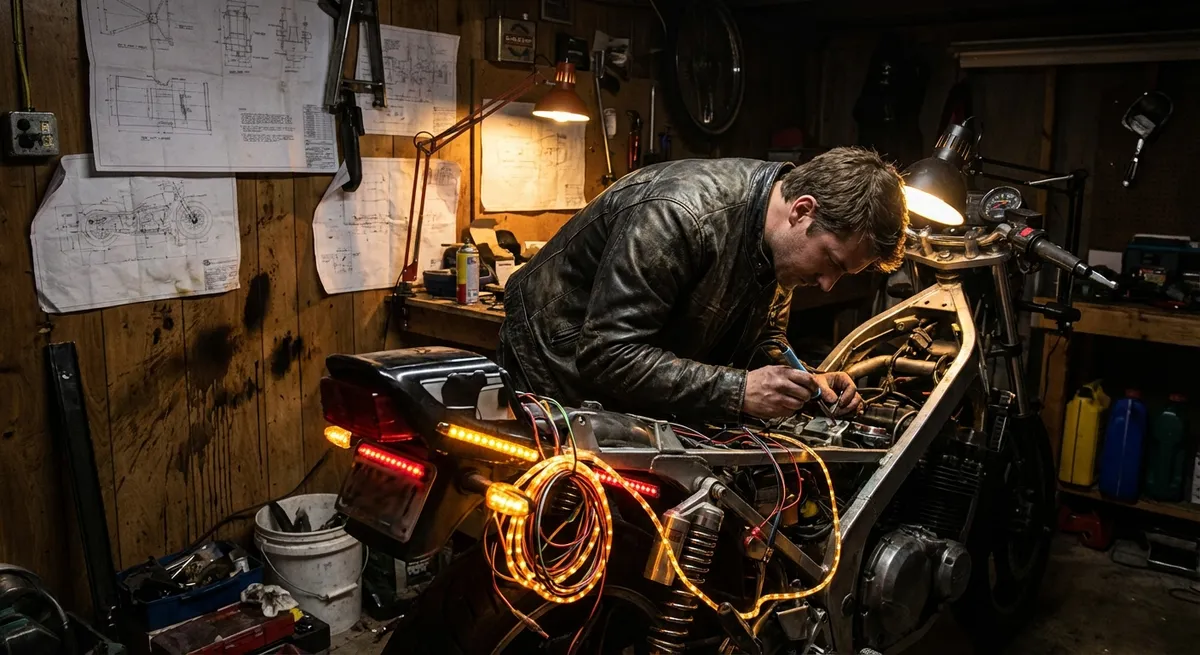
Harness and connector integrity
The real-world failure point is usually not the LED itself; it’s the connectors and harness:
- Use weather-sealed connectors (e.g., IP67+ rated, Deutsch or OEM-style sealed plugs) on any external lighting.
- Strain-relief all connections so vibration doesn’t work-harden copper or pull terminals loose.
- Avoid Scotchlok / insulation-piercing connectors on critical circuits; solder and heat-shrink or use proper crimp terminals with sealant.
A lighting system is only as reliable as the wiring that feeds it. On a performance or adventure build, your standard should be “motorsport grade,” not “trailer wiring grade.”
Technical Point 4: High-Contrast Signaling — Brake, Turn, and Auxiliary Conspicuity
Forward vision is half the system. The other half is how aggressively and intelligently your bike communicates its motion to everyone around you.
Brake lighting: from simple bright to high-information
Stock brake lights on many bikes are technically legal but functionally weak. You want a system that:
- Responds instantly (LED vs halogen delay).
- Clearly differentiates between tail and brake states (at least 3–5× intensity jump).
- Uses modulation or pulsing in a controlled, non-gimmicky way to catch attention without becoming visual noise.
Technically oriented options:
- Deceleration-sensing modules that flash or intensify the brake light during hard engine braking, not just when you touch the lever or pedal. These rely on accelerometers or tapping into CAN bus data.
- Multi-stage brake logic: a short high-frequency burst (e.g., 3 rapid flashes) followed by a steady high-intensity brake light. This pattern is attention-grabbing but quickly resolves into a stable signal.
Be aware of local legal constraints—some regions limit modulation patterns. Choose systems that explicitly comply with DOT/ECE where applicable.
Turn signals: optics, placement, and temporal pattern
Performance turn signals aren’t just small and bright; they’re optically efficient and well-positioned.
Technical criteria:
- Angular visibility: look for signals rated for wide-angle output (minimum ±45° horizontally, ±15° vertically, more is better), so you’re visible even when the bike is leaned or when someone isn’t directly behind you.
- Temporal clarity: flash rate should be stable and within legal ranges (~60–120 flashes/min). Hyper-flash might draw attention but can also look like a fault and be technically illegal.
- Sequential vs simple: sequential indicators can improve spatial perception of direction, but only if bright and well-timed. Bad implementations are just distraction.
Placement matters:
- Widely spaced front and rear signals improve distance and speed judgment for other drivers.
- Avoid burying signals inside luggage outlines or too close to brake and tail lights where signals visually merge.
Conspicuity lighting: always-on strategy
Adding low-output, always-on auxiliary lights can dramatically improve daytime visibility without causing glare. Key approach:
- Use low-wattage, tightly focused DRLs mounted lower or higher than the main headlight to create a light triangle. This geometric separation makes your motion and distance easier to perceive.
- Prefer amber for peripheral conspicuity in poor weather; amber penetrates moisture and stands out from white DRLs and LED headlights on cars.
- Keep intensity controlled; the goal is to be clearly present, not to cause disability glare for others.
Technical Point 5: Environmental and Mechanical Durability for Real-World Riding
Riders tend to obsess over light output and aesthetics, but the critical differentiator on a serious build is durability under vibration, impact, and environment.
Ingress protection (IP) and sealing
Check IP codes:
- IP67 = dust tight + immersion up to 1 m for 30 min.
- IP68/IP69K = enhanced protection, often including high-pressure spray resistance.
For exposed auxiliary lighting on ADV, dual-sport, or track bikes that see rain washes:
- Aim for IP67 minimum, IP69K preferred.
- Verify that the connectors and pigtails are equally robust; a sealed lamp with a non-sealed plug is a false sense of security.
Vibration and mechanical shock
Motorcycles transmit significantly more vibration than cars, especially singles and twins at low RPM and off-road. Look for:
- Lamps advertised or tested for powersports or off-road use, not just “automotive styling.”
- Internally potted electronics (epoxy-encapsulated drivers) that won’t fatigue and crack under long-term vibration.
- Robust mounting hardware: stainless or high-grade aluminum brackets with locking fasteners (nyloc nuts, threadlocker where appropriate).
Thermal cycling and UV resistance
Your lighting system will see wide swings in temperature and UV exposure:
- Polycarbonate lenses should have UV-resistant coatings; cheap uncoated plastics will haze and micro-crack over time, diffusing light and reducing intensity.
- Housings should be corrosion-resistant; anodized aluminum or high-quality coated metals show their worth after a few winters or salty coastal rides.
Serviceability and failure modes
A serious setup is designed under the assumption that something will eventually fail, usually at the worst possible moment.
Build with:
- Independent circuits for critical systems (e.g., auxiliary lights on separate fuse/relay so a failure doesn’t take out the OEM headlight).
- Thoughtful routing: avoid tight bends, steering pinch points, and sharp edges that can cut into sheathing over time.
- Accessible mounting and wiring so you can troubleshoot at the roadside with a basic toolkit and test light.
A lighting system that’s 5% less bright but 10× more reliable under abuse is a performance upgrade. Night pace doesn’t matter if you’re limping home on hazards because your main beam died in the rain.
Conclusion
A serious motorcycle lighting system is a performance tool, not a cosmetic add-on. If you approach it like you’d approach suspension tuning or brake upgrades—starting with human vision, then optics, then electrical integrity, then durability—you end up with something that actually changes how you ride.
You see hazards earlier. You read surface detail deeper into the corner. Drivers register you faster, understand your intentions sooner, and misjudge your distance less often. That’s real, measurable performance: extra seconds of reaction time, extra meters of visual information, and a dramatically lower chance that someone else’s mistake becomes your crash.
Build your lighting like you build everything else that matters on the bike: with respect for physics, attention to detail, and zero tolerance for decorative junk. At night, in the rain, or at real pace, the difference between “bright” and “engineered” is the difference between surviving the unknown and riding straight into it.
Sources
- [NHTSA – Motorcycle Safety: Headlights and Visibility](https://www.nhtsa.gov/road-safety/motorcycle-safety) - U.S. National Highway Traffic Safety Administration overview of motorcycle visibility, headlight use, and conspicuity-related safety considerations.
- [FMVSS No. 108 – Lamps, Reflective Devices, and Associated Equipment](https://www.ecfr.gov/current/title-49/subtitle-B/chapter-V/part-571/subpart-B/section-571.108) - U.S. federal regulation detailing technical requirements for vehicle lighting, including beam patterns and performance standards.
- [SAE International – Vehicle Lighting Standards](https://www.sae.org/standards/browse/?subcommittees=2124175) - Professional engineering standards for automotive and motorcycle lighting performance, beam patterns, and testing methodologies.
- [IIHS – Headlight Ratings and Research](https://www.iihs.org/ratings/headlights) - Insurance Institute for Highway Safety research on headlight beam patterns, glare, and real-world visibility impacts.
- [University of Michigan Transportation Research Institute – “Motorcycle Conspicuity”](https://deepblue.lib.umich.edu/handle/2027.42/1715) - Research examining how lighting, color, and positioning affect motorcycle conspicuity and crash risk.
Key Takeaway
The most important thing to remember from this article is that this information can change how you think about Gear & Equipment.