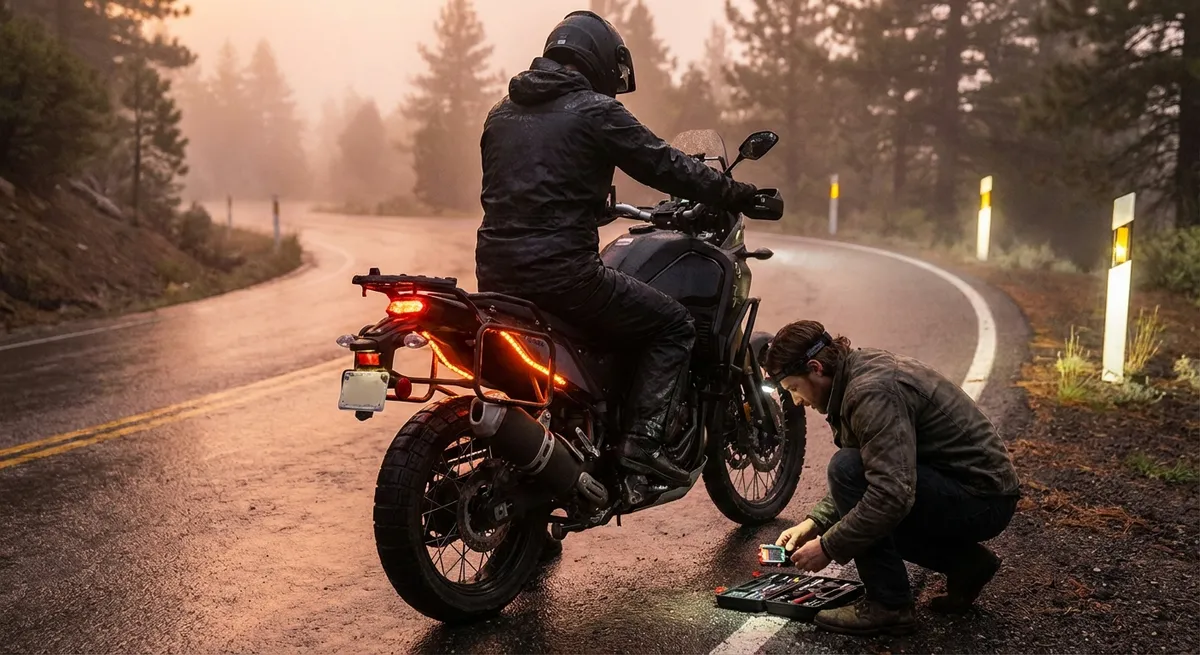
You can’t ride what you can’t see—and they can’t avoid what they can’t perceive. For all the obsession with horsepower, lean angles, and compound chemistry, most riders under-engineer the most critical system on the bike: visibility. Not just being “bright” or “loud,” but building a layered, technical visibility package that works in rain, glare, and chaos at 70 mph.
This isn’t about buying more fluorescent stuff. It’s about treating your gear like a signal processing system: managing contrast, light, reflection, and motion so drivers’ brains lock onto you faster—and keep you in their threat model.
Building a Visibility System, Not Just Buying Bright Gear
Visibility is a systems problem. Helmet, jacket, lights, and luggage either work together—or cancel each other out. Think of your visibility package as a 3D geometry problem: how much of your body is signaling from every practical viewing angle?
A high-visibility jacket with a matte-black backpack? You’ve just erased 30–40% of your surface area from rear traffic. A bright helmet but all-dark legs and boots? You’ve lost crucial motion cues that drivers subconsciously track. The target state: multiple, redundant “channels” of visibility—color, reflection, active light, and biomotion—strategically distributed over your body.
When you shop or reconfigure your kit, stop thinking in single items and start thinking in coverage maps: front, rear, lateral, and vertical planes. The question isn’t “Is this jacket bright?” It’s: “What does my silhouette look like in a side mirror, at night, in rain, under streetlight glare?”
Technical Point 1: Contrast Beats Color — Spectral Strategy for Real Roads
A lot of riders fixate on fluorescent yellow without understanding why it works—or when it doesn’t. Human vision is optimized to detect contrast boundaries, not absolute brightness. Fluoro does well in many environments because its wavelength spikes outside most natural background tones, but it can still disappear against certain signage, construction zones, or urban clutter.
You want spectral separation from your dominant riding environment. In urban settings with lots of bright signage and warm light pollution, cool-tone accents (white, ice-blue reflectives, silver) can pop harder than pure neon. In rural or wooded zones, fluorescent yellow or orange strongly contrasts with greens and browns, but pairing them with black or dark gray panels creates hard edges that the visual cortex can snap to.
Think about three layers of visual logic:
- Base tone: Often dark for practicality and perceived “cool factor.” That’s fine—use it as your contrast background.
- High-chroma zones: Fluoro or bright accents on torso, shoulders, and helmet to establish your main signal footprint.
- Edge framing: High-contrast piping or panels that outline limbs and torso, creating “object boundaries” that stand out in peripheral vision.
Your evaluation test: stand your gear up (or wear it), step back 15–20 meters, squint, and look slightly away. If your outline collapses into the background, your contrast strategy is weak—regardless of how bright it looks up close.
Technical Point 2: Reflectivity as an Optical Circuit, Not Decoration
Reflective elements are not stickers—they’re precision optical components. Quality retroreflective materials use microprisms or glass beads to return light in a tight cone back toward its source, which is why a tiny strip can look nuclear-bright in headlights and almost invisible under ambient light.
The technical parameters that matter:
- Placement height: Car headlights generally sit between ~0.5–1.1 m off the ground. Reflectives on boots, lower legs, and panniers live squarely in that beam. High-mounted reflectives on top boxes and helmet edges catch SUV/truck headlights and rearview mirrors.
- Angle of incidence: Retroreflective intensity drops as the angle between light source and viewer increases. That means material on the sides of your body is far more useful than a big reflective logo across your chest that only lights up from dead-ahead.
- Surface cleanliness and wear: Dust, chain fling, road grime, and UV exposure degrade reflectivity significantly over time. Treat it like a functional surface: clean it regularly and inspect for dulling or cracking. If it looks “matte” under a flashlight, its optical efficiency is already compromised.
For real-world tuning, have a friend sit in a car at night with low-beams on and slowly approach while you stand still, then walk, then simulate lane changes. Note which areas “ignite” first and which stay dark. Then you know where to add reflective tape or swap panels—not just where the marketing photos looked cool.
Technical Point 3: Engineering Biomotion Cues Into Your Gear Layout
Biomotion—the pattern of how human joints move—is one of the strongest cues the brain uses to detect other people, especially in low light. Safety researchers have repeatedly shown that reflective markers at the points of articulation (ankles, knees, wrists, elbows, shoulders) dramatically improve detection distance and recognition as a human.
For riders, this is huge. You’re not just a blob of light; you’re a moving structure:
- Ankles and lower legs: Highly dynamic in stop-and-go and low-speed maneuvering. Reflective bands or panels around the calves and ankles act like strobing visual anchors as you walk or put a foot down.
- Wrists and forearms: Visible when signaling, lane-checking, or adjusting controls. Reflective piping on gauntlet gloves and jacket cuffs creates arcs of motion that scream “person” to nearby drivers.
- Shoulders and upper arms: Big lateral swings when you countersteer or head-check. Reflective or high-contrast patches here increase side-profile recognition.
If your gear is all reflective only on the back logo and tail of the jacket, you’re leaving biomotion on the table. Intelligent gear design mirrors lab setups: distributed, symmetrical reflectives around joints, with enough gaps that movement is visible as changing geometry—not just a dull glow.
A strong biomotion setup means that even a quick shoulder check, foot dab, or mirror glance sends complex motion signals into surrounding traffic’s peripheral vision. That’s far more powerful than one oversized reflective panel that just looks like a static rectangle.
Technical Point 4: Active Lighting as a Tuned Output, Not a Gadget
Aux lights, LED brake modulators, helmet beacons—there’s no shortage of techy visibility add-ons. The problem is that many riders install them without thinking like an electrical engineer or human-factors specialist. Output that’s too bright, too scattered, or too “noisy” can paradoxically make you harder to interpret.
Consider three design constraints:
- Luminous intensity vs. glare: More lumens aren’t automatically better. Aim auxiliary lights low and slightly outward, with beam patterns that add foreground fill and lateral presence without washing out your brake/tail lights. You want layering—distinct signals, not a single white blob.
- Temporal encoding: Flashing brake modules can improve reaction time, but high-frequency, continuous strobing may trigger discomfort or be filtered out as “non-threat background” (like emergency vehicle reflections). Look for brake modulators that do a rapid burst on initial application, then settle to steady-on. That sharp time-locked change is what the brain keys on.
- Spectral separation in the rear: Red is mandated for rear signaling, but you can still play with saturation and lens design. A high-contrast LED brake light with defined edges is easier to parse than a fuzzy incandescent glow buried deep in a smoked lens.
Helmet-mounted lights can be incredibly effective if they’re subtle and stable: a small, constant rear red marker at head height draws a strong vertical line that’s hard to miss, especially in mixed traffic. The engineering objective is predictable, interpretable light behavior—not a carnival.
Technical Point 5: Optical Performance of Helmet Visors and Eye Systems
Your own vision is part of the visibility system. If your eyes are struggling with glare, fog, or poor contrast, you make worse line choices, react later, and maneuver more abruptly—each of which makes you harder to predict.
Treat helmet optics like precision instruments:
- Optical class & distortion: Many premium visors are “optically correct” or injection-molded to minimize distortion across the field of view. Cheap or heavily curved aftermarket visors can introduce subtle warping, especially at the periphery, which can distort distance and speed perception during head checks and lean-ins.
- Anti-fog tech: Pinlock inserts, hydrophilic coatings, or dual-pane systems aren’t luxuries; they’re stability tools. Fog forces micro-adjustments (cracking the visor, changing posture) that disrupt your smooth control inputs and may shift your head into suboptimal lighting angles.
- Tint management: A dark smoke visor at night is obviously bad, but even a light tint can degrade your contrast sensitivity in rain or low light. The ideal is a clear primary visor plus an internal drop-down sun visor or photochromic system that adapts. What matters isn’t “darker”—it’s controlled reduction of glare while preserving as much shadow detail as possible.
- Hydrophobic exteriors: A good hydrophobic coating on the outside of the visor causes water to bead and shed at lower speeds, preserving image clarity and edge definition. This reduces cognitive load; you spend less mental bandwidth tracking droplets and more on traffic motion and gaps.
Your test is simple: ride the same route with and without upgraded optics, paying attention to how early you detect hazards, how stable your lines feel in transition zones (sun to shade, dry to wet), and how much you need to consciously “work” to see. Any reduction in effort is performance you’ve just freed up for tactical riding decisions.
Conclusion
Visibility isn’t just color. It’s geometry, optics, motion, and human perception woven into a system you wear and ride with every day. When you start treating your gear like a visibility circuit—with inputs (ambient light, vehicle headlights), processors (your visor, coatings, geometry), and outputs (color, reflectivity, active lighting, biomotion)—you realize how much performance you’ve been leaving on the table.
You don’t have to turn yourself into a rolling construction cone. You have to think like an engineer and a rider at the same time: where does light actually fall, how does the brain actually see, and how do you convert every square inch of gear into useful signal? Build that system with intent, and you won’t just be seen more—you’ll be seen sooner and understood faster. That’s where survival and speed quietly shake hands.
Sources
- [U.S. National Highway Traffic Safety Administration (NHTSA) – Motorcycles](https://www.nhtsa.gov/road-safety/motorcycles) – Statistics and safety guidance on motorcycle visibility and crash factors
- [CDC – Motorcycle Safety](https://www.cdc.gov/transportationsafety/motorcycle/index.html) – Public health perspective on motorcycle injuries and the role of protective and conspicuous gear
- [3M Transportation Safety – Retroreflective Technology](https://www.3m.com/3M/en_US/road-safety-us/applications/retroreflective-technology/) – Technical background on how retroreflective materials work and where they’re most effective
- [Vision and Road Safety – Monash University Accident Research Centre](https://www.monash.edu/muarc/archive/our-publications/muarc048) – Research on visual perception, conspicuity, and their impact on traffic safety
- [Shoei – Tech & Safety Features](https://shoei-helmets.com/safety-technology/) – Details on helmet shell design, visor optics, and anti-fog/anti-distortion technologies
Key Takeaway
The most important thing to remember from this article is that this information can change how you think about Gear & Equipment.