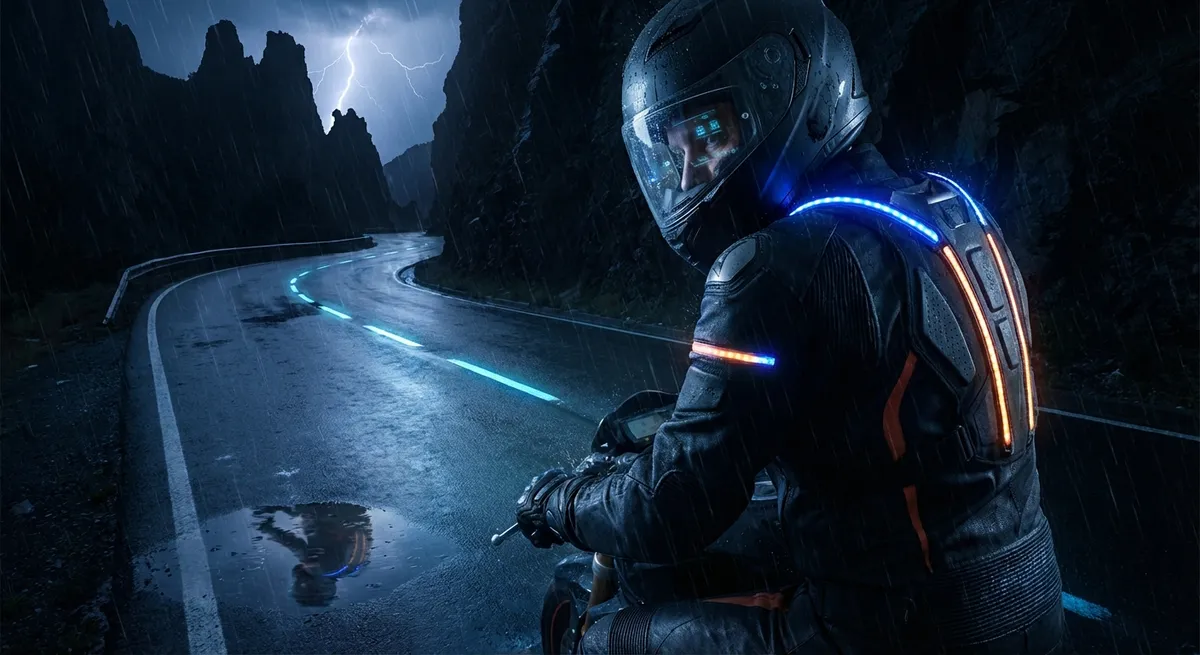
Motorcycle gear is no longer just leather, plastic, and foam—it’s an engineered system that manages signal (what other road users can perceive), stability (what keeps your body and senses under control), and survivability (what actually keeps you alive when everything goes wrong). If you ride like it matters, your gear should be specced and evaluated like components on a race bike: materials, standards, failure modes, and integration.
This isn’t about looking “kitted-out.” It’s about understanding the technical backbone behind modern riding gear and using that knowledge to build a system that performs when the physics gets violent.
Rethinking Gear as an Integrated Safety System
Most riders buy gear piecemeal: a jacket here, gloves there, maybe a back protector if something on YouTube scared them. Technically, that’s backwards. Your gear should function as a coordinated safety system with three priorities:
- Energy management: how the kit absorbs, distributes, and redirects impact and abrasion forces away from your body.
- Signal clarity: how visible, legible, and predictable you are to other road users in varying light and weather conditions.
- Rider stability: how effectively the gear maintains your ergonomics, vision, and physiological state (temperature, fatigue, concentration).
Think of your body as the chassis and your gear as the crash structure, aero package, and sensory interface. A properly engineered kit will:
- Maintain structural integrity during a slide (no burst seams, no rotating armor).
- Keep armor correctly aligned on impact zones as your body rotates and tumbles.
- Manage temperature and moisture so your reaction time doesn’t degrade.
- Make you optically “loud” when conditions are visually noisy (rain, dusk, traffic glare).
Once you frame gear as a system instead of a shopping list, the spec sheet stops being marketing noise and starts being engineering data.
Technical Point 1: Understanding Impact Armor Physics (CE Levels Aren’t Enough)
Most riders know “CE Level 1” and “CE Level 2,” but don’t actually know what those numbers represent. For impact protectors under EN 1621 standards:
- Level 1: Transmitted force ≤ 35 kN on average, with no single impact > 50 kN
- Level 2: Transmitted force ≤ 20 kN on average, with no single impact > 30 kN
In plain terms: Level 2 armor lets roughly half (or less) of the peak impact energy through compared to Level 1 under test conditions.
Key technical details that matter beyond the label:
- Material type
- Viscoelastic foams (D3O-type, SAS-TEC-style) stiffen under impact and remain flexible at rest; they work superbly for repeated street-level impacts.
- Hard shell + foam composites are more common in track suits and off-road armor; the shell spreads force over a larger area while the foam absorbs the remainder.
- Temperature performance
EN 1621 testing is done at specific temperatures, but your armor might see 5°C dawn commutes and 40°C desert afternoons. Some foams harden excessively in the cold or get too soft in the heat, changing their real-world response time and energy absorption curve.
- Coverage and geometry
- Full-length back protectors that reach from T1 to tailbone.
- Knee and elbow armor that wraps around the sides, not just the front.
- Chest protectors that cover sternum and ribs, not just a thin central strip.
- Integration stability
- Tight tolerance in armor pockets (no rattling, no sliding).
- Adjustable straps or cinches on limbs to lock armor over joints.
- Correct sizing so armor doesn’t rotate out of line when you move or crash.
A CE Level 2 protector that leaves a third of your joint or vertebrae uncovered is a partial solution at best. Look for:
Armor only works if it stays where the impact is. Technically, this is a retention and kinematics problem:
When you evaluate armor, treat it like suspension: type, range, response under different conditions, and correct placement matter as much as the spec number.
Technical Point 2: Abrasion and Burst Resistance – Beyond “It’s Leather, So It’s Safe”
Survival in a slide is about time and distance before the outer layer fails and your skin becomes the friction surface. That’s governed by:
- Abrasion resistance: how long the material survives contact with asphalt at speed.
- Burst/tear strength: how well seams and panels hold together when loaded and twisted.
Under the EN 17092 standard for garments, different classes (AAA, AA, A, etc.) are tested using a Darmstadt-type abrasion machine. Higher ratings correspond to survival at higher impact/slide speeds.
Key technical cues:
- Materials by use-case
- Track / high-speed road:
- 1.2–1.4 mm full-grain cowhide or kangaroo leather in primary impact zones.
- Double layers at shoulders, elbows, hips, and knees.
- Street / touring:
- High-denier synthetics: 500D–1000D+ Cordura, SuperFabric, Armacor, or similar in impact zones.
- Reinforced seat and knee panels.
- Urban / casual:
- Single-layer “motorcycle denim” is not normal denim. Look for Kevlar/aramid/ UHMWPE weaves with tested abrasion ratings, not just a yellow lining and a logo.
- Zone construction
- Zone 1 (high impact: shoulders, elbows, knees, hips, seat): max abrasion and tear resistance, double or triple layers, external sliders if possible.
- Zone 2 (moderate impact: forearms, outer thighs, chest): solid abrasion fabrics, reinforced seams.
- Zone 3 (low impact: inner arms, torso sides): lighter, breathable but still tear-resistant textiles.
- Seam engineering
- Double or triple-stitched safety seams in impact areas.
- Hidden (folded) safety seams where the stitching itself is protected from abrasion.
- Bonded, high-tensile threads (polyamide or polyester) rated for dynamic loading.
- Public test data
A technically competent garment uses a zoned design:
Most catastrophic failures in real crashes come from seams exploding, not fabric wearing through. You want:
Where possible, look for manufacturers who publish EN 17092 class ratings for specific garments, not just “meets CE standards.” AAA in the shoulders doesn’t magically make the rest of the jacket AAA.
Think of abrasion resistance like tire compound: wrong compound for the operating envelope and you’re gambling with margins you don’t really have.
Technical Point 3: Visibility Engineering – Retroreflective, Fluorescent, and Motion Cues
Being seen is not a fashion decision; it’s an optical engineering problem competing with modern traffic environments flooded in LEDs, reflections, and visual clutter.
There are three technical pillars:
Retroreflection (night, low-light, indirect illumination)
- Retroreflective materials return light towards the source (car headlights). - Placement matters more than square inches. Strategically excellent locations: - Upper arms and shoulders (high and in motion). - Helmet sides and rear. - Calf/ankle zones (biological motion—drivers’ brains key on moving “walking” patterns). - Continuous strips outline your silhouette better than random patches.
Fluorescence (daytime and overcast conditions)
- Fluorescent yellows, oranges, and limes convert UV into visible light, effectively “amplifying” brightness in daylight and gray weather. - They do very little at night without direct light sources. - Technical consideration: UV exposure degrades fluorescent dyes. Gear that was vivid neon three years ago may be optically muted now.
Contrast and patterning (separation from background)
- High-contrast blocks (e.g., black + hi-viz) create strong edges your outline can be detected against mixed backgrounds. - Helmets benefit from macro-contrast designs: simple, bold shapes over busy graphics. The goal is silhouette recognition at a glance, not artwork appreciation.
Add to this:
- Helmet spec relevance
While SNELL, ECE 22.06, and DOT focus on impact performance, some modern lids integrate better reflectives, integrated brake lights, or Bluetooth lighting cues. The tech may be secondary to the shell’s crash performance, but if visibility features are well-implemented and don’t compromise structural integrity, they’re legitimate functional upgrades.
- Environmental tuning
- Urban night: emphasize retroreflectives and lighting (aux lights + reflective gear).
- Daytime rural: emphasize fluorescence and contrast.
- All-weather commuting: hybrid strategy (fluorescent textiles + reflective piping + helmet accents).
Treat visibility like you’d treat lighting on the bike: coverage, angle, redundancy, and brightness all matter.
Technical Point 4: Environmental Control – Ventilation, Insulation, and Moisture Management
A rider who’s overheating, dehydrated, or freezing has slower reactions, worse judgment, and lower grip strength. That’s not comfort—it’s control system degradation. Good gear manages heat, air, and sweat like a well-tuned cooling system.
Key technical layers in a performance-oriented setup:
- Base layer (skin interface)
- Synthetic or merino wool with high moisture-wicking capacity, low drying time, and minimal seam bulk.
- Avoid cotton; it saturates, stays wet, and accelerates chill when temperatures drop.
- Compression-style bases can reduce muscle oscillation and fatigue on long rides.
- Mid layer (insulation and volume for warm air)
- Fleece, synthetic loft, or down (for off-the-bike use) depending on packability and moisture conditions.
- For active riding, synthetic insulation is preferred—it maintains performance when damp.
- Zonal insulation is ideal: extra around core and kidneys, less in arms to preserve dexterity.
- Shell layer (abrasion + weather)
- Laminated waterproof fabrics (e.g., 2- or 3-layer Gore-Tex, similar membranes) keep external water out and allow vapor to escape, but need vents for real heat dumping.
- Drop-liner designs are cheaper but can waterlog the outer shell and get heavy, soaking evaporative cooling away from where you need it.
- For hot climates, heavily vented shells paired with separate rain layers provide better thermal headroom.
Critical technical details in shell design:
- Vent layout & flow path
- Effective ventilation = intake + exhaust + clear airflow path over the body.
- Look for large chest or collar intakes and rear exhaust ports that aren’t blocked by a backpack.
- Pit zips, forearm vents, and 2-way zippers allow precise control and avoid ballooning.
- Glove and boot microclimate
- Hands and feet overheat and chill quickly due to high surface area and constant wind exposure.
- Gore-Tex (or similar) gloves and boots should balance thickness with lever feel; too bulky and you lose brake finesse.
- Separate summer and winter systems are often better than “all-season” compromises.
When your gear keeps your core temp in the optimal band and your sweat under control, your brain stays clearer, your reaction window stretches, and your riding precision remains high even hours into a ride.
Technical Point 5: Electronic Augmentation – Airbags, Comms, and Data Layer
The modern gear ecosystem is becoming electronically augmented, adding an information and protection layer on top of traditional materials engineering.
Airbag Systems
Moto airbag technology has matured aggressively in the last decade, moving from track-only to street-ready systems:
- Algorithm-driven protection
- Inertial Measurement Units (IMUs) measure acceleration, rotation, and orientation; algorithms detect crash signatures (high-g impacts, abnormal pitch/roll/yaw changes, loss of wheel contact).
- Street-focused systems are tuned for lower-speed, multi-impact crash profiles and urban hazards.
- Coverage zones
- Common protected regions: collarbones, chest, ribs, upper back, and in some designs, neck stabilization.
- A properly-fitted airbag vest can significantly reduce thoracic and clavicle injuries—areas where classic armor is weak.
- Integration modes
- Stand-alone vests: worn over or under any jacket with enough expansion room.
- Integrated suits/jackets: cleaner packaging, but less modular if standards and tech improve.
Communications and Sensory Integration
- Comms systems (Bluetooth intercoms, mesh networks)
- Safe usage is about reducing cognitive load, not turning your helmet into a distraction device.
- Technically, you want:
- Glove-friendly tactile controls or solid voice recognition.
- Clear audio at highway speeds without excessive volume that masks engine/traffic cues.
- Reliable battery life for full-day rides.
- Navigation and HUD concepts
- Bar-mounted or tank-mounted nav is still the control-friendly default; HUD systems are emerging but must be evaluated critically:
- Field of view and brightness must not obscure or compete with primary vision.
- Information density should be minimal: speed, next turn, critical alerts—not a dashboard of everything.
- Data logging and analytics
- Action cams with GPS overlay, smartphone apps, and some smart jackets can log speed, lean angle, and G-forces.
- Used intelligently, they can highlight:
- Braking performance degradation as you tire.
- Consistency of corner entries and exits.
- Realistic lean angles vs perceived risk, helping you tune your mental margin.
Electronics cannot replace fundamentally sound protective gear—but they can meaningfully upgrade the survivability envelope and situational awareness when chosen with a technical, not gadget-driven, mindset.
Conclusion
Your gear isn’t “just what you wear when you ride.” It’s a precision-engineered interface between your body and the physics of impact, abrasion, weather, and visibility. The difference between casually chosen equipment and a technically curated system is the difference between hoping your kit works and understanding how and why it will work when you need it most.
Evaluate armor by its energy management and stability, textiles by their abrasion and seam integrity, visibility by optics not aesthetics, climate performance by its effect on your physiology, and electronics by their contribution to survivability—not entertainment. When you build your gear set like a system instead of a style, you’re not just dressing for the slide.
You’re engineering your odds.
Sources
- European Commission – Protective equipment for motorcyclists – Overview of PPE standards and regulatory context for motorcycle gear in the EU.
- BSI Group – EN 17092 Protective garments for motorcycle riders – Technical breakdown of the EN 17092 garment standard and its test methods.
- Dainese – D-air Airbag Technology – Manufacturer explanation of motorcycle airbag design, deployment logic, and protection zones.
- NHTSA – Motorcycle Safety Fact Sheet – U.S. government data on motorcycle crashes, injuries, and the role of protective equipment.
- Gore-Tex – How Gore-Tex Fabrics Work – Technical description of waterproof/breathable membrane behavior relevant to environmental control in riding gear.
Key Takeaway
The most important thing to remember from this article is that this information can change how you think about Gear & Equipment.