Every bike has a story, but most riders only listen when it’s already shouting—overheating, misfiring, wobbling, or leaking. The real game is won earlier, in the quiet phase: when parts are still “working,” but tolerances are drifting, materials are fatiguing, and lubrication is losing its edge. This is where serious riders live—inside the invisible window between “feels fine” and “this just failed.”
This isn’t a checklist article about oil changes and chain lube. This is about learning to read subtle, technical signals from your motorcycle so you can prevent catastrophic failure, preserve performance, and actually feel confident pushing the bike the way it was engineered to be ridden.
Below are five technical maintenance domains where enthusiasts can detect and control hidden wear long before it becomes a problem.
1. Underside of Performance: Reading Tire Wear as a Dynamic System
Tires aren’t consumables; they’re data logs made of rubber. If you’re only checking tread depth, you’re wasting information your bike is feeding you for free.
Start by breaking wear into three zones: center, mid-shoulder, and edge. Excess center wear with untouched shoulders usually indicates overinflation or heavy highway usage; a squared-off profile will destabilize turn-in and force you to use more steering input than the chassis was designed for. Underinflation shows up as wear on both shoulders with a relatively preserved center—this builds heat, degrades carcass integrity, and can lead to delamination at sustained speed.
Look for cupping or scalloping on the front tire—alternating high/low tread blocks around the circumference. This pattern often points to compromised damping (typically underdamped rebound) or a worn/loose steering head bearing. Even if the fork “feels fine,” the tire may be telling you that your suspension is no longer controlling oscillations properly over repeated load cycles.
Feathering on one side of the tread—especially on the rear—can be an indicator of misalignment or chain tension asymmetry. On bikes with aggressive power delivery, uneven wear can also expose how you’re loading the chassis on throttle: abrupt on/off application can hammer the contact patch, while smooth roll-on produces a more uniform wear band.
Treat every tire change as a performance debrief:
- Capture PSI hot and cold vs. wear pattern.
- Note typical riding conditions (commute vs. canyons vs. track).
- Photograph the tire and compare to the previous set.
You’re building your own real-world dataset, specific to your weight, your roads, your style. That’s worth more than any generic setup advice.
2. Chain, Sprockets, and the Physics of Incremental Slack
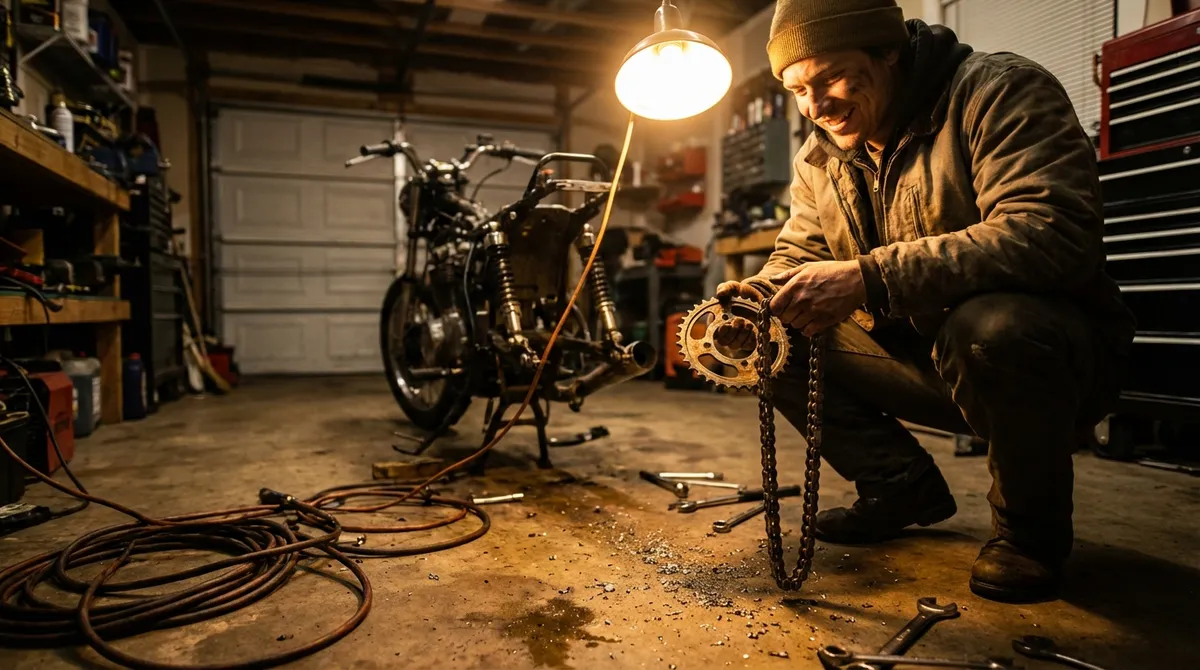
Chain maintenance is not “clean, lube, repeat.” It’s drive-line metrology—spotting the point where play, pitch, and profile shift from “serviceable” to “destructive.”
Begin with maximum chain stretch measurement. Pick a section on the lower run, apply light tension, and measure a fixed number of links (the manual often specifies 20–25 pins). Compare the measured length to the service limit. Once you’ve passed that, every launch and shift is loading sprockets with misaligned pitch, accelerating tooth wear and noise.
Next, inspect sprocket tooth geometry. Healthy teeth have a symmetric, well-defined profile. Hooked teeth (leaning in direction of chain pull), thinned tips, or a “shark fin” look means the hard surface layer has worn through, exposing softer base metal. At this point the system is no longer just “worn”—it’s actively reshaping the chain under load.
Check for stiff links not only by bending the chain sideways, but by watching it run over the rear sprocket. A single link that rides high or lags as it seats into the teeth is a localized lubrication/contamination failure—often the result of water intrusion or abrasive grit. This doesn’t just feel rough; it injects micro-impacts into the driveline, subtly stressing gearbox output bearings over time.
Chain slack is not a single number; it’s a dynamic requirement that depends on suspension geometry. The tightest chain position is usually when the countershaft, swingarm pivot, and rear axle form a straight line. If you never check slack with the suspension compressed toward that line (or at least approximate it with a tie-down or helper), you may be running too tight when the shock is loaded, even if it looks in-spec on the stand. A too-tight chain under full compression is a silent killer of countershaft seals and bearings.
3. Brake Performance: Beyond Pad Thickness and Lever Feel
Brakes rarely go from “fine” to “failure” overnight. Their degradation profile is a slow slide in friction consistency, fluid integrity, and thermal management. Enthusiasts can feel this—if they know what to look for.
Start by treating brake fluid like a performance component, not an afterthought. Glycol-based fluids (DOT 3, 4, 5.1) are hygroscopic—they absorb moisture from the atmosphere, which lowers boiling point and increases internal corrosion risk. Even if you never boil the fluid, absorbed water can form vapor pockets under high heat or accelerate pitting in caliper bores and master cylinder internals.
Use a brake fluid tester or at least track change intervals aggressively if you ride in high humidity or at elevation. A fresh fluid flush doesn’t just change color—it restores predictable compressibility and temperature margins, which directly affects how precisely you can modulate braking at the limit.
Inspect pad surface and transfer layer. A healthy system isn’t just pad + rotor; it’s the interface between them. Glazed pads (shiny, smooth surface) and rotors with a mirror-like finish are signals of overheating or riding the brakes lightly for extended periods. Lightly deglazing rotors with appropriate abrasive (as recommended by the pad manufacturer) and bedding-in new pads correctly creates a uniform transfer layer—critical for consistent mu (friction coefficient) across temperature ranges.
Pay attention to pad taper: if the leading edge of the pad is significantly thinner than the trailing edge, something in the caliper mechanics is off. This can be seized slide pins on floating calipers, asymmetric piston movement, or caliper misalignment. All of these reduce effective pad contact area and increase the chance of localized rotor hot spots and warping.
Finally, track lever travel and bite point over time. A slowly lengthening lever throw—without visible fluid leaks—can indicate seal lip wear, micro-bypassing in the master cylinder, or progressive air ingress through aged rubber hoses. This isn’t just about feel; it’s about preserving the sharp, linear connection between your fingers and the contact patch.
4. Suspension Wear You Can’t See But Can Definitely Feel
Forks and shocks age in silence. Even if they aren’t leaking, they can be underperforming badly long before most riders notice. The problem is that degradation is gradual; your brain normalizes it. The way around that is structured observation.
Fork oil doesn’t just lubricate; it defines damping characteristics. Over time, oil shears (loses viscosity), absorbs contaminants, and can aerate more easily. The result: rebound that feels “lazy,” increased brake dive, and poor mid-corner support. If your fork service interval is measured in presidential terms instead of mileage or years, you’re riding on guesswork.
A technical approach:
- Measure static and rider sag front and rear with a repeatable method.
- Record values and compare every 6–12 months.
- If the sag numbers creep without adjusting preload, you’re seeing springs losing rate or changes in internal friction.
Inspect fork stanchions under strong, angled light. Tiny pits or rust spots will eventually cut fork seals from the inside, causing “mystery” leaks. Even microscopic damage increases seal friction, which adds stiction—ruining small-bump sensitivity and corrupting your feel for traction at the front. Addressing a lightly pitted tube now (repair or replacement) is infinitely cheaper than running until the seal fails, contaminating your pad/rotor and risking a sudden loss of fork oil.
On the shock side, pay attention to heat behavior. After a hard ride, the shock body will be hot; that’s normal. But if you notice damping fading as the ride progresses—more wallow, less support out of corners—your oil is likely breaking down under thermal load or the gas charge is compromised. An OEM shock can often be rebuilt or re-valved; don’t assume “stock = disposable.”
Small changes in suspension health translate into huge changes in how predictable the bike feels at the limit. Pro riders spend thousands chasing feel. You can gain a big percentage of that just by restoring your suspension to what the engineer actually designed.
5. Electrical and Charging System: Quiet Drift Toward Failure
Electrical failures are rarely as sudden as they appear. Most of the time, the charging system has been yelling in data for weeks or months—you just weren’t looking.
Begin with baseline numbers:
- Measure battery voltage at rest after at least a few hours off the charger.
- Measure charging voltage at idle and around 3–5k rpm.
Store these values. Recheck every few months. A healthy system will hold relatively consistent numbers; downward drift is your early-warning radar.
A typical healthy reading on many bikes: around 12.6–12.8 V at rest (fully charged AGM), and roughly 13.5–14.5 V at a fast idle or cruising RPM, depending on the specific system. Significantly lower charging voltage may signal regulator/rectifier issues, stator problems, or excessive resistance in wiring/connectors. Significantly higher can overcook the battery and fry electronics.
Feel and inspect the regulator/rectifier harness and stator connector. Discoloration, hardened or melted plastic, or brittle insulation all point to resistance-driven heat—often from corroded terminals or poor contact. This isn’t cosmetic; that localized thermal spike can cascade into total charging failure.
Look for stray parasitic draws. If you’re repeatedly finding a weak battery after a few days of sitting and the battery tests fine, something is leaking current. An aftermarket accessory wired incorrectly to constant power, a failing relay, or an aging module can all sip your battery dry. A basic multimeter in series with the battery (and a systematic process of pulling fuses) is often enough to identify the culprit.
Finally, don’t ignore subtle sensor-related issues. Modern bikes lean heavily on inputs from throttle position, manifold pressure, wheel speed, and more. Intermittent connectors, water ingress, or damaged wiring looms can produce inconsistent behavior—occasional stumbles, weird idle changes, or traction control quirks—long before a solid fault code appears. When you feel a pattern, document conditions (RPM, load, temp, duration) and trace wiring in those regions. Maintenance in the modern era is as much about signal integrity as it is about mechanical wear.
Conclusion
Real maintenance for real riders isn’t about ticking boxes; it’s about engineering-level awareness of how components age under real loads. The most valuable work you can do isn’t just swapping parts—it’s learning to read the language of wear:
- Tires telling you about geometry, damping, and loading.
- Chains and sprockets revealing alignment and tension dynamics.
- Brakes exposing fluid health and mechanical asymmetries.
- Suspension quietly indicating when the chassis has drifted from its design intent.
- The charging system broadcasting its health in volts and degrees—if you’re listening.
The difference between a bike that “still runs” and a bike that feels surgically precise, trustworthy, and ready for anything is hidden in these details. Pay attention to the quiet phase, and your motorcycle won’t have to shout.
Sources
- [Michelin Motorcycle Tire Wear Guide](https://motorcycle.michelinman.com/advice/tire-wear) - Explains tire wear patterns, inflation effects, and how riding conditions affect wear
- [DID Chain Technical Information](https://www.didchain.com/technology/maintenance) - Covers motorcycle chain wear, stretch measurement, and maintenance best practices
- [Brembo Brake Systems: Technical Insights](https://www.brembo.com/en/company/news/ten-things-about-motorcycle-brakes) - Provides detailed information on motorcycle brake behavior, components, and performance
- [Öhlins Motorcycle Suspension Technical Info](https://www.ohlins.com/support/manuals/motorcycle/) - Official manuals on suspension setup, servicing intervals, and how oil and components age
- [BikeBandit: Understanding Motorcycle Charging Systems](https://www.bikebandit.com/blog/motorcycle-charging-system-diagnostics) - Practical overview of motorcycle charging diagnostics, voltage ranges, and common failure modes
Key Takeaway
The most important thing to remember from this article is that this information can change how you think about Maintenance.