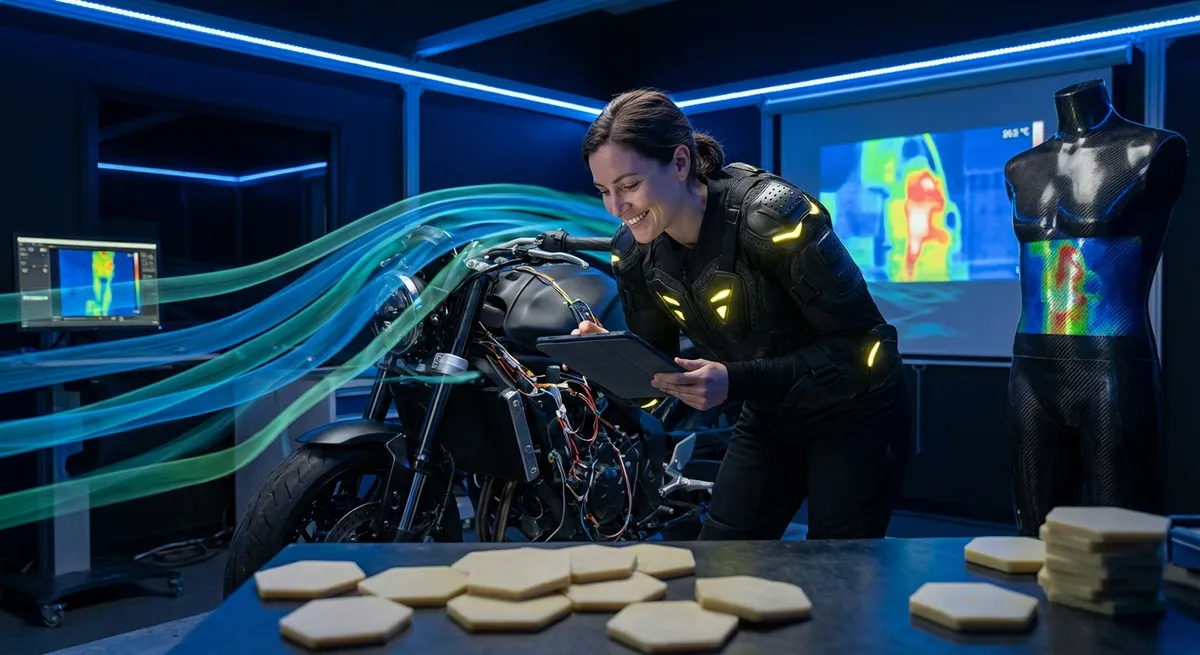
Motorcycle gear isn’t “extra.” It’s part of the system. Your helmet, jacket, gloves, boots, and base layers are extensions of the chassis and the rider control loop. When you start thinking about gear as engineered safety components—instead of lifestyle accessories—you unlock real performance: higher confidence, longer ride windows, and better survivability when things go wrong. This is where materials science, impact dynamics, and thermal management collide with pure riding passion.
Impact Energy Management: Beyond “It Has CE Armor”
Most riders know “CE-certified armor” is good, but few understand what that actually means in terms of physics.
When you hit the deck, the goal isn’t to “block” impact; it’s to manage energy. Your body decelerates from whatever speed you’re traveling to zero in a tiny fraction of a second. Protective armor exists to stretch that deceleration time and distribute force over a larger area—both of which directly reduce peak loads on bones and soft tissue.
CE standards for limb and back protectors (EN 1621-1 and EN 1621-2) quantify how much force passes through the armor during a controlled impact test.
Technical point #1 – Understanding CE impact levels:
- EN 1621-1 (limb armor):
- Level 1: Average transmitted force ≤ 35 kN
- Level 2: Average transmitted force ≤ 20 kN
- EN 1621-2 (back protectors):
- Level 1: Average transmitted force ≤ 18 kN
- Level 2: Average transmitted force ≤ 9 kN
Less transmitted force = more energy absorbed = lower risk of serious injury. But there’s nuance:
- Material behavior:
- Viscoelastic foams (like D3O-style materials) are soft until loaded quickly, then stiffen to absorb energy. Great for comfort and repeated small hits.
- Hard-shell with foam backing spreads load well over sliding impacts and point loads but can feel bulkier.
- Coverage vs. rating: A Level 2 protector that leaves a gap at your elbow is worse than a Level 1 that actually stays centered while you ride.
What matters on the bike isn’t just the label; it’s whether that armor stays in the correct position at the instant of impact. That’s dictated by fit, garment patterning, and closure systems just as much as the foam chemistry.
Abrasion and Burst Resistance: The Real Job of Your Outer Shell
Everyone loves talking about leather vs. textile, but the real engineering story is abrasion time and seam integrity.
Road surfaces are brutal. Sliding at 35–50 mph generates intense heat and localized shear forces that can instantly shred cheap fabrics and compromise seams. The objective is to avoid burn-through or seam failure before you come to a stop.
Technical point #2 – Key construction details that actually matter:
- Material choice and weight:
- High-quality leather (1.2–1.4 mm cowhide or kangaroo) generally offers excellent abrasion time.
- Technical textiles like Cordura, Armacor, SuperFabric, or other high-denier nylon/polyamide blends with reinforcements can rival or exceed leather in specific zones.
- Seam strategy:
- Look for double or triple stitching in impact zones (shoulders, elbows, knees, hips).
- Safety seams: at least one row of stitching is buried and protected from direct abrasion.
- Layering concept:
- Outer shell handles abrasion.
- Internal layers (mesh, foam, armor pockets) deal with impact and comfort.
- A well-engineered jacket distributes loads across multiple panels so a single tear doesn’t cause catastrophic failure.
A jacket or suit that passes a higher-level EN 17092 class (like AA or AAA) or the older EN 13595 professional standard didn’t get there by accident. It’s the outcome of detailed testing on Cambridge or Darmstadt-type abrasion machines and burst-strength rigs. For a rider, that translates to simple purchasing behavior: prioritize garments with tested, documented abrasion and burst ratings, not just “premium” price tags.
Helmet Performance: What the Shell and Liner Are Really Doing
Helmets are the most visible piece of gear, yet many riders still shop them like sneakers: style first, everything else second. A modern motorcycle helmet is an engineered energy-management structure wrapped around one of the most complex organs you have.
Technical point #3 – How a helmet manages impact and rotation:
- Outer shell:
- Typically made from polycarbonate, fiberglass, composite, or carbon fiber.
- Its job is to spread impact forces over a larger area and prevent penetration.
- EPS liner (expanded polystyrene):
- This is the real deceleration device. It crushes in a controlled way to extend the time your head takes to slow down, reducing peak g-forces.
- Multi-density EPS lets different regions of the helmet respond appropriately to varying impact severities.
- Rotational energy systems:
- Systems like MIPS, SPIN, or other slip-plane technologies are designed to reduce rotational acceleration—one of the most damaging mechanisms for the brain, especially for diffuse axonal injuries.
- Ventilation and noise trade-offs:
- More vents typically mean better airflow but can generate more turbulence and noise.
- Proper aero shaping reduces buffeting and neck fatigue at speed, which indirectly improves rider focus and reaction time.
Helmet certification (DOT, ECE, Snell, FIM) is the compliance baseline, but real-world performance depends heavily on fit. A premium shell with sloppy fit can underperform a midrange helmet that locks in properly around your crown, cheeks, and occipital region. The correct fit ensures the EPS and shell can do their job in line with your skull, not sliding around on impact.
Thermal Regulation and Moisture Control: Performance You Can’t See
Most riders underestimate how much thermal load affects reaction time, fatigue, and overall control. Sweat, trapped heat, and evaporative cooling all change how your body and brain perform on the bike.
Technical point #4 – The science of staying within your “operating window”:
- Base layers vs. cotton:
- Synthetic or merino wool base layers move moisture away from skin and maintain a more stable microclimate.
- Cotton saturates, clings, and accelerates conductive heat loss when conditions change—bad in both heat and cold.
- Passive vs. active airflow:
- Large vents only work if the garment’s internal structure allows air to actually flow around your torso and then exhaust.
- 3D mesh liners, vent channels, and correctly placed exit vents are part of the system.
- Overheating consequences:
- Elevated core temperature and dehydration degrade cognitive performance, visual acuity, and fine motor control—exactly what you rely on for precise throttle and brake inputs.
- Layering strategy:
- A windproof mid-layer can drastically extend comfort range without forcing you into a bulky outer shell.
- In colder conditions, strategic insulation at the core (chest and back) is more valuable than thick, clumsy layers at the limbs.
Thermal management is not comfort fluff; it’s riding performance engineering. When your body is running in the right temperature and hydration zone, your brain stays sharper, you read traffic better, and you’re less likely to make the “small” error that snowballs into a big one.
Ergonomics and Control Interfaces: Gloves, Boots, and the Human-Machine Link
The final layer of gear is where human tissue directly interfaces with mechanical controls: gloves to bars and levers, boots to pegs and pedals. Protection is mandatory—but not at the cost of control resolution.
Technical point #5 – Designing protection without killing feel:
- Gloves:
- Look for palm-side engineering, not just knuckle armor flexing on the rack.
- Palm sliders (often TPU or hard plastic) help your hand slide instead of grabbing the tarmac, reducing scaphoid and wrist injuries.
- Thin but abrasion-resistant palm materials (kangaroo leather, reinforced synthetics) maintain lever feel while extending abrasion time.
- Pre-curved fingers and floating knuckle armor reduce fatigue and pressure points during long grips.
- Boots:
- Key areas: shank stiffness, ankle bracing, heel/toe cups, and torsion control.
- Good boots limit abnormal ranges of motion (twisting, hyperextension) while still allowing enough articulation for precise shifting and rear brake modulation.
- A proper shank spreads the load across the sole when you land hard on the pegs or in a crash, protecting mid-foot bones.
- Fit as a performance variable:
- Overly loose gloves delay input and reduce feedback; overly tight ones restrict blood flow and numb your hands.
- Boots that don’t lock your heel and ankle in place will “float,” making it harder to build consistent muscle memory on controls.
The right gloves and boots turn your body into a better sensor and actuator in the riding system. You get more information from the bike, and your commands are transmitted with less lag and more precision—while staying inside a much safer envelope if everything goes sideways.
Conclusion
Motorcycle gear is engineered hardware, not a fashion accessory. Each piece—helmet, armor, shell, base layers, gloves, boots—plays a specific role in managing energy, friction, temperature, and control. When you choose equipment through a technical lens, you’re not just “being safe”; you’re tuning the entire rider-machine system for performance and survivability.
Think in terms of: What energy is this piece of gear designed to handle? Impact, abrasion, heat, or motion control? How does it manage that load—through material choice, structure, or both? And does it still let you ride with the precision and feel you demand?
Build your kit like you’d build a motorcycle: intentional, tested, and engineered to work as a system at real-world speeds.
Sources
- [European Commission – Protective equipment: Motorcyclists](https://road-safety.transport.ec.europa.eu/stay-safe/bi-functional-pedestrian-and-cyclist-urban-environments/protective-equipment-motorcyclists_en) – Overview of motorcycle protective equipment and relevant standards in the EU
- [BMW Motorrad – Safety and Function of Rider Equipment](https://www.bmw-motorrad.com/en/experience/stories/safety/protective-clothing.html) – Manufacturer explanation of how modern motorcycle gear is engineered for protection
- [Snell Memorial Foundation – Helmet Standards and Testing](https://smf.org/standards) – Technical details on motorcycle helmet impact and performance testing
- [NIH / NCBI – Motorcycle Protective Clothing: Protection from Injury or Just the Weather?](https://www.ncbi.nlm.nih.gov/pmc/articles/PMC3981673/) – Research article analyzing effectiveness of motorcycle protective clothing in crashes
- [CDC – Traumatic Brain Injury & Concussion: Helmet Use](https://www.cdc.gov/traumaticbraininjury/prevention/index.html) – Background on helmet use, head injury mechanisms, and prevention principles
Key Takeaway
The most important thing to remember from this article is that this information can change how you think about Gear & Equipment.