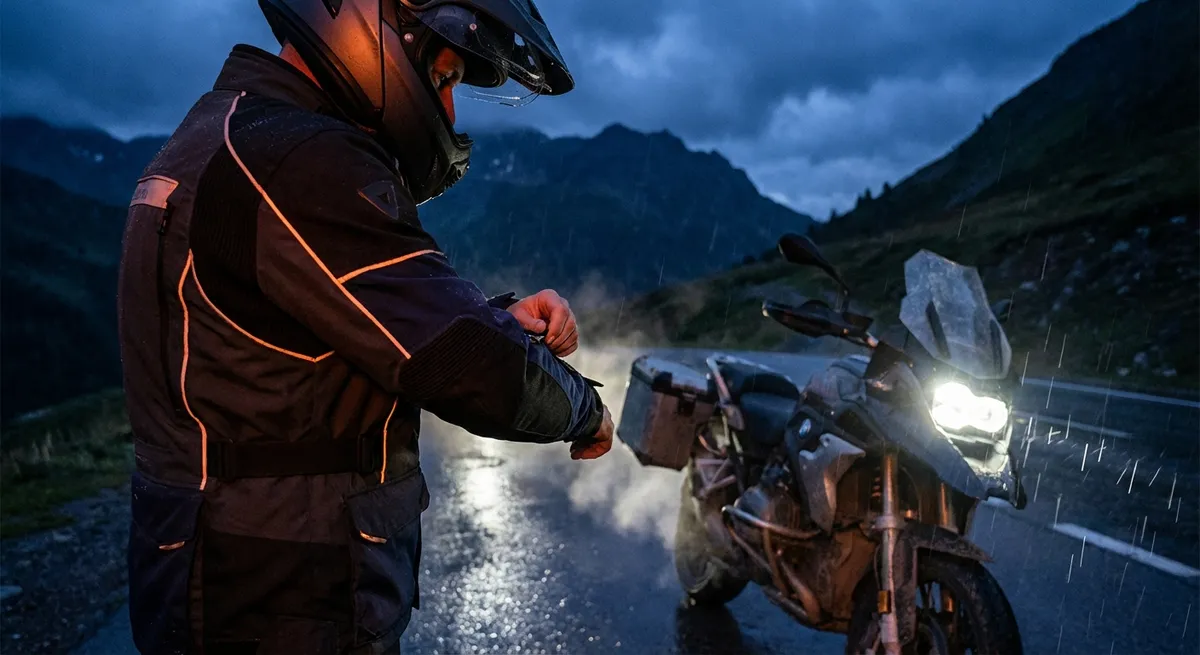
Riding gear isn’t just armor and abrasion resistance—it’s a thermal and moisture-management system wrapped in textiles, leather, and membrane tech. When the sky can’t decide between sun, fog, and sideways rain, the rider who understands how their gear actually works has a massive advantage in comfort, focus, and safety. This isn’t about buying the most expensive jacket; it’s about building a system that manages airflow, sweat, impact, and weather as one engineered package.
Building a Layer Stack Like a Cooling System
Most riders think in terms of “summer jacket” and “winter jacket.” Engineers think in terms of heat flow and vapor transfer. You want to build your gear stack like a cooling system with controlled pathways for heat and moisture to escape, and controlled barriers to wind and water coming in.
The base layer is your first heat exchanger. Synthetic or merino fabrics that wick sweat away from skin reduce conductive heat loss and evaporative cooling at the wrong time (like on a cold highway after a gas stop). Cotton traps moisture, stays wet, and turns any airflow into a refrigerator against your chest and arms—exactly what you don’t want on a long day where conditions change.
Your mid-layer is your insulation stage: fleece, light synthetic puffy, or active insulation pieces designed to trap still air. The key is low bulk with high loft that doesn’t bind or fight the armor’s position. If your mid-layer bunches at the elbows or shoulders, it can shift armor off target zones in a crash and restrict precise control inputs.
The outer layer is the control valve for wind and water. A textile jacket with well-designed vents, or a laminated shell over a mesh jacket, allows you to “tune” the system like adjusting a radiator shroud. Think of it as variable aerodynamics for your body: close everything in the cold, crack vents in mild conditions, and fully spool up the airflow when it’s hot—but always in a way that doesn’t flap, balloon, or destabilize the gear at speed.
Membranes, Lamination, and What “Waterproof” Actually Means
“Waterproof” on a hangtag doesn’t tell you how a jacket behaves at 70 mph in sustained rain. The construction method matters as much as the membrane brand name. There are three main architectures: drop-liner, removable liner, and laminated shells—and each has a different real-world behavior.
A drop-liner uses a separate waterproof-breathable membrane hanging behind the outer shell. When it rains, the outer soaks up water but the liner blocks it from reaching you. The downside: the shell becomes heavy, cold, and can take hours to dry. On touring days with repeated storms, that damp outer layer acts like a cold sink, pulling heat out of your core.
Removable waterproof liners are convenient for packing but problematic in real weather. Putting a liner inside means your jacket’s large vent panels are effectively upstream of the membrane—so once the liner is in, most direct airflow is gone. You end up with a clammy microclimate: blocked wind, trapped sweat, and a jacket that still saturates on the outside. It’s “dry” but not necessarily comfortable or thermally stable.
Laminated shells (where the membrane is bonded directly to the outer textile) behave differently. Water beads and sheds instead of soaking in deeply, the fabric dries faster, and vents can be engineered to bypass the membrane (direct-to-body vents). This supports high airflow in hot, humid conditions and maintains waterproof integrity when closed. For riders who refuse to stop every time the weather shifts, laminated shells are the closest thing to a true “ride-through-anything” solution.
The trade-off is cost and stiffness. Laminated gear can feel harsher when new, with less drape than a casual textile jacket. But from a systems-engineering perspective, it’s the most controllable platform for thermal and moisture management on long, variable-weather rides.
Armor: Not Just CE Level, But Energy Pathways and Fit
Most riders stop at “CE Level 1 vs Level 2” and call it a day. That’s like buying a tire based only on diameter. The way armor is shaped, placed, and integrated into the garment determines how effectively it manages impact energy and whether it stays over the right anatomy when everything goes sideways.
Impact protectors are essentially tuned foam or composite structures designed to lengthen the time an impact takes and spread the load over a larger area. Level 2 armor typically allows less transmitted force than Level 1 under standardized testing, but the comfort curve matters. Softer, viscoelastic materials that stiffen under impact are more likely to be worn correctly, all day, because they don’t feel like rigid plates digging into joints.
Fit is the often-ignored engineering variable. If the elbow armor rotates off the olecranon (the point of your elbow) when you reach for the bars, or the shoulder cup floats above the acromion when you’re in a tuck, the protection zone shifts. On impact, you can end up with armor adjacent to the damage instead of between you and the ground. This is why pre-curved patterns, adjustable armor pockets, and cinch straps on biceps and forearms are not cosmetic—they’re alignment mechanisms.
Back and chest protectors deserve the same scrutiny. Many jackets ship with foam place-holders that are essentially impact-shaped packing material. Upgrading to tested, certified protectors with adequate venting channels is one of the highest-value modifications you can make. Look for a protector that matches the jacket’s pocket size exactly, doesn’t bow or buckle when you move, and still permits airflow through perforations or channeling to keep your back from becoming a heat sink.
Ventilation as an Aerodynamic System, Not Just Holes in Fabric
A vent is not just a zippered hole. It’s part of a pressure-management system interacting with your bike’s fairing, your body position, and the flow field around your torso. Poorly designed vents create localized turbulence, flapping panels, and hot spots; well-designed ones build a pressure gradient that pulls hot air out as efficiently as possible.
The front of your torso, especially behind a windshield, sits in a relatively high-pressure zone. Air entering through chest or shoulder vents needs a low-pressure exit path behind you—typically back exhaust vents placed high between the shoulder blades or at the rear of the sleeves. Without those exhaust ports, intake vents just inflate the jacket like a parachute, increasing drag and destabilizing the garment at speed.
Mesh panels behave differently from zippered vents. A full mesh chassis allows bulk airflow, but at the cost of controlled flow direction. In extremely hot, dry conditions, too much direct blast can accelerate dehydration and evaporative cooling beyond what your body can sustainably handle, especially at freeway speeds. In very humid conditions, mesh airflow can feel ineffective because sweat can’t evaporate efficiently, regardless of volume of air.
Zippered vents in laminated shells, especially “direct-to-body” designs that bypass the membrane, offer better modulation. You can fine-tune how much air comes in and where it goes, matching your vent settings to speed and ambient temperature. Think of it like adjusting your throttle and braking: small, deliberate changes rather than binary open/closed. On a long ride with changing elevations and microclimates, this fine control becomes the difference between staying sharp or riding in a fog of fatigue.
Gloves and Boots: Closing the Thermal and Safety Loops
Jackets and pants get all the attention, but your extremities are where thermal mismanagement shows up fastest—and where small gear choices can have outsized effects on control feel and crash outcomes.
Gloves are a three-way compromise between feel, protection, and insulation. Thicker, heavily insulated winter gloves often destroy lever feedback; ultra-thin summer race gloves expose you to windchill, water ingress, and abrasion risk. A technically balanced glove uses multi-density construction: robust palm materials (like full-grain leather with reinforced heel-of-palm sliders), impact padding across the scaphoid and knuckles, and strategic insulation on the back of the hand, leaving the palm thinner to preserve tactile feedback.
Waterproof glove membranes introduce another engineering challenge: moisture management from the inside. Hands sweat under load. If the membrane sits directly against your skin, sweat can’t escape efficiently, and you end up with a swampy microclimate even in dry weather. A well-designed glove uses a liner and membrane configuration that creates a wicking path away from the skin while still blocking external water and wind.
Boots close the system at the bottom. Touring and adventure boots with integrated waterproof membranes and shin protection form an extension of your lower-leg armor, but they also act as thermal chambers. Too little insulation, and your feet freeze in early-season rides; too much, and heat buildup leads to fatigue and sweat-soaked socks that chill rapidly once ambient temps drop. Look for shank support (to distribute peg pressure), malleolus (ankle) protection placed directly over the bone, and sole compounds that balance walking grip with peg feedback and durability.
Critically, both gloves and boots must integrate with the rest of your kit. Gauntlets should overlap the jacket’s cuffs in a way that doesn’t create a water channel directly into your sleeve. Pants should overlap boot shafts so airflow and water don’t funnel up your shin. Consider these junctions like sealing flanges in a fluid system: every gap becomes an unexpected inlet for wind, water, or heat loss.
Conclusion
Riding gear isn’t a pile of individual products; it’s a closed-loop system managing impact energy, heat flow, moisture, and aerodynamics around a human who’s trying to ride precisely and think clearly. When you start treating your kit like a piece of engineering—tuning layers for heat transfer, selecting construction methods for real-world waterproofing, aligning armor as a structural component, and managing airflow as a pressure system—you stop being at the mercy of the weather and start riding through it, on your terms.
The payoff is simple but profound: when your gear is thermally stable, aerodynamically calm, and mechanically protective, your brain is free to focus on lines, braking points, and traction feel instead of zippers, drafts, and soggy gloves. That’s not just comfort—that’s performance and safety, engineered from the skin out.
Sources
- [GORE-TEX Technology: How It Works](https://www.gore-tex.com/technology/how-it-works) - Technical overview of waterproof-breathable membrane construction and performance
- [Dainese Safety & Protection Standards](https://www.dainese.com/us/en/experience-dainese/tech-lab/safety/) - Details on impact protection development, CE standards, and armor design philosophy
- [Rev’it! Technical Articles: Ventilation Explained](https://www.revitsport.com/en/blog/ventilation-explained) - In-depth look at motorcycle garment ventilation concepts and constructions
- [NHTSA Motorcycle Safety Facts](https://www.nhtsa.gov/road-safety/motorcycles) - U.S. government data on motorcycle crashes and the role of protective gear
- [CPSC – Motorcycle Helmets and Protective Gear](https://www.cpsc.gov/s3fs-public/349.pdf) - Consumer Product Safety Commission document discussing protective equipment principles and impact protection basics
Key Takeaway
The most important thing to remember from this article is that this information can change how you think about Gear & Equipment.