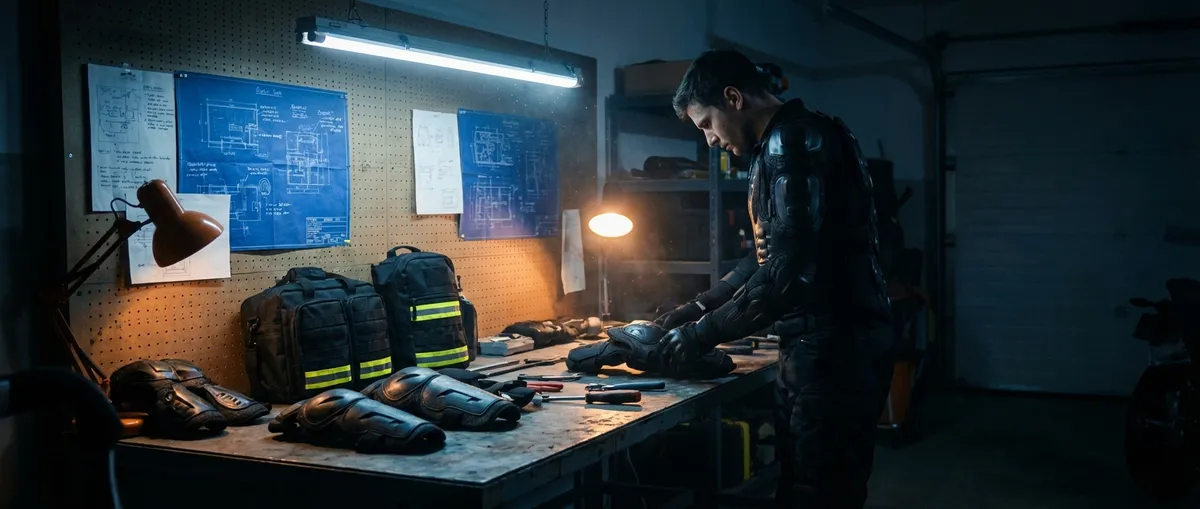
Motorcycle gear isn’t a pile of products—it’s a tightly integrated system that has to manage impact, abrasion, climate, and information flow at speed. When your loadout is engineered instead of guessed, the bike feels calmer, your reactions get sharper, and fatigue drops off a cliff. This isn’t about buying more; it’s about building a gear stack that behaves predictably at 25 mph and 125 mph, in rain, heat, and crosswinds.
This guide breaks down five technical points serious riders should use to engineer their gear and equipment as a coherent system, not a random collection of parts.
1. Impact Energy Management: Matching Armor to Real-World Forces
Most riders know “CE Level 1 vs Level 2,” but few think in terms of actual energy and impact velocities. Your armor is a mechanical filter between kinetic energy and soft tissue—it needs to be spec’d like a component, not an accessory.
Modern limb and back protectors are typically rated under EN 1621 standards, with two key numbers:
- Drop height / impact energy (usually 50 J or 75 J in lab tests)
- Residual force (how much force gets through the armor in kN)
What matters in the real world:
- Level 1 vs Level 2 isn’t just a label. For EN 1621-1:
- Level 1: average residual force < 35 kN
- Level 2: average residual force < 20 kN
That difference is massive in what your body actually sees.
- Coverage geometry is as important as rating. A Level 2 shoulder protector that leaves your AC joint exposed is a design failure. Look for armor that:
- Wraps around joints (3D shaped, not flat pads)
- Stays indexed when you move, brake, and tuck
- Sits in sewn-in pockets that prevent vertical migration in a slide
- Back protection should be sized relative to spine length, not jacket size. Many riders are using armor 5–8 cm too short, leaving the lower thoracic or upper lumbar spine exposed. When possible, choose:
- A full-back insert that covers from C7 to just above the coccyx
- Or a stand-alone back protector with shoulder/waist straps that locks to your body, not just your jacket
- Chest protection is not optional in high-speed environments. Steering head, tank, and bars become blunt forces in a crash. Look for CE EN 1621-3 chest inserts or one-piece airbag vests that incorporate thoracic protection.
- Check impact performance at temperature. Some viscoelastic materials stiffen significantly in cold weather. If you ride near freezing temps, look for published performance across temperature ranges or test it yourself: armor that feels like a brick at 5°C will transmit more force in a crash.
Engineered take: treat armor like suspension. You’re tuning the “spring and damping” between impact energy and your bones. Fit, coverage, rating, and temperature response are all part of the same system.
2. Abrasion and Seam Engineering: Beyond “Leather vs Textile”
The slide is often longer than the impact is violent. What keeps your skin off the asphalt isn’t marketing—it’s textile structure, layer stacking, and stitching architecture.
Key technical aspects:
- Material class and slide time. Under EN 17092 (for garments), classes range from AAA (highest) down to C. While lab tests don’t map perfectly to every crash, they give useful bounds:
- AAA gear is generally built to survive high-speed road use
- AA is balanced for typical street speeds
- A is minimal and more like urban/low-speed
For serious road work, aim for consistent AA/AAA zones on high-risk areas: shoulders, elbows, hips, seat, knees, and outer thighs.
- Layer stacking is more important than a single “miracle fabric.” High abrasion resistance comes from:
- A tough outer shell (leather, high-denier polyamide, UHMWPE blends, or aramid reinforcements)
- An underlying structural or comfort liner that keeps skin isolated when the outer layer heats up
- Optional additional abrasion panels at slide zones (seat, hips, outer arms)
- Seams are the real failure mode. The fabric often survives; the stitching lets go. Look for:
- Double or triple-stitched main seams in impact/slide zones
- External safety seams (visible external “rolled” seams where the strongest stitching is tucked away from direct abrasion)
- Heavy-gauge thread (polyester or bonded nylon) with bar-tacking or bartack-like reinforcement at critical junctions (shoulders, knees, pockets)
- Leather thickness and quality grading. For track or aggressive road use:
- 1.2–1.4 mm cowhide or kangaroo is common; thinner leathers may be comfortable but give up slide distance
- Grain consistency and suppleness matter—brittle, over-treated leather can crack under torsion in a slide
- Zone-based construction. High-end gear uses different materials by zone:
- 600D–1000D+ polyamide or leather on shoulders, elbows, knees, seat
- Lighter, more flexible panels in low-risk or mobility zones (inner arms, inner thigh, back of knees)
This isn’t just comfort—correct zoning keeps high-abrasion resistance exactly where the tarmac will attack.
Engineered take: think of your outerwear like a monocoque chassis. If the seams blow out, the shell fails, regardless of the sticker on the hang tag.
3. Microclimate Control: Building a Thermal and Moisture System, Not Just Layers
Rider performance drops sharply when your brain is managing overheating, numb hands, or soaked base layers. The right gear stack builds a controlled microclimate from skin outward, tuned for evaporation and airflow under motion.
Consider your gear as a 3-layer thermal system (even if it’s all “one jacket”):
- Base layer: moisture transport, not warmth. The job: pull sweat off your skin and move it outward so evaporation happens away from your body. You want:
- Synthetic or merino base with low water absorption and good wicking
- No cotton—once it’s wet, it stays wet, destroying your ability to thermoregulate
- Compression or close fit to avoid damp “air pockets” that chill you when you stop
- Mid-layer: adjustable insulation. This is your thermal throttle:
- Synthetic loft (like Thinsulate, PrimaLoft) packs small and insulates when damp
- Fleece is cheap and effective but bulky; better for commuters than compact touring loads
- Down is very warm per gram, but fragile if it gets wet unless it’s treated and protected by a reliable shell
- Shell: regulate airflow like a variable valve timing system. Instead of thinking “waterproof or not,” think “controllable air and vapor movement”:
- Direct intake vents (chest, shoulders, thighs) plus exhaust vents (back, calves) to create a pressure-driven airflow path at speed
- True waterproof/breathable membranes (GORE-TEX, eVent, or proven proprietary membranes) with vent designs that bypass or manage the membrane where needed
- 2-layer vs 3-layer constructions: 3-layer laminates are structurally more stable in heavy rain and at speed, with less waterlogging
- Seasonal tuning via vent cross-section. A tiny “zip vent” is cosmetic at 100°F. For real cooling under mesh or textiles:
- Large, direct vents placed in high dynamic pressure zones (upper chest, shoulders)
- Exhaust ports high on the back to let hot, moist air out
- Pants with thigh vents that open into actual airflow, not hidden behind tank or fairings
- Hands and feet as early-warning sensors. If your gloves and boots trap moisture with no evaporation path, your extremities will become your limiting factor long before your core:
- For hot climates: ventilated or perforated gloves with impact and abrasion protection balanced against actual road risk
- For wet/cold: layered sock systems and gloves with separate liner options allow you to tune for dew point and ride duration
Engineered take: your goal is an adaptive microclimate that prevents sweat accumulation and skin chilling cycles. You’re managing phase-change energy (sweat evaporation) like a cooling system, not just “staying warm or dry.”
4. Aerodynamics and Stability: How Your Gear Alters the Bike’s Behavior
At 60+ mph, your gear is part of the bike’s aero package. Poorly designed equipment can introduce buffeting, neck load, and crosswind instability that you’ll subconsciously fight for hours.
Key technical factors:
- Helmet shell shape and neck torque.
- Look for shells designed for your predominant riding posture: upright, sport, or tuck. The angle of the chin bar and top vents relative to oncoming flow affects lift and drag on your head.
- Spoilers aren’t cosmetic; they manage separation zones at the rear of the shell, reducing turbulence and “head shake” at speed.
- A well-designed helmet reduces required neck muscle torque during head checks by minimizing drag differential when you turn your head.
- Jacket bulk and flapping.
- Excess fabric at shoulders, biceps, and chest acts like a series of small wings and flaps. At highway speeds this can:
- Increase fatigue via constant micro-impacts on your arms and torso
- Transmit oscillations into your arms, degrading steering precision
- Use volume adjusters (straps, snaps, waist cinches) to eliminate loose zones and create a smooth external surface.
- Backpacks and luggage as aero surfaces.
- A tall, square backpack can act like a sail, increasing drag and sensitivity to crosswinds.
- For high-speed or windy conditions, prioritize:
- Low-profile hydration packs
- Tail bags or seat packs that keep mass and aero load behind and low, rather than high on your shoulders
- When you must use a backpack, choose ones with contoured shells and minimal external straps or hanging gear.
- Boot and pant interaction.
- Boot-out vs boot-in (under the pant) affects both snag risk and airflow.
- Loose pant cuffs can balloon at speed, channeling air and water directly into your boots. For high-speed or wet work, ensure snug closures at the boot interface.
- Crosswind and frontal area management.
- The moment you add wide panniers, a top box, and a bulky jacket, your side profile becomes a larger, less predictable sail.
- Balance the bike visually from the side: a massive top box with no side cases concentrates aero load high and rearward. Side cases plus a modest tail pack generally yield more stable handling.
Engineered take: think in terms of drag, lift, and sideforce. Your gear should increase stability and reduce turbulence, not fight the bike’s chassis design.
5. Electrical and Data Integration: Power, Visibility, and Information Flow
Modern riding isn’t just leather and foam—it’s an electrical architecture. Helmets, cameras, comms, lighting, and navigation all draw power and attention. Done right, your gear becomes an integrated cockpit, not a cable salad.
Build it like a system:
- Power budget and distribution.
- Estimate your normal loads: heated grips, heated gear, GPS, phone, auxiliary lights, comms. Compare with your bike’s stator output and base draw from ECU, fuel pump, and lights.
- Use a fused distribution block or CAN-bus-safe power hub instead of stacking random ring terminals on the battery. This reduces failure points and simplifies troubleshooting.
- Heated gear as a controllable load.
- Jacket liners, gloves, pants, and insoles can easily exceed 100+ watts combined on high.
- Use a heat controller with at least dual zones (core vs extremities) so you can prioritize hands/feet while avoiding overheating your torso.
- Route quick-disconnects where they won’t interfere with body movement or risk snagging in a get-off (e.g., left front or side, not directly in the center where they can catch on the tank).
- High-visibility lighting integration.
- Auxiliary lights should be optically and electrically integrated, not just bolted on:
- Choose optics (spot vs flood vs hybrid) based on your riding environment (twisty roads vs long highway vs off-road).
- Ensure they’re aimed correctly to avoid blinding oncoming traffic—this is both a safety and legal concern.
- Consider helmet-mounted or jacket-mounted LED brake or position lights synced with your bike’s brake light for additional conspicuity, where legal.
- Comms, audio, and mental workload.
- Helmet comms are invaluable for navigation, group riding, and situational awareness—but they’re also a cognitive load.
- Configure your system to prioritize:
- Navigation prompts
- Group safety communications
- De-prioritize music and non-critical notifications once speed or complexity increases
- Data capture and post-ride analysis.
- GPS logs and action camera overlays (speed, lean, G-loads) can be powerful training tools when used honestly.
- Mount cameras where they:
- Don’t affect helmet aerodynamics significantly
- Don’t obstruct vents or compromise shell structure (beware drilling or using hard mounts in impact zones)
- Stay within legal and insurance restrictions where applicable
Engineered take: design your “electrical exoskeleton” with the same rigor you’d apply to wiring a race bike. Every wire, light, and widget should earn its place in function, reliability, and distraction cost.
Conclusion
Gear and equipment aren’t decorations—they’re extensions of the chassis, suspension, and control system you ride every day. When you spec armor for energy management instead of labels, choose shells for seam integrity instead of fashion, tune your microclimate like a cooling system, clean up your aero profile, and architect your electrical add-ons, the bike transforms.
You feel calmer at speed, sharper in traffic, and more resilient when conditions turn ugly. That’s the point of a smart loadout: not to own more gear, but to engineer a gear stack that lets you ride harder, longer, and with a bigger safety margin—without sacrificing the visceral, mechanical joy that pulled you onto two wheels in the first place.
Sources
- European Commission – Protective equipment for motorcyclists – Overview of motorcycle PPE, standards, and safety considerations in the EU context
- GORE-TEX – How Waterproof Breathable Fabrics Work – Technical explanation of waterproof/breathable membrane behavior and construction
- Shoei Helmets – Technical Information – Details on helmet aerodynamics, shell construction, and ventilation design
- Dainese – Safety and Certification Guide – Breakdown of CE standards (EN 1621, EN 17092) and how they relate to real-world protective gear
- MSF (Motorcycle Safety Foundation) – Protective Gear – Rider-focused guidance on selecting and using motorcycle protective equipment
Key Takeaway
The most important thing to remember from this article is that this information can change how you think about Gear & Equipment.