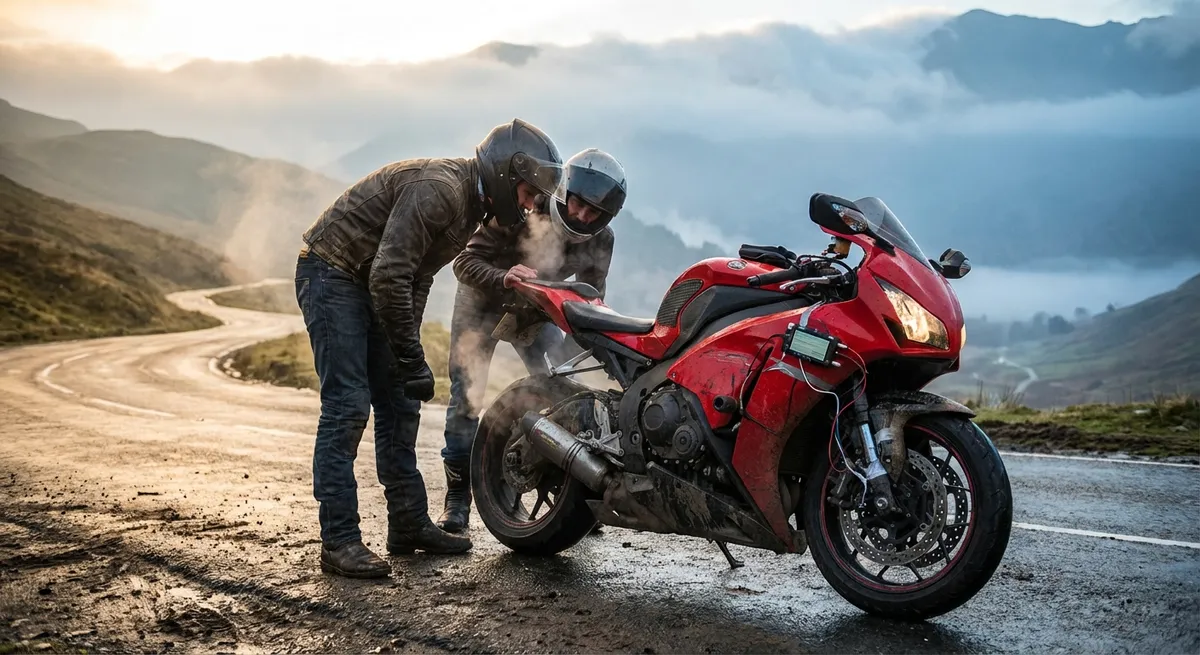
Most “reviews” read like press releases: perfect weather, perfect roads, and a borrowed bike that goes back to the manufacturer before anything actually wears out. Moto Ready doesn’t ride like that—and we don’t test like that either. If a motorcycle can’t hold its line on a broken backroad, shed heat in stop‑and‑go traffic, and stay predictable when you’re tired and a little sloppy, we’re not interested.
This is how we review motorcycles when the goal isn’t a viral spec sheet, but a machine you’d actually trust at 80 mph, three hours from home.
1. Chassis Behavior Under Real Load, Not Parking-Lot Impressions
Most test rides report that a bike “feels stable” or “turns quickly.” That’s useless without context. We characterize chassis behavior by systematically loading the bike in multiple scenarios and quantifying how it reacts.
On broken pavement, we look for how the frame, swingarm, and suspension communicate as a single structure: does the bike flex predictably or does it “hinge” in the middle when you hit offset bumps mid-corner? A strong chassis will deflect once, settle, and track; a weak one oscillates—tiny corrections at the bars become bigger at the rear, and the bike draws an S-shape instead of a line.
We evaluate front-end confidence by how much mid-corner input is required to maintain line: a neutral chassis lets you adjust with micro-pressure on the inside grip; a compromised one forces visible steering corrections. Under heavy braking, we test stability by trail-braking progressively deeper until ABS intervention. We’re watching for fork dive geometry changes that suddenly quicken steering and threaten a tuck, versus a controlled shift that maintains a stable rake and trail window.
We also ride two-up and with luggage whenever possible. Many bikes feel taut solo, then turn vague and imprecise with 60–80 lbs of added real-world load. A legitimately sorted chassis should preserve steering character and recovery behavior with that extra mass, not transform into a wallowing tour bus.
2. Engine Character in the Usable Band, Not the Brochure Redline
Almost every modern engine makes “enough” peak power. What matters to us is how it delivers torque and response in the band you actually live in: roughly 3,000–8,000 rpm on the street, depending on the platform. We ride with deliberate laziness—lugging a gear taller than ideal—to see if the motor can pull cleanly or if it detonates, surges, or falls flat.
We characterize throttle response at three levels: initial pick‑up from closed, linearity across moderate roll-on, and predictability at partial throttle mid-corner. Poorly mapped or over-aggressive ride-by-wire setups can turn minor wrist inputs into major torque spikes, which is a recipe for low-speed instability on wet or gravel-strewn pavement. We deliberately ride on imperfect surfaces to see if power delivery can be modulated with precision.
We also look at torque curve usability: does the engine have a broad plateau where small rpm changes don’t radically alter output, or is it peaky and binary—“off” below 6,000 and “on” above? On real roads with oncoming traffic and short passing windows, a wide, flat torque band matters more than any dyno hero number.
Heat management is another non-negotiable. High-compression or high-output engines that feel great on a cool test day can become intolerable in city traffic. We simulate worst-case use: slow urban crawls, extended idling, frequent fan cycling. We note if the ECU noticeably pulls timing or power as temperatures climb, and whether the bike cooks your right thigh into submission.
3. Braking Systems Tuned for Control, Not Just Stopping Distance
Modern ABS and radial calipers make it easy to claim “excellent brakes,” but sophistication lives in feel and control, not just deceleration. We break braking performance into: initial bite, progression, lever travel vs. pressure curve, rear brake usefulness, and electronic intervention quality.
Initial bite that’s too abrupt can destabilize the chassis in low-traction or downhill situations; too soft and you’re wasting precious distance before real decel. We test multiple braking styles—one-finger aggressive sport braking, full-hand commuting grabs, and trailing into corners—to see if the system maintains a linear relationship between input and decel across all scenarios.
ABS calibration is critical. Good systems intervene late and transparently, allowing a skilled rider to exploit near-threshold grip with just a slight pulsing hint at the lever. Poorly tuned units cut in early, extend stopping distances, and can make the bike feel like it “runs long” on bumpy surfaces. We intentionally brake hard on imperfect pavement—paint lines, patchwork asphalt, and ripples—to reveal this.
We care deeply about rear brake tuning. On the street, the rear is a stabilizing tool, not just a secondary decelerator. A usable rear brake should offer fine control for low-speed maneuvers and downhill corner speed adjustment without quick lockup or immediate ABS overreaction. When available, we also evaluate cornering ABS behavior by applying brakes while leaned to realistic street angles to check for stability and predictable correction.
4. Suspension Reality Check: Damping, Adjustability, and Fatigue Behavior
Suspension is where many bikes reveal their real engineering—and cost cutting. Spec sheets love to tout “fully adjustable” forks and shocks, but the presence of clickers means nothing without effective damping ranges and internal consistency. We adjust preload, compression, and rebound methodically, but what we’re really probing is whether each change produces a measurable difference in chassis behavior.
On rough backroads, we analyze compression damping’s ability to absorb sharp hits without spiking force into the rider. Overdamped compression feels solid in a showroom but translates to harshness and reduced grip on real pavement. We watch how much of the travel is used under big hits and heavy braking; a balanced setup should use most of its stroke before bottoming, without frequently crashing into the stops.
Rebound damping is evaluated through “stacked” bumps and recovery between turns. Too little rebound and the bike pogos—unweighting the tire at exactly the wrong moment. Too much, and the suspension packs down, gradually riding lower in its stroke and steepening geometry mid-run. We deliberately ride repeated corner sequences at increasing pace to see if the bike retains the same attitude from entry to exit, or slowly droops and gets nervous.
We also test “fatigue stability.” A suspension package that feels “sporty” for 15 minutes can become exhausting over two hours if small, sharp impacts are transmitted directly to the rider. We use longer loops to see if the bike’s ride quality encourages extended time in the saddle or quietly punishes you into parking it early. That long-duration behavior matters far more than how it feels in a 10-minute press demo.
5. Electronics as Performance Tools, Not Marketing Features
Traction control, ride modes, and quickshifters can either extend your capability or interfere with it. We treat electronics as a system, not separate gadgets, and judge them on their integration and subtlety rather than their presence. A well-integrated electronics suite should support a skilled rider riding swiftly on a compromised surface, not just save ham-fisted mistakes.
Traction control is evaluated primarily on marginal grip: damp asphalt, cool tires, light gravel overlay. Overly conservative systems cut power so early that they prevent sensible drive out of corners; underdamped systems allow sudden slides that require big corrections. The best calibrations let the tire work—tiny, controlled slip—before trimming torque smoothly, rather than punching holes in the power delivery.
Ride modes must change more than just throttle maps to earn our respect. We look for coherent packages where engine response, TC thresholds, ABS logic, and sometimes suspension adjustment all align toward a clear purpose: rain, commute, sport, etc. If a “rain” map just dulls throttle but keeps aggressive ABS calibration and abrupt clutch engagement, it’s not actually helping you manage low grip.
Quickshifters and auto-blippers are tested under load, at light throttle, and at partial lean. A truly sorted system will deliver near-clutchless precision with minimal driveline lash. Poorly implemented ones feel jerky at low rpm, punish the gearbox, and make the rider hesitant to use them in technical riding. We intentionally shift at “awkward” points—off-throttle, low in the revs, mid-corner—to expose weaknesses.
Finally, we scrutinize user interface and human factors: can you actually adjust modes on the move without hunting through layers of menus and taking your eyes off the road too long? Electronics that are theoretically advanced but practically unreachable when riding hard don’t make you safer or faster—they just clutter the brochure.
Conclusion
A real motorcycle review isn’t about who can recite the spec sheet with the most adjectives. It’s about how a machine behaves when the pavement is bad, the ride is long, the weather changes, and your focus ebbs and flows like it does in real life. At Moto Ready, we evaluate motorcycles as complete dynamic systems: chassis, engine, brakes, suspension, and electronics working together—or fighting each other.
When we say a bike is worth your time and money, it’s because we’ve ridden it in the conditions where weaknesses can’t hide. That’s the difference between a motorcycle that dazzles on launch day and one that still feels sharp, predictable, and eager every time you walk up to it, years later.
Sources
- [Motorcycle Handling and Chassis Design – Tony Foale](https://motochassis.com/) - Technical reference on chassis dynamics, load transfer, and suspension theory
- [Bosch Motorcycle Safety Systems](https://www.bosch-mobility.com/en/solutions/motorcycle-safety-systems/) - Details on modern ABS, traction control, and cornering assistance technologies
- [SAE International – Motorcycle Dynamics and Rider Control](https://www.sae.org) - Engineering papers and standards on braking performance, stability, and vehicle control (search “motorcycle dynamics”)
- [KTM Official Technology Overview](https://www.ktm.com/en-us/technology.html) - Manufacturer explanations of ride modes, traction control, and electronic rider aids in real products
- [Harvard University – Internal Combustion Engine Fundamentals (Course Resources)](https://guides.library.harvard.edu/hpsc) - Background on engine performance, combustion, and heat management principles
Key Takeaway
The most important thing to remember from this article is that this information can change how you think about Motorcycle Reviews.