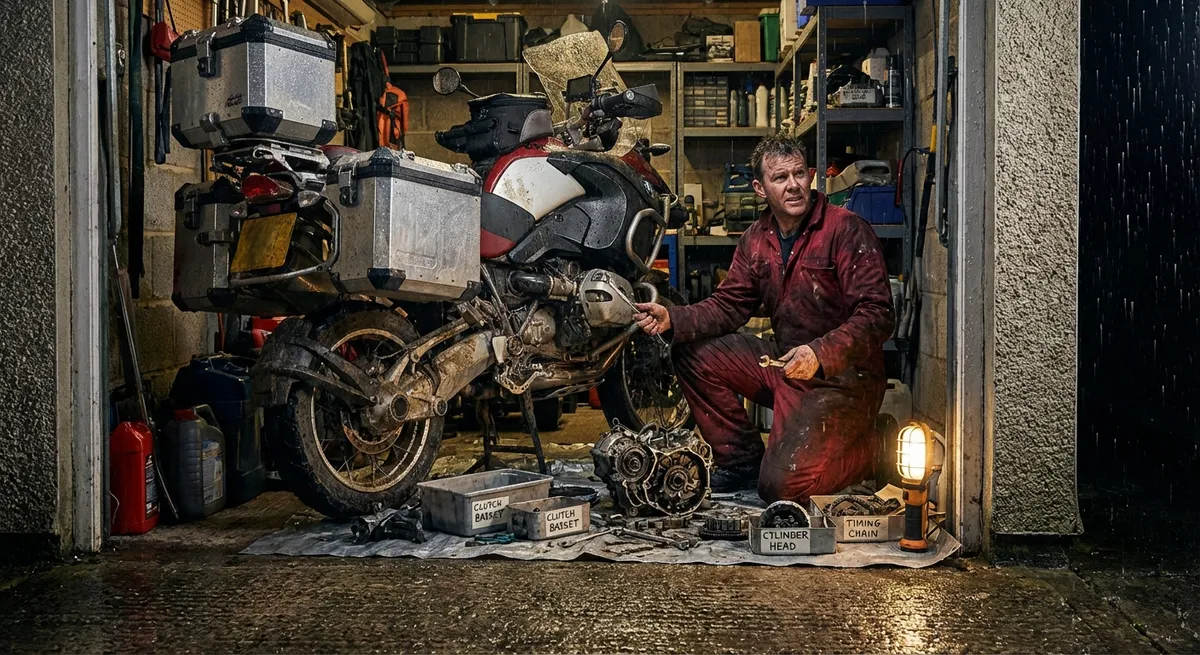
Most riders maintain what they can see: shiny plastics, clean chains, fresh oil. The motorcycles that feel trustworthy at speed—on a rain-soaked commute or a midnight mountain run—are the ones maintained below the surface. This isn’t about checklist servicing; it’s about engineering reliability into the machine you actually ride, under the conditions you actually punish it with.
This is deep-cycle maintenance: slow, deliberate work that turns a motorcycle from “kept running” into “ready for anything.”
Building a Maintenance Baseline: Data, Not Guesswork
If you can’t describe the mechanical state of your motorcycle, you’re not maintaining it—you’re reacting to it.
Every serious rider should build a baseline profile of their bike’s health and keep it updated:
- Compression and Leak-Down Readings
Record cylinder compression and, ideally, a leak-down test when the engine is healthy. Those numbers become your reference. Future deviations tell you if rings, valves, or head gaskets are wearing before you feel power loss or starting issues.
- Charging System Voltage Map
- At idle (fully warmed)
- At 3–4k rpm with lights off
- At 3–4k rpm with all typical accessories on (heated grips, auxiliary lights, etc.)
Measure system voltage:
Log these readings. If charging performance starts degrading, you can spot a stator or regulator/rectifier issue early instead of discovering it on the shoulder of a highway.
- Oil Consumption and Appearance Trend
- Brand and viscosity
- Interval mileage
- Quantity added between changes
Don’t just change oil—track it. Log:
Note color, smell, and metallic presence on the drain plug magnet. Gradual changes here are early warning for ring wear, valve seal issues, or fuel dilution.
- Brake System Baseline
- Rotor thickness and runout
- Pad thickness and contact pattern
- Lever travel before bite point
Measure:
Once you know “normal,” any sponginess or uneven pad wear stops being a mystery and starts being a diagnostic data point.
- Steering and Suspension Neutrality
- Effort required to initiate a turn
- Any self-centering feel at slow speeds
- Whether the bike tracks straight hands-off
After a fresh setup (new head bearings or properly torqued stem), note:
This is your chassis feel baseline. Any new weave, headshake, or reluctance to turn is easier to attribute to wear or incorrect torque.
Serious maintenance starts with this: making your bike a known quantity instead of a vague “feels fine.”
Precision Chain & Sprocket Management: More Than Just Lubing
Chain and sprocket care isn’t cosmetic; it’s power delivery, handling stability, and driveline security.
Go beyond “clean and lube” and think in terms of load paths and geometry:
Tracking Chain Stretch as a System
Measure chain length over a defined link count (e.g., 20 links pin-to-pin) with a vernier caliper or precise ruler. Log it at: - New - After 500–1,000 km - At each service interval Uneven “stretch” usually isn’t the chain elongating uniformly—it’s local wear at specific pins. If your measurement grows unevenly across segments, assume accelerated sprocket wear and plan a full chain-and-sprocket replacement, not just a chain.
Analyzing Sprocket Tooth Geometry
Inspect tooth profile, not just “hooking.” Look for: - Chamfer wear on the drive side vs. coast side - Polishing patterns on the tooth valley - Uneven wear on inner vs. outer teeth If the leading edge of the teeth is heavily worn while the trailing side looks new, your chain is overly slack under acceleration or has tight spots causing load spikes.
Aligning by Tension, Not Just Marks
Swingarm alignment marks are suggestions, not gospel. Use: - A chain alignment tool, or - A pair of precisely placed straightedges along the rear wheel Then verify by feel: rotate the wheel through a full revolution while observing chain slack at multiple points. If slack varies significantly, you have either: - A kinked/tight chain section, or - Misalignment putting lateral load into the chain and output shaft bearing.
Tension Under Real-World Load
Your chain tension spec is based on swingarm geometry. The chain is tightest when: - Front sprocket center - Swingarm pivot - Rear axle Are in nearly a straight line. With the bike loaded (you + luggage), check where that point is in your suspension stroke. If you always ride loaded, set chain tension for that condition, not for an unloaded bike.
Lubrication as Heat and Friction Management
Use a lube appropriate for: - Your environment (wet, dusty, or clean roads) - Your speed and duration of riding Thicker, tacky lubes hold up to long highway stints but collect grit off-road. Light, dry-style lubes stay cleaner but require more frequent application. The goal isn’t “looks wet”—it’s minimizing friction and heat at the rollers and O/X/Z-rings, preserving the internal grease where it matters.
Chains and sprockets are a dynamic system: treat them like a driveline, not just a consumable.
Thermal & Fluid Discipline Inside the Engine
Enthusiasts obsess over oil brand and coolant color while ignoring the mechanical reality those fluids are managing.
Deep maintenance here is about thermal margins and lubrication integrity:
- Oil Viscosity vs. Duty Cycle
- Climate (cold starts vs. desert heat)
- Riding style (short trips vs. track days or heavy two-up touring)
Stick to manufacturer viscosity as a starting point, but adapt to:
Thicker oil isn’t automatically “better.” Too viscous oil on cold starts delays lubrication to cams and bearings. Too thin under heavy load and heat can compromise film strength. If you routinely push the bike hard, verify oil pressure and temperature where possible (factory gauges, OBD, or external sensors).
- Oil Filter as a Forensics Tool
- Spread the media
- Inspect with a magnet and under good lighting
- Ferrous (magnetic): gears, bearings, cams
- Non-ferrous (non-magnetic, often copper/brass): bushings or thrust washers
At oil change, cut the filter open:
Find glitter-like metal? Identify type:
A clean filter over time builds confidence; rising metal load over successive changes tells you something is starting to shed material.
- Coolant System Pressure Integrity
- Holds pressure
- Hits stable operating temperature
- Recovers quickly after load spikes
A cooling system in spec:
Replace the radiator cap on an age/mileage schedule, not when it fails. A weak cap reduces boiling margin, especially at altitude or under heavy load. Inspect hoses for swelling, softness near clamps, or oil contamination. Any white crust at hose connections indicates slow leaks or vapor escape.
- Detecting Early Head Gasket or Combustion Leaks
- Unexplained coolant loss with no visible leaks
- Bubbles in the expansion tank at idle (once air is properly bled)
- Sweet smell in the exhaust
Signs to watch:
A chemical test for combustion gases in coolant is cheap and can confirm or clear up suspicions before catastrophic failure.
- Fuel System Cleanliness as Combustion Control
- Spray pattern
- Flow uniformity among cylinders
Periodic injector cleaning (on-bike with proper equipment or off-bike bench cleaning) restores:
This directly affects combustion efficiency, exhaust gas temperatures, and long-term valve and piston crown health.
Your engine isn’t a black box. With the right discipline, you’re not just changing fluids—you’re monitoring the health of a thermal and lubrication system working at race-engine levels of stress.
Chassis Torque Integrity: Fasteners as a Handling System
Handling isn’t just springs and damping; it’s every single fastener holding the machine together at speed. The bike’s torsional stiffness and predictability depend on correct torque and clamping forces.
Treat your chassis like a load-bearing structure, because that’s exactly what it is:
Structured Torque Rounds
Build a periodic torque checklist for critical components: - Front axle and pinch bolts - Triple clamp pinch bolts - Rear axle & adjusters - Brake caliper bolts - Engine mount bolts - Rear suspension linkage and shock mounts Don’t repeatedly “snug” bolts; use a calibrated torque wrench and follow the sequence specified in the service manual. Over-torqued triple clamps, for instance, can make forks bind and ruin small-bump compliance.
Engine Mount Torque and Vibration Behavior
Engine mounts don’t just hold the engine—they’re a tuned structural member of the frame: - Incorrect torque can change vibration frequency and amplitude - Mis-torqued mounts can subtly alter frame flex characteristics If you’ve had the engine out or mounts loosened, re-torque to factory specs in the specified order, and reassess vibration and handling.
Brake System Mechanical Integrity
Beyond pad thickness: - Inspect caliper slide pins (on sliding calipers) for corrosion and binding - Check rotor buttons (on floating rotors) for freedom of movement - Verify pad backing plates aren’t warped or deformed A caliper that can’t float or a rotor that can’t move correctly will cause pulsation, tapered pad wear, and inconsistent braking feel—long before you’re “out” of pad or rotor thickness.
Suspension Linkage and Bearing Health
Pull linkage apart on a defined schedule (especially if you ride in rain or off-road): - Clean and inspect needle bearings - Repack with high-quality waterproof grease - Replace any pitted or rusted bearings A “mysteriously harsh” rear shock is often just a dry, notchy linkage turning the rear end into a partial hardtail.
Visual Witness Marks as Movement Detectors
Use paint pens to mark: - Critical fasteners to adjacent surfaces One line across bolt head and bracket. If the bolt rotates, the line breaks. This provides a quick pre-ride scan method for things like: - Axle nuts - Triple clamp bolts - Brake calipers - Steering damper mounts
When riders talk about a bike feeling “planted” or “solid,” a huge part of that is hidden here: clamping forces quietly doing their job.
Electrical Reliability: From Fragile Wiring to Trustworthy Electronics
Modern motorcycles are rolling computer networks. If you want true reliability, you have to treat the electrical system with the same respect you give your engine.
Think in terms of voltage stability, connection integrity, and environmental protection:
Battery as a Critical System Node
Periodically: - Load-test the battery - Measure resting voltage after 12–24 hours with no riding - Verify cranking voltage drop A healthy battery: - Holds above ~12.6–12.8 V rested (for typical lead-acid/AGM) - Doesn’t nosedive under starter load Weak batteries kill regulators, starters, and can wreak havoc on ECUs and ABS modules.
Ground Path Engineering
Poor grounds cause “ghost” issues: - Intermittent sensor faults - Flickering lights - Erratic idle or throttle response Remove and clean main ground points: - Frame ground - Engine ground straps Use fine sandpaper or Scotch-Brite, then apply a thin film of dielectric-safe corrosion inhibitor at the metal-to-metal interface.
Connector Sealing and Strain Relief
Inspect: - Coil connectors - Injector plugs - Main harness junctions - Handlebar switchgear connectors Look for: - Green corrosion - Stiff, heat-brittled sheathing - Wires bent sharply near connectors Use proper connector tools, dielectric grease on seals (not on pin contact surfaces themselves unless specified), and add strain relief (heat-shrink, loom, or clamps) where the harness flexes with steering or suspension movement.
Accessory Load Budgeting
Before adding heated gear, lights, or gadgets, create a power budget: - Note stator output (from manual) - Estimate baseline draw: ECU, fuel pump, ignition, lights, ABS, fans - Add planned accessories Leave a safety margin. Constantly running at or near stator capacity overheats regulators and can cook stators. If you’re close to the limit, LED conversions and lower-draw accessories can free up electrical headroom.
Environmental Hardening for Real Riding
If you ride in heavy rain, off-road, or winter: - Reroute vulnerable harness sections away from sharp edges and pinch points - Add additional sleeving over exposed runs - Ensure drain holes in switchgear housings and light assemblies are clear Consider periodic contact cleaner use on bar switches, then follow with an appropriate protective spray to prevent moisture intrusion.
Motorcycling at speed depends on predictable electronics as much as on combustion. If the electrons aren’t under control, nothing else is.
Conclusion
Deep-cycle maintenance is not about polishing the visible and hoping for the best. It’s about understanding how your motorcycle actually transmits load, heat, torque, current, and force—and then maintaining those systems with intent.
When you:
- Track baselines instead of guessing,
- Treat chains and sprockets as a tuned driveline,
- Manage oil and coolant as active, monitored systems,
- Maintain fasteners as structural components, and
- Engineer your electrical system for real-world abuse,
you transform your motorcycle from something that “usually starts and kind of handles” into a machine you can push—hard—without that nagging doubt in the back of your mind.
This is the maintenance that builds trust. And trust is what lets you ride the way you actually want to ride.
Sources
- Motorcycle Safety Foundation – Maintenance Tips - Practical maintenance guidance and safety-focused recommendations from a major rider education organization
- Honda Powersports – Owner’s Manual Library - Factory specifications and maintenance procedures applicable as a reference for many modern motorcycles
- Yamaha Motors – Technical Information & Service Data - Official service and maintenance documentation that illustrates correct torque specs, service intervals, and inspection points
- SAE International – Lubricants and Engine Technology - Engineering-level background on oil behavior, viscosity, and engine lubrication fundamentals
- U.S. Department of Transportation / NHTSA – Motorcycle Safety - Data and technical information on motorcycle safety, including the role of mechanical condition in crash risk
Key Takeaway
The most important thing to remember from this article is that this information can change how you think about Maintenance.