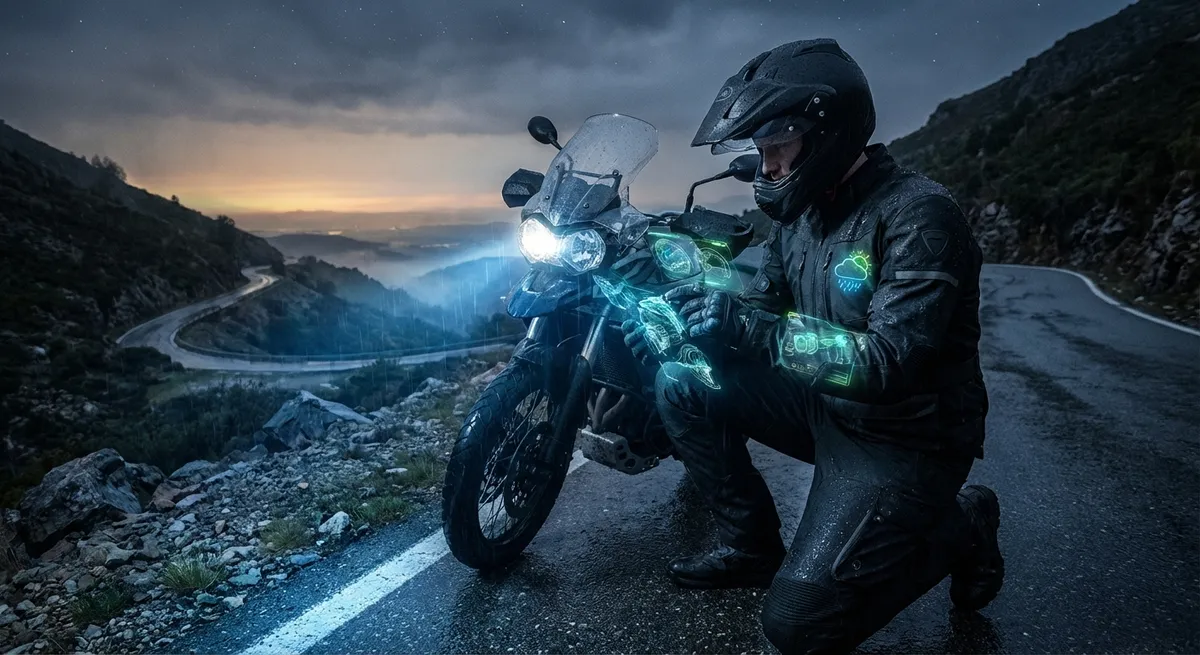
You don’t “wear” good gear—you integrate it into a riding system. When you start thinking like a test engineer instead of a casual consumer, jackets, boots, and armor stop being lifestyle props and become components in a high-performance safety package. The right setup doesn’t just save skin in a crash; it reduces fatigue, sharpens feedback, and lets you ride faster, longer, and more precisely with the same margin of safety.
This is a deep dive into how to spec, evaluate, and tune your protective gear as if you were building a prototype test rig—because in a very real sense, you are. The test subject is you.
1. Impact Energy Management: Understanding Armor Beyond the Label
Most riders stop reading at “CE Level 1” or “CE Level 2,” but that’s like buying a bike based only on horsepower. To engineer your gear properly, you need to understand what that rating actually measures.
Motorcycle impact protectors in most markets are tested against EN 1621 standards. In simple terms, a weight is dropped onto armor and the transmitted force (what reaches your body) is measured in kilonewtons (kN). The lower the number, the better the energy absorption.
- For limb armor (EN 1621-1):
- Level 1: average transmitted force ≤ 35 kN
- Level 2: average transmitted force ≤ 20 kN
- For back protectors (EN 1621-2):
- Level 1: ≤ 18 kN
- Level 2: ≤ 9 kN
- Stated test standard and level on the label, including the type (e.g., Type A or Type B – B is larger coverage).
- Coverage area: a Level 2 protector that only covers half your spine is a false sense of security. Coverage and correct positioning matter as much as rating.
- Multi-impact behavior: viscoelastic (D3O-type) materials can stiffen on impact and recover, but high-energy, repeated hits or extreme temperatures can change their behavior. Manufacturers who publish performance curves at different temperatures are showing you they’ve done their homework.
- No folding or wrinkling when in riding position
- No floating gaps at shoulders/elbows when you push/pull the fabric
- Stable placement when you simulate a slide by pulling the fabric toward typical impact directions (forward/down, side/down)
Technically minded riders should look for:
Pro move: when you upgrade armor (especially in a jacket not designed around aftermarket pieces), check for:
Armor only works if it’s in the impact zone at the moment of impact. That’s a fit and kinematics problem, not a catalog problem.
2. Slide Dynamics: Abrasion Resistance as a System, Not a Single Layer
Abrasion is where many gear conversations get lazy—“leather is better than textile” and the debate dies there. Reality is more nuanced and more interesting.
The critical variable is how long the material can resist wear on a typical road surface before failure. Standards like EN 17092 classify garments into AAA, AA, A, B, and C, partially based on abrasion performance on different zones of the body. The real engineering insight: you don’t slide on one fabric; you slide on a multi-layer stack.
Key technical considerations:
- Outer shell material:
- High-quality 1.2–1.3 mm cowhide or kangaroo leather typically outperforms most textiles in pure abrasion time.
- Advanced textiles (e.g., Armacor, SuperFabric, Cordura blends with UHMWPE fibers like Dyneema) can approach or exceed leather performance in specific zones with less weight.
- Zone mapping:
- High-risk zones (shoulders, elbows, hips, knees, seat) should have either multi-layer reinforcement or higher-grade materials. Look for clear zone diagrams or explicit AAA/AA ratings.
- Seam construction:
- Many failures in real-world crashes occur at seams, not the middle of panels. You want double or triple stitching, ideally with safety (hidden) seams where at least one line of stitching is not exposed to direct abrasion.
- Thermal load:
- Long slides generate heat. Multiple layers (outer shell, internal reinforcement, liner) spread and slow that thermal load. This is why integrated systems beat “just heavy leather + T-shirt.”
- Higher abrasion shells (leather or zoned textiles)
- Correct base layers (synthetic or wool, not cotton, which holds sweat and increases friction burns)
- Proper fit that doesn’t allow the shell to twist or ride up, exposing skin
A rider thinking in systems will pair:
You’re not just trying to “not get holes in your jacket”; you’re managing friction, heat, and material failure modes as a whole package.
3. Biomechanics and Fit: Tuning Gear Around Your Riding Posture
Too many riders fit gear while standing like a mannequin, then wonder why it binds on the bike. Fit is a biomechanical interface problem: the garment must align with your body’s neutral riding posture, not your neutral standing posture.
When you evaluate fit, do it in your primary riding stance:
- On your bike or a similar one (clip-ons vs upright bars dramatically change angles)
- Feet on pegs, hands on bars, head in your usual tilt angle
- Armor tracking:
- Shoulder, elbow, knee, and hip armor should stay centered over joints through full steering and braking movement. If armor migrates off the joint when you reach for the bars, it’s misaligned for your bike.
- Pre-curved construction:
- High-quality gear uses pre-curved sleeves and legs, accordion stretch at knees/shoulders, and strategic panels to reduce material bunching. Bunching equals pressure points, friction hot spots, and unpredictable sliding behavior.
- Articulation vs. protection:
- A purely “comfortable” garment that feels like streetwear usually has compromised protection zones or too much slack. You want controlled resistance—the suit should support you in the riding position, not hang off you.
- Neck and helmet interface:
- Check collision between collar and helmet at full head turn and tuck. A collar that pushes the helmet can restrict vision at exactly the wrong time.
- You “spring rate” with size choice and base layers
- You “damp” with armor choice and panel tension
- You “set sag” by checking how it settles on your body on the bike, not in front of a mirror
Technical checks:
For serious riding, treat your gear like semi-custom suspension:
4. Thermal and Moisture Management: Controlling Rider Performance, Not Just Comfort
Temperature control isn’t a luxury—it’s a performance and safety parameter. Your brain’s reaction time and fine motor control degrade when you’re overheated, dehydrated, or shivering. Proper gear is basically a wearable climate-control and fluid-management system.
Key technical aspects:
- Layering architecture:
- Base layer: moisture transport away from skin. Prefer technical synthetics or merino wool. Avoid cotton; it holds sweat and accelerates chilling once airflow increases.
- Mid layer: insulation (fleece, technical synthetic, or light down) chosen based on airflow and season.
- Shell layer: wind, abrasion, sometimes water. You want to separate impact/abrasion function from thermal function where possible—modular systems are more tunable.
- Membrane behavior:
- Waterproof-breathable membranes (Gore-Tex, D-Dry, Drystar, etc.) have performance envelopes. Under heavy rain + high humidity, breathability drops; under dry, cool conditions, they can feel almost windproof while still venting some vapor.
- Laminate shells (membrane bonded to outer fabric) resist waterlogging and keep weight stable; drop-liner constructions can feel heavier and colder when saturated.
- Ventilation flow paths:
- True airflow requires intake and exhaust. Chest vents with no rear exhaust often just create localized cold spots, not full-body cooling.
- On faired bikes, vents need to be placed outside the wind shadow. What looks good on a mannequin may sit in dead air behind a fairing at speed.
- Core temperature in a range where you can focus for hours
- Sweat moving away from skin, not trapped against it
- Evaporative cooling balanced against windchill as speed rises or drops
From a performance standpoint, your goal is to keep:
This is why serious riders often build two or three overlapping gear systems rather than trying to force one “4-season” setup to handle everything.
5. Boot and Glove Engineering: Interfaces, Not Accessories
Boots and gloves are not accessories; they’re control interfaces with built-in failure mitigation. You use them every second you’re on the bike. Any slop, dead zone, or delay in their feedback loops costs you precision.
Boots: Structural Support and Load Paths
You want a boot that:
- Controls torsion (twisting), hyperextension, and crushing to a reasonable degree
- Still allows precise modulation of brake and shifter
- Shank construction:
- A good midsole/shank prevents the foot from folding over the peg in a crash and distributes peg loads across your whole foot during long rides.
- Ankle bracing systems:
- External or internal bracing (hinges, TPU supports) significantly improves resistance to inversion/eversion injuries compared to soft “riding sneakers.”
- Outsole compound and pattern:
- Too-hard compounds slide on wet paint and metal. Look for grippy but not gummy rubber with channeling for wet surfaces and enough stiffness that pegs don’t create hot spots.
Important technical components:
Think of boots as a tuned chassis for your lower leg: they transmit inputs and resist destructive forces at the same time.
Gloves: Tactile Resolution vs. Impact and Abrasion
Glove engineering is a constant trade-off:
- Thicker = more protection, less feel
- Thinner = more feel, less margin in a slide or impact
- Palm construction:
- Multi-layer leather with palm sliders (TPU or similar) helps you slide instead of catching and tumbling—a major factor in wrist, scaphoid, and forearm injuries.
- Seam placement:
- External seams in high-flex areas can reduce internal pressure points and improve feel, but if poorly executed, they can be an abrasion weak point.
- Cuff design:
- Full gauntlet gloves should go over or under the jacket with overlap, not meet edge-to-edge. In a slide, separation between glove and sleeve is a direct line to degloving injuries.
Technical features that matter:
Treat your hands and feet like high-precision actuators: your gear should protect them without introducing hysteresis (lag or dead zone) into control inputs.
Conclusion
Motorcycle gear is not cosplay and not a fashion accessory—it’s engineering. Every zipper, panel, stitch, membrane, and piece of armor is part of a system that manages energy, temperature, friction, and biomechanics around a human body traveling at speed.
The moment you stop asking “Is this jacket cool?” and start asking:
- What’s the impact curve on this armor?
- How do these seams behave in a 25-meter slide?
- Does this fit my riding posture, not my standing posture?
- What happens to my reaction time after three hours in this thermal setup?
- Can I still modulate brake and throttle to the millimeter in these gloves and boots?
—your gear stops being random and starts becoming Moto Ready.
Build your kit like an engineer, test it like a rider, and you’ll unlock not just more safety, but more performance and more confidence every time you roll out.
Sources
- [European Commission – Protective Equipment Regulations](https://single-market-economy.ec.europa.eu/single-market/european-standards/harmonised-standards/personal-protective-equipment_en) – Overview of CE and EN standards relevant to motorcycle PPE
- [Gore-Tex Professional – How Waterproof Breathable Membranes Work](https://www.gore-tex.com/experience/technology/waterproof) – Technical explanation of membrane behavior and breathability
- [Roadracing World – Motorcycle Protective Gear Performance Tests](https://www.roadracingworld.com/news/category/airbag-systems-riding-gear/) – Independent testing and reporting on real-world armor and gear performance
- [NHTSA (National Highway Traffic Safety Administration)](https://www.nhtsa.gov/motorcycle-safety/gear) – U.S. government guidance on motorcycle protective gear and injury reduction
- [University of New South Wales – Motorcycle Clothing Study](https://www.neura.edu.au/wp-content/uploads/2015/07/Motorcycle_Clothing_Hurt_Reduction.pdf) – Research on the effectiveness of motorcycle clothing in crash injury reduction
Key Takeaway
The most important thing to remember from this article is that this information can change how you think about Gear & Equipment.