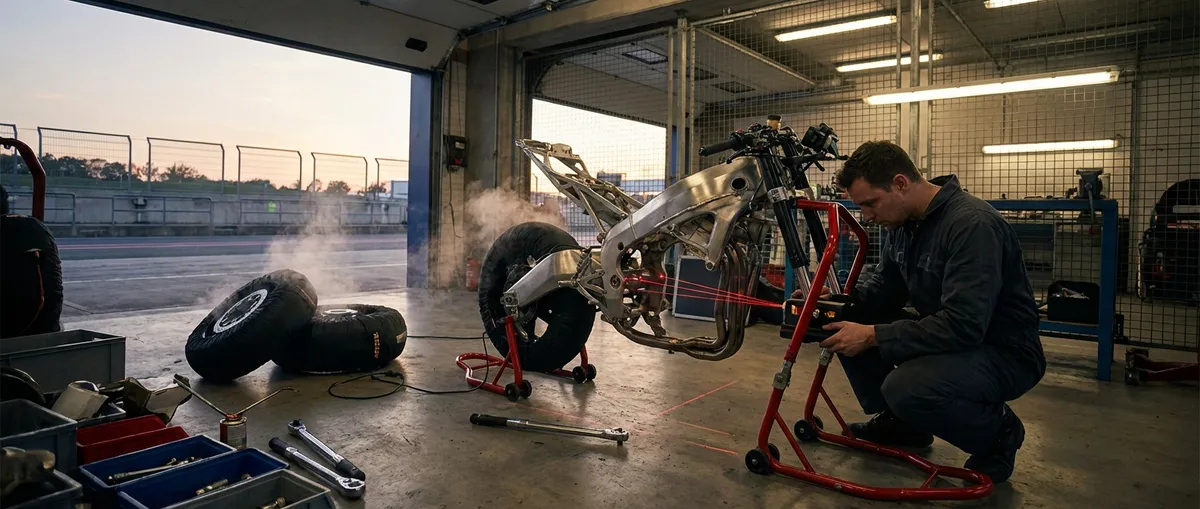
A spec sheet will tell you horsepower, weight, and maybe rake and trail. But the real character of a motorcycle lives in its chassis — the invisible architecture that decides whether the bike feels like a scalpel, a sledgehammer, or something magically in between. When you review a motorcycle like an engineer instead of a casual shopper, you stop asking “Is it fast?” and start asking “How does this frame manage load, feedback, and time?” This is where motorcycles stop being products and start being instruments.
This review framework isn’t about one specific model. It’s a technical lens you can use on any motorcycle you test ride or evaluate. If you care about feel, precision, and long-term confidence, you review the chassis first — the rest of the bike just follows orders.
1. Frame Behavior Under Mixed Load: Flex, Torsion, and Feedback
The frame is not just a skeleton; it’s a spring, a tuning fork, and a communication line from tire to rider. When you ride a bike for review, you’re really testing how the frame manages combined loads: braking, cornering, and acceleration all at once.
On the road, you can feel this by deliberately stressing the chassis in controlled ways:
- Mid-corner corrections: Enter a corner at a steady throttle, then add a gentle steering input or slight line adjustment. On a well-developed frame, the bike tracks obediently with minimal delay and no vague “hinge” sensation in the middle.
- Braking while leaned: Trail the brakes lightly into the corner. A good chassis will compress and settle, not twist and complain. If the bike feels like it’s “winding up” then releasing, the torsional stiffness vs. flex balance is off for your use.
- Transition speed: Rapid left-right transitions (like a chicane or S-bend) reveal how mass is distributed around the roll axis. A stiff but heavy-feeling bike may resist lean initiation then fall in abruptly. A more compliant frame with smart geometry feels neutral and predictable.
Technically, manufacturers balance lateral flex (for grip feel and compliance) with torsional stiffness (for stability and steering precision). Race-oriented frames often chase torsional stiffness, while road-biased platforms allow a touch more flex so the tires can track imperfect surfaces.
When you write or think about a bike’s chassis in a review, don’t just say “stiff” or “planted.” Ask:
- Does the frame store and release energy smoothly, or does it feel like a delayed spring?
- Does feedback feel analog and continuous, or digital and on/off?
- Can you predict what the frame will do when you hit an unfamiliar bump mid-corner?
If the answer is yes, you’re on a well-tuned platform. If not, the geometry, materials, or assembly tolerances are fighting each other.
2. Front-End Geometry You Can Feel: Rake, Trail, and Mechanical Traction
Rake and trail are often quoted like magic numbers, but what matters on the ride is what they do to your inputs and the tire’s mechanical grip envelope.
Here’s how to interpret and test front-end geometry in real time:
- Initial turn-in: Bikes with steeper rake and shorter trail react quickly but can feel nervous if the rest of the chassis doesn’t support that agility. On test rides, start with gentle countersteer inputs and note whether the bike rolls in linearly or “falls” once a threshold is crossed.
- Mid-corner neutrality: The best front ends create a “self-centering” feel in the middle of the corner. If you can loosen your grip slightly at lean and the bike just holds line, trail is doing its job. If the front feels like it’s running wide or tucking with tiny throttle changes, that geometry or weight bias needs scrutiny.
- Mechanical traction test: On a familiar corner, add a very slight increase in lean angle and throttle simultaneously. You’re not testing grip limits, you’re testing how the contact patch talks to you. A great front end whispers early: a slight lightening through the bars, a gentle change in vibration. A mediocre one doesn’t talk until it’s nearly out of ideas.
Technically, trail creates a restoring torque that keeps the front wheel aligned and stable, while rake contributes to both agility and stability depending on the whole chassis package. But for a reviewer, the key questions become:
- Does the front end tell you the truth early, or surprise you late?
- Can you use tiny steering inputs mid-corner to adjust line without unsettling the chassis?
- Do braking and steering feel like one combined system, or two separate actions you’re managing?
When a motorcycle gets its front-end geometry right, you stop thinking about “confidence” and start thinking about “precision.” Confidence is emotional. Precision is repeatable.
3. Suspension as a Signal Processor: Damping Quality Over Click Counts
Manufacturers love to talk about adjustability: compression, rebound, preload, maybe even separate high- and low-speed circuits. But adjustment range means nothing if the damping curve is poorly shaped. When reviewing a motorcycle, your job is to feel that curve.
Think of suspension as a signal processor for the road:
- High-frequency input (small bumps, ripples): Good forks and shocks filter harshness but keep information. You should still feel surface texture, just without impact spikes. If the bike feels “floaty” here, rebound is often too slow or the spring rate too soft for your weight.
- Low-frequency input (big hits, braking, acceleration): On hard braking, you’re evaluating compression damping support. Watch for fork dive that starts fast then slows progressively — that’s a healthy curve. A linear or uncontrolled dive will force the bike onto its nose, changing geometry drastically and reducing margin for error.
- Recovery behavior: After a big bump, how fast does the bike settle? A well-valved shock returns to neutral in one clean movement — no pogo, no multi-step bounce. That single motion tells you rebound damping is doing real work instead of just checking a spec box.
On a test ride, run through a structured set of inputs:
- Gentle brake to a stop – assess initial movement and small-amplitude control.
- Firm brake from moderate speed – look for composure, not just stopping power.
- Ride through a known rough section seated, then standing – isolate what’s coming through the pegs vs. bars vs. seat.
- Corner over a mid-corner bump – the key test: the chassis should flex and move, but the line should not dissolve.
From a technical standpoint, the art is in matching spring rate, damping profile, and bike mass distribution. A stiff spring with lazy damping feels harsh and wooden. A soft spring with aggressive damping feels vague and overdamped.
Your review notes should go beyond “firm” or “soft” to describe:
- How many oscillations after a big bump?
- Does the bike return to its original attitude?
- Does braking compress the suspension within a manageable range, or to the stop?
This is how you separate marketing-grade “adjustability” from rider-grade suspension engineering.
4. Mass Distribution and Rotating Inertia: Why Some Bikes Disappear Under You
Power-to-weight is simple; where the weight lives and how it spins is not. Two bikes with identical curb weights can feel radically different because of mass centralization and rotating inertia.
On a serious chassis review, you’re evaluating:
- Pitch inertia: How easily the bike transitions between on-throttle (rear squat) and off-throttle (front dive). If the bike feels like it “rocks” front-to-back with delay, there’s too much pitch inertia or poorly matched damping.
- Roll inertia: The effort needed to initiate lean and to stand the bike up. This is separate from steering geometry; heavy wheels, high-mounted components, and long wheelbases all affect this. A well-centralized bike feels light in roll but stable in yaw.
- Engine rotational effects: Crankshaft rotation, gearbox, and clutch all add their gyro influence. Some layouts (like certain longitudinal cranks) introduce a noticeable torque reaction when you blip the throttle at a standstill. On the move, that gyro can either stabilize or resist steering transitions depending on design.
To assess mass distribution:
- Perform gentle no-hands coasting (where safe) to feel how the bike tracks purely under geometry and weight bias.
- Do slow-speed U-turns and parking-lot figure-eights. If the bike feels like its weight lives high and far from the roll axis, you’ll fight inertia instead of guiding it.
- At moderate speed, roll the bike from side to side with rhythmic countersteer inputs. You’re looking for linear response to effort: twice the input, about twice the roll rate, not a lag-then-drop sensation.
From a technical perspective, good mass centralization lowers the polar moment of inertia around the roll axis. That’s why so many modern designs route exhausts under or near the engine, pack fuel closer to the center, and minimize unsprung and rotating mass at the wheels.
When you review a motorcycle with this in mind, you can stop using vague terms like “flickable” and instead talk about:
- Roll response vs. speed
- Stability vs. steering effort
- How quickly the bike can change attitude without feeling nervous
This is the difference between a bike that just goes where it’s pointed and a bike that feels like an extension of your intent.
5. Structural Integration: Engine, Swingarm, and the Real Backbone of the Bike
Modern motorcycles are rarely just “frame plus engine.” The engine cases, swingarm pivot zone, and even subframe often work together as a single stressed structure. When you review a bike, part of what you’re feeling is how well those elements share load and vibration.
Key areas to evaluate on the road:
- Engine as a stressed member: In many sport and adventure platforms, the engine is not just bolted in; it is the frame. Listen and feel for how vibration passes through the bars and pegs. A well-integrated engine-frame structure transmits information, not punishment.
- Swingarm stiffness and length: Long, stiff swingarms give better traction and reduce squat, but can slow transitions if the whole rear section is overbuilt. On throttle exits, a well-balanced rear assembly will squat slightly, hook up, and drive — not wallow or step out unpredictably.
- Subframe behavior under load: Load the bike if you can — luggage, passenger, or at least simulate with your body position shifts. If the rear starts steering the bike under weight transfer, you’re feeling subframe and rear chassis flex that isn’t under tight control.
On the test ride, use combined-load scenarios to probe structural integration:
- Hard acceleration over imperfect pavement: Is the rear tracking straight, or is there a vague weaving as loads pass from tire to swingarm to frame?
- Fast sweepers with light throttle modulation: Does the bike hold a consistent radius, or does the chassis “breathe” and force continuous correction?
- Braking hard from speed, then immediately turning: Does the frame respond as a single rigid system, or do you feel a delay between front and rear settling?
Technically, engineers are managing load paths: where braking, cornering, and acceleration forces travel through metal and joints. Weld quality, casting design, and bolted interfaces all matter, but for the reviewer, the outcome is simple: either the bike feels structurally coherent, or it feels like three separate parts that happened to be assembled together.
When you describe structural integration, focus on:
- Whether the bike feels like one solid instrument at pace
- How it reacts when the road and your inputs get rough at the same time
- Whether vibration and flex feel tuned or just unavoidable
Conclusion
A motorcycle review that stops at power and styling is a missed opportunity. The real story lives in the chassis: the frame’s flex signature, front-end geometry, suspension damping behavior, mass distribution, and structural integration. These five technical lenses transform a test ride from “fun” or “not fun” into a repeatable evaluation system you can apply to any machine.
When you start to review motorcycles like this, the spec sheet becomes just a hypothesis. The ride is the experiment. And the chassis — not the engine, not the electronics — is the data that matters most for riders who demand precision, feedback, and long-term trust from their machines.
Sources
- Kawasaki Motors – Chassis & Frame Technology Overview - Manufacturer explanation of modern frame concepts, rigidity balance, and mass centralization
- Öhlins – Suspension Basics and Damping Fundamentals - Technical primer on compression/rebound damping, spring rates, and suspension behavior
- Yamaha Motor – Chassis Design & Mass Centralization Concepts - Detailed look at how geometry, frame design, and weight distribution interact
- BMW Motorrad – Telelever and Frame Integration - Insight into alternative front-end and structural integration approaches
- Motorcycle Safety Foundation – RiderCourse Materials - Practical context for how chassis behavior affects real-world control and feedback
Key Takeaway
The most important thing to remember from this article is that this information can change how you think about Motorcycle Reviews.