Motorcycles don’t suddenly “break.” They talk first—through vibration, smell, temperature, play, and noise. Most riders never learn to speak that language, so problems only show up when something finally snaps. Maintenance isn’t just oil changes and chain lube; it’s the technical art of interpreting micro-signals from a machine running at thousands of RPM under load. This is how you move from reacting to failures to predicting them—turning your bike into a system you can read like telemetry data.
Micro-Backlash: Understanding Mechanical Play Before It Becomes Slop
Every rotating assembly on your motorcycle has a designed-in tolerance window—tiny, controlled amounts of “play” that allow parts to move, heat up, and survive under load. When that play grows, it becomes backlash, and backlash turns into shock loads that eat components.
Start with the drivetrain. With the bike off, in first gear, rock the rear wheel back and forth gently and feel how much movement occurs before the engine begins to rotate. That rotation gap is total system backlash: chain stretch, sprocket wear, cush drive play, and gearbox lash all layered together. A fresh, properly adjusted chain with healthy sprockets and cush rubbers will show a crisp but minimal take-up. Excess movement indicates either stretched chain links (look for “hooked” sprocket teeth), hardened or crumbling cush drive rubbers, or aggressive wear inside the gearbox.
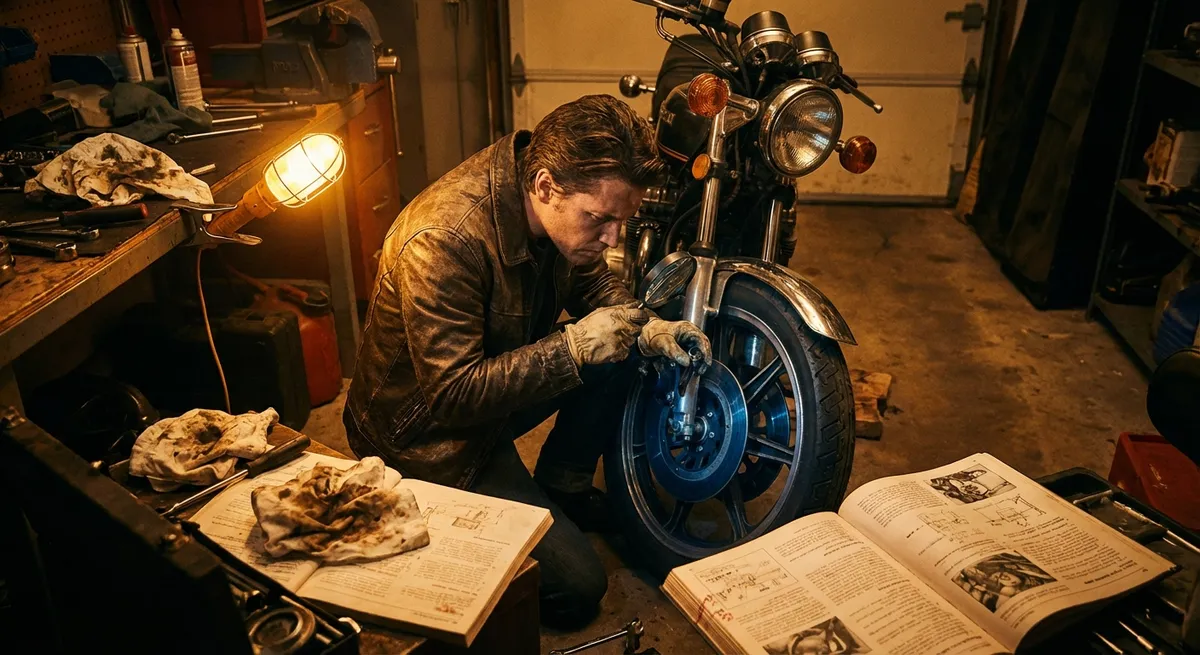
Apply the same logic to steering and suspension. On the front end, lock the front brake and rock the bike forward and back while feeling for a click in the steering head—this can indicate loose or notched head bearings. At the rear, lift the bike (or use a paddock stand) and check for side play at the swingarm; movement here suggests worn swingarm or linkage bearings. None of these failures are random—they all progress through measurable stages of growing mechanical play that you can feel long before anything “breaks.”
Thermal Signatures: Using Temperature as a Maintenance Data Point
Heat is one of the clearest signals your motorcycle sends, and most riders completely ignore it. Every system—engine, brakes, charging, drivetrain—emits a temperature profile that either confirms health or screams “something is wrong” in silence.
On a routine ride, pay attention to how quickly the engine reaches operating temperature and how stable it stays there. Modern liquid-cooled bikes are designed to live in a relatively narrow temperature band; wide or sudden fluctuations often point to a sticking thermostat, partially clogged radiator, or failing fan. An infrared thermometer becomes a powerful diagnostic tool here: compare the temperature of the left and right radiator sides, or the inlet vs outlet hoses. A large delta can hint at restricted flow.
Brakes tell their own thermal story. After a spirited ride, carefully (and safely) measure rotor temperatures left vs right. A significantly hotter rotor can mean a dragging caliper piston or sticky slide pin. If one rotor is cool relative to the other under consistent braking, you might have air in one side of a dual-disc system or a weak master cylinder circuit. Same idea with the chain: uneven temperature along its length after a long ride can indicate tight spots or poor lubrication distribution.
Even the charging system gives thermal clues. A regulator/rectifier that’s hotter than normal to the touch (relative to ambient and past behavior) may be overworking due to a failing stator or bad battery. Learning these temperature baselines turns random “electrical gremlins” into trackable failure progression.
Vibration Profiling: Separating Normal Harmonics from Damage Signals
Every engine architecture has a native vibration pattern—parallel twins buzz, V-twins pulse, inline-fours spin smooth up high. The key is learning what’s “normal harmonic” and what’s “damage signature.”
Begin by mapping your bike’s vibration across the RPM range. On a smooth, familiar road, pay attention to specific RPM bands where vibration increases, changes character, or migrates to different contact points (bars, pegs, seat). A consistent, narrow-band vibration at a particular RPM is often engine balance related and may be inherent. But a new, broad-band vibration that appears across multiple RPMs—especially after a tire change, chain adjustment, or impact—needs investigation.
Unbalanced wheels typically show up as a speed-dependent vibration (not RPM-dependent): you’ll feel it at a certain road speed regardless of gear. Drivetrain vibration often tracks more with load—appearing under acceleration but fading on a steady cruise. A failing wheel bearing may present as a low-frequency growl or vibration that increases with speed and changes when you lean the bike side-to-side (loading and unloading that bearing).
Even internal engine issues can be detected early by subtle changes in vibration. A slightly bent valve, failing big-end bearing, or loose engine mount will alter the feel of the bike at specific RPM points. Advanced riders sometimes place a fingertip lightly on various engine casings at idle and just off-idle to feel for asymmetric vibration—comparing, for example, between the clutch cover side and the alternator side. Pattern recognition over time is everything.
Fluid Forensics: Reading Oil, Coolant, and Brake Fluid Like Lab Reports
Fluids are the blood chemistry panel of your motorcycle. You don’t just “change” them—you interrogate them. Every drain interval is a diagnostic event.
Engine oil should always be evaluated, not just discarded. Check color, smell, and consistency. Very dark oil isn’t automatically bad; it can simply mean the detergent package is doing its job. What you’re really hunting for is metallic sheen (use a bright light), sludge-like texture, or fuel smell. Fuel dilution in oil often points to excessive idling, stuck injectors, or incomplete combustion. Sending an oil sample to a lab for used oil analysis (UOA) can reveal elevated levels of specific metals—iron, aluminum, copper—that map to particular internal components (cams, bearings, pistons).
Coolant should be visually clean and consistent in color. Rust tint suggests interaction with unprotected iron surfaces (like inside older radiators or engine jackets), while milkiness can indicate oil intrusion from a failing head gasket or oil cooler. Regularly inspect the overflow bottle level; gradual, unexplained loss without visible leaks can be an early sign of internal head gasket failure.
Brake fluid is hygroscopic—it absorbs moisture—and its color progression is telling. Fresh DOT 4 is clear to light amber; dark brown fluid indicates oxidation and moisture contamination, which lower the boiling point. That’s not just a “feel” issue; it’s a hard fade risk during aggressive braking. For precision, use a brake fluid tester to measure water content rather than guessing by color alone.
Torque Integrity: Fasteners, Clamping Force, and the Myth of “Good and Tight”
Mechanical reliability is ultimately held together by clamping force—what you apply through torque. But torque is not about “tightness” in the hand-feel sense; it’s about achieving a specific stretch in a fastener that matches the load and material.
Start with critical subsystems: axle pinch bolts, brake caliper bolts, handlebar clamps, engine mount brackets, and triple clamp pinch bolts. Each of these has a specified torque value for a reason. Under-torque leads to shifting, fretting, and uneven loading; over-torque can stretch or neck the fastener, permanently altering its clamping characteristics or even pre-cracking it.
Use a quality torque wrench and learn its limitations. Many riders unknowingly use a 1/2" drive torque wrench at the very bottom of its range for small fasteners, where it’s least accurate. For precision, use a 1/4" or 3/8" wrench for low-torque applications (like bodywork, levers, and smaller brackets), and reserve the big wrench for axles and major chassis components. Always torque in stages and in recommended patterns (criss-cross or sequence-based), especially on items like brake calipers or engine covers, to prevent distortion.
Thread preparation is just as technical. Dry torque values assume clean, oil-free threads; introduce anti-seize or lubrication and you change the friction coefficient, effectively increasing clamping force at the same torque. That’s why manufacturers specify when to use threadlocker, engine oil, or nothing at all. Ignoring those details can cause subtle, creeping shifts in component alignment that show up later as warped rotors, misaligned wheels, or cracked mounting ears.
Conclusion
A “reliable” motorcycle isn’t the product of luck or just following a maintenance schedule—it’s the result of high-fidelity observation. Mechanical play, thermal patterns, vibration signatures, fluid condition, and torque integrity are all data channels your bike broadcasts every mile. When you start treating maintenance as signal analysis instead of chore work, failures stop being surprises and start being predictable endpoints you can avoid by intervening early. That’s the real performance upgrade: a machine whose behavior you understand deeply enough to trust at speed, in the wet, loaded with gear, miles from anywhere.
Sources
- [Motorcycle Safety Foundation – T-CLOCS Inspection Checklist](https://msf-usa.org/wp-content/uploads/2020/08/T-CLOCS_Inspection_Checklist_2020.pdf) - Official pre-ride inspection framework that reinforces systematic checks of critical systems
- [Motul – Understanding Engine Oil Analysis](https://www.motul.com/us/en-US/news/understanding-used-oil-analysis) - Explains how used oil analysis can reveal internal engine wear and contamination
- [Brembo – Brake System Maintenance Tips](https://www.brembo.com/en/company/news/brake-maintenance-tips) - Technical guidance on brake fluid condition, pad/rotor health, and thermal behavior in braking systems
- [SKF – Bearing Damage and Failure Analysis](https://www.skf.com/group/services/engineering-consultancy-and-optimization/bearing-failure-analysis) - Detailed discussion of how bearing wear presents through noise, vibration, and heat
- [Engineering Toolbox – Torque, Preload and Fasteners](https://www.engineeringtoolbox.com/torque-preload-fasteners-d_1693.html) - Technical background on the relationship between torque, friction, and clamping force in threaded fasteners
Key Takeaway
The most important thing to remember from this article is that this information can change how you think about Maintenance.