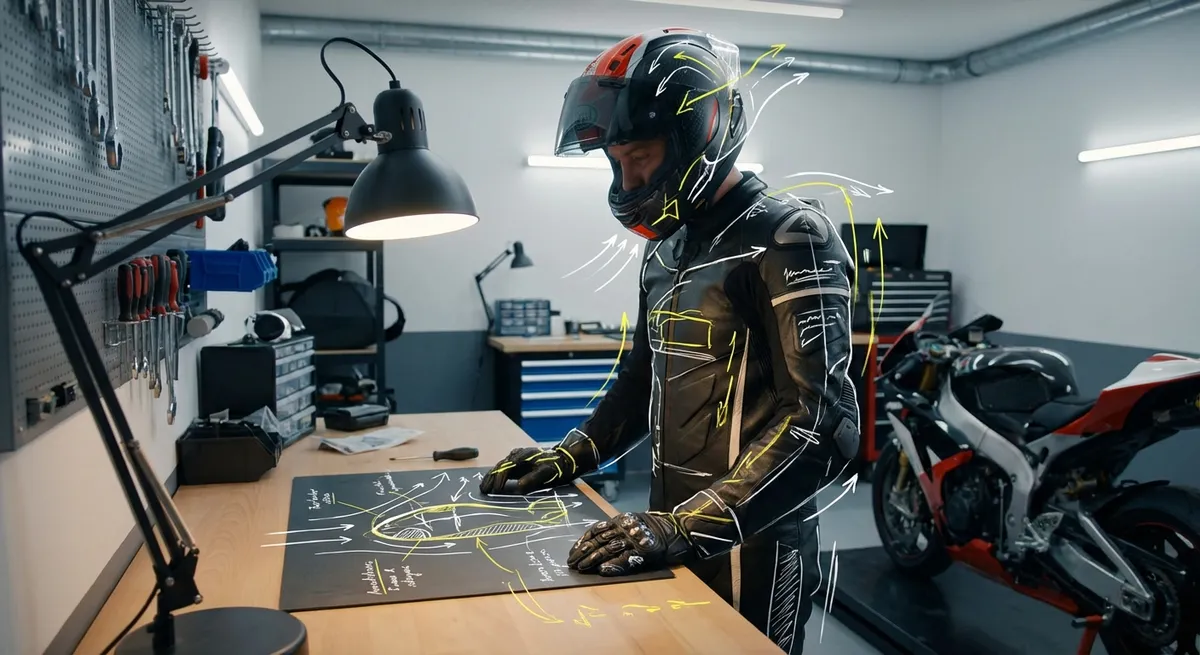
There’s a whole universe of engineering hiding in your jacket, gloves, and boots—and most riders never tap into it. We obsess over horsepower, geometry, and tire compounds, but treat our gear like a fashion decision with armor sprinkled in. That’s leaving performance on the table. Dialed‑in gear doesn’t just save your skin when it goes wrong; it actively makes you faster, smoother, and mentally sharper every time you ride.
Think of your kit as a system, not a pile of parts. Every textile choice, armor spec, seam, and vent changes how your body interfaces with the motorcycle. When you start looking at your equipment like chassis components, you can tune it for your riding style, environment, and risk tolerance with the same precision you bring to sag, clickers, and tire pressures.
1. Impact Energy Management: Beyond “It Has CE Armor”
Most riders stop at “CE level 1 or level 2” and call it a day, but impact protection is a lot more nuanced than a label. CE Level 1 limb armor allows up to 35 kN of force transmitted in testing, while Level 2 caps that at 20 kN—on paper, level 2 wins. But the shape, coverage, and behavior under repeated hits matter just as much. A slim but short pad that leaves your joint edges exposed is far less effective than a slightly bulkier protector that wraps around the sides of your knees or shoulders.
There are three main technologies you’ll see: traditional multi‑layer foam, viscoelastic “soft” armor that stiffens on impact, and air‑assisted systems like airbag vests. Viscoelastic pads behave like a slow fluid under normal movement (comfortable, flexible) and like a solid under a fast hit (crash), which is why the same pad can feel supple yet pass level 2. Pay attention to temperature stability in the spec or marketing materials—cheap viscoelastic can go rock‑hard in cold weather or floppy in high heat, changing both comfort and protection.
Coverage and fixation are critical. If the armor isn’t held tightly in place while you’re in your actual riding position—tucked, upright, or ADV‑standing—its lab rating is meaningless. Try your gear on, get into your real stance, twist at the hips, simulate reaching for the bars, and feel if the pads track your joints or float. Look for garments with armor pockets that allow vertical height adjustment and elasticated retainer straps or internal sleeves that “lock” protectors to your elbows and knees.
For high‑speed or track use, integrated or stand‑alone airbag systems change the whole game. They massively increase the deceleration distance for your torso and neck, slashing peak loads to the spine, ribs, and collarbones. Focus on inflation algorithm (track vs street vs touring profiles), deployment time (measured in milliseconds), and post‑deployment usability (can it be repacked by the user or dealer only?). If you regularly ride fast in traffic or on the track, an airbag becomes less a luxury and more a chassis upgrade for your body.
2. Abrasion and Tear Resistance: Reading Labels Like a Materials Engineer
Textile gear is not “all the same,” even when everything is called “600D polyester” online. Abrasion resistance depends on base material, weave, denier (fiber thickness), coatings, and reinforcement layers. For street speeds, EN 17092 ratings give you a baseline: Class AAA > AA > A. But don’t just buy the highest letter blindly—look at where the garment uses which materials. A well‑designed AA jacket with high‑denier or aramid reinforcements in the “impact zones” (shoulders, elbows, outer arms, upper back) can outperform a sloppy AAA jacket that only chases a lab result.
Key materials to look for: high‑denier nylon (e.g., 1000D or more) in slide zones, Cordura‑branded fabrics (since they’re backed by tighter quality control), and aramid or UHMWPE (ultra‑high‑molecular‑weight polyethylene) reinforcements at high‑risk panels like hips and seat. UHMWPE blends often show up marketed as “single‑layer motorcycle denim” and can give near‑leather slide times in a properly engineered garment, but check for independent test data or at least AA/AAA certification to avoid fashion‑first impostors.
Seams are the quiet failure point in many crashes. A strong fabric is useless if it’s held together by weak single stitching that bursts the moment it sees a tangential force. Look for double or triple‑stitched major seams, ideally with hidden or “safety” seams—this means the strongest stitching is protected inside and not the one exposed to abrasion. If you can, turn the gear inside out (or at least open it fully) and inspect internal seam construction rather than trusting exterior styling.
For leather, thickness and tanning quality matter more than brand hype. Around 1.2–1.4 mm cowhide or kangaroo leather in impact zones is the sweet spot for sport and track use, balancing abrasion resistance with flexibility and weight. Panels with accordion stretch and perforation should be strategically placed away from primary slide areas, not right on the shoulders or hips where they’ll be the first thing to touch the ground. Aggressive perforation looks cool, but every hole is a potential tear initiation point if it’s in the wrong spot.
3. Ergonomics as a Performance Mod: Fit, Articulation, and Fatigue
You can measure the performance of ergonomics by how long you can ride hard before you start making mistakes. Poorly fitted gear steals mental bandwidth: you’re thinking about a pressure point on your wrist, a seam digging into your knee, or a collar flapping at 70 mph instead of line choice, braking markers, and traffic. Properly tuned fit acts like a reduction in cognitive load, giving you processing power back when everything gets busy.
Pre‑curved patterning is non‑negotiable for serious riding, especially in gloves and pants. Gloves should follow a natural semi‑closed position; if you feel resistance when you form a full fist, that’s extra muscular effort you’ll be spending for every braking input. Over a long ride or aggressive session, that translates into forearm pump and slower, less precise lever modulation. Likewise, pants with pre‑shaped knees and stretch zones behind the hamstrings and above the seat will reduce the fight between your body and the material every time you move on the bike.
Look closely at closure systems. Micro‑adjustable wrist and waist closures (Velcro plus snaps or ratchets) let you fine‑tune how the garment sits at different layers (base layer only vs thermal liner vs rain shell). Gear that only fits “perfectly” in one configuration is gear that will never feel quite right in changing conditions. The same goes for boots: a good system blends solid ankle bracing with flexible forefoot and sophisticated closure (BOA dials, buckles, or robust zippers with proper gussets) that distributes pressure evenly instead of creating hot spots.
Internal volume matters. Armor pockets that are oversized lead to pad migration; boot shafts that are too wide allow your ankle to twist; gloves with excess fingertip length reduce lever feel. Fit your gear in your actual riding socks, base layers, and on your real bike if possible—mock riding position in the showroom is still better than walking around the store. Check if the collar interferes with your helmet base or if the back length rides up, exposing your lower back when you lean forward.
Small ergonomic wins add up: a properly anchored back protector that doesn’t dig into your tailbone, a collar design that seals without choking at full tuck, cuffs that slide under or over your gloves cleanly depending on use case (track vs touring). Each solved annoyance is another micro‑distraction removed. On a day where something unexpected happens—gravel, an erratic driver, a late braking point—that freed attention can be the difference between a near miss and a helpless passenger moment.
4. Thermal and Moisture Control: Keeping Your Brain in the Operating Window
Your body is a heat engine bolted to a heat engine. Managing temperature and moisture isn’t “comfort fluff”; it’s core to maintaining reaction times, decision quality, and physical endurance. Once your core temp drifts too high or too low, your brain starts dropping performance—yet many riders still wear a single “do everything” jacket with token vents and call it done.
Understand the stack: base layer, mid layer (if needed), protective shell, and optional over‑shell for rain. A proper moisture‑wicking synthetic or merino base layer is a huge upgrade over cotton, which holds sweat against your skin and turns into a swamp or ice pack depending on the conditions. Wicking fabric pulls moisture into a larger surface area where it can evaporate through your vents and membrane, keeping your skin in a more stable thermal and friction state.
For shells, decide whether you want laminated or drop‑in waterproofing. Laminated membranes (e.g., a 2‑ or 3‑layer fabric where the waterproof layer is bonded to the outer shell) resist “wet‑out” in prolonged rain and don’t pick up as much water weight, which keeps your gear lighter and less clammy. They also generally vent better at speed since moisture vapor doesn’t have to travel across a soaked outer shell. Drop‑in or removable liners are cheaper and often more flexible for hot conditions (you can pull the liner entirely), but once the outer is soaked, you’ll feel the chill from evaporative cooling and added weight.
Vent design matters more than vent quantity. Look for intake vents in high‑pressure zones (upper chest, shoulders, biceps) and exhaust vents in low‑pressure areas (upper back, lateral torso) to create a genuine airflow pathway, not just random holes. On ADV or upright bikes, chest vents do more work; on sportbikes, shoulder and upper arm vents see more direct flow. Mesh panels are excellent for hot, dry climates but can be hazardous in slides if not backed by abrasion‑resistant underlays in key zones—inspect carefully.
Don’t neglect the extremities. Gloves with dual‑chamber designs (a “warm” chamber with insulation and a “feel” chamber with thinner palm) can effectively give you two gloves in one. Insulated boots, or at least proper wind and water sealing with a breathable membrane, prevent the kind of deep chill that leads to stiff ankles and delayed foot inputs. On the opposite end, perforated race gloves and vented boots can drastically cut comfort fatigue in hot weather, letting you stay aggressive and precise longer.
5. Tactile Feedback and Control Interface: Your Contact Patch With the Bike
The same way you care about tire feel through the bars and seat, you should care about signal quality from the controls through your gear. Every layer between your skin and the lever, peg, or grip is a filter. If that filter is too soft, bulky, or dead, it dulls your ability to read traction, brake threshold, and engine behavior. Gear that maximizes feel without sacrificing protection is the sweet spot.
Start with gloves. Palm construction should be as close to a single, continuous piece of high‑quality leather or equivalent as possible in the main contact zone, with external seams where feasible. Internal seams can create pressure points and reduce fine tactile sensitivity. Look for strategically placed palm sliders made from TPU or similar materials—they’re designed to prevent the palm from grabbing and rotating under you in a slide, reducing scaphoid and wrist injuries, but they must be shaped and located so they don’t interfere with normal bar feel when you’re upright.
Finger articulation is more than just “has stretch panels.” Check whether the glove naturally rests in a bar‑gripping shape and if the leather bunches when you fully close your hand around a grip. Excess material equals lag in input. On the flip side, gloves that are too tight cut off circulation, which kills feel in a different way. For aggressive street and track, a semi‑race glove with robust knuckle and finger armor, scaphoid protection, and a secure double closure at the wrist gives you the best combination of impact safety and precise control feedback.
Boots determine how accurately you can modulate rear brake and shifts. Stiff, high‑protection boots with carefully engineered hinge systems at the ankle can deliver wonderful protection without making your foot feel like it’s in a cast. Pay attention to how easily you can feel the gear lever “click” and how precisely you can feather the rear brake, especially at low speeds where finesse matters. If every downshift feels like guesswork, the boot is too vague for technical riding.
At the contact between you and the chassis (seat, tank, inner knees), suit or pants grip zones matter. Panels of grippier leather or rubberized material at the inside of the knee and thigh help you lock onto the bike under braking and in corners, which means your arms can relax and work only on steering, not on holding you in place. This directly improves front‑end feel and reduces fatigue. For track or spirited canyon riders, this “human chassis stability” is as important as suspension setup.
Finally, think about how your gear integrates with your controls: does the jacket hem snag the seat when you hang off? Do bulky cuffs interfere with lever reach adjusters? Does your backpack or hydration pack strap block full shoulder movement? Every interference is a signal delay or unwanted input. Refine those interfaces until your gear becomes transparent—when you’re fully “plugged in,” your bike’s feedback loop is as pure as your tire contact patch allows.
Conclusion
Treat your gear like part of your motorcycle’s performance package, not just a dress code. When you understand how impact absorption, abrasion resistance, ergonomics, thermal management, and tactile feedback all interact, you stop buying jackets and gloves—and start spec‑ing a system that’s tuned to the way you ride. The payoff is huge: smoother inputs, longer focus, more confidence at the limit, and better odds when things go off script.
The next time you open a product page or walk into a shop, ignore the lifestyle photos for a moment and read it like a data sheet. Ask the same questions you’d ask about a new shock or tire. Because the truth is simple: your kit is your exoskeleton. Build it with the same obsession you bring to your bike, and every ride becomes sharper, safer, and a lot more satisfying.
Key Takeaway
The most important thing to remember from this article is that this information can change how you think about Gear & Equipment.