Every motorcycle has two lives: the one marketing promised, and the one you engineer in your garage. The gap between those two is pure maintenance. Not the “wipe it down and change the oil sometimes” kind—but maintenance that respects metallurgy, fluid dynamics, thermal cycles, and load paths. If you’re the rider who hears a bearing long before it fails, or feels a chain just before it binds, this is your field manual.
Below are five technical focus areas that actually move the needle on performance, reliability, and feel—maintenance that rewires how your bike ages under you.
1. Chain and Sprocket Dynamics: Managing Load Paths, Not Just Slack
A chain drive isn’t just “tight or loose”—it’s a constantly varying load path from crankshaft to rear contact patch. How you maintain it directly affects throttle response, bearing life, and even suspension behavior.
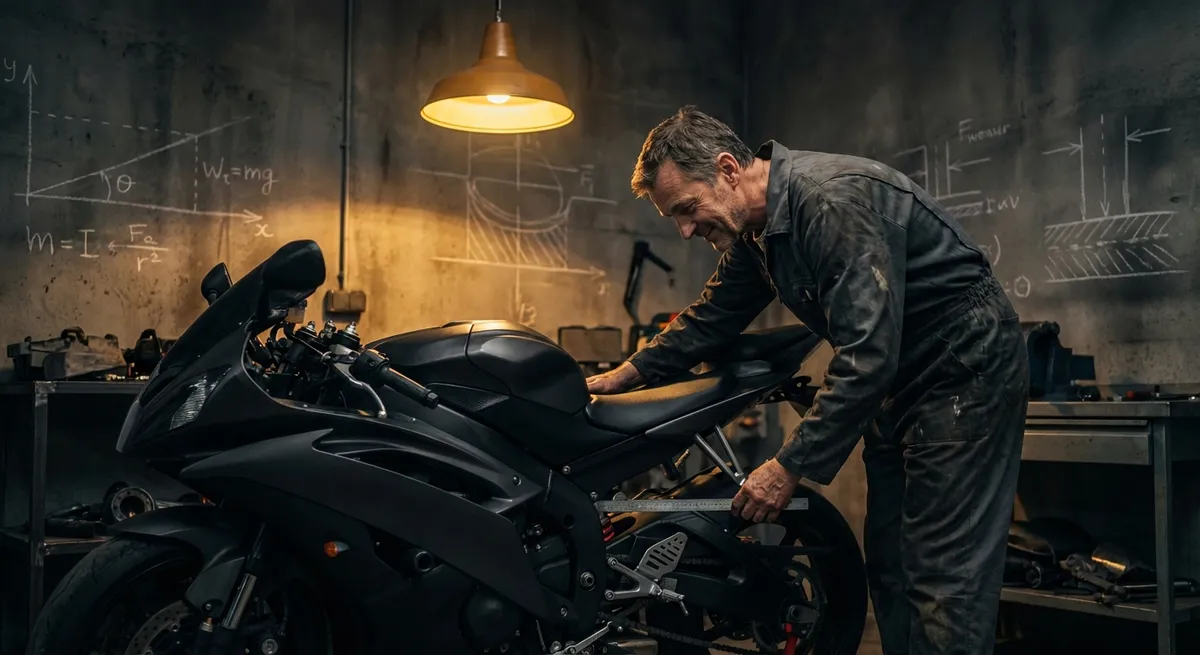
Proper chain slack must be measured at the tightest point in the rotation, not just “somewhere in the middle.” Rotate the wheel slowly and find the point of maximum tension, then set slack within the manufacturer’s spec at that position. Too tight, and you’re transferring shock loads into countershaft bearings and rear hub bearings every time the suspension compresses. Too loose, and you get lash, inconsistent throttle response, and accelerated sprocket wear.
Lubrication isn’t about making the chain shiny—it’s about reducing boundary friction and protecting O-rings or X-rings that trap the factory grease. Clean with a soft brush and a dedicated chain cleaner or kerosene (check the manufacturer’s recommendation), then apply a chain lube that leaves a tacky film instead of a dry dust magnet. The goal: a thin, uniform film on the rollers and side plates, not big globs that fling.
Watch sprocket teeth like a machinist, not a casual owner. Hooked teeth (leaning in the direction of rotation) or a “shark fin” profile mean the pitch relationship between chain and sprocket is failing, even if the chain still “looks okay.” Replace chain and both sprockets as a set; mixing old and new just accelerates wear. For hard riders or those running higher torque loads (tuned engines, frequent two-up, or loaded touring), consider moving to a higher-grade X-ring chain with known tensile strength and better fatigue characteristics.
2. Brake System Integrity: Controlling Heat, Pressure, and Pad Chemistry
Brakes are a thermodynamic system: turning kinetic energy into heat and managing where that heat goes. Maintenance here is about preserving predictable friction and consistent hydraulic behavior.
Brake fluid is hygroscopic—it absorbs water over time. That water lowers the boiling point of the fluid and corrodes internal components. Replace brake fluid at least every two years (more often if you ride hard in mountains or on track). Use fresh, sealed DOT-rated fluid that matches or exceeds OEM spec; once opened, a bottle should be treated as short-life due to moisture absorption.
Pay attention to lever feel changes over time. A spongier lever can indicate entrained air, deteriorating rubber lines, or moisture-laden fluid. Braided stainless lines don’t just “feel better”; they reduce volumetric expansion under pressure, providing more linear pressure transfer to the caliper and more repeatable braking performance, especially under heat.
Pad selection is a materials decision: organic, semi-metallic, and sintered pads each have different friction curves as temperature rises. Sintered pads typically offer stable performance under high heat, but can be more aggressive on rotors. Street riders who ride in variable weather may prefer pads with better cold bite and progressive feel, while track riders generally favor high-temp stability and resistance to fade. Whatever you choose, bed them in properly: controlled, progressive stops that gradually heat-cycle pads and rotors to establish an even transfer film.
Inspect rotors for blueing (localized overheating), radial cracks, or measurable runout. Pulsation at the lever under light braking can indicate rotor warp or uneven pad deposition, not always a “warped disc” in the classic sense. Use a dial indicator if you want to be precise; specs are often in the 0.1–0.3 mm range. Keep caliper pistons and slide pins clean and lightly lubricated with high-temp brake grease where specified—sticking pistons can create uneven pad wear and unpredictable braking behavior.
3. Engine Oil as a Dynamic Component, Not a Consumable
Engine oil isn’t just “changed every X miles”—it is an active structural component in a high-shear, high-temperature environment. For motorcycles with shared sumps (engine + gearbox + wet clutch), the oil is doing triple duty: lubrication, cooling, and friction management.
Viscosity ratings (e.g., 10W-40) are more than numbers—they describe how the oil flows at cold and hot temperatures. Follow the manufacturer’s viscosity range, but tune your choice to your real environment. If you ride in high ambient temperatures or under sustained high-load conditions (track days, long highway climbs), an oil at the upper end of the recommended viscosity range, and with a robust high-temperature high-shear (HTHS) rating, will better maintain film strength.
Only use oil meeting JASO MA or MA2 (for wet-clutch bikes). Automotive oils with friction modifiers can cause clutch slip, especially under heavy load. Synthetic vs. semi-synthetic vs. mineral is about base stocks and additive packages, but the real performance lies in shear stability and resistance to viscosity breakdown from gearbox gear mesh. A good motorcycle-specific synthetic can maintain its viscosity longer under repeated high-RPM use.
Analyze your riding pattern before choosing intervals. Short, frequent cold rides contaminate oil with fuel and moisture, making calendar time as important as mileage. Extended high-RPM riding accelerates oxidation and additive depletion. Riders who alternate commuting with spirited weekend use may benefit from changing slightly earlier than the upper bound of the OEM interval, especially on high-compression or high-revving engines.
Filter selection matters. A quality filter with proper bypass valve operation maintains oil flow even when clogged or under cold-start high-viscosity conditions. Cheap filters can fail internally, collapsing media or bypassing at the wrong pressures. If you’re pushing hard—hot climates, track work, or heavily loaded touring—match a premium oil with a filter that has known test data and OEM or better flow specs.
4. Suspension Health: Preserving Damping Precision and Chassis Geometry
Suspension is where comfort, grip, and stability intersect—and it’s one of the most neglected parts of the bike from a maintenance standpoint. Oil inside your fork and shock degrades over time from shear, thermal cycles, and contamination from seals and wear particles.
Fork oil isn’t immortal. As it degrades, damping characteristics shift: you may experience more brake dive, harsher response to sharp bumps, and a vague or unsettled front end. Manufacturers often suggest fork service intervals that are optimistic for aggressive riders. If you ride hard, hit rough surfaces regularly, or weigh significantly more or less than the “average rider” used for baseline tuning, periodic fork oil changes (often in the 15,000–25,000 km / ~10,000–15,000 mile range, or every few years) keep the damping curve predictable.
Inspect fork seals for any oil film on the inner tube. A single bug or speck of grit can compromise a seal; using a seal cleaning tool or a thin plastic strip can often resolve minor seepage before it becomes a full leak. Pitting or corrosion on fork tubes can shred seals—keep tubes clean and consider light corrosion protection if you ride in harsh environments.
Rear shocks are often forgotten because they’re less accessible. Many OEM shocks are technically “non-serviceable,” but in practice, many can be rebuilt by specialists. As shock oil aerates and wears, rebound control degrades, and you’ll feel the rear “pogo” or wallow, especially in fast transitions or on bumpy corners. If your bike has adjustable preload, compression, and rebound, record your baseline settings before any service so you can return to a known good setup.
Suspension health also ties into chassis geometry. Sag (static and rider) determines how much travel is available in each direction and how your rake/trail values behave under load. Worn springs, leaking shocks, or improperly set preload shift weight balance, change steering response, and alter front/rear grip distribution. Regularly check sag values when you change riding configurations (solo vs. two-up, luggage vs. bare), and treat suspension maintenance as a performance and safety priority, not an afterthought.
5. Electrical System Reliability: Managing Voltage, Not Just “Does It Start?”
Modern motorcycles are rolling electrical networks: ECU, ride-by-wire, IMUs, ABS, TFT dashboards, heated grips, auxiliary lights, charging ports, and more. Reliability here is about stable voltage, low-resistance connections, and proper load management.
The battery is the foundation. Measure charging voltage at the terminals with the engine running at around 3–5k rpm; most systems should produce roughly 13.5–14.5 V. Too low suggests stator or regulator/rectifier problems; too high risks overcharging and cooking the battery and electronics. Age your battery by behavior, not just years—slow cranking, repeated resets, or intermittent ABS/TC lights can be early symptoms of low voltage under load.
Keep terminals clean and tight, with a light coat of dielectric grease on exposed connections to fight corrosion. Any time you add aftermarket electrical accessories, calculate their combined current draw and compare it to the alternator’s output and the bike’s base consumption. Overloading the system causes marginal voltage situations at idle or low RPM where the alternator output is reduced.
Inspect wiring harness routing, especially near steering head pivots and high-movement areas. Repeated flexing can cause internal conductor fatigue even if insulation looks okay. Look for chafing where harnesses pass near sharp edges or tight gaps. Use proper loom, grommets, and mounts instead of zip-tying wires to random brackets.
Ground paths are often the silent killers of reliability. A loose or corroded main ground strap can cause bizarre sensor readings, weak spark, or intermittent faults. Periodically detach key grounds, clean contact surfaces to bare metal (if applicable), and reattach securely. For CAN-bus equipped bikes, avoid hacky splices and “backyard” taps; use approved connectors or dedicated accessory circuits to maintain signal integrity.
Conclusion
Real maintenance is applied engineering. It’s looking at your motorcycle as a system of interacting loads, fluids, temperatures, and signals—then making deliberate, technical choices that stack the odds in your favor every time you roll out.
When you maintain chain tension to protect bearings, choose brake fluids and pads for heat management, treat oil as a structural component, keep suspension damping within spec, and manage your electrical system like a power engineer, you’re not just “keeping the bike running.” You’re shaping how it feels at full lean, full brake, and full commitment.
That’s the difference between owning a motorcycle and engineering one that stays ready—every start, every corner, every season.
Sources
- Motorcycle Owner’s Manuals – Honda Powersports – Official service intervals, torque specs, and fluid recommendations from a major OEM
- Yamaha Technical Information – Chain and Sprocket Care – OEM guidance on correct chain adjustment and lubrication principles
- NHTSA Motorcycle Safety – Braking and Control – U.S. government information on motorcycle safety systems and braking behavior
- Penn State – Tribology and Lubrication Basics – Educational material on friction, wear, and lubrication that underpins engine oil and chain lube behavior
- Öhlins Motorcycle Suspension Service Information – Official suspension manuals detailing service intervals, damping concepts, and setup fundamentals
Key Takeaway
The most important thing to remember from this article is that this information can change how you think about Maintenance.