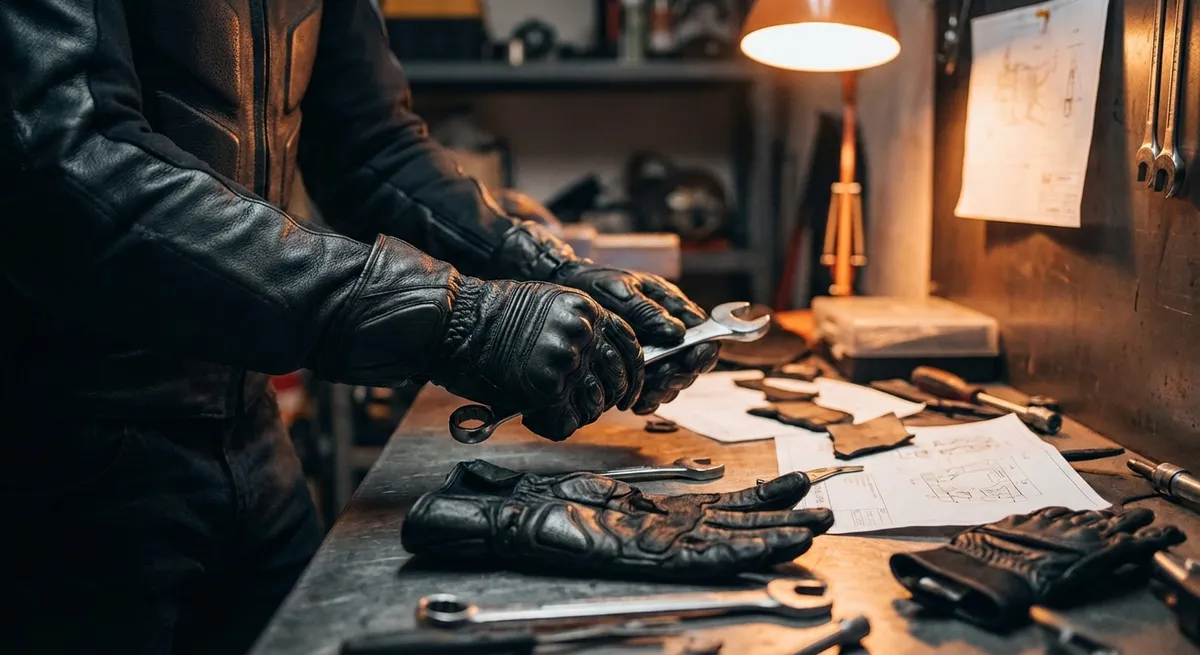
Your hands are your primary interface with the machine. They read front-end feedback, meter throttle, and modulate brake pressure down to the gram. Yet gloves are usually the last thing riders obsess over—until the first real crash, or the first hour-long slog in cold rain when you can’t feel the levers.
This isn’t just about “good protection” or “comfortable fit.” High-performance gloves are a system: impact management, abrasion resistance, tactile feedback, moisture control, and mechanical leverage, all working together. Dial that system in, and your riding becomes smoother, more precise, and far safer—without sacrificing feel.
Let’s break down the tech that actually matters.
1. Impact & Slide: Understanding How Gloves Really Fail
Most riders think glove protection is “hard knuckles = safe.” That’s incomplete at best.
In a real crash, your hands don’t just hit once; they impact, twist, and slide. A glove has to handle all three phases:
- Initial impact – when you instinctively throw your hands out or punch the ground/bar.
- Abrasion and heat – as your hand slides across asphalt.
- Torsion and tearing – when the palm catches on something and the material wants to rotate or split.
Key technical details to look at:
- Palm material layering
- Premium race gloves often use kangaroo leather in the palm because it delivers high abrasion resistance at lower thickness than cowhide, preserving feel.
- Reinforcement panels (double or triple layers) at the heel of the palm and outer pinky edge are critical; these zones hit first in a slide.
- Scaphoid sliders vs pure leather padding
- The scaphoid bone (inside of your wrist near the thumb) is a frequent fracture point.
- Hard scaphoid sliders are designed to promote sliding instead of grabbing the asphalt. When leather or soft foam catches, it can cause wrist hyperextension or rotational injuries.
- A good slider is low-friction, well-shaped, and solidly anchored with strong stitching or rivets.
- Knuckle and finger armor that can move
- Thermoplastic or carbon knuckle protection should be mounted on a floating panel so it can track with your hand movement.
- If the armor is locked in place, it can “lever” against your hand in a crash or restrict finger curl, reducing precise brake input.
- Stitching architecture
- External seams on the fingers reduce pressure points and blistering but must use high-tensile, heat-resistant thread (often bonded nylon or Kevlar) and multi-row stitching.
- The first thing that fails in many cheap gloves isn’t leather—it’s thread. When stitching blows out, the glove unzips around your hand.
- Certification standards (EN 13594)
- Gloves tested to EN 13594:2015 are assessed for impact absorption, abrasion, seam strength, and joint coverage.
- Levels:
- Level 1: Basic performance.
- Level 2: Higher abrasion/impact thresholds.
- Look for certification labels if you ride aggressively or at trackdays; it’s one of the few objective metrics we have.
Technical takeaway: A serious glove is designed to slide, not grab; to stay structurally intact even when the leather is thinning; and to let your hand move naturally under and around the armor.
2. Lever Feel, Grip, and Friction: Engineering Control Through Your Fingers
You don’t just “wear” gloves; you’re transmitting highly nuanced commands through them. If friction, fit, or padding is wrong, your braking and throttle inputs become digital instead of analog.
Think about glove tech in terms of friction coefficients and mechanical leverage:
- Palm thickness vs tactile feedback
- Thicker palms isolate you from vibration and reduce fatigue but dull the micro-feedback from the lever and bar.
- For performance riding, look for thinner palms with reinforced zones, not uniform padding.
- High-end race gloves usually feel “too thin” to casual riders—until they notice how precisely they can trail brake and roll on throttle.
- Material friction against controls
- Synthetic palms (Clarino, Amara, etc.) can offer very consistent friction levels, especially when damp, which helps in rain.
- Leather tends to polish over time; if it gets too slick, your fingers may slip under hard braking or in the wet.
- Some gloves add silicone grip prints on the fingertips; these can help, but if overdone they can “grabby-up” your inputs and feel unnatural.
- Pre-curved finger design
- A properly pre-curved glove naturally rests in a semi-grip shape.
- This reduces flex effort while holding the bars and improves fine motor control under fatigue, especially on sport and naked bikes with more forward lean.
- Articulation panels and stretch zones
- Accordion panels on the fingers and back of the hand add range of motion without stretching the main structural leather.
- For braking performance, you want finger flex to be low-resistance, so your forearm loads stay minimal and you avoid pump on long descents or track sessions.
- Seam placement for braking fingers (index + middle)
- Internal seams rubbing on your finger pads create hot spots, which unconsciously change how you pull the lever.
- Performance-oriented gloves often use external or offset seams on index/middle fingers to keep the contact surface clean and predictable.
Technical takeaway: Glove design directly affects how you brake, how you feed in throttle, and how long you can ride at pace before fatigue corrupts your inputs.
3. Retention Systems: Why Gloves Come Off in Crashes (and How to Prevent It)
One of the most brutal failure modes: the glove isn’t destroyed—the rider’s hand just slides out of it.
In many crash tests and real-world incidents, glove ejection is traced to weak or missing retention systems. You’re looking for a multi-stage retention strategy:
- Primary wrist closure (inner strap)
- This should sit low on the wrist, under the protruding wrist bones, so it can’t just slide off over your hand.
- It needs to be tight enough that you have to deliberately unstrap it to remove the glove—if you can pull the glove off without touching the strap, it’s too loose or poorly designed.
- Secondary gauntlet closure (outer strap or cinch)
- On full-gauntlet gloves, the outer closure locks the whole system in place over or under your jacket cuff.
- Ideally, this strap doesn’t just compress foam; it cinches down across structural leather panels that wrap around the wrist.
- Coverage and overlap with jacket
- Glove cuffs and jacket sleeves must overlap significantly; gaps become weak points.
- For track or aggressive street use, gauntlets offer better integration and less chance of the jacket sleeve pushing the glove off on impact.
- Velcro quality and stitching
- Cheap hook-and-loop wears out fast; once it loses bite, your retention system is compromised.
- Check that Velcro is border-stitched (stitched around edges), and not just glued and tacked.
- Pull tab robustness
- The small tab you grab to tighten the strap is often a structural weak spot.
- If that tears off, you can’t tension the glove properly. Look for reinforced tabs with multiple stitch lines or laminated layers.
Technical takeaway: A glove that fits well but lacks secure retention is almost useless in a violent crash. Treat wrist and gauntlet systems like you treat a helmet’s chin strap: non-negotiable.
4. Climate Control: Thermoregulation, Moisture, and Long-Distance Function
Riding comfort isn’t vanity—it’s a performance variable. Numb, sweaty, or frozen hands destroy your fine-motor precision and reaction time.
Think like an engineer: gloves must manage heat transfer, moisture movement, and airflow.
Hot weather / high exertion
- Perforation mapping
- Random perforations look sporty but can create weak zones in high-abrasion areas.
- Better designs keep the palm mostly solid, with perforation on the fingers, side panels, and back of the hand—areas less likely to grind against asphalt in a slide.
- Inner lining and wicking
- A good summer glove uses a thin, hydrophilic inner layer that pulls sweat away from your skin towards the outer layers where it can evaporate.
- Poor liners bunch, twist, or delaminate, creating pressure points and reducing feel.
- Vent channels in armor
- Some advanced knuckle and finger protectors incorporate vents and channels to funnel air over the top of the hand.
- This helps manage sweat without sacrificing protective shell coverage.
Cold and wet conditions
- Insulation without bulk at control zones
- High-quality winter gloves focus bulk on the back of the hand and knuckles (where wind hits) while keeping palms thinner for control.
- Look for differentiated insulation mapping—more on the dorsal side, less on the palmar side.
- Waterproof membranes (Gore-Tex, D-Dry, Hydratex, etc.)
- These rely on a micro-porous or monolithic membrane that lets water vapor (sweat) escape but blocks liquid water.
- Crucially, the membrane must be properly bonded or layered; if it floats and twists, you lose tactile precision and can’t get the glove on/off easily when damp.
- Cuff strategy with waterproof gear
- For heavy rain, integrating glove and jacket correctly matters more than brand logos:
- Over-the-cuff gloves (gauntlet outside jacket): Better at stopping rain from dripping into glove when hands are down.
- Under-the-cuff gloves: Better at keeping water from running up the arm in extended highway rain.
- The right choice depends on your jacket design and how you ride, but you must think of the system, not the glove alone.
Technical takeaway: Choose glove architecture based on real thermal loads and riding conditions, not just labels like “summer” or “winter.” Poor climate control will quietly erode your control inputs long before you feel “unsafe.”
5. Fit, Ergonomics, and Long-Term Performance: Tuning Gloves to Your Riding Style
Two riders can wear the same glove model and experience completely different performance. Hands vary in palm width, finger length ratio, thumb angle, and even knuckle placement.
Treat glove selection like a fitment exercise, not a fashion choice.
- Finger length and curvature alignment
- When you curl your fingers into a bar-grip shape, the glove’s finger padding and armor should line up with your joints.
- If knuckle protectors sit between joints or restrict flex, they’ll cause fatigue and can even shift during a crash.
- Palm width vs excess material
- Excess leather bunching in the palm acts like a soft spacer between you and the bar.
- Over time, those folds can harden into ridges and create pressure points. In aggressive riding, they reduce your ability to read front-end feedback.
- Thumb articulation and control reach
- A cramped or over-stretched thumb design makes it harder to use indicator switches, horn, and starter with precision, especially on ADV and touring bikes with larger switchgear.
- Look for gusseted or stretch-panel thumbs if you have a wider grip or ride with larger bars.
- Break-in behavior of materials
- Full-grain leather stretches and molds to your hand; synthetic-heavy gloves stay closer to out-of-box fit.
- A performance leather glove should start snug but not circulation-cutting, with the expectation it’ll loosen slightly. If it’s already loose in the shop, it may feel sloppy after a month.
- Use-case matching: street, touring, ADV, track
- Track / aggressive sport: Prioritize tactile feedback, high-end scaphoid/pinky protection, long gauntlet, Level 2 or race-derived designs.
- Touring / commuting: All-day comfort, weather management, good but not necessarily race-spec armor; easier on/off and touchscreen capability matter.
- ADV / dual-sport: Balance abrasion (street) with impact (off-road), good wrist mobility for standing on pegs, and robust stitching that can handle frequent flexing and mud.
Technical takeaway: A correctly selected and broken-in glove becomes a calibrated interface between your nervous system and the bike. A poorly fitted one is just an expensive hand muff.
Conclusion
Your gloves are not an accessory; they’re a critical control component. Every time you trail the brake to the apex, feather the clutch in traffic, or catch a rear slide with a precise throttle adjustment, you’re relying on the engineering baked into that thin layer over your hands.
Build your hand setup like you’d build a brake system:
- Understand how it fails (impact, slide, tearing, glove ejection).
- Choose materials and structures that manage real-world loads.
- Match the design to your climate, riding style, and risk envelope.
- Treat fit as a performance variable, not just comfort.
When you finally ride with gloves that get all of this right, the bike feels different—more communicative, more transparent, more alive. That’s when you realize: it wasn’t just you getting better. Your interface finally caught up.
Sources
- [European Commission – Protective Gloves for Motorcyclists (EN 13594 Overview)](https://osha.europa.eu/en/legislation/guidelines/guidance-use-personal-protective-equipment-motorcycling) - Explains standards and testing approach for motorcycle protective gloves in the EU
- [GORE-TEX – How Waterproof Breathable Membranes Work](https://www.gore-tex.com/technology/original-gore-tex-products) - Technical breakdown of membrane construction and moisture management used in many motorcycle gloves
- [NHTSA – Motorcycle Safety Gear and Protection](https://www.nhtsa.gov/road-safety/motorcycle-safety) - U.S. government guidance on motorcycle protective equipment and its role in crash injury reduction
- [Alpinestars – Race Glove Technology Overview](https://www.alpinestars.com/pages/technology) - Manufacturer’s technical descriptions of race-derived glove construction, materials, and impact/abrasion solutions
- [Dainese – Motorcycle Glove Safety and Materials](https://www.dainese.com/us/en/motorbike/motorcycle-gloves/) - Product and technology information covering glove armor, leather types, and design philosophy
Key Takeaway
The most important thing to remember from this article is that this information can change how you think about Gear & Equipment.