Motorcycles rarely fail “out of nowhere.” They whisper for thousands of miles before they scream. The riders who rack up huge, trouble‑free mileage aren’t lucky—they’re fluent in the language of wear. This isn’t basic “change your oil” maintenance. This is about treating your bike like a mechanical dataset, where every mark, sound, and temperature shift is a diagnostic clue.
This guide dives into five technical, high‑leverage maintenance points that serious riders can use to read their bike like an engineer, not a consumer.
1. Chain & Sprocket Forensics: Measuring Beyond the Slack Spec
Most riders only know one chain metric: free play. That’s barely scratching the surface.
A modern O‑ring/X‑ring chain is a precision assembly. As it wears, it doesn’t just “stretch”—the pins and bushings lose material, increasing pitch (distance between links). That change in pitch is what destroys sprockets and introduces harsh driveline lash.
Key technical checks:
- Pitch growth measurement
- Count 20 pins.
- Hook a tape measure or caliper from center of pin 1 to center of pin 21.
- Compare to your chain’s nominal pitch (usually 5/8" = 15.88 mm per link for 520/525/530).
Instead of guessing “this chain feels loose,” measure it:
Example: 20 links × 15.88 mm = 317.6 mm.
If you’re more than ~1% over spec, the chain is done, even if you can still adjust slack.
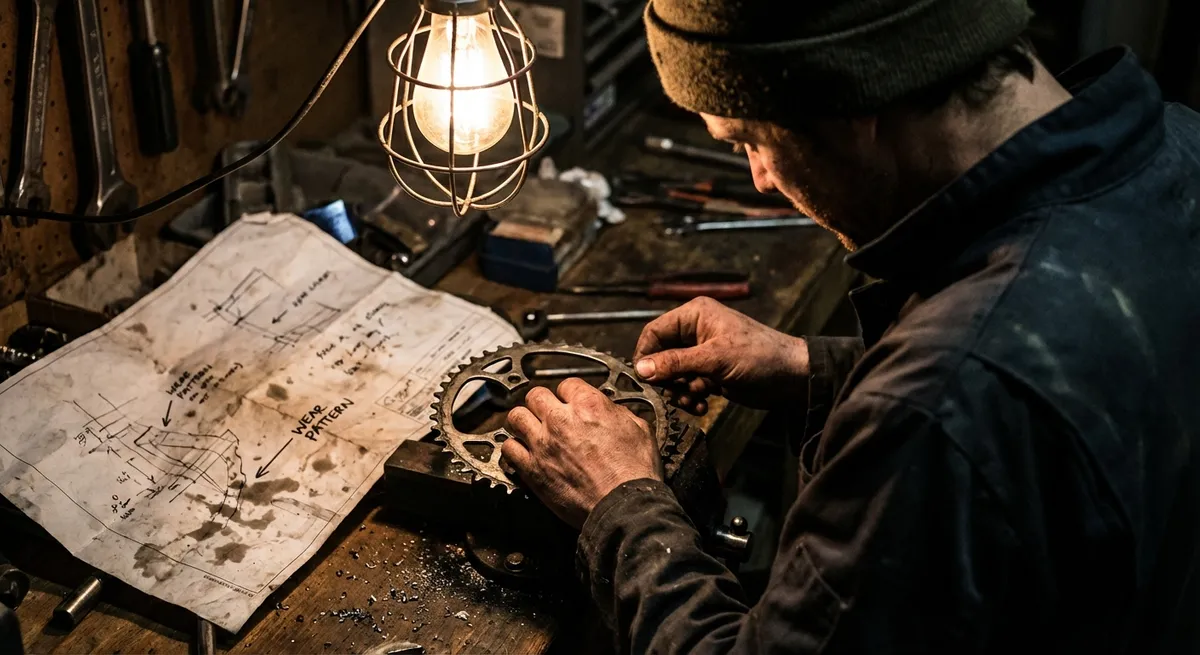
- Hooked sprocket profile
- Healthy tooth: symmetrical, almost “shark fin” but centered.
- Worn tooth: leading edge is thinner and “hooks” in the direction of chain rotation.
- If the hook is visually obvious, replace chain and both sprockets as a set—running a new chain on hooked teeth accelerates wear and can cause jump‑over under load.
- Side wear and alignment
- Measure alignment from swingarm pivot to axle (tape measure both sides).
- Don’t fully trust swingarm alignment marks; they’re often off by a millimeter or two.
- Misalignment increases friction, heat, and can promote chain kinking.
- Lubrication pattern as a diagnostic
- If only the outside plates are wet and rollers are dry, your lube isn’t penetrating or you’re over‑cleaning with harsh solvents.
- If the chain is flinging lube in a perfect band on the rim, but the inner links are rusting, your application technique is wrong—focus at the lower run near the rear sprocket, while slowly rotating the wheel.
Inspect teeth from the side, not just from above:
Uneven wear marks on the sprocket flanks or chain side plates indicate misalignment:
After a long ride:
When the chain and sprockets are right, throttle transitions become cleaner, off‑on corner exits are smoother, and your traction control (if you have it) gets a more stable mechanical input to work with.
2. Brake System Health: Heat, Hydraulics, and Pad Geometry
Brakes don’t just stop the bike—they’re your only real tool to reshape speed. A degraded braking system feels vague, chews up rotors, and can cook fluid on a spirited descent.
Instead of only eyeballing pad thickness, look at the system as a heat management and hydraulic integrity puzzle.
Core checks:
- Pad taper and caliper condition
- Uneven taper (thicker at one end) means the pads aren’t loading evenly.
- Likely causes: sticky slide pins, seized caliper pistons, or misaligned caliper mounting.
- Clean pistons with brake cleaner and a soft brush when extended; dry, then cycle them carefully with lever pressure to ensure even movement.
- Rotor surface and float
- Bluing or rainbow discoloration: localized overheating—often from dragging pads or seized pistons.
- Lateral runout or pulsing at the lever: check with a dial indicator against spec.
- For floating rotors, ensure the bobbins can move—use a bobbin tool or bolt + nut with brake cleaner to free them up (following manufacturer guidance).
- Brake fluid age and performance
- Replace fluid at least every 1–2 years, more often if you ride hard in mountains or track.
- Consider DOT 4 or DOT 5.1 with higher dry/wet boiling points (never mix DOT 5 silicone with glycol fluids).
- Watch for a “longer” lever after repeated hard stops—that’s heat‑soaked, boiling‑prone fluid begging for replacement.
- Lever free play and ratio
- There’s a small amount of free play before pressure builds.
- The lever doesn’t contact the bar under maximum braking with two fingers.
- Poorly adjusted levers can keep the system slightly pressurized, causing pad drag and heat buildup.
Remove the calipers (carefully) and inspect:
Look for:
Brake fluid is hygroscopic—it absorbs moisture, dropping its boiling point and corroding internals:
Adjust your lever so:
Well‑maintained brakes give you a linear, predictable pressure‑to‑deceleration curve. That predictability is what lets you trail brake with confidence and precision on the street without crossing into panic territory.
3. Bearings and Contact Patches: Feeling Drag You’re Not Looking For
Any rotating assembly on your bike—wheels, steering stem, swingarm pivot, linkage—is either helping you or quietly stealing performance. Worn or contaminated bearings show up first as vague handling and extra drag long before they howl or seize.
Technical evaluation steps:
- Front wheel bearings
- Spin the wheel lightly. It should coast smoothly and quietly.
- Grab the wheel at 3 and 9 o’clock; push‑pull to feel for play.
- Any notchiness, grinding, or free play means inspect/replace bearings.
- Steering head bearings
- Gently turn bars from lock to lock. It should be buttery smooth.
- A “center detent” or notchy feel straight ahead is classic tapered roller wear.
- Lightly push the fork legs fore/aft; feel for a knock at the headstock.
- Proper torque on the steering stem is critical—too tight and the bike resists turn‑in; too loose and you get instability under braking.
- Swingarm and linkage
- Grab the rear wheel and lift; feel for vertical play separate from suspension movement.
- Any lateral play or clunk is a red flag for pivot or linkage bearings.
- Greasing schedule matters: many OEMs ship bikes with minimal grease from the factory. If you ride in wet/salty environments, proactive disassembly, cleaning, and proper waterproof grease packing can double or triple bearing life.
- Tire condition beyond tread depth
- Cupping/scalloping on front: often under‑damping, incorrect pressure, or worn suspension bushings.
- Cold tearing on edges: too much load/torque for the compound at the temperature/pressure you’re running.
- “Square” rear profile: lazy turn‑in and a vague mid‑corner feel. The bike will resist lean initiation even if tread remaining looks legal.
With the front wheel off the ground:
Keep the front wheel off the ground:
With the bike supported under the frame:
Serious riders read tires like telemetry:
Bearings and tires define how honestly your bike follows input. When they’re right, the bike will fall into a lean consistently, track true at speed, and require fewer micro‑corrections mid‑corner.
4. Electrical Integrity: Voltage, Grounds, and Real Charging Health
Modern motorcycles are rolling sensor networks. A slightly weak charging system doesn’t just risk a no‑start—it can create ghost issues in ABS, ride‑by‑wire, quickshifters, and dash electronics.
Go beyond “the battery is new” and treat the electrical system as a quantifiable subsystem.
Key electrical checkpoints:
- Battery resting and cranking voltage
- Healthy, fully charged 12 V battery at rest: ~12.6–12.8 V.
- Below ~12.2 V resting regularly means chronic undercharging or aging cells.
- During crank: voltage should stay above ~10 V. Dropping into the 9s or below suggests high internal resistance or a failing battery, even if it still starts.
- Charging system test
- Check voltage across battery terminals.
- Typical healthy range: 13.5–14.5 V at 4–5k rpm.
- Undercharging (e.g., 12.8–13.1 V at revs) will gradually kill batteries and starve systems under heavy accessory load.
- Overcharging (15 V+) risks boiling the battery and frying electronics—regulator/rectifier issues are common on some platforms.
- Grounds and connectors
- Inspect main frame and engine ground straps; remove, clean mating surfaces to bare metal, and reassemble with appropriate torque.
- Look for green/white corrosion on connectors, especially near headstock and under seat.
- For high‑vibration environments, a tiny dose of dielectric grease on non‑sealed connectors can stave off oxidation (never pack sensor pins so heavily that you insulate them).
- Parasitic draw and accessories
- Measure parasitic draw with the bike off and key out (multimeter in series with battery). A few mA for a clock/ECU memory is normal; tens or hundreds of mA will drain a battery over a week or two.
- Use relays and switched power sources for high‑draw accessories to avoid permanent live drains and overloaded circuits.
Using a multimeter:
With the bike at idle and ~4–5k rpm:
Many “intermittent” issues are poor grounds:
If you’ve added heated gear, lights, or nav:
Electrical consistency underpins every advanced feature on modern bikes. When voltage delivery is rock solid, you get crisper fueling, more reliable safety systems, and fewer “mystery” errors that waste riding time.
5. Heat Management: Coolant, Oil Shear, and Real‑World Thermal Load
Engines are heat machines. Their lifespan and behavior are defined by how effectively you control temperature and lubrication quality under your actual riding conditions—not just according to the manual.
Monitor and tune your heat management like this:
- Coolant condition and system integrity
- Change coolant according to time as well as mileage—additive packages degrade even if you don’t rack up miles.
- Use the correct spec (silicate‑free for many aluminum engines; follow your OEM). Avoid random car coolants unless you’ve verified compatibility.
- Inspect radiator fins for bent sections and road debris; carefully straighten with a fin comb.
- Check for dry, chalky residue around hose clamps and water pump weep holes—early sign of leaks.
- Thermostat and fan behavior
- Observe actual coolant temps in different conditions (steady cruise vs city traffic).
- Over‑cooling at speed (never reaching designed operating temp) can be as bad as overheating—fueling, wear, and oil performance all depend on proper temp.
- If the fan engages too late or never, test the temp sensor and fan relay, not just the fan motor.
- Oil viscosity and shear in context
- Use the viscosity grade recommended for your climate and ride pattern, but remember: oils shear down in shared‑sump motorcycle engines faster than in cars.
- Hard, high‑RPM use and wet clutches stress the oil film. Change intervals from the manual assume average use—if you’re routinely pushing into the upper rev range, treat those intervals as a ceiling, not a target.
- Send oil for analysis (e.g., Blackstone Labs or similar services) at least once; you’ll get wear metal data and a reality check on your interval.
- Thermal signatures as diagnostics
- Compare header temps between cylinders at idle and after a short ride; a notably colder tube can indicate a weak/lean/rich cylinder or ignition issue.
- Check brake rotor temps after a spirited ride: one rotor much hotter can confirm pad drag or piston issues.
- Assess radiator and hose temps to spot blocked cores or partially stuck thermostats.
An inexpensive IR thermometer or thermal camera is real‑world gold:
When your cooling and lubrication systems are dialed, the bike holds a stable temp window, oil stays cleaner longer, and performance is repeatable lap after lap—or pass after pass on your favorite road.
Conclusion
Maintenance isn’t a checklist—it’s a language. Every wear pattern, voltage number, rotor color, and bearing feel is a sentence your motorcycle is writing about its internal life. When you start reading those sentences, you stop being surprised by failures and start predicting them.
The payoff isn’t just reliability. It’s feel: smoother driveline response, sharper braking, cleaner turn‑in, more consistent performance. The bike stops being “a machine you maintain” and becomes a system you tune.
The next time you’re in the garage, don’t just look for what’s broken. Look for what’s trending. That’s where real, rider‑level engineering lives—and that’s how you keep your motorcycle truly Moto Ready.
Sources
- U.S. National Highway Traffic Safety Administration (NHTSA) Motorcycle Safety - Background on motorcycle safety factors and the importance of proper maintenance
- Motorcycle Safety Foundation – Owner’s Maintenance Guidelines - OEM-level guidance on basic inspection points and service intervals
- Park Tool – Chain Wear Measurement Basics - Technical explanation of chain pitch growth and wear measurement (bicycle-focused but directly applicable in principle)
- Brembo – Technical Information on Brake Systems - Detailed insight into brake components, heat, and performance considerations
- Penn State University – Lubrication and Wear Fundamentals - Research context for oil film, wear mechanisms, and why proper lubrication strategy matters
Key Takeaway
The most important thing to remember from this article is that this information can change how you think about Maintenance.