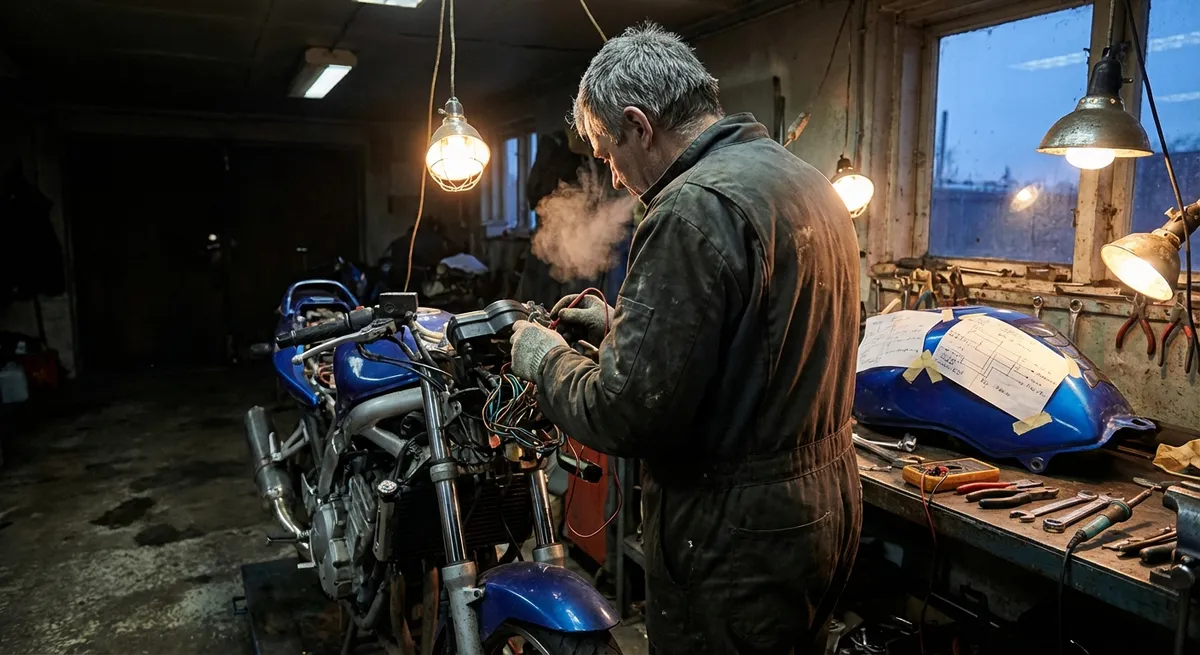
There’s nothing glamorous about a bike that just… works. No launch video. No dyno chart. No hero shots. But ask any serious rider: the real flex isn’t peak horsepower, it’s a machine that fires on the first press of the starter after sitting for weeks, shifts cleanly at redline, and never surprises you with a roadside failure. That isn’t luck—that’s engineered reliability, built in your own garage through disciplined, technical maintenance.
This isn’t a “wash your bike and check your oil” post. We’re going to treat your motorcycle like what it actually is: a tightly integrated mechanical system with tolerances, load paths, thermal cycles, and wear mechanisms you can manage on purpose—not react to after they fail.
Below are five technical pillars of reliability you can actively design into your maintenance routine.
1. Lubrication Strategy: Managing Film Strength, Shear, and Contamination
Oil is not just “fluid in the engine.” It’s a structural component that carries load between moving parts through hydrodynamic and elastohydrodynamic films. You’re not just changing oil—you’re managing film thickness, shear stability, and contamination over time.
Key technical concepts:
- Viscosity vs. temperature curve: That 10W-40 or 5W-30 isn’t a label; it’s a map of how thick the oil stays as it heats. A modern water-cooled inline-four running 12,000+ rpm with tight bearing clearances is engineered around specific viscosity behavior at operating temperature. Deviate too far—especially with cheap or inappropriate oil—and you alter oil film thickness on crank and cam journals.
- Shear stability in shared-sump engines: Most motorcycles share oil between the engine and gearbox. The gearbox’s gear mesh and shift dogs mechanically shear the oil’s viscosity modifiers. That’s why JASO MA/MA2 spec exists: it defines friction behavior for wet clutches and sets limits on how oil behaves under that shear load. Using automotive “energy conserving” oil can cause friction modifiers to contaminate the clutch and alter engagement.
- Oxidation and thermal cycles: Every heat soak—particularly in stop-and-go or high ambient conditions—contributes to oil oxidation. Oxidized oil forms acids and varnish, increasing wear and sticking rings or lifters. Long-interval oil changes that might be acceptable in a car can be brutally optimistic on a high-specific-output bike that regularly sees high rpm.
- Particle contamination and clearances: Tiny wear particles from the gearbox, clutch, and top end circulate in the oil. Filtration is designed around specific particle sizes, but filters don’t catch everything. Once contaminants approach the scale of component clearances (e.g., bearing or ring gaps), they stop acting like dust and start acting like cutting tools.
How to engineer reliability with lubrication:
- Change oil based on hours of operation and thermal severity, not just mileage. A track day at 11,000 rpm is not the same as a Sunday cruise.
- Choose oil that meets OEM viscosity and JASO MA/MA2 or the manufacturer’s specific specification. Deviations should be deliberate and justified (e.g., extreme ambient temps, sustained high load).
- Cut open your oil filter occasionally. Look for metallic flakes, non-ferrous particles, or debris that indicate abnormal wear. Treat this like a lab report on the inside of your engine.
- For bikes stored seasonally, change oil before storage. Spent oil is acidic and moisture-laden; you don’t want that sitting in your engine all winter.
2. Electrical Integrity: Voltage Drop, Contact Resistance, and Ground Paths
Most “mysterious” bike problems are not mysterious—they’re voltage and resistance problems. Your electrical system is a network of potential failure points: connectors, grounds, crimps, and harness routing. Reliability here is about managing contact resistance and voltage stability over time.
Key technical concepts:
- Voltage drop under load: The starter doesn’t care what your battery reads at rest; it cares what voltage is available under load. Corroded terminals or weak grounds increase resistance, dropping voltage and reducing starter torque while hammering the solenoid.
- Contact resistance at connectors: Every connector pin and ground bolt is a resistor that can grow over time due to corrosion, fretting, or looseness. Modern ECUs, ride-by-wire systems, and ABS modules expect stable, clean voltage and signal quality. Intermittent faults often trace back to slight increases in contact resistance.
- Regulator/rectifier thermal stress: Many bikes use shunt-type regulators that dump excess alternator power as heat. Mounting location and airflow matter; a poorly cooled regulator runs hotter, fatigues solder joints, and can fail in ways that overvoltage or undervolt the entire system.
- Ground reference quality for sensors: Sensors like MAP, TPS, or wheel-speed sensors rely on a stable electrical ground reference. A “noisy” or floating ground can make the ECU think conditions are changing when they aren’t, leading to misfires, poor fueling, or random error codes.
How to engineer reliability in the electrical system:
- Perform annual voltage tests:
- Battery at rest.
- Battery during cranking.
- Charging voltage at idle and 3–5k rpm with lights on.
Abnormal readings tell you a lot about battery health and charging system performance.
- Remove and treat major grounds and battery terminals with a proper contact cleaner and, where appropriate, a non-insulating protectant (e.g., light dielectric grease around—but not between—metal contacts).
- Inspect, clean, and lightly treat key connectors—ECU, regulator/rectifier, main fuse block, and ignition switch. Look for discoloration, heat marks, or verdigris (green corrosion).
- Ensure wiring harnesses are properly supported, not hanging by connectors, and not routed where the steering head, seat, or tank can pinch them.
3. Mechanical Interfaces: Fasteners, Preload, and Fatigue
Reliability isn’t just about “tightening bolts.” Mechanical interfaces—axles, triple clamps, engine mounts, brake calipers—depend on correct torque, clamping force, and surface condition to carry loads without loosening or fatiguing.
Key technical concepts:
- Torque vs. clamping force: Torque is only a proxy for the real goal: clamp load. Friction at threads and under the bolt head dramatically affects how much clamping force you actually get for a given torque value. Dirty or lubricated threads will not behave like the dry, clean threads many torque specs assume.
- Load path through critical assemblies: Your forks, swingarm, and wheels form structural load paths that carry braking, cornering, and acceleration forces. Mis-torqued axle pinch bolts or triple clamp bolts can distort components, induce binding, or alter handling precision.
- Fastener fatigue and reuse: Some bolts are explicitly designed as torque-to-yield (stretch bolts); others simply work-harden and fatigue over repeated cycles. Critical engine, suspension, and brake fasteners may need periodic inspection or replacement, especially if they’ve been repeatedly removed.
- Thread engagement and materials: Steel bolts into aluminum castings (engine cases, triple clamps, subframes) are especially susceptible to over-torque and thread pull-out. Proper thread engagement depth and clean threads are crucial.
How to engineer reliability at mechanical interfaces:
- Use a calibrated torque wrench for structural components: axles, pinch bolts, brake calipers, engine mounts, triple clamps, and major chassis hardware. Follow the order and stage torque procedures in the service manual (e.g., tightening sequences for cylinder heads or clamp bolts).
- Clean threads with a nylon or brass brush before reassembly. Match the torque spec to the assumed thread condition (dry vs. lightly oiled) as called out in the manual.
- Replace any visibly stretched, corroded, or galled fasteners—especially on brakes, suspension, and engine internals. Cheap insurance compared to component or rider failure.
- For bikes frequently disassembled (track bikes, adventure builds), keep a log of how many times critical fasteners have been cycled. Periodically renew axle nuts, caliper bolts, and critical structural hardware.
- Respect clamp components that also serve alignment purposes (e.g., triple clamp pinch bolts). Uneven torque can twist fork legs and compromise both handling and fork seal life.
4. Thermal Management: Heat Rejection, Coolant Chemistry, and Material Expansion
Engines don’t just burn fuel—they manage heat. Your cooling system is a deliberately engineered heat-rejection network. Ignoring it doesn’t just risk “running hot”; it quietly accelerates wear, warps components, and weakens materials over time.
Key technical concepts:
- Heat flux and local hot spots: Combustion chambers and exhaust ports experience extreme local heat flux. Coolant passages, oil jets, and fin geometry (on air-cooled engines) are designed to move heat away fast enough to prevent localized boiling or hot spots that lead to pre-ignition and detonation.
- Coolant chemistry and corrosion: Modern coolants include corrosion inhibitors, anti-foam agents, and buffering compounds. Over time, these deplete, and the coolant becomes both less effective at transferring heat and more corrosive to aluminum, magnesium, and ferrous metals.
- Radiator fin efficiency: Bent, clogged, or bug-packed fins reduce surface area and airflow, compromising heat exchange. High-output engines with compact radiators are particularly sensitive to even small airflow losses.
- Thermal cycling and expansion: Engines, heads, exhausts, and even brake components live through thousands of thermal cycles. Improper warm-up or repeated hard use from cold can stress joints, gaskets, and mating surfaces as materials with different expansion rates fight each other.
How to engineer reliability through thermal control:
- Treat coolant like a service item, not a lifetime fluid. Replace it on an interval aligned with the manufacturer’s guidance or more frequently if you ride hard in hot climates.
- Use coolant that meets or exceeds OEM specs—particularly for aluminum compatibility. Mixing random coolants can create additive incompatibilities and sludge.
- Inspect radiators and oil coolers for:
- Packed fins (insects, dirt, rubber from track days).
- Bent fins that block airflow.
- Weeping seams, white or green residue indicating slow leaks.
- Warm the engine with light load, not long idles. Ride gently until coolant and oil reach stable operating temps. Idling excessively can overheat localized regions while the rest of the engine is still thermally uneven.
- For air- and oil-cooled engines, respect airflow: sustained low-speed, high-load operation in hot weather can push them beyond their intended thermal envelope.
5. Rotating Assemblies and Bearings: Preload, Alignment, and Surface Fatigue
Bearings and rotating parts are where reliability goes to die quietly if you’re not paying attention. Wheels, steering head, swingarm, and transmission all depend on correct preload, lubrication, and alignment to prevent surface fatigue and premature failure.
Key technical concepts:
- Bearing preload vs. free play: Tapered and angular-contact bearings (common in steering heads and some wheels) require precise preload. Too loose, and you get play, impact loading, and brinelling; too tight, and you generate excess heat and accelerated wear.
- Brinelling and false brinelling: Tiny dents in bearing races (often from impacts, hard landings, or long-term vibration at rest) create “notches” you feel as notches or stickiness when turning the bars. This directly degrades steering precision and feedback.
- Wheel and sprocket alignment: Misaligned wheels or chain runs introduce lateral loads into bearings and increase wear on chains, sprockets, and tires. Even small misalignments at the axle result in significant tracking issues at speed.
- Surface fatigue in rolling elements: Overloaded or under-lubricated bearings develop micro-cracks that grow into spalling—visible pitting and flaking on races and rollers. Once this starts, failure accelerates quickly.
How to engineer reliability in rotating systems:
- Inspect steering head bearings at least annually:
- Check for notchiness lock-to-lock.
- Feel for play under braking (rock the bike while applying the front brake).
- Adjust preload per the service manual’s torque or drag procedures.
- When servicing wheel bearings, feel them with the wheel off the bike:
- They should rotate smoothly and quietly.
- Any gritty sensation, notchiness, or side play is a replacement, not a “monitor.”
- Check chain alignment with more than just swingarm marks:
- Use an alignment tool or string method.
- Confirm rear wheel tracks cleanly with the front.
- Replace bearings proactively on high-mileage or heavily abused bikes (frequent two-up, track use, or off-road impacts). Bearing sets are cheap compared with the consequences of a failure at speed.
Conclusion
Reliability isn’t a trait your bike either “has” or “doesn’t.” It’s something you engineer—deliberately—through how you maintain it. When you start thinking in terms of film strength instead of just “oil change,” contact resistance instead of “maybe the battery is bad,” and preload instead of “that bolt feels tight,” you move from owner to operator, from rider to engineer.
The payoff is a machine that becomes predictable, trustworthy, and quietly outstanding. It starts every time, shifts cleanly, runs at stable temperature, tracks straight, and communicates clearly through every control. That’s not magic, and it’s not brand loyalty. It’s the quiet science of reliability—and it’s entirely in your hands.
Sources
- [JASO Engine Oil Standards Explained – JALOS](https://www.jalos.or.jp/onfile/pdf/4T_EV1105.pdf) – Official documentation outlining JASO MA/MA2 specifications for motorcycle oils, including friction and shear requirements
- [Motorcycle Maintenance: Lubrication and Bearings – Penn State Extension](https://extension.psu.edu/motorcycle-maintenance-lubrication-and-bearings) – Educational overview of lubrication principles and bearing care relevant to motorcycles
- [Electrical System Diagnostics – Motorcycle Safety Foundation](https://www.msf-usa.org/downloads/MOM_eCourse_Guide_2019.pdf) – MSF guide with sections on basic electrical checks and pre-ride inspection procedures
- [Cooling System Basics – U.S. Department of Energy](https://www.energy.gov/eere/vehicles/articles/fact-936-january-23-2017-coolant-maintenance) – DOE resource explaining coolant function, chemistry, and maintenance intervals
- [Wheel Bearings and Alignment – Transport for NSW Technical Guide](https://roads-waterways.transport.nsw.gov.au/documents/roads/safety-rules/vehicle-standards-information/vsi-27-axles-wheels-tyres.pdf) – Official guidance on wheel bearings, alignment, and load considerations applicable to motorcycle wheel assemblies
Key Takeaway
The most important thing to remember from this article is that this information can change how you think about Maintenance.