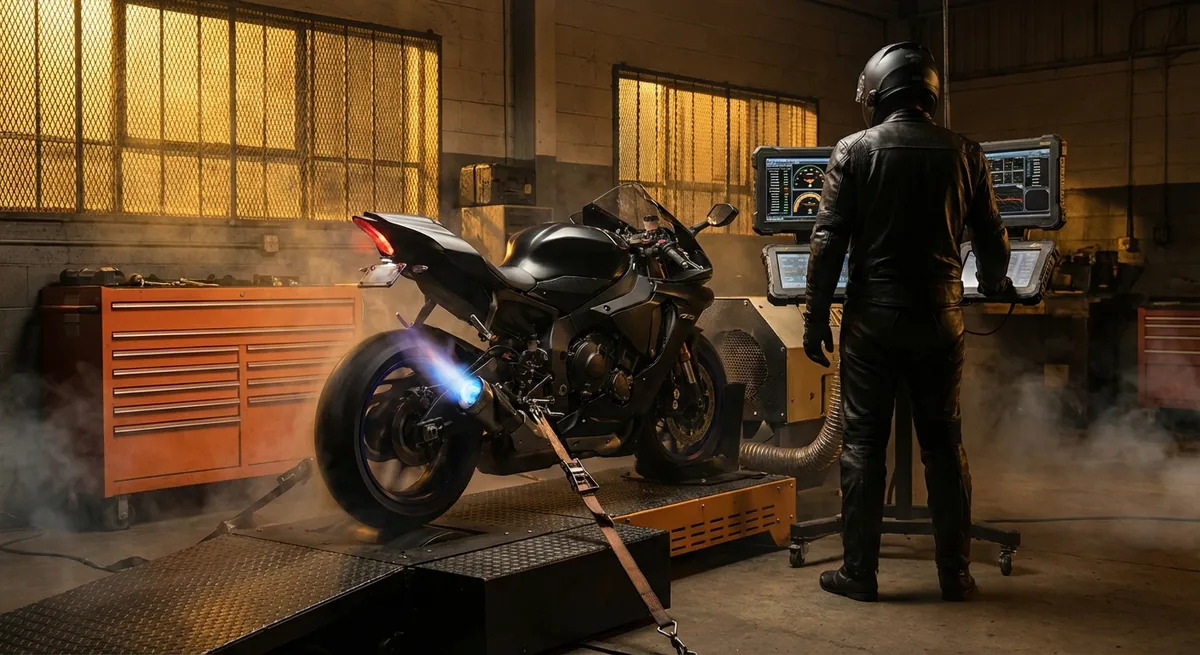
Every spec sheet lies by omission. Power, weight, electronics, “rider aids” — they’re only fragments. What matters is how a motorcycle behaves when you brake late into a downhill decreasing-radius turn, when you trail the lever to the apex, when the tires are hot and your brain is even hotter. At Moto Ready, motorcycle reviews aren’t about memorizing brochures; they’re about stress-testing machines in the exact chaos real riders live in.
This is how we dissect motorcycles as dynamic systems, not lifestyle accessories — with instruments, repeatable test loops, and a ruthless focus on what the rider actually feels at the bars, pegs, and seat.
1. Chassis Dynamics: Reading Flex, Geometry, and Feedback in Motion
A motorcycle’s character is written in its chassis — rake, trail, wheelbase, stiffness distribution, and weight bias. We don’t just list numbers; we translate them into sensations a rider can actually anticipate.
On test routes, we deliberately stack corner types: fast sweepers, mid-speed transitions, and tight cambered corners. We look for how quickly the bike settles after turn-in, how much it fights mid-corner corrections, and whether the chassis stores and releases energy predictably. A well-sorted frame and swingarm combo will compress, hold, and release without oscillation or surprise; a marginal one will wag, stand up on the brakes, or feel “hinged” at the middle under aggressive direction changes.
Steering geometry tells us how tolerant a bike is of imperfect inputs. Steep rake and shorter trail can feel telepathic at pace but nervous on broken pavement; lazier numbers can calm the bike but demand more deliberate inputs. We pay attention to how feedback comes through the bars and pegs — is it filtered and vague, or granular enough that you know when the front is just starting to smear across the asphalt?
The verdict in our reviews isn’t “handles well” vs “doesn’t.” It’s: this is the exact envelope where the chassis shines, this is where it goes vague, and this is the kind of rider who will unlock it rather than fight it.
2. Suspension as a System: Compression, Rebound, and Real-World Damping Windows
Suspension reviews at Moto Ready start with two assumptions: 1) the factory setup is a compromise, and 2) you will ride outside the marketing photographer’s perfect pavement. We test how wide the “usable” damping window actually is — not just whether the fork and shock have clickers.
We begin with static measurements: rider sag front and rear, free sag, and baseline damping positions. Then we run defined segments: sharp-edge impacts (potholes, expansion joints), long-wave heaves, and combined braking-while-leaned scenarios. The goal is to see whether the suspension is primarily spring or primarily damper — budget setups often use stiff springs with underdamped circuits, giving you harshness and poor control.
For compression, we evaluate whether initial movement is free enough to track small surface detail without blowing through the stroke under hard braking. For rebound, we watch what the bike does after a big hit: does it pogo back, pack down under repeated bumps, or settle in one clean motion? With fully adjustable units, we’ll describe our “sweet spot” settings in click counts or turns from full hard/soft, and how those change with riding style or payload.
In reviews, we specify whether a suspension is primarily tunable for comfort, for pace, or genuinely capable of both with proper adjustment or re-springing. We don’t just say “firm” or “plush” — we map what happens to the contact patch when the road stops being polite.
3. Engine Character: Beyond Horsepower, Into Usable Torque and Throttle Strategy
Dyno charts are useful, but they don’t tell you how a bike pulls when you’re one gear too tall coming out of a decreasing-radius turn. Moto Ready engine evaluations focus on torque shape, throttle translation, and how power integrates with the chassis and electronics.
We look at low-rpm tractability: does the engine chug, snatch, or smoothly pull from just above idle? This matters for real-world hairpins and urban work. Midrange is judged by roll-ons in fixed gears — third and fourth from 40–60 mph, for example — to see if the engine responds with urgency or just noise. Top-end is less about peak power and more about how the bike behaves when fully extended: is it composed at redline or does the character fall apart?
Throttle mapping is a major technical focus. We assess how much twist it takes from closed to a given percentage of throttle, whether on/off transitions upset the chassis, and how ride modes actually change that behavior. A powerful engine with a coarse throttle map is harder to ride fast than a milder one with a beautifully progressive response.
We also consider engine braking calibration: how aggressively the bike drags speed off-throttle, especially entering corners. A well-tuned system lets you use engine braking as a tool without overloading the rear tire; a poor one forces constant clutch modulation or ABS interventions.
Our reviews spell out whether the engine is a scalpel for precise corner exits, a hammer for highway passing, or a genuinely versatile tool that can do both without drama.
4. Braking Systems: From Initial Bite to Heat Management and Stability
Brakes aren’t just about stopping distance; they’re about controllability under imperfect inputs. Moto Ready braking tests are built around three pillars: feel, fade resistance, and chassis stability.
We evaluate initial bite and lever progression: does the system respond linearly to pressure, or is it grabby at the top then dead later? On spirited runs with repeated heavy braking zones, we watch for fade — does the lever come back to the bar, does modulation vanish, or does the system stay consistent once the pads and fluid are hot?
We’re equally critical of rear brake tuning. A rear pedal that’s too wooden or too eager to lock/trigger ABS is useless when you’re trying to tighten a line mid-corner or settle the chassis on corner entry. We test rear brake behavior on slight downhill hairpins and low-speed U-turns to see how predictably it can be used as a tool instead of just an emergency backup.
ABS and linked braking systems are judged by intrusion logic and timing. Overprotective ABS that cuts in on smooth, controlled braking over modest ripples costs you feel and distance. We deliberately brake over imperfect surfaces to see whether the system “trusts” a skilled rider or panics at the first sign of slip. Where cornering ABS is fitted, we assess whether it intervenes gracefully mid-lean or shoves the bike upright.
Our reviews translate all this into rider language: this bike rewards one-finger trail braking, this one needs an early squeeze and straight-line decel, and this one can be leaned on hard without the electronics second-guessing you.
5. Electronics and Rider Aids: Evaluating Logic, Not Just Feature Lists
Modern motorcycles live or die by the quality of their software. At Moto Ready, we treat electronics like another component in the dynamic system, not a bullet point. Traction control, wheelie control, power modes, quickshifters, and engine-brake management are all scrutinized under repeatable, controlled abuse.
We test traction control on corner exits with deliberate, progressive throttle application. Good systems let minor, controlled slip occur before gently trimming power; bad ones chop the throttle abruptly, unsettling the chassis and killing drive. Where possible, we test multiple levels to find the mode that allows a skilled rider to ride at pace without feeling strangled.
Quickshifters and auto-blippers are evaluated across the rev range, not just at full-throttle high-rpm shifts. We look for consistency in partial-throttle, mid-rpm corners where a clumsy shift can throw the bike off line. Lag, missed cuts, or harsh re-engagement all subtract from the dynamic polish of the package.
Instrumentation and interface design also matter. We judge how quickly a rider can change key parameters — traction control level, ABS mode, engine map — with gloves on, and whether the dash presents meaningful data (gear, fuel range, coolant temp, real-time consumption) without visual clutter. The best systems make mode changes intuitive and fast, so you adapt the bike to the road instead of bending your ride to the default settings.
In our reviews, electronics aren’t “good” just because they exist. They’re good if they extend the rider’s capabilities without masking fundamental flaws in chassis, engine, or brakes.
Conclusion
A proper motorcycle review should feel like a debrief after a hard ride, not a rephrased spec sheet. At Moto Ready, every machine is treated as a dynamic equation: chassis geometry, suspension behavior, engine character, braking logic, and electronics all interacting under real loads, real heat, and real rider mistakes.
When we say a bike is stable, we mean it stayed composed when we braked deeper than we should have. When we say the engine is friendly, we mean it pulled cleanly out of a wrong-gear corner instead of punishing us. Our goal isn’t to crown the “best” bike in a vacuum; it’s to match specific dynamic personalities to specific riders and roads.
If you ride hard, ride long, or just care how things actually work at the edge of grip, Moto Ready reviews are built for you — passionate, technical, and always grounded in how the motorcycle feels where it matters: on the road, at speed, with your decisions on the line.
Sources
- NHTSA Motorcycle Safety – Braking and Stability - Background on braking, stability, and motorcycle safety considerations from a U.S. government agency
- BMW Motorrad – Riding Modes and Rider Assistance Systems - Technical overview of modern motorcycle electronics and rider aids from a major manufacturer
- Kawasaki – Chassis and Suspension Technology - Explains chassis, frame, and suspension technologies that influence handling characteristics
- Motorcycle Safety Foundation – Basic Motorcycle Dynamics - Educational material on motorcycle dynamics, braking, and control (PDF)
- SAE International – Motorcycle Dynamics Research - Collection of technical papers on motorcycle chassis, suspension, and stability engineering
Key Takeaway
The most important thing to remember from this article is that this information can change how you think about Motorcycle Reviews.