Heat is the silent tax you pay on every mile. It eats oil, cooks wiring, hardens plastics, fatigues metals, and slowly erodes the sharpness of how your bike feels. If you want a machine that pulls hard, shifts clean, and stays trustworthy, you don’t just “change oil and lube a chain”—you engineer its thermal environment.
This isn’t about race paddocks and dyno rooms. It’s about real riders, real roads, and building a maintenance mindset that treats heat like the primary design constraint it actually is.
Understanding Your Engine’s Thermal Envelope
Every engine lives inside a “thermal envelope”: a temperature range where components, lubrication, and clearances behave as designed. Spend most of your time inside that envelope and your machine ages gracefully. Spend too much time outside it, and you accelerate wear in ways that normal service intervals can’t fix.
Combustion temperatures can exceed 2,000°C (3,600°F), but metals, gaskets, and oil never see that directly. Instead, the energy gets managed by conduction (into the head, cylinder, and piston), convection (coolant or airflow), and radiation (out from hot surfaces). Your job as an owner is to maintain every system that controls where that heat goes and how fast it gets there.
Air-cooled engines rely heavily on fin efficiency and oil quality. Liquid-cooled engines add coolant chemistry, pump performance, thermostat behavior, fan control, and radiator cleanliness to the equation. Ignore any one of these, and the whole thermal model skews—manifests as detonation, rough hot idle, cooked clutches, or choppy fueling that mysteriously appears “only when it’s hot.”
Thermal balance maintenance is not a cosmetic detail; it’s core engine health.
Technical Point 1: Oil as a Structural Component, Not Just a Fluid
Oil isn’t only lubrication; in modern motorcycles it’s effectively a structural element of the engine’s thermal and mechanical system. It provides:
- Hydrodynamic film between bearings and journals
- Boundary lubrication for cams, followers, and rings
- Detergent action to keep deposits suspended
- Cooling of pistons, valvetrain, and clutch (in shared-sump designs)
- Corrosion control on internal surfaces
In high-output modern engines, oil temperatures commonly run in the 90–120°C range (194–248°F), and localized surfaces can be hotter. At elevated temps, viscosity drops, oxidation accelerates, and additive packages deplete faster. That’s why “the same mileage” on a cool highway commute is not equal to the same mileage in summer stop‑and‑go traffic.
Actionable, technical maintenance:
- *Select viscosity based on the service manual and your climate profile. If your manufacturer specifies a range (e.g., 10W‑40, 15W‑50), understand that higher hot viscosity grades can protect better under sustained high oil temps—but may affect cold-flow characteristics.
- Respect time-based intervals, not just mileage. Short-trip, high-heat usage (urban, heavy traffic, loaded touring) shears and oxidizes oil faster than long, stable runs. Even if you don’t hit the mileage target, change on time.
- Monitor oil color and smell between changes. Dark is normal; burnt or acrid indicates thermal abuse. Metallic shimmer in drained oil or on a magnetic plug suggests boundary lubrication breakdown or abnormal wear.
- For bikes with oil coolers, periodically inspect lines, fittings, and the cooler core for damage or blockage. Bent fins, caked bugs, or road grime reduce heat rejection efficiency, raising your average oil temperature.
Treating oil as a consumable structural component—not a simple fluid—keeps clearances stable, temperatures predictable, and mechanical sympathy grounded in physics, not folklore.
Technical Point 2: Coolant Chemistry and Real Heat Transfer
Coolant is not “just water with a color.” It’s a precisely engineered heat-transfer fluid plus corrosion inhibitor plus anti-cavitation agent. When you stretch coolant change intervals—or mix random coolant types—you’re quietly sabotaging the heat rejection capacity of your engine.
Key technical realities:
- Ethylene glycol (or propylene glycol) itself is worse at transferring heat than water but provides freeze protection and raises the boiling point. The magic is in the additives: corrosion inhibitors, anti-foaming agents, and buffer chemicals.
- Aluminum heads and radiators are sensitive to pH drift. As coolant ages, its corrosion inhibitors get consumed, and pH can move into a zone where it starts attacking aluminum, solder, and seals.
- Cavitation at the water pump impeller (especially in high-RPM engines) can erode metal and reduce pump effectiveness. Good coolant chemistry reduces this risk.
Precision coolant maintenance:
- Use the correct coolant type: silicate-free for most modern aluminum engines, and exactly what the OEM specifies (HOAT, OAT, etc., if applicable). Avoid mixing types; when switching, fully flush.
- Respect replacement intervals in years, not just miles. Even low-mileage bikes with original coolant for 6–8 years are at risk of corrosion and reduced pump and radiator life.
- Inspect the radiator core and cap. Bent fins and external contamination destroy effective surface area. A weak cap lowers system pressure, dropping the boiling point and increasing the risk of localized boil and hot spots.
- Check hoses for soft spots, bulges, or seepage. Elevated, sustained temperatures accelerate rubber degradation; a hose that “looks okay” from the outside may be structurally compromised.
Stable coolant chemistry is non-negotiable if you want consistent combustion chamber temperatures and knock-resistant operation.
Technical Point 3: Electrical and Charging Systems Under Thermal Load
Most riders don’t connect “heat” with “electrical system,” but the link is direct and brutal. Resistance rises with temperature; insulation ages faster; regulators and stators live in thermally hostile environments. Once your charging system becomes marginal under heat, everything downstream—fuel injection, ignition timing, even ABS—can start behaving erratically.
Key technical relationships:
- Stator windings are immersed in hot engine oil on many bikes. Excess oil temperature pushes insulation toward its thermal limit; any manufacturing weakness or oil breakdown accelerates failure.
- Shunt-type regulators (common on many bikes) dissipate surplus alternator output as heat—and they often sit in poorly ventilated locations. A hot regulator runs less efficiently and can drift out of spec under load.
- Voltage drops under heat cause subtle problems: weak spark under high compression, slower injector response, misbehavior in sensors relying on stable reference voltage.
Targeted maintenance for electrical thermal resilience:
- Measure system voltage at the battery with the engine hot, lights on, and RPM at your typical cruise. You’re aiming for roughly 13.5–14.5 V on most modern bikes. Anything marginal when hot deserves investigation.
- Inspect and clean high-current connections: battery terminals, main ground, starter relay, and regulator/rectifier connectors. Heat plus resistance equals more heat—this feedback loop cooks connectors and looms.
- Ensure your regulator/rectifier has real airflow. If your bike allows relocation or improved ventilation (within manufacturer guidance), do it. Avoid enclosing it with luggage or bodywork that traps heat.
- Route aftermarket electrical add-ons defensively. Additional lights, heated gear, and gadgets increase load. Use relays, proper fuses, and high-quality connectors to avoid hot spots in the wiring harness.
An electrical system that stays stable under thermal stress doesn’t just “start reliably”—it preserves the precision of every sensor and actuator your modern motorcycle depends on.
Technical Point 4: Brake Thermal Management as a Wear Strategy
Brakes convert kinetic energy into heat. That’s the entire job description. When you think of brake maintenance as “pad swaps and fluid every few years,” you’re missing the most important parameter: how you manage brake temperature in actual riding.
Technical behavior of hot brake systems:
- Pad friction coefficients are temperature-dependent. Each compound has an operating window; below it, initial bite may be weak; above it, fade sets in as binders overheat and gas out.
- Rotors store and radiate heat. Warping, glazing, and heat-checking are often the result of repeated high-energy stops without enough cool-down time, not just “old rotors.”
- Brake fluid boils when overheated, turning hydraulic circuits into foam and vapor. That’s spongy lever feel at best, total loss of braking at worst.
Preventive, thermally-aware brake maintenance:
- Use the correct fluid grade (DOT 4, DOT 5.1, etc.) as specified—higher DOT numbers (excluding silicone DOT 5) generally have higher boiling points but may absorb moisture faster. Replace on time; moisture contamination dramatically reduces boiling point.
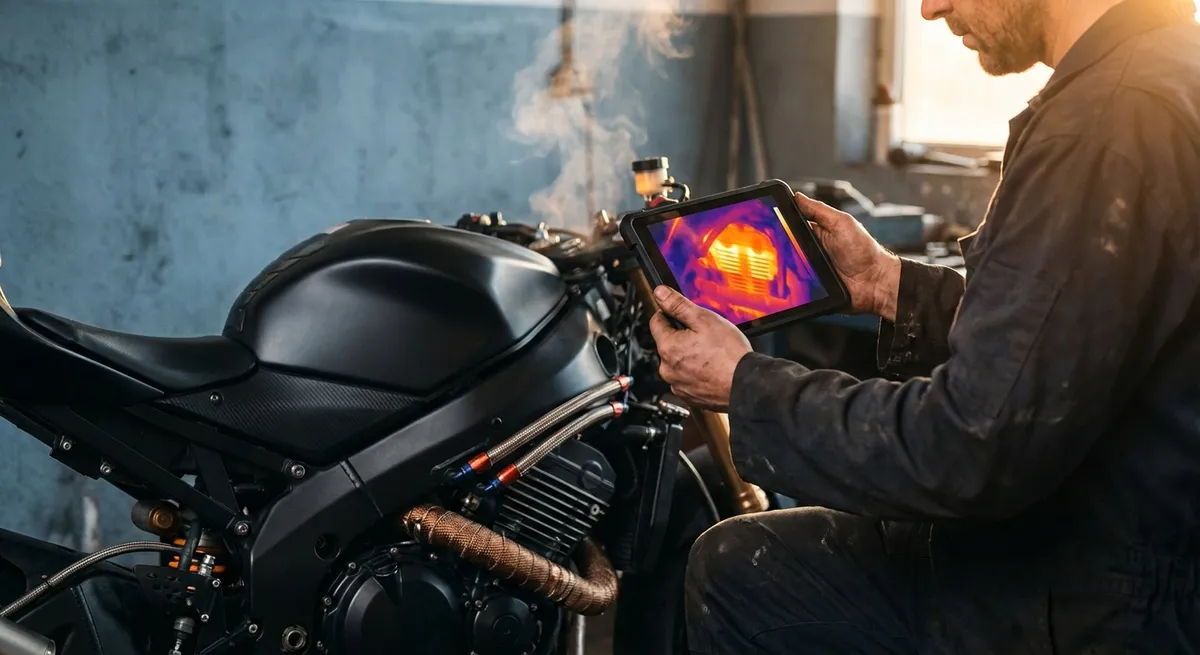
- Inspect pad condition and rotor surface with a heat lens. Bluing on rotors, uneven discoloration, or pad edge crumbling are thermal-injury signatures. They may indicate riding style or stuck caliper pistons causing drag and extra heat.
- Check caliper piston and slide pin freedom. A dragging brake is a self-heating system: more drag → more heat → more expansion → more drag. Tear down, clean, and lubricate as per the service manual.
- Be deliberate in braking technique. Fewer, firmer stops that bring you decisively down from speed, followed by some rolling airflow, are thermally kinder than constant dragging—especially on mountain descents or track days.
Treating the brake system as a thermal machine, not just a friction device, gives you consistent lever feel and rotor life, and protects you from fade at exactly the wrong moment.
Technical Point 5: Driveline Heat, Alignment, and Efficiency
Your chain, sprockets, gearbox, and final drive are all heat machines in disguise. Misalignment, poor lubrication, or incorrect tension doesn’t just wear parts—it converts more of your engine’s output into unwanted frictional heat.
Driveline thermal realities:
- Chain articulation at each link pin generates heat. Dry, contaminated, or over‑tensioned chains create localized high friction, which manifests as accelerated O‑ring failure, stiff links, and more drag.
- Gearbox oil shears under load. Incorrect viscosity or degraded oil increases boundary contact between gear teeth, generating additional heat, especially on long, high-load stints.
- Shaft drives and bevel gears rely on correct hypoid gear oil and proper fill levels; under-lubrication or wrong spec oils can cause localized scoring and heat soak in the final drive housing.
Technical maintenance for a cooler driveline:
- Set chain slack precisely using the service manual procedure, accounting for rider weight and suspension compression. Too tight is worse than too loose from a thermal perspective—it constantly loads countershaft bearings and chain pins.
- Lubricate at realistic intervals for your environment. Wet, abrasive, or dusty use will demand more frequent cleaning and lubing than ideal lab conditions. A lightly oiled, clean chain runs significantly cooler than a dry, gritty one.
- Use the correct spec gear oil for transmissions and final drives. GL‑5 vs GL‑4, viscosity grades, and friction modifiers all matter when tooth load and sliding contact geometry are considered.
- Periodically check sprocket alignment and runout.* Misalignment forces chain side-loads, causing heat at side plates and guides, plus accelerated wear on output shaft seals and bearings.
When your driveline runs cool and efficient, you feel it as clean throttle response, quiet running, stable cruising RPM, and fewer surprises at inspection time.
Conclusion
Every motorcycle is a rolling thermal problem you get to manage. Oil, coolant, wiring, brakes, and driveline components all share one enemy: uncontrolled, unmonitored heat. When you raise your maintenance mindset from “replace worn parts” to “stabilize the machine’s thermal environment,” everything sharpens—response, reliability, and the way the bike feels after 40 minutes in summer traffic, not just the first 5.
Thermal balance isn’t a race-only obsession. It’s the difference between a bike that slowly turns vague, noisy, and fragile, and one that feels mechanically confident year after year. Build your maintenance around heat, and the payoff is simple: more trust at the edge of performance, and more miles where the machine feels as eager as you do.
Sources
- Motorcycle Engine Oil Guide – AMSOIL Tech Article – Detailed discussion of motorcycle-specific oil roles, temperature, and additive considerations
- Coolant and Corrosion in Aluminum Engines – U.S. EPA Archive – Technical information on coolant chemistry, corrosion, and system longevity in liquid-cooled engines
- Motorcycle Electrical System Basics – MSF (Motorcycle Safety Foundation) – Overview of charging system components, failure modes, and inspection practices
- Brake Fluid and High-Performance Braking – Brembo Technical Insights – Explanation of brake fluid boiling points, thermal behavior, and maintenance recommendations
- Motorcycle Chain and Sprocket Care – DID Chain Tech Info – Manufacturer guidance on chain lubrication, tension, and inspection tied to friction and durability
Key Takeaway
The most important thing to remember from this article is that this information can change how you think about Maintenance.