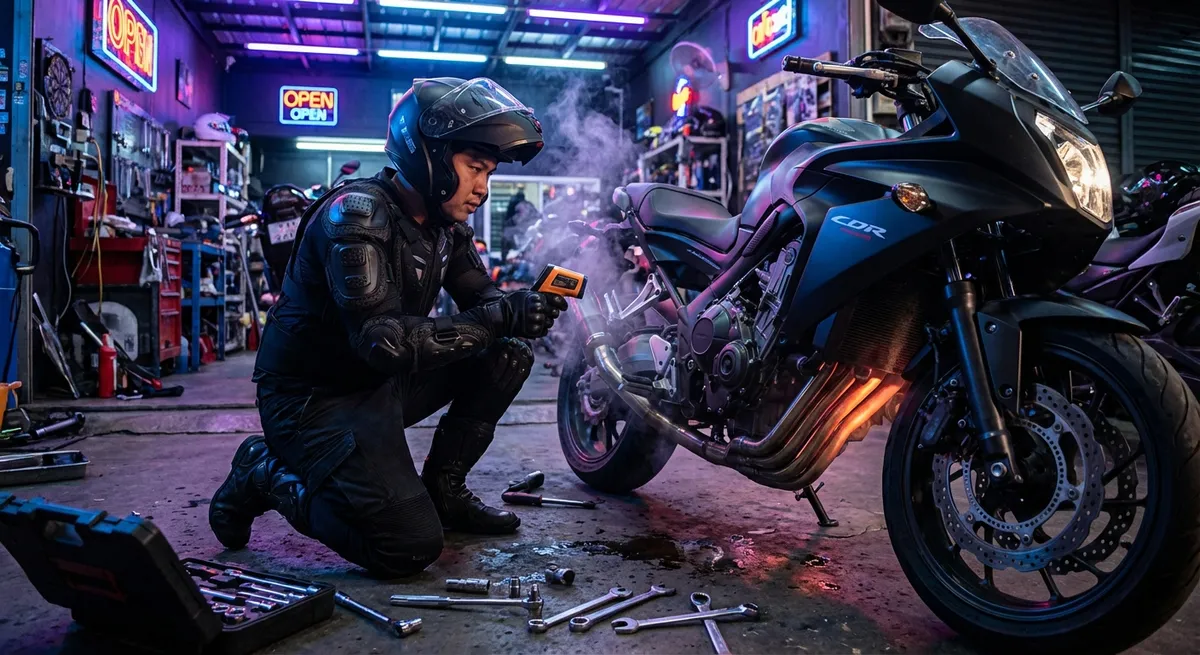
Heat is the silent killer in motorcycle longevity. You don’t hear it failing like a chain, you don’t see it fraying like a tire. But every ride is a thermal event, and if you don’t manage that heat, you’re literally cooking your engine, your oils, your electrics, and even your braking system. The riders who get big, reliable miles out of their bikes don’t just change oil on schedule—they manage temperature like a race engineer.
This isn’t generic “check your coolant” advice. This is about understanding how your bike moves, rejects, and survives heat, and then maintaining it so you can ride hard with mechanical confidence instead of mechanical roulette.
Heat Paths: Understanding Where the Energy Actually Goes
When your engine burns fuel, only a fraction becomes forward motion. The rest turns into heat that must be moved somewhere: into the oil, into the coolant (if liquid-cooled), into the metal, and ultimately into the air.
Understanding these paths turns maintenance from superstition into engineering:
- Combustion chamber → cylinder head → cooling medium
In a liquid-cooled engine, heat flows through the aluminum head into coolant channels, then into the radiator, then into ambient air. On air-cooled or air/oil-cooled engines, fins and oil galleries play the starring role.
- Pistons and rings → cylinder walls → oil and metal mass
The more load and RPM, the more friction and localized hotspots. If oil can’t carry this heat away efficiently, your ring lands, skirts, and even cylinder coatings start to suffer.
- Bearings and gearbox → oil → cases
High RPM + low-quality or old oil = elevated bearing temp, sheared viscosity, and eventual pitting or scuffing. Long before you notice a “problem,” damage is already accumulating.
- Exhaust valves → valve seats → coolant / fins / exhaust gas
Lean mixtures, poor valve clearance, and carbon buildup amplify exhaust valve temperatures. Maintenance here is literally protecting one of the hottest parts in your entire engine.
Once you see the bike as a heat management system, maintenance becomes focused and logical: anything that helps heat escape or prevents it from rising too far is high-value work.
Oil as a Heat Sink: Viscosity, Shear, and Real-World Intervals
Engine oil is not just lubrication—it’s a mobile heat sink. It absorbs heat from pistons, bearings, cams, and gearbox components and transports it to the sump and cases, where it radiates out to airflow and, in some engines, to an oil cooler.
Technical points that matter more than the logo on the bottle:
Viscosity at temperature is everything
Don’t obsess over cold-side numbers (e.g., 10W) unless you ride in real cold. What matters most is the high-temp viscosity rating (the second number, like 40 or 50). That’s your film strength at operating temp. Aggressive riders in hot climates often benefit from the upper end of manufacturer-approved viscosity ranges.
- Shear stability vs. gearbox punishment
Combined engine/gearbox oil (shared sump, common in many bikes) undergoes brutal shear through gear meshes and wet clutches. Cheap oils lose viscosity quickly, meaning your “10W-40” can behave more like a much thinner fluid after hard use. Synthetic oils with high shear stability maintain film thickness longer—especially noticeable if you ride high RPM frequently.
- Oil change intervals: spec vs. usage mode
Manufacturer intervals assume mixed, relatively moderate usage. If you:
- Ride aggressively in hot conditions
- Do frequent short trips with no full warm-up
- Sit in city traffic with high idle temp
…your realistic “thermal” interval is shorter than the book suggests. Riders who value engine life adjust based on heat load, not just mileage.
- Oil temperature vs. coolant temperature
Even if your dash temp looks normal, your oil might be significantly hotter. Long highway pulls at high RPM or slow technical off-road riding can overheat oil without triggering coolant alarms. If your bike supports an oil temp sensor (or aftermarket gauge), it’s a worthwhile data point, especially on performance machines.
Oil level and cavitation risk
Running near the minimum mark doesn’t just reduce lubrication margin—it reduces thermal mass. Less oil = faster heat saturation and higher local temps. Keep it in the upper safe zone, especially for track days, mountain runs, or extended high-speed stints.
Oil maintenance is heat control. Treat every oil service as a recalibration of your engine’s thermal safety net.
Coolant, Radiators, and Pressure: Why Overheating Is a System Failure
Liquid-cooled engines run within a narrow thermal window where clearances, combustion, and oil behavior are optimized. Drift too far above that, and you’re playing with warped heads, cooked gaskets, detonation, and oil breakdown.
To keep the system honest, maintenance needs to go deeper than “yep, there’s fluid in the tank”:
Coolant chemistry actually matters
Modern coolants are engineered for aluminum engines, mixed-metal systems, and high temperatures. Using automotive coolant not approved for motorcycles, or mixing types (OAT, HOAT, silicate-based, etc.), can reduce corrosion protection and heat transfer, or even create sludge. Follow your manufacturer’s spec and avoid random mixing.
System pressure = elevated boiling point
Your radiator cap is a pressure regulator. A healthy cap raises the boiling point of coolant, allowing it to absorb more heat before phase change. A weak cap or damaged seal means lower system pressure and earlier boiling, vapor pockets, and erratic cooling. Replacing an old radiator cap is cheap insurance on any older or high-mileage bike.
Radiator fin density and airflow
Bent, clogged, or bug-caked fins reduce heat exchange area. That translates directly into higher operating temperatures, especially at low speeds. Periodically: - Inspect for bent fins and gently straighten with a fin comb - Rinse with low-pressure water from the back side outward - Avoid high-pressure washers that flatten fins or force water into connectors
Thermostat & fan switch = thermal logic
The thermostat regulates coolant circulation; the fan switch or ECU maps decide when your fan kicks in. A sticking thermostat or lazy fan switch doesn’t always cause immediate, dramatic overheating—often it just raises your steady-state temp. If your bike suddenly “runs a bar hotter” on the dash for no clear reason, don’t ignore it.
Bleeding air: invisible hot spots
Air pockets in the cooling system are insulators. They cause localized hot spots that your gauge may not show. Any time you drain coolant, follow the factory bleed procedure (tilt angles, bleed screws, running the engine with cap off as specified). Skipping this turns maintenance into a slow-fuse failure.
Liquid cooling maintenance is about maintaining a well-pressurized, high-efficiency heat conveyor. When done right, your temperature gauge becomes boring—which is exactly what you want.
Braking Systems and Heat: Pads, Fluid, and Fade Resistance
Your brakes are engineered heat absorbers. Every time you brake hard, kinetic energy is converted directly into thermal load in rotors, pads, calipers, and fluid. Manage that heat, and your stopping power stays crisp. Neglect it, and you risk fade, glazing, and fluid boil.
Key technical points that serious riders should maintain around:
- Pad compound vs. thermal behavior
- Organic pads: Quicker bite, quieter, often less rotor wear but can fade faster under high heat.
- Sintered: Better high-temp performance, more consistent under repeated hard braking, but potentially more rotor wear.
- Track-only compounds: Designed to operate at higher temps; they can be mediocre when cold on the street.
Choose the compound that matches your real-world heat profile—commuting, mountain carving, track, or touring with luggage.
Rotor condition and cooling efficiency
Warped or heavily scored rotors don’t just affect lever feel; they can cause uneven heat distribution and localized hot spots. Floating rotors need free-moving buttons to expand and contract with heat—if they’re seized with corrosion, thermal stress concentrates and warping risk increases.
Brake fluid boiling points and water absorption
DOT 3, 4, and 5.1 fluids are hygroscopic—they absorb water over time. Water dramatically drops the boiling point, so under hard braking the fluid can partially vaporize, causing a soft or disappearing lever: classic brake fade. Riders who: - Brake aggressively - Ride mountains/track - Or live in humid climates should treat brake fluid changes as heat management, not just a “fresh fluid” ritual.
Caliper service and drag-induced heat
Sticky caliper pistons or dry slide pins cause pad drag. That drag is constant friction, feeding constant heat into your rotors and pads—even off the brakes. Regular caliper cleaning, piston movement checks, and lubrication of slide pins (where applicable) directly reduce unnecessary heat and improve brake feel.
Lines and expansion under heat
Old rubber lines expand more when hot, which softens lever feel right when you need maximum precision. Stainless braided lines reduce expansion, improving consistency under sustained high-temp braking—especially valuable for spirited or heavy bikes.
Maintaining your braking system with a heat-aware mindset is the difference between confident late braking and hoping the lever doesn’t come back to the bar on a long downhill.
Electrics, Charging, and Heat-Loaded Components
Electrical systems don’t usually fail dramatically until they’ve been cooked for years. High current, poor connections, and restricted airflow all convert electricity into unwanted heat in your stator, regulator/rectifier (R/R), and wiring harness.
Understanding these as heat-generating components reframes your maintenance strategy:
Stator as a permanent heat source
The stator sits in a bath of hot oil, generating current and heat every time the engine turns. High loads (aux lights, heated gear, accessories) increase current and thermal stress. Darkened varnish on windings or “burnt” smell during inspection is a thermal history lesson: it’s been running too hot.
Regulator/rectifier placement and cooling
The R/R converts AC to DC and shunts or manages excess voltage—dumping the surplus as heat. It needs airflow and solid mounting to a heat-sinking surface. Corroded mounting points or relocation into a low-airflow pocket traps thermal energy and shortens lifespan. If you upgrade to a modern MOSFET or series-type R/R, treat placement like you would a mini radiator.
Connectors and resistance heating
Any connector with corrosion or poor crimping becomes a resistor. Resistance in a high-current circuit = localized heat. Over time, this can: - Melt connector housings - Harden insulation - Cause intermittent charging or ignition issues Periodically inspect high-load connectors (stator-R/R, R/R-battery, main ground) for discoloration, melting, or hardened insulation.
Battery health under thermal cycling
Lead-acid and AGM batteries hate chronic heat. High under-seat temps, constant fast-charging from weak batteries, and poor ventilation shorten life. Lithium batteries tolerate heat differently but have stricter charging requirements—pair them with a healthy, well-regulated charging system, or you’re stressing their internal protection circuitry.
Load management and safety margin
Don’t run your charging system at the edge of its capacity. Adding high-draw accessories without considering stator output and R/R capacity is inviting thermal overload. Build in a margin: aim to use significantly less than the system’s rated output at cruising RPM, not at idle.
Electrics are another thermal conversation. Cool, well-connected, and properly loaded electrical components are boringly reliable—the best kind of reliable.
Conclusion
Every time you twist the throttle, you’re lighting a controlled thermal bomb and trusting your motorcycle’s systems to tame it. Maintenance is not just about “keeping it running”; it’s about controlling where the heat goes, how fast it gets there, and how safely it leaves.
When you:
- Choose oil for its high-temp behavior
- Maintain coolant and pressure, not just level
- Treat your brakes as heat absorbers that need periodic reset
- Keep your charging system cool and well-connected
…you stop being a passive owner and start thinking like your bike’s thermal engineer.
Do that consistently, and your reward is simple: an engine that feels tight at 50,000 miles, brakes that stay confident on the last hairpin, and electrics that just work—no drama, no mystery, just dependable performance every time the bike comes up to temperature.
Sources
- [Motorcycle Engine Oil Guide – Mobil 1](https://www.mobil.com/en/lubricants/for-personal-vehicles/automotive-articles/motorcycle-engine-oil) – Detailed information on motorcycle oil behavior, viscosity, and thermal performance
- [Motorcycle Cooling Systems – Cycle World Tech Article](https://www.cycleworld.com/story/blogs/ask-kevin/motorcycle-cooling-systems/) – In-depth explanation of how cooling systems work and why proper maintenance matters
- [NHTSA Motorcycle Braking and Performance Research](https://www.nhtsa.gov/motorcycle-safety) – Research and safety information related to braking performance and system integrity
- [Electrical System Basics for Motorcycles – Motorcycle Consumer News (archived via MCC)](https://www.motorcycleconsumernews-digital.com/mcnews/201805/MobilePagedArticle.action?articleId=1391518) – Technical overview of charging systems, regulators, and common failure modes
- [Penn State – Heat Transfer Fundamentals](https://www.mne.psu.edu/lamancusa/me33/Chap3.pdf) – Educational reference on conduction, convection, and heat transfer principles applicable to understanding motorcycle thermal management
Key Takeaway
The most important thing to remember from this article is that this information can change how you think about Maintenance.