Heat is the quiet tax you pay every time you twist the throttle. It attacks your oil, your braking system, your charging system, and your fuel delivery—especially when you ride hard, ride loaded, or ride in real-world heat instead of brochure weather. If you understand where that thermal load goes, you stop “hoping it’s fine” and start managing your bike like a system.
This isn’t about polishing. This is about keeping your engine clear-headed at redline, your brakes consistent at the bottom of the mountain, and your electronics unbothered in traffic on a 100°F day.
Below are five technically grounded points that turn “general maintenance” into deliberate thermal management for real riders.
1. Oil as a Thermal Component, Not Just a Lubricant
Engine oil is a primary heat-transfer medium, not a background fluid you change when the sticker says so. On many bikes, oil is responsible for removing an enormous fraction of combustion heat from the piston crown, cylinder walls, and valvetrain. Treat it like part of the cooling system.
Key technical considerations:
- Viscosity vs. operating temperature: A 10W-40 that looks perfect on paper can shear down under sustained high RPM, dropping its high-temperature high-shear (HTHS) performance. When oil thins, you lose film strength and thermal stability. For riders who live in the upper half of the tachometer or ride loaded/two-up, a manufacturer-approved higher-temperature-grade oil (e.g., moving from 10W-40 to 10W-50 where allowed) can maintain a safer viscosity at operating temperature.
- Base stock and additive package:
- Synthetic oils typically have better oxidative stability and thermal resistance than conventional oils, especially above ~230°F (110°C).
- Detergent and dispersant additives help keep hot spots (like ring lands and cam lobes) clean; once those are depleted, varnish and deposits insulate hot surfaces and trap heat.
- Oil change interval vs. thermal stress:
- Short trips where the oil never reaches and holds full operating temperature (moisture and fuel dilution), or
- Aggressive/track use where bulk oil temperature and localized film temps are high
Factory intervals assume a blend of conditions. If most of your riding is:
then your functional interval is shorter than the book figure. Riders who track or carve mountain roads routinely should monitor oil color, smell (fuel), and level more aggressively, even if they stick to the official change interval.
- Inspect, don’t guess:
- Look at oil on a white cloth: metallic glitter = abnormal wear, milkiness = coolant or condensation issues, strong fuel smell = dilution from rich running or repeated cold starts.
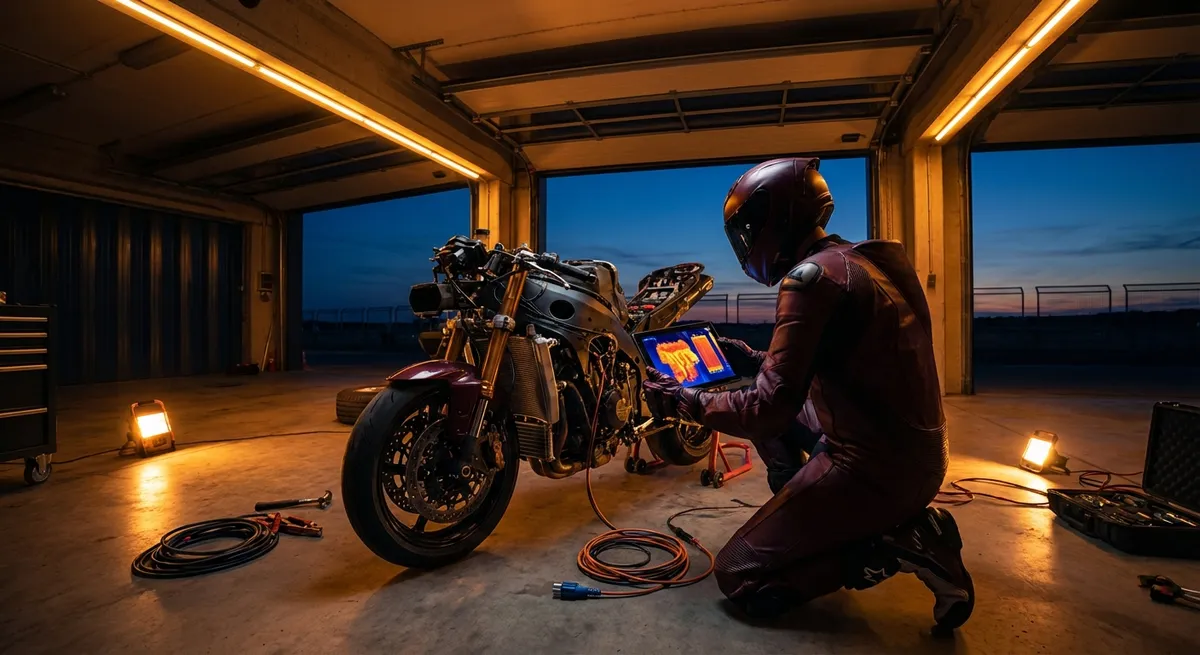
- If you push the bike hard in heat, add an inline temp gauge (if your bike doesn’t have one) or use an OBD reader where supported and watch oil/coolant temperatures after long pulls and in extended idle.
Treat oil as both lubricant and heat circuit. When you change viscosity, brand, or interval, you are re-tuning the temperature behavior of the engine—whether you mean to or not.
2. Cooling System as a Tunable Circuit, Not Just a Radiator
Liquid-cooled engines are controlled heat engines. Your coolant, thermostat, pump, hoses, and radiator function as a single thermal circuit with defined flow and restriction points. Understanding how they work together keeps you from “upgrading” yourself into problems.
Technical points to manage:
- Coolant mix is a performance variable:
- A 50/50 ethylene-glycol/water mix is standard because it balances boiling point, freezing point, and corrosion protection.
- More glycol = higher boiling point but lower specific heat (it carries less heat per degree).
- Track/race environments often use distilled water plus corrosion inhibitor because water has the highest specific heat—but this sacrifices freeze protection and some boil margin.
If you ride in extreme heat but not freezing cold, a carefully chosen ratio within OEM guidance and a high-quality coolant can optimize your thermal headroom.
- Radiator fin health and airflow:
- Bent fins reduce surface area and disrupt laminar airflow, cutting heat rejection.
- Clogged fins (bugs, dirt, rubber) act as insulation. Use low-pressure water and a soft brush; never blast radiator cores with high-pressure washers.
- Check for “shadowed” sectors: If part of the radiator is blocked by accessories or luggage, you’ll create localized hot zones.
- Thermostat and fan as control elements:
- A lazy or partially stuck thermostat delays coolant flow or prevents full circulation, causing erratic temperature swings. Test/replace on schedule instead of waiting for obvious overheating.
- Fan switch temperature and fan motor health matter in slow traffic. If the fan only kicks in well above nominal spec, you’re stress-testing oil, plastics, and wiring harnesses every commute.
- System pressure and cap integrity:
The radiator cap (or pressure tank cap) elevates boiling point by raising system pressure. A weak cap lets coolant boil and vapor-lock in hot spots before the gauge looks catastrophic. Replace caps at reasonable intervals rather than waiting for visible failure.
A cooling system that’s “within spec but tired” won’t show on a casual glance—but it will show in reduced power consistency, oil life, and component fatigue in summer or under load. Thermal margin is a resource; protect it.
3. Brake Heat Management: Turning Kinetic Energy into Controlled Temperature
Your braking system is a heat engine in reverse: it turns motion into temperature. When it’s maintained as a thermal unit—fluid, pads, rotors, and lines—you unlock repeatable braking instead of one good stop and three vague ones.
Core technical factors:
- Brake fluid as a heat buffer:
- DOT ratings (3, 4, 5.1) define minimum dry and wet boiling points.
- The wet boiling point (after water absorption) is what matters on a bike that actually sees weather, washes, and time.
- Once fluid is contaminated, vapor bubbles can form under hard braking as caliper temperatures spike. That’s where long lever travel and “vanishing brakes” come from.
- Service interval vs. real use:
- Mountain ride with heavy braking
- Track their bikes
- Commute year-round in humidity
Even if a manual says every 2 years, riders who:
should treat 12–18 months as practical maximums. Clear fluid that’s aged is not necessarily thermally trustworthy.
- Pad compound, rotor mass, and heat soak:
- Sintered pads handle high temperatures better, with more consistent friction at the cost of rotor wear.
- Organic pads can fade earlier under continuous hard use but may feel more progressive at moderate speeds.
- Larger or thicker rotors increase thermal mass, soaking more heat before surface temps spike.
- Lines as a control element:
- Old rubber lines can expand slightly under heat and pressure, reducing lever feel and feedback exactly when you need precision.
- Braided stainless lines don’t “cool better,” but they maintain consistent pressure and feel under elevated caliper temperatures.
Your front end is not just suspension and geometry; it’s also a thermal battlefield every time you come down a pass. Build a braking system that’s thermally honest with how you ride.
4. Electrical and Charging System: Managing Invisible Heat Load
Modern bikes route a lot of current through compact components: stators packed near hot engine cases, regulators that dump excess voltage as heat, ECUs and sensors living in warm, vibration-heavy spaces. Chronic electrical issues often start as chronic thermal issues.
Technical areas to monitor:
- Stator and regulator heat scenarios:
- In many permanent-magnet charging systems, the regulator/rectifier “shunts” extra power to ground as heat when the system doesn’t need it. That means high RPM + low electrical demand = high thermal stress on the reg/rec.
- Poor airflow around the regulator or mounting it near hot engine surfaces shortens life and can cause intermittent charging, especially on summer rides.
- Connector and harness integrity:
- Resistance at connectors (corroded or partially loose plugs) turns them into localized heaters under load.
- Look for discoloration, melted plastic, or hardened/brittle insulation around high-load circuits (fan, ignition, fuel pump).
- Dielectric grease at specified connectors isn’t cosmetic; it preserves low-resistance contact and protects against moisture that accelerates heating.
- Battery as a thermal victim and actor:
- High under-seat temperatures—especially on bikes with exhaust routing close to the subframe—accelerate lead-acid battery degradation.
- Lithium batteries are lighter and can handle high discharge loads well, but many chemistries dislike both deep cold and prolonged high heat. Mounting and insulation (or shielding) matter.
- Fan, pump, and sensor reliability:
Items like radiator fans, fuel pumps, and temperature sensors spend their life in elevated heat baths. A “weak fan” or intermittently failing temp sensor transforms the entire thermal behavior of the bike. Replace questionable sensors and marginal fans proactively rather than chasing ghost overheating issues later.
Your wiring diagram is also a heat map. Any time current concentrates, resistance increases, or airflow decreases, you are rewriting the temperature story of your bike’s internals.
5. Intake, Exhaust, and Under-Body Heat: Protecting Performance and Rider
The heat your engine throws off doesn’t vanish—it re-enters the system through intake air, fuel temperature, plastics, and even your legs. Managing this “secondary” heat is maintenance, not just comfort.
Key technical considerations:
- Intake air temperature (IAT) and real horsepower:
- Hotter intake air is less dense. On fuel-injected bikes, the ECU compensates, but you’re still down on volumetric efficiency.
- Heat-soaked airboxes (especially on faired bikes in slow traffic) raise IAT, dulling throttle response and peak output.
- Keeping intake ducting clear of obstructions, sealing leaks where hot engine-bay air can bleed into the intake, and ensuring fairing vents aren’t blocked all help preserve cooler, denser charge air.
- Fuel system thermal behavior:
- In-tank fuel pumps are cooled by the fuel itself; running near-empty consistently raises pump temperature and accelerates wear.
- High tank temperatures (sun, engine heat, poorly insulated exhaust routing) increase vapor formation, potentially aggravating hot-start issues and evaporative losses.
- Exhaust routing, shielding, and wrap:
- Aftermarket headers or de-cat systems often raise radiated heat into fairings, the rider’s legs, and nearby cabling.
- Heat shields and properly designed guards are not just comfort items—they protect plastics, wiring, and paint from long-term heat soak.
- Exhaust wrap can contain heat inside the pipe, raising exhaust gas velocity, but it also raises pipe surface temperatures and can accelerate corrosion if moisture gets trapped. Use it with intent, not as a fashion choice.
- Under-body airflow and fairing vents:
- Fairings direct not just clean air but also spent hot air. If you block or modify vent exits (aux lights, cameras, crash protection, luggage), you can trap hot air around the engine and tank.
- Periodically inspect the path hot air is supposed to take out of the bike and ensure your accessories haven’t turned that path into a dead-end.
Heat that doesn’t leave the bike through designed pathways will find new ones—through your intake, your legs, your electronics, or your fuel. When you configure accessories or exhaust, you are also re-writing your bike’s thermal airflow.
Conclusion
A high-performance motorcycle is a moving thermal problem set. Power is heat. Braking is heat. Charging is heat. The question is whether that heat moves through engineered pathways or piles up in the wrong places.
When you treat oil as a cooling medium, the coolant loop as a designed circuit, brakes as thermal devices, the charging system as a heat network, and your intake/exhaust as airflow architecture, maintenance stops being reactive. It becomes engineering.
That’s the difference between a bike that “runs” and a bike that feels mechanically confident at temperature—on the hottest day, at the highest RPM you dare hold, with the longest downhill still ahead of you.
Sources
- [Mobil: Engine Oil Fundamentals](https://www.mobil.com/en/lubricants/for-personal-vehicles/auto-care/engine-oil-basics) – Overview of how engine oil works, including its role in lubrication, cooling, and protection
- [Engineering Toolbox: Ethylene Glycol–Water Heat Capacity](https://www.engineeringtoolbox.com/ethylene-glycol-d_146.html) – Technical data on coolant mixtures, specific heat, and how concentration affects heat transfer
- [U.S. Department of Transportation – Brake Fluids (FMVSS 116)](https://www.ecfr.gov/current/title-49/subtitle-B/chapter-V/part-571/subpart-B/section-571.116) – Official specifications and boiling point requirements for DOT brake fluids
- [Battery University – How Heat and Other Factors Affect Battery Life](https://batteryuniversity.com/article/bu-806a-heat-losses-in-large-battery-systems) – Technical discussion of how elevated temperatures impact battery performance and lifespan
- [SAE Technical Paper: Effects of Intake Air Temperature on Engine Performance](https://www.sae.org/publications/technical-papers/content/2012-01-0637/) – Research paper examining how intake air temperature influences combustion and power output
Key Takeaway
The most important thing to remember from this article is that this information can change how you think about Maintenance.