Heat is the quiet engineer of your motorcycle’s performance. Get thermal control right, and your bike feels sharp, consistent, and confident. Get it wrong, and you’re dealing with power fade, cooked oil, warped components, and a machine that feels “off” even when the spec sheet says it should be perfect.
This isn’t just about not overheating. It’s about deliberately managing how your engine, oil, fuel, and brakes handle temperature so the bike lives in its performance sweet spot every ride.
Below are five technical, maintenance-focused points serious riders can use to tune and protect their machines through smarter thermal control.
1. Oil as a Thermal Component, Not Just a Lubricant
Engine oil is your primary internal heat-transfer medium. Beyond lubrication, it’s constantly carrying heat away from the hottest zones—pistons, bearings, valve gear—and dumping it into the crankcase and, if equipped, the oil cooler.
For sport and high-performance street bikes, the viscosity you choose must match both riding style and temperature range. A 10W-40 that’s perfect for mild commuting can thin out aggressively in 40 °C track-day abuse, reducing film strength in loaded bearings and around the big-end journals. Conversely, a heavier oil like 15W-50 can be too viscous on cold starts in cooler climates, slowing flow to critical valvetrain components and adding parasitic drag.
Thermal stability matters just as much as viscosity grade. Look for oils with a high High-Temperature High-Shear (HTHS) rating and strong resistance to oxidation; these maintain their viscosity and protective film under continuous high-temperature operation. Synthetic oils typically outperform mineral oils here because of more uniform molecular structure and better resistance to breakdown.
If your bike has an oil temperature readout or you run an aftermarket gauge, pay attention to stable operating temps rather than one-off spikes. A healthy, hard-run engine will typically stabilize somewhere around 90–120 °C oil temperature depending on design. Repeated excursions above that range indicate either cooling limitations, airflow obstruction (fairings, luggage, or debris blocking the cooler/radiator), or oil past its service life.
Maintenance actions that directly affect oil-based thermal control:
- Change oil and filter on time or earlier if you ride hard or in hot, slow traffic.
- Inspect oil coolers for bent fins, stone damage, or caked debris.
- Verify that hoses to external coolers aren’t kinked, rubbing, or weeping.
- Use a viscosity range recommended in the service manual for your climate and load profile, not just what the bottle marketing suggests.
2. Cooling System Efficiency: More Than Just “Not Overheating”
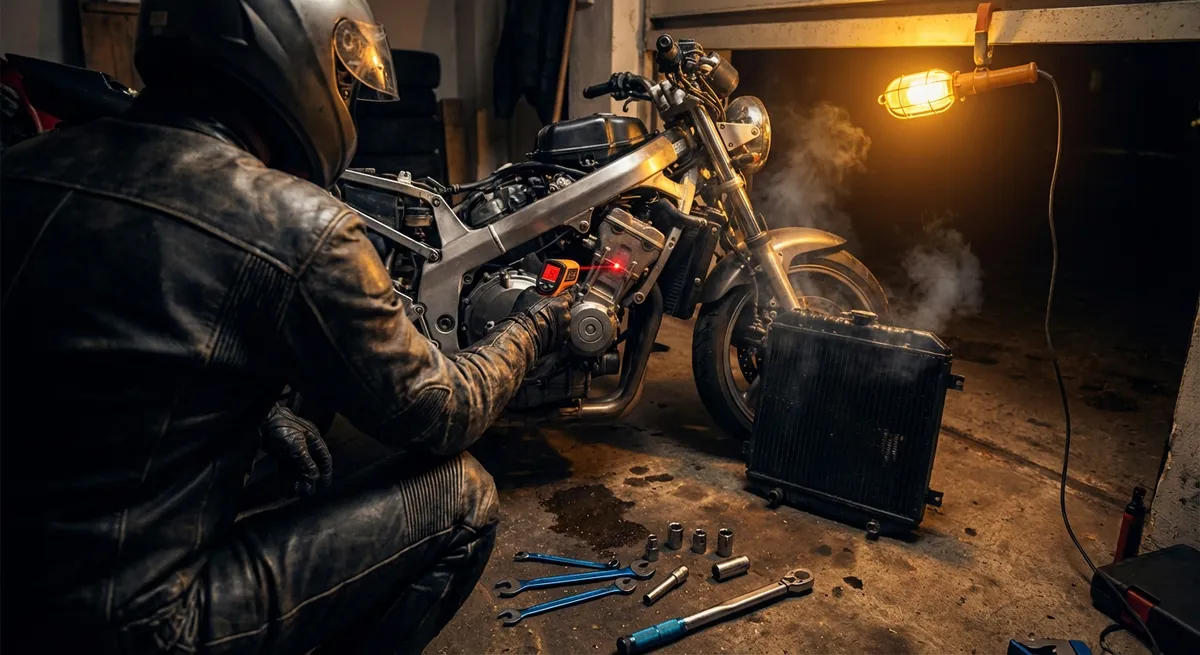
Liquid-cooled engines live or die by how well the cooling system can move heat from the cylinder head and block to ambient air. Many riders only pay attention when the overheat light comes on—but performance begins degrading well before that.
Coolant doesn’t just move heat; its mixture ratio, additives, and system pressure determine the boiling point inside your engine’s hottest spots. A common 50/50 ethylene glycol–water mix offers corrosion protection and raises the boiling point significantly over plain water, especially under system pressure (often around 1.1–1.6 bar for modern bikes). This prevents localized boiling around exhaust valve seats and combustion chambers, where raw metal temperatures can spike.
Your radiator’s performance depends heavily on fin integrity and airflow. Bent fins reduce surface area, bugs and grime block air channels, and aftermarket accessories (aux lights, crash bars, stacked oil coolers) can create dead zones in the airflow pattern. On faired bikes, damaged or missing ducting and shrouds can severely reduce flow efficiency even if the radiator itself looks fine.
Critical maintenance checks for efficient cooling:
- Flush and replace coolant at the interval in your service manual; degraded coolant loses anti-corrosion and anti-boil additives.
- Inspect the radiator externally for bent fins, debris, and leaks; clean carefully with low-pressure water and a soft brush.
- Verify the radiator cap is in good condition—its job is to maintain system pressure and raise the boiling point.
- Confirm the fan engages at the correct temperature; a failed thermo switch, relay, or fan motor will cook your engine in city traffic.
- Check hoses for soft spots, swelling near clamps, and minor seepage—the weak hose is the one that fails under heat and pressure on a hot day.
Optimized cooling doesn’t just prevent meltdown; it stabilizes combustion conditions, providing more consistent power delivery and throttle response, especially during aggressive riding or extended climbs under load.
3. Brake Thermal Management: Controlling Fade and Feel
Brakes are thermal devices: kinetic energy turns into heat, and that heat must go somewhere. On a high-performance motorcycle, everything in the braking system is working against increasing temperature—pads, fluid, seals, and even the wheel and tire.
Repeated hard stops, mountain descents, or track riding push the brake system into temperature regimes where fade begins. Pad compounds behave differently as they heat: some street pads lose friction when hot, others gain bite but wear faster. The wrong compound for your use case can mean either dead-feeling brakes after a few hard corners or overly aggressive bite that’s hard to modulate during normal commuting.
Brake fluid is equally critical. Glycol-based DOT 4 and DOT 5.1 fluids absorb moisture over time, which lowers their boiling point. Under hard braking, caliper temperatures can spike enough to boil water-contaminated fluid, creating compressible vapor bubbles. That’s when your lever goes long and mushy—classic brake fade from fluid boil, not just pad temperature.
Key maintenance steps for thermal control in brakes:
- Replace brake fluid at least every 1–2 years, more often if you ride in wet climates or do regular track days.
- Select a pad compound aligned with your riding: OEM or sport-touring pads for mixed riding, track-oriented pads for high-temp use (but expect more noise and cold-sensitivity).
- Inspect rotors for blueing (sign of overheating), deep scoring, and thickness below the minimum spec; thin rotors overheat faster and are more prone to warping.
- Ensure calipers slide freely on their pins (if floating) and pistons retract smoothly; draggy calipers build unnecessary heat between braking zones.
- Check that brake lines are not ballooning under pressure; high-performance braided stainless lines maintain firmer feel at high temperatures.
Dialed-in brakes aren’t just about stopping distance. Consistent lever travel and predictable friction characteristics across a wide temperature range build confidence—allowing you to brake later, harder, and more precisely without mentally budgeting for fade.
4. Intake Air, Fuel, and the Temperature-Compensation Game
Your ECU constantly juggles fuel delivery based on incoming air temperature, manifold pressure, and other sensor data. Hotter intake air is less dense, so the engine ingests fewer oxygen molecules per cycle; the ECU trims fuel to prevent over-enrichment. The result: noticeable power loss on scorching days or when the engine bay is heat-soaked.
While modern fuel injection systems are designed to cope with temperature swings, a poorly maintained bike shifts the balance from “managed variation” to “performance liability.” Dirty air filters, heat-soaked airboxes, mis-located aftermarket filters, and clogged injectors all exacerbate the impact of hot intake air.
Fuel quality and volatility play a role, too. In extreme heat or at altitude, lower-octane or low-quality fuel is more prone to pre-ignition and knock. Modern knock sensors and ignition maps can protect the engine, but they do so by retarding timing—again reducing performance. Consistently running fuel below the recommended octane for your engine design means you’re always operating with a performance handicap when the engine is hot and loaded.
Maintenance and setup actions to support stable combustion:
- Replace air filters at or before the suggested interval, especially on adventure or dusty use; reduced airflow amplifies the effects of hot, thin intake air.
- Inspect intake ducting and airbox seals to ensure they’re drawing relatively cool, forward-facing air, not recirculated engine bay heat.
- Use the manufacturer-recommended octane rating; if you regularly ride fully loaded in high ambient temperatures, err on the safe side with better fuel.
- Consider periodic injector cleaning (professionally or via quality cleaners) if you notice rough idle, poor hot starts, or uneven throttle response.
- On performance builds, ensure aftermarket intakes and exhaust systems are properly mapped; a lean hot mixture is both power-robbing and engine-hostile.
Viewed as a system, thermal control here is about keeping the engine in a combustion environment that’s predictable. That predictability translates directly into smoother response, better midrange pull, and less “moodiness” from your engine as conditions change.
5. Heat Cycles, Materials, and Long-Term Mechanical Integrity
Every component on your motorcycle experiences heat cycles: it heats up during use and cools down when parked. Over years, those cycles accumulate into material fatigue, seal hardening, and changes in clearances. Proper maintenance can significantly slow that decay.
Aluminum cylinder heads, magnesium covers, steel fasteners, composite gaskets—each expands and contracts differently with temperature. Torque values in the service manual are specified with this in mind. Reusing head bolts that are torque-to-yield, skipping re-torque procedures where specified, or ignoring correct tightening sequences can lead to localized stresses that only reveal themselves after repeated high-temperature cycles: seeping gaskets, warped mating surfaces, and micro-cracks.
Rubber and elastomer components—O-rings, valve stem seals, fuel lines, coolant hoses—are especially vulnerable. High temperatures accelerate polymer aging. Once hardened, seals lose their ability to conform under pressure, leading to oil sweating, vacuum leaks, and coolant “mystery losses.” Many riders chase fueling or idle problems that are ultimately just heat-aged rubber creating unmetered air paths.
Thermal-aware long-term maintenance practices:
- Follow torque sequences and values religiously on top-end work; this preserves sealing surfaces through thousands of heat cycles.
- Proactively replace hoses, O-rings, and rubber lines as the bike ages, not just when they fail; 7–10 years in a hot environment can be a realistic upper bound for many elastomer components.
- Inspect plastic and composite parts near exhausts and radiators (fan shrouds, connectors, covers) for embrittlement and discoloration.
- Keep exhaust mounting hardware tight and in good condition; excessive vibration plus heat cycling can crack headers and collector joints.
- Consider heat shielding or rerouting for lines and connectors running near exhausts, radiators, or catalytic converters; many OEMs run close to the thermal edge for packaging reasons.
By thinking in terms of heat cycles and material fatigue instead of only mileage, you maintain the structural integrity that lets your engine, chassis, and ancillaries continue delivering design-level performance deep into the bike’s life.
Conclusion
Performance isn’t just horsepower, torque, or top speed. It’s how consistently your motorcycle can deliver what it was designed to do, ride after ride, under real-world thermal stress.
When you treat oil, coolant, brakes, intake, and materials as parts of one integrated thermal system, maintenance stops being a checklist and becomes tuning—tuning for stability, predictability, and durability. That’s what separates a bike that merely runs from one that feels alive and precise, even when the thermometer and your right wrist are both pinned.
Manage heat well, and you’re not just protecting your machine. You’re unlocking a level of control and confidence that spec sheets can’t show—but every serious rider feels the moment they roll on the throttle or trail the brakes into a corner.
Sources
- Yamaha Motor – Engine Oil and Maintenance Basics – Manufacturer guidance on oil selection, viscosity, and maintenance intervals.
- Honda Powersports – Motorcycle Coolant and Radiator Care – Official information on cooling system maintenance and why coolant condition matters.
- NHTSA – Brake System Safety and Maintenance – Background on brake system performance, safety considerations, and maintenance relevance.
- Penn State University – Fundamentals of Engine Coolants – Technical overview of coolant properties, boiling point, and system pressure effects.
- U.S. Department of Energy – Engine Efficiency and Combustion Basics – Explains how combustion conditions, temperature, and fuel quality impact engine performance and durability.
Key Takeaway
The most important thing to remember from this article is that this information can change how you think about Maintenance.