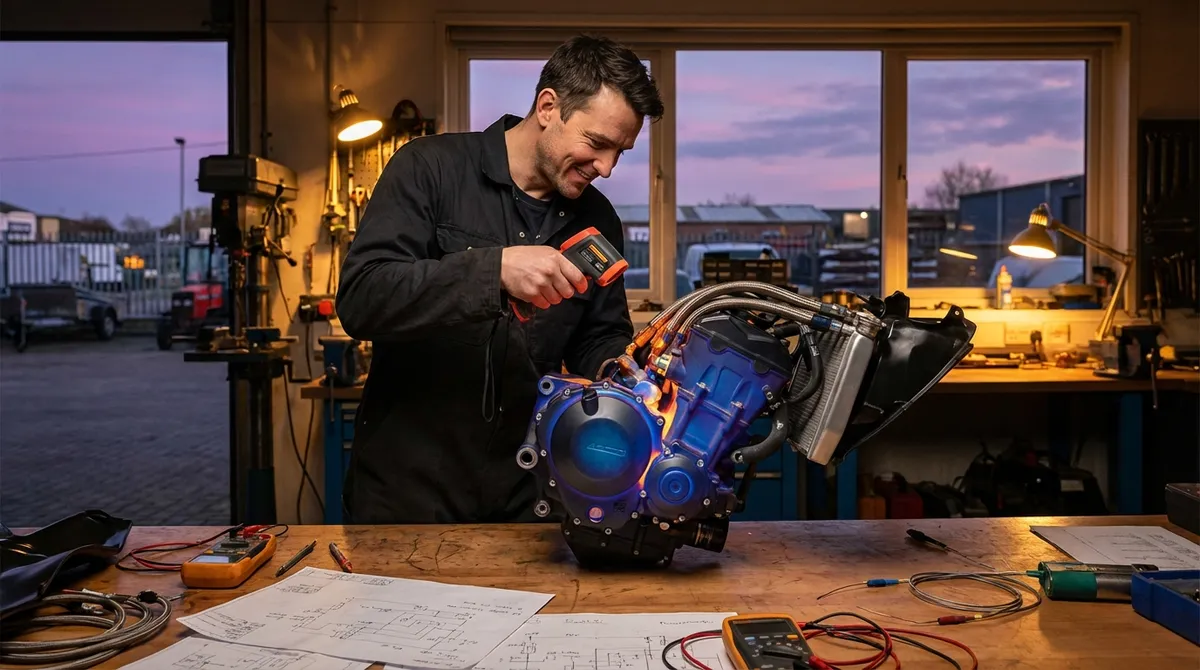
Heat is the silent killer of engines, electronics, and even brake systems. You rarely “see” it fail—until a warped rotor, cooked stator, or broken-down oil film sends you into an expensive repair or a sketchy riding moment. If you want a motorcycle that feels tight at 50,000 miles instead of tired at 15,000, you need to think like an engineer and manage heat as a primary maintenance variable, not an afterthought.
This isn’t about polishing chrome or changing oil on schedule. This is about thermal discipline—understanding where your bike makes heat, how it flows through the system, and what specific maintenance keeps that thermal load under control.
Below are five technical maintenance pillars that directly control temperature, stress, and long-term reliability.
1. Lubrication as a Thermal System, Not Just “Oil Changes”
Engine oil is not just lubrication—it’s a primary heat-transfer medium. In many modern bikes, especially high-revving and sport-oriented engines, the oil system removes a significant portion of the engine’s waste heat, especially around the crank, pistons, and transmission.
Key technical points to manage:
- Viscosity vs. Operating Temperature
- Too thin when hot → the hydrodynamic film collapses under load, bearing wear accelerates, and metal temps spike.
- Too thick when cold → delayed flow on cold starts, increased shear, and potential starvation at high RPM until fully warmed.
- Shear Stability and Gearbox Load
- A 10W-40 that’s heavily sheared and heat-cycled can act like a tired 10W-30 or worse at operating temperature.
- Result: rising operating temps, more noise, vague shifting, and reduced protection under sustained load.
- Oil Cooler and Flow Path Inspection
- Clean fins gently with low-pressure water and soft brushes; avoid folding fins over.
- Inspect for seepage at crimp joints and banjo bolts. Minor seepage under light load often turns into a spray at high temperature and pressure.
- Confirm correct routing of lines if they’ve ever been removed—incorrect routing can trap air pockets or create hot spots.
- Practical Action: Choose an oil with the viscosity and spec your manual recommends for your climate and usage, and commit to shorter intervals if you ride hard, in hot climates, or do a lot of stop-and-go. Treat the oil system as your engine’s primary thermal safeguard, not just a consumable.
The viscosity grade (e.g., 10W-40, 5W-30) is a prediction of behavior at specific temperatures. If you ride in high ambient temps, sustained highway speeds, or do track days, your oil sees higher bulk and local film temperatures, especially at the piston crown and rod bearings.
Many motorcycles share engine oil with the transmission. Gear teeth and shift dogs shear the oil, mechanically chopping long-chain additive molecules. Over time, the oil can behave like a lower viscosity grade than the label suggests. That means:
On bikes with oil coolers (air/oil cooled and many liquid-cooled engines), the cooler is effectively a small radiator. If its external fins are clogged with bugs, dirt, or bent from impacts, your oil temps climb. Maintenance details:
2. Cooling System Integrity: Pressure, Flow, and Air Management
On liquid-cooled motorcycles, the cooling system is a closed, pressurized heat-exchanger network. The radiator is just the visible part; the “health” of the system is in pressure control, flow stability, and the condition of internal surfaces.
Critical maintenance angles:
- Coolant Chemistry and Electrolysis Control
- Result: pitting in aluminum surfaces, eroded water pump housings, and eventually internal leaks.
- Best practice: Replace coolant per the manufacturer’s interval or sooner if you see discoloration, particles, or smell strong “burnt” or sour odors.
- System Pressure and Boiling Margin
- The system vents too early, coolant flashes to vapor at hot spots, and you get micro-boiling in the head.
- That vapor displaces liquid coolant, creating local hot spots and potential detonation under load.
Modern coolants are engineered for aluminum blocks, heads, and radiators. When neglected, coolant degrades chemically, loses corrosion inhibitors, and can become electrically conductive, causing galvanic corrosion.
The radiator cap is a pressure regulator. By raising system pressure, it raises the boiling point of the coolant. If the cap spring weakens:
Maintenance: Test or replace the cap at recommended intervals or when chasing unexplained temperature rise.
- Flow Path: Pump, Thermostat, and Hoses
- Water pump: Inspect weep holes and seals for moisture or staining—a slight coolant trace is often an early warning.
- Thermostat: A sticking thermostat can cause slow warm-up (stuck open) or sudden overheating (stuck closed or partially closed). Replace if temps behave erratically or after major engine work.
- Hoses: Old hoses soften, swell, or develop internal delamination that partially blocks flow. Squeeze cold hoses—spongy, over-soft, or oil-contaminated rubber is a replacement candidate.
- Airflow Engineering: Fans, Shrouds, and Fins
- Keep radiator fins clean and straight; bent fins reduce effective surface area and airflow.
- Ensure fan shrouds, ducts, and side cowls are correctly installed after service. Misaligned plastic means disrupted airflow and higher temperatures at low speed.
- For air-cooled and air/oil-cooled engines, inspect cylinder and head fins for caked mud, tar, or heavy grime; this layer acts as insulation.
Thermal takeaway: A cooling system isn’t “working” just because the gauge isn’t pegged. Clean, chemically-stable coolant, confirmed pressure control, and unblocked flow keep combustion and metal temperatures predictable—and that predictability is what preserves engine life.
3. Brake Heat Management: Pad Chemistry, Fluid Boil, and Rotor Stress
Brakes turn kinetic energy into heat. How that heat is generated, moved, and dissipated determines whether your lever feel stays consistent on a mountain descent—or vanishes into fade.
Key technical maintenance factors:
- Pad Compound and Heat Range
- Too cold: poor initial bite and longer stopping distances.
- Too hot: coefficient of friction drops (fade), pads glaze, and heat soaks into the fluid and caliper seals.
Brake pads have an optimal temperature window. If you’re using purely street-oriented organic pads but routinely ride heavy, fast, or loaded (passenger + luggage), you may be pushing pads beyond their stable friction range.
Maintenance: Choose pad compounds aligned with your riding—sintered or semi-sintered for sustained high-speed or heavy loads, street-performance compounds for aggressive canyon or track-day crossover use.
- Fluid Boiling Point and Hydroscopic Decay
- Local fluid temps spike at the caliper.
- If the fluid boils, vapor bubbles compress under lever pressure → sudden soft lever or “no brakes” sensation.
Brake fluid absorbs moisture over time (it’s hygroscopic). As water content increases, the boiling point drops. Under hard braking:
Always replace fluid at least every 1–2 years, more often if you ride aggressively in hilly terrain or track environments. Use a DOT spec compatible with your system, and remember: higher DOT number doesn’t help if it’s old and water-saturated.
- Rotor Thickness, Runout, and Heat Cycling
Rotors are thermal shock absorbers. They must handle repeated heat cycles without warping.
Maintenance items:
- Measure rotor thickness and compare to the stamped “MIN TH” spec. Thin rotors overheat faster and are more susceptible to warping.
- Check runout (wobble) with a dial indicator. Excessive runout creates uneven pad contact, localized hotspots, pulsing at the lever, and accelerated pad/rotor wear.
- Clean rotor surfaces regularly to remove pad transfer layers that can create uneven friction and hot spots.
- Caliper Service and Heat Soak
Sticking pistons or dry slider pins prevent pads from releasing cleanly, dragging the brakes and generating constant low-grade heat. That heat migrates into fluid and seals even when you’re not braking hard.
Regularly:
- Clean caliper bodies and pistons; use fresh brake cleaner and a soft brush.
- Re-grease slider pins with high-temp brake grease.
- Inspect dust seals and piston boots for cracks or swelling.
Result: Consistent braking performance is fundamentally a heat-management achievement, and your maintenance decisions determine whether your system handles peak loads or collapses under them.
4. Electrical System Heat: Stators, Regulators, and Connector Integrity
Modern motorcycles pack more electronics than ever: ride-by-wire, IMUs, heated grips, auxiliary lighting, and charging ports. All of that rides on an electrical system that turns mechanical power into electrical power—and heat is both a byproduct and a threat.
Technical maintenance focus:
- Stator and Regulator/Rectifier Thermal Load
- If your R/R is mounted in a poorly ventilated area or caked in dirt, its heat rejection plummets.
- Overheating R/Rs can fail gradually (low voltage, dimming lights, battery not charging) or catastrophically.
- Keep cooling fins clean and unobstructed.
- On older or known-problem models, consider relocating the R/R to an area with better airflow or upgrading to a series-type regulator (if compatible).
- Connector Resistance and Heat Buildup
- Look for discoloration, melted plastic, or brittle insulation at high-current connectors (stator to R/R, R/R to battery, main fuse block, accessory circuits).
- Even slight green/white corrosion on terminals can cause voltage drop and local heating.
Many charging systems are “shunt” type. The stator generates near-maximum output, and the regulator/rectifier (R/R) shunts excess to ground as heat.
Maintenance:
Corroded or loose connectors create resistance; resistance under load equals heat.
Maintenance: Periodically disconnect and inspect critical connectors, clean with contact cleaner, and apply dielectric grease where appropriate (on the outside of pin interfaces as a moisture barrier).
- Battery Health and Internal Heating
- Measure resting voltage and watch for unusual hot spots on the casing after long rides.
- Batteries near end-of-life can pull excessive charge current, overheating both themselves and upstream components.
A weak or sulfated battery runs hotter under charge and discharge, stressing the charging system.
Proactive replacement is cheaper than cooking a stator or regulator.
- Load Mapping and Fuse Discipline
- Stay within the alternator’s rated capacity and avoid piggybacking high-draw accessories onto light-gauge OEM circuits.
- Use proper-gauge wiring, dedicated fused circuits, and relays to keep current away from sensitive switches and thin factory wires.
Adding LED auxiliary lighting or heated gear is attractive, but every watt is heat somewhere in the system.
In short, an electrically healthy bike is thermally balanced: low resistance, solid connections, adequate heat sinking, and thoughtful accessory management.
5. Drivetrain and Wheel Assemblies: Friction, Load, and Temperature
Your final drive and wheel components don’t just transfer power—they convert some of it into heat through friction. Controlling that friction is what keeps chains alive, bearings quiet, and tires wearing evenly.
Core technical points:
- Chain Tension, Alignment, and Lubrication as Heat Control
- Follow the manufacturer’s slack spec, measured at the recommended point (often mid-span, on the side stand or with rider—check your manual).
- Ensure rear wheel alignment is truly straight; misalignment forces the chain to scrub across sprocket teeth and heats the system.
- Use a suitable chain lube for your climate (drier, less tacky in dusty environments; more tenacious in wet conditions). Proper lubrication reduces sliding friction in O/X-ring interfaces and helps shed heat under sustained load.
- Hub and Wheel Bearings: Grease Film Integrity
- Spin wheels off the ground: listen for growling or roughness.
- After a long ride, cautiously feel near hub areas; unusual localized warmth (not from brakes) can be a warning sign.
- Replace bearings that show any play, roughness, or seal damage; once the grease film breaks down, failure can be rapid.
- Tire Pressures and Carcass Temperature
- Set pressures cold, accounting for load (passenger, luggage) and speed.
- If you routinely see more than ~10% pressure increase from cold to hot on the same route, your cold starting pressure may be too low.
- Inspect for heat-checking, sidewall cracking, or unusual wear patterns that signal chronic overheat.
- Sprocket Condition and Load Distribution
- Always replace sprockets with chains as a set.
- Inspect for asymmetrical wear (one side of the tooth more worn), which indicates misalignment and excessive friction.
A too-tight chain is a constant friction heater. That heat lives in the chain rollers, sprocket teeth, and countershaft/output shaft bearing.
Bearings convert rolling motion into minimal friction—until water intrusion, overloading, or dried grease turn them into heat pumps.
Underinflated tires flex excessively, turning that flex into heat. Elevated carcass temperatures accelerate wear, can destabilize compounds, and in extreme cases lead to structural failure.
Hooked, razor-sharp, or cupped sprocket teeth don’t just wear chains—they concentrate load into tiny contact patches. That concentrated stress raises surface temperatures and accelerates material fatigue.
Maintained correctly, your drivetrain runs cool and quiet. Excessive heat is almost always a symptom of friction you can engineer out with better setup and more disciplined inspection.
Conclusion
Every system on your motorcycle is fighting a heat budget. Engines, brakes, electronics, and drivetrains all convert your riding into temperature spikes and thermal cycles. Maintenance isn’t just about “doing the schedule”—it’s about actively managing where that heat goes, how fast it’s removed, and whether your materials stay inside their design limits.
When you treat oil as a thermal fluid, coolant as a corrosion and heat-control chemistry, brakes as energy absorbers, wiring as a managed resistor network, and chains and bearings as friction systems, your maintenance shifts from reactive to engineered.
The payoff is huge: rock-solid performance at the end of a hard ride, predictable behavior at the edge of traction, electrical systems that don’t randomly die, and a machine that still feels mechanically tight long after the odometer says it shouldn’t.
Thermal discipline is the difference between a bike that just survives the miles—and one that begs you to add more.
Sources
- [Motul – The Importance of Oil in Engine Cooling](https://www.motul.com/us/en-US/news/products-innovation/engine-oil-and-cooling) – Explains the role of engine oil in heat removal and protection
- [U.S. Department of Energy – Advanced Coolant Technologies](https://www.energy.gov/eere/vehicles/articles/vehicle-technologies-office-fact-advanced-coolants) – Overview of coolant chemistry and thermal management concepts
- [Brembo Technical – How Brakes Work](https://www.brembo.com/en/company/news/how-disc-brakes-work) – Detailed explanation of brake heat generation, fade, and component function
- [BikeBandit – Motorcycle Charging Systems Explained](https://www.bikebandit.com/blog/motorcycle-charging-systems-explained) – Practical breakdown of stators, regulators, and common failure modes
- [Bridgestone Motorcycle – Tire Pressure and Performance](https://www.bridgestone.com/products/motorcycle_tires/learn/pressure.html) – Technical guidance on tire pressure, temperature, and performance impact
Key Takeaway
The most important thing to remember from this article is that this information can change how you think about Maintenance.