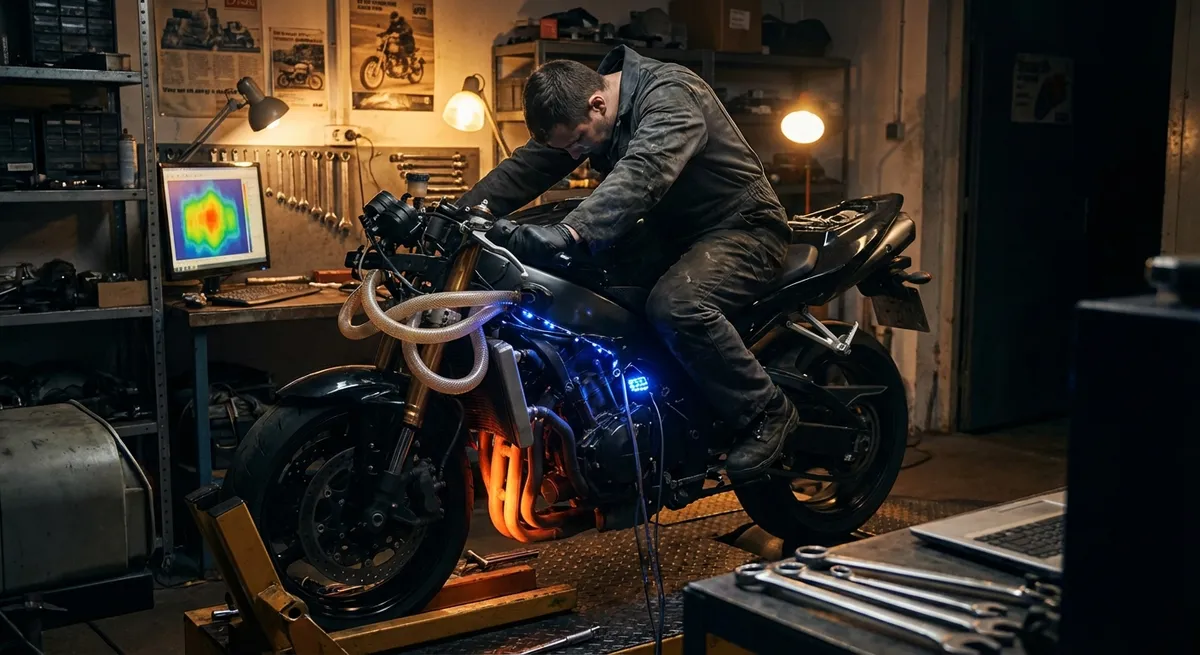
Heat is the silent assassin of motorcycle performance. It cooks oil, warps components, fatigues wiring, and slowly erodes the tight, mechanical “rightness” that makes a bike feel sharp and trustworthy. Most riders obsess over horsepower and bolt-ons; the serious ones engineer thermal discipline—controlling how their machine generates, transfers, and sheds heat.
If you want a motorcycle that pulls hard on a summer mountain pass and still feels mechanically crisp at 60,000 miles, you need to treat heat as a primary design variable in your maintenance, not an afterthought.
This is your blueprint.
1. Oil as a Thermal Component, Not Just a Lubricant
Oil isn’t just there to stop metal-on-metal contact; it’s a major heat transport fluid. How you choose it, change it, and manage it directly affects operating temperature, long-term wear, and even clutch behavior.
Key technical points:
- Viscosity and operating temp are married. The common 10W-40, 10W-50, or 15W-50 grades are envelopes for viscosity at different temps. Run your engine hotter than intended and that “40” weight behaves more like a thinned-out 30 in real use, compromising film strength on bearings and cam lobes.
- Shear stability matters in shared-sump engines. Most motorcycles share engine and gearbox oil. Gear dogs and helical gears mechanically shear the oil, degrading viscosity faster than in automotive engines. Look for JASO MA/MA2-rated oil from reputable manufacturers with published data on high-temperature, high-shear (HTHS) performance.
- Oil change intervals must track thermal severity. Track days, hot-climate commuting in stop-and-go traffic, or heavy luggage in mountainous terrain all spike oil temperature and oxidation. That tidy “every 6,000 miles” in the manual often assumes milder conditions. A practical rule: if you’re seeing sustained coolant temps near the high end of normal or can feel the bike radiating significant heat at idle, shorten your oil interval by 25–40%.
- Oil as a diagnostic signal. Dark oil is not automatically “bad”; smell and feel matter. Burnt, acrid odor and unusually thin feel at temperature often indicate thermal stress. Cut open your oil filter occasionally—excessive glitter (beyond normal break-in) is a warning that either lubrication or temperature (or both) is out of spec.
- Don’t ignore the cooling role of proper oil level. Too low and the engine starves under high RPM and heat; too high and aeration foams the oil, reducing heat transfer and film integrity. On sight glasses, aim for slightly below max when hot and level—not stacked at the top.
When you think “oil,” think “liquid heat-management system” as much as “lubricant.” Your engine will thank you at 100,000 km.
2. Radiator and Coolant: Treat the Cooling Circuit Like a Heat Exchanger, Not a Sticker Mount
Radiators are not decorative fins for brand decals; they’re engineered heat exchangers with a delicate balance of airflow, coolant speed, and surface area. Neglect this loop and you’re essentially detuning your entire machine.
Key technical points:
- Coolant is a chemical system, not just colored water. Ethylene glycol or propylene glycol mixes do three jobs: freeze protection, boiling point elevation, and corrosion inhibition. Over time, corrosion inhibitors get consumed; internal passages develop scale and galvanic corrosion, reducing heat transfer. Fresh coolant restores that efficiency.
- Flow rate vs. heat transfer. It’s a myth that “slower coolant always cools better.” Modern systems are designed for a specific pump flow at a given RPM. Too slow, and you reduce total mass flow; too fast, and you can reduce the dwell time in the radiator, but overall system design is what matters. Your real leverage: keeping passages clean and fins unobstructed so the stock system can work as designed.
- Radiator fin integrity is critical. Bent, clogged, or bug-caked fins act like insulation. Periodically:
- Shine a light through the radiator—if you can’t see good light, airflow is compromised.
- Use low-pressure water from the back side forward to clear debris.
- Carefully straighten compressed fins with a fin comb or small flat tool—micro airflow improvements add up.
- Cap pressure and boiling margin. The radiator cap sets system pressure, directly controlling coolant boiling point. A weak or aged cap reduces pressure, lowering the boil margin and allowing local vapor pockets in hot spots (like around exhaust valve seats). Replace caps at manufacturer intervals or sooner if you see crust around the cap neck or erratic temperature behavior.
- Fan performance and electrical health. If the fan doesn’t spin at full speed or cuts in late, suspect:
- Failing fan motor
- High-resistance connector or ground
- A marginal battery/charging system that can’t maintain voltage under load
Electrical degradation is a thermal problem in disguise.
Treat the cooling system like a race car’s brake ducts: every degree of unnecessary heat you remove is more mechanical life and consistent performance you add.
3. Chain and Drivetrain: Friction as Lost Power and Unnecessary Heat
Your final drive is a continuous friction generator. Every watt of drag is converted into heat in the chain, sprockets, bearings, and even the swingarm. Done right, chain maintenance is not only about longevity—it’s about reducing parasitic loss and thermal loading.
Key technical points:
- *Lubricant choice changes friction and temperature. A well-lubed O-ring or X-ring chain runs cooler and transfers more of your crank power to the rear wheel. Overly sticky lubricants build up dirt, acting like grinding paste and another source of frictional heat. A thin, penetrating, motorcycle-specific chain lube or chain wax applied sparingly to warm chain links reduces both stiction and abrasive wear.
- Alignment is a thermal problem, not just a wear problem. Misaligned sprockets force the chain to scrub sideways across the teeth, generating heat along the side plates and rollers. Over long rides, this can raise chain temperature significantly, degrading seals and accelerated stretch. Use:
- String or laser alignment tools, not just swingarm tick marks.
- Visual confirmation from behind that chain run is true at multiple wheel rotations.
- Bearing life is tied directly to thermal management. Over-tight chains preload countershaft, wheel, and swingarm bearings. That preload forces bearings to work harder, generating more heat at a microscopic level. You won’t feel it on a quick test ride—but you will feel it as roughness and play at 40,000–60,000 miles. Always set chain slack at the tightest point in the rotation and within the spec window, erring toward the looser end for loaded touring or aggressive suspension travel.
- Sprocket geometry and smoothness. Hooked teeth, burrs, or rough machined edges chew at the chain’s rollers, adding friction. Long before you see obvious shark-toothing, you can feel drag by spinning the rear wheel in neutral and feeling for resistance and “grittiness.” A new chain on worn sprockets runs hotter and wears like sandpaper.
- Heat as a quick diagnostic on fast runs. After a spirited ride, carefully (without burning yourself) compare:
- Chain temperature
- Rear hub area
- Swingarm near the pivot
Excessively hot chain/hub relative to the rest of the bike can indicate over-tension, alignment errors, or inadequate lubrication.
Every reduction in drivetrain friction means more real-world acceleration, higher cruising efficiency, and cooler-running components that last.
4. Electrical and Charging System: Managing Invisible Thermal Load
Your motorcycle’s electrical system is a distributed heat network. Stators, regulators/rectifiers, connectors, and even your battery deal in watts that eventually become heat. Weakness here doesn’t just cause starting issues; it cascades into fan malfunction, ECU derating, light output reduction, and inconsistent fueling.
Key technical points:
- Stator and regulator as heat engines. In many bikes, the stator makes near-constant output above a certain RPM, and the regulator/rectifier dumps surplus energy as heat. Poor cooling, dirty connectors, or corrosion increase resistance, forcing components to run hotter. Inspect:
- Reg/rec mounting area—ensure it has solid airflow and good thermal contact with its bracket.
- Connectors for browning, melted plastic, or hard/brittle insulation.
- Voltage drop equals heat in the wrong place. Ohm’s law is brutal: small resistance at high current equals heat. High-resistance joints (corroded grounds, oxidized connectors) become localized heaters. Symptoms:
- Dim or flickering lights at idle
- Fans that seem weak or slow
- EFI glitches or intermittent sensor codes under heat soak
Clean grounds and critical connectors with contact cleaner and apply dielectric grease where specified.
- Battery health and thermal runaway risk. Old or sulfated lead-acid batteries run hotter under charge/discharge cycles. They force the charging system to work harder, often raising stator and reg/rec temps. Regular load testing and replacing marginal batteries is indirectly thermal maintenance for the entire system.
- Harness routing and radiant heat. Wiring that runs too close to headers, exhausts, or hot engine surfaces slowly embrittles, then fails. Heat shields, reflective sleeves, or rerouting away from radiant sources prevent micro-cracks and intermittent faults that are almost impossible to track mid-trip.
- Fan and pump performance depend on clean power. If your cooling fan or (on some models) electric water pump is starved for voltage, coolant temps spike while the rest of the bike looks “mechanically fine.” Always evaluate the charging system when chasing heat issues—temperature problems are often downstream of electrons, not coolant.
When you stabilize your electrical system thermally, you stabilize everything that depends on it—cooling, fueling, ignition, and even rider confidence on long, hot days.
5. Brake System: Heat Management for Control and Component Survival
Brakes convert motion into heat—lots of it. Proper maintenance isn’t just about power and feel; it’s about controlling where that heat goes and how fast it gets there.
Key technical points:
- Fluid boiling point is your thermal ceiling. DOT 4 and DOT 5.1 fluids have defined dry and wet boiling points. Over time, brake fluid absorbs moisture, dragging that boiling point down. Hard braking on long descents or aggressive track use can then push caliper temps past the wet* boiling point, causing vapor formation and a spongy lever. Regular fluid changes (often annually or more for hard use) reset your thermal ceiling.
- Pad compound and rotor pairing. A mismatch between pad material and rotor design (solid vs. floating, drilled vs. slotted) can lead to:
- Uneven heat distribution
- Glazing (an overheated, glassy pad surface)
- Local rotor hotspots, which can cause pulsing and micro-cracking
Pads should be selected not just for “bite,” but for consistent friction across the operating temperature range you actually ride in.
- Caliper service as heat control. Sticky pistons trap pads closer to the rotor, creating light drag and constant heat build. Over long rides, that sustained mild friction:
- Warms wheel bearings
- Raises rotor temperature
- Accelerates pad wear
Cleaning and periodically rebuilding calipers (seals, dust boots, and pistons) restores correct retraction and prevents constant micro-heating.
- Heat soak and fade behavior as feedback. On a long downhill where you’re repeatedly on the brakes:
- Monitor lever travel and feel—any lengthening or “woodiness” is a warning.
- If possible, use more engine braking and firm, intermittent brake applications instead of light, constant dragging. This allows more cooling intervals, less average rotor temperature, and less risk of fluid or pad thermal saturation.
- Rotor condition and thermal stress. Blueing, hairline cracks between drill holes, or obvious runout indicate thermal stress beyond design margins. That’s either riding style, stuck calipers, or poor pad choice. Address the cause, not just the symptom.
The goal isn’t “cold brakes”—it’s brakes that accept, manage, and shed heat in a predictable, repeatable way. That’s what lets you brake later, more confidently, and more often without mechanical penalty.
Conclusion
Thermal discipline is what separates a merely “maintained” motorcycle from a truly engineered one.
When you start thinking in terms of heat flow—through oil, coolant, chains, wires, and rotors—you stop reacting to problems and start designing reliability into your machine. The result is a bike that:
- Maintains consistent performance on the hottest days
- Ages slowly and evenly across systems
- Feels mechanically “tight” far beyond the mileage where most bikes go vague
Power is easy to bolt on. What’s hard—and deeply satisfying—is building a motorcycle that runs cool, hard, and long because you’ve respected the physics that govern every ride.
Sources
- [U.S. Department of Energy – Engine Efficiency & Combustion Basics](https://www.energy.gov/eere/vehicles/articles/engine-efficiency-and-combustion-basics) – Overview of how engines convert fuel to heat and mechanical work, relevant to understanding thermal loads in motorcycles
- [Honda Powersports – Motorcycle Maintenance Schedule Example](https://powersports.honda.com/discover/honda-advantage/maintenance-schedule) – Illustrates OEM approaches to service intervals for oil, coolant, and other systems
- [Yamaha Motorsports – Chain and Sprocket Care Guide](https://www.yamahamotorsports.com/motocross/pages/chain-and-sprocket-tech-tips) – Technical guidance on chain alignment, lubrication, and wear, with direct implications for heat and friction
- [Brembo – Brake System Technical Information](https://www.brembo.com/en/company/news/brake-fluid-what-you-need-to-know) – Detailed explanations of brake fluid boiling points, fade, and thermal behavior of braking systems
- [SAE International – Lubricant Viscosity & Engine Protection Overview](https://www.sae.org/binaries/content/assets/cm/content/topics/engine-oil-viscosity.pdf) – Technical background on oil viscosity, temperature effects, and high-temperature, high-shear performance
Key Takeaway
The most important thing to remember from this article is that this information can change how you think about Maintenance.