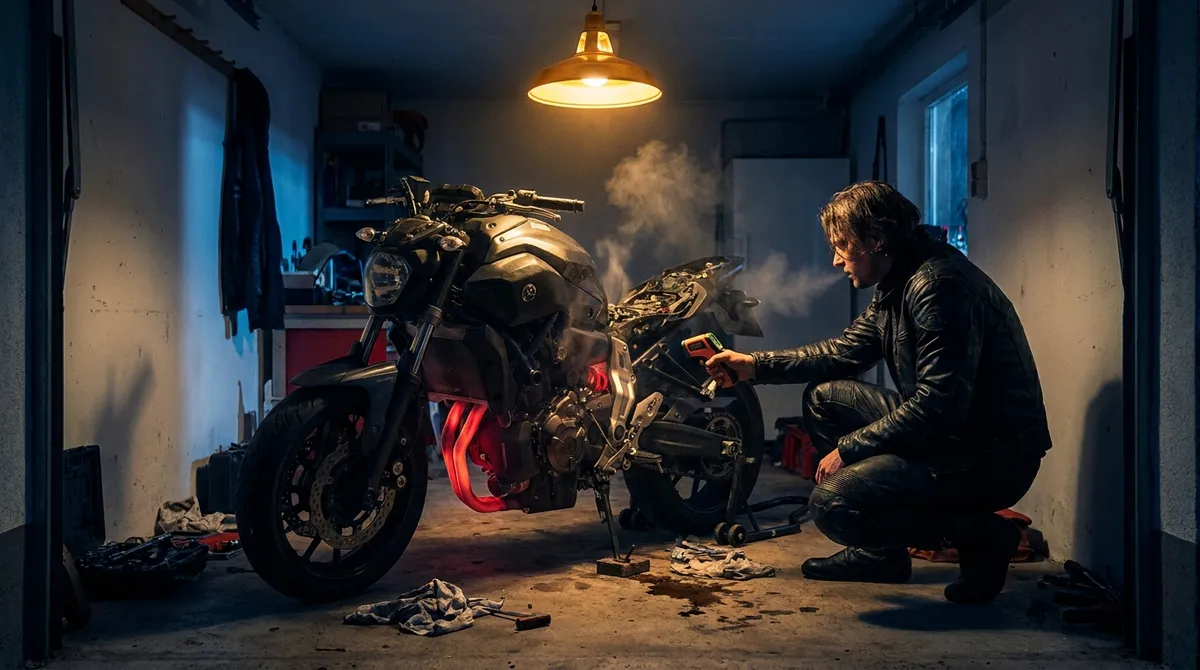
Modern motorcycles live and die by how well they manage heat. Oil temp, coolant flow, brake temperatures, tire heat cycles—if you understand these systems, you stop “hoping it’s fine” and start riding a bike that stays consistent lap after lap, canyon after canyon. Thermal discipline isn’t sexy clickbait; it’s what separates a bike that feels sharp at 8/10ths from one that gets vague, fades, and eats itself when you actually push.
This is maintenance as thermal engineering: five high-impact, technical areas where controlling heat means more power, more feel, and more reliability.
Oil Is a Heat System, Not Just a Lubricant
Engine oil is your primary internal heat-transfer medium. Treating it like “just lubrication” is how you end up with a bike that runs hot, shears oil early, and loses consistency under sustained load.
A good synthetic oil (proper viscosity grade per your service manual) does three jobs: lubricates, suspends contaminants, and—critically—moves heat out of hot zones (piston crowns, bearings, cams) to the sump or cooler. If you ride aggressively, sit in traffic frequently, or track the bike, you’re forcing that oil to live near the top of its temperature window more often.
Key technical points:
- Viscosity under heat load matters more than the label. A 10W-40 that shears down behaves like a thinner grade at temperature, reducing film strength. Look for JASO MA/MA2 motorcycle-specific oils from reputable brands that publish high-temperature high-shear (HTHS) data—this is the number that tells you how the oil holds up when seriously hot.
- Oil change intervals should be usage-based, not just mileage-based. Short, cold trips with lots of idling and stop-start in city heat contaminate oil faster than long, steady highway pulls. If your riding is mostly urban and hot, shorten the interval by 20–30% compared to the manual recommendation.
- Temperature monitoring is worth it. If your bike has an oil temp readout, learn its “normal” stabilized range for cruising, canyons, and track. If not, an aftermarket sensor and display can tell you when you’re pushing into abuse instead of use. Repeated operation above ~260–280°F (127–138°C) for conventional street engines will hammer oil life.
- Oil coolers get dirty and ineffective. Finned radiators or oil coolers clogged with road grime, bugs, or rubber reduce heat rejection. Cleaning them with low-pressure water and a soft brush (never a high-pressure washer directly into the fins) is real performance maintenance, not cosmetics.
- Filter quality is thermal reliability. A cheap filter that bypasses too early or too often reduces both filtration and effective oil flow under high heat and high RPM. Stick with OEM or reputable aftermarket filters that publish bypass pressure specs within OEM range.
Treat engine oil as a managed heat system, and you get a motor that feels the same on a long mountain run as it does during the first 20 minutes.
Cooling Circuits: Flow, Pressure, and Real Heat Rejection
Liquid-cooled bikes are only as good as their coolant flow and radiator efficiency. The thermostat, water pump, radiator, and fan form one integrated thermal circuit; if any piece underperforms, your “normal temp” reading can hide weak spots that only show when you go hard.
Coolant isn’t just antifreeze; it’s a heat-transfer cocktail. Too much glycol and you reduce heat capacity and thermal conductivity. Too little, and you lose corrosion protection and raise the boiling risk. Most OEMs spec a 50/50 mix of ethylene glycol and distilled water because it balances boiling point, corrosion resistance, and freeze protection for mixed climates.
Critical maintenance dimensions:
- Coolant age affects thermal efficiency. Additives break down over time, forming scale, corrosion, and deposits on narrow passages in the head and radiator. If your coolant is more than 2–3 years old (or whatever your manual states), you’re not just risking corrosion—you’re losing real heat rejection area.
- Radiator fin condition changes your temp ceiling. Bent or clogged fins reduce surface area and airflow. Straighten mildly bent fins with a fin comb or small flat tool, and keep the radiator face clean. On faired bikes, verify that the ducting and shrouds are intact and properly seated—these shape airflow; missing plastics aren’t just cosmetic.
- Thermostats can fail “lazy,” not just stuck. A thermostat that opens late or not fully might still give you a “normal” dash temp at light load, then run borderline hot when climbing or riding hard. If you’re chasing intermittent overheating and everything else checks out, test or replace the thermostat as a preventative measure.
- Fan function is binary but airflow path is not. Just because the fan spins doesn’t mean it’s effective. Check that nothing blocks the fan intake side, that the shroud is intact, and that any aftermarket accessories (aux lights, crash bars, radiators guards) don’t severely restrict airflow.
- Bleeding air from the system is non-negotiable. Air pockets in the head or at sensors can create hot spots and false readings. Whenever you change coolant, follow the factory bleeding procedure—typically involving specific fill points, bleeder screws, and tilting or revving the bike to move trapped air.
A cooling system that’s thermally honest gives you a stable operating window—so when the temp climbs, you know it’s a real problem, not end-of-life coolant trying to fake it.
Brakes: From Pad Compound to Heat Soak Management
Brakes convert kinetic energy to heat. That’s literally their job. Maintenance here is partly about pad life and hose condition—but the real performance layer is about how your system handles repeated high-energy events.
When you brake hard from speed, friction between pad and rotor dumps a surge of heat into both. Do it once? Easy. Do it repeatedly on a mountain descent or at a trackday? Now you’re in the world of fade, boiling fluid, and pad glazing.
Five technical levers that matter:
- Pad material and temperature window. Street pads are tuned for strong initial bite from cold, with a moderate temperature ceiling. Track-oriented pads tolerate much higher temperatures but may feel dead or noisy when cold. Choose a pad compound appropriate to your use; a “race” pad on a commuter bike is wasted, and a commuter pad on a track bike will overheat and smear.
- Fluid changes control boiling margin. Brake fluid absorbs moisture over time, lowering its boiling point. DOT 4 fluid with ~3–4% water content can have a wet boiling point more than 100°F lower than fresh fluid. If you ride aggressively, flush at least annually; for track use, more often. High-spec fluids with higher dry and wet boiling points buy you headroom, but only if changed regularly.
- Hose condition affects feel under heat. Rubber hoses expand more when hot and under high pressure, which softens lever feel. Braided stainless lines significantly reduce expansion, giving you more consistent lever travel when the system is heat-soaked. This is a real performance upgrade, not just a cosmetic one—especially on older bikes.
- Rotor surface and thickness are heat sinks. Worn-thin rotors have less thermal mass and heat up faster, moving you toward fade sooner. Inspect rotor thickness against service limits, and watch for bluing, cracking, or heavy surface irregularities—signs of repeated overheat events.
- Bed-in is controlled heat cycling. Properly bedding new pads and rotors is essentially a controlled thermal process: you bring the system up to temperature in stepped, moderate stops, then allow cooling. This transfers an even layer of pad material to the rotor and stabilizes friction characteristics. Skipping this can lead to vibration, uneven deposits, and inconsistent bite once things get hot.
Treat your braking system like a precision heat machine. You’re not just changing pads—you’re managing how your motorcycle survives repeated high-energy conversions without losing feel or control.
Tires and Heat Cycles: Grip Lives in the Temperature Band
Tires are chemical and structural systems built around temperature windows. Every compound has a range where grip, feedback, and wear are optimized. Maintenance here isn’t just about tread depth; it’s about how you let the tire heat, work, and cool over its life.
When you ride, tire carcass flex and tread deformation generate internal heat. Pressure, load, ambient temperature, pace, and road surface all influence the steady-state temperature. The mistake is treating “correct pressure” as a static number instead of a temperature-dependent baseline.
Technical points that pay off in real grip:
- Set cold pressures for the environment and use. The manual’s recommended cold pressures are a compromise for load, efficiency, and life. If you ride aggressively on twisty roads, modestly adjusting pressures (within manufacturer guidelines and common practice for your tire model) can bring carcass temps into a more optimal window for grip and feel. Always start from tire maker recommendations, not random internet numbers.
- Check hot behavior, not just cold readings. After a spirited run, feel how the tire behaves: Is the profile scrub pattern even? Any tearing or feathering? If possible, measure hot pressures in the pits or parking lot. Large pressure increases can signal excessive carcass flex or overworking the tire; tiny changes can indicate underloading or too-stiff setup.
- Understand heat cycles for performance tires. Track-oriented or hypersport tires are more sensitive to repeated full heat cycles (cold → hot → cold). Over many cycles, rubber can harden and lose elasticity, even if tread depth looks fine. If your front suddenly feels vague on turn-in or your rear stops “keying in” to the surface after months of intermittent use, age and heat cycling may be the real limit, not wear.
- Storage is thermal history too. Tires sitting in direct sun, near heaters, or next to ozone-generating equipment (motors, welders) age faster. UV and heat accelerate the breakdown of rubber compounds. Store wheels/tires in a cool, dry, dark place to preserve their chemical integrity.
- Don’t ignore warm-up time on the street. Street tires don’t need warmers, but they still need a few miles of progressive loading to reach a stable temperature. Hammering cold tires in cool weather is a classic low-side script. Build corner speed and lean angle gradually at the start of every ride.
Grip is not magic. It’s a temperature-controlled chemical negotiation between rubber, asphalt, and load. Maintain tires with thermal behavior in mind, and they’ll tell you exactly what they’re doing long before they let go.
Electrical and Charging: Heat as the Silent Reliability Killer
While oil, coolant, brakes, and tires are obvious heat actors, your electrical system quietly lives on the edge of thermal limits too. Modern bikes run dense wiring harnesses, compact stators, and tightly packaged regulators/rectifiers—all of which dislike prolonged high temperature.
Overheating here doesn’t just mean failure; it often starts as intermittent gremlins, sensor glitches, or random resets that only appear when the bike is hot-soaked in real-world use.
Crucial thermal maintenance angles:
- Regulator/rectifier (R/R) placement and cooling. The R/R dumps excess stator power as heat. If it’s buried behind bodywork or caked in grime, its heatsink becomes ineffective. Ensure it has clean airflow, and inspect connectors for discoloration or melting—both are signs of chronic overheat and resistance.
- Connector integrity under heat cycling. As wiring heats and cools, metal contacts expand and contract. Loose, oxidized, or corroded connectors develop higher resistance, which creates even more heat under load. Periodically inspect high-current connectors (stator to R/R, R/R to battery, main grounds) and clean or replace as needed.
- Battery life and ambient heat. A battery living near exhausts or in a closed, hot compartment ages faster. Heat accelerates plate degradation and electrolyte loss (for conventional batteries). If your bike allows it, minor shielding or airflow improvements around the battery area can extend life, especially in hot climates.
- Aftermarket load and stator stress. Extra lights, heated gear, and electronics increase stator output demand, which increases heating in both the stator and R/R. Before adding electrical accessories, check your bike’s available charging headroom at cruising RPM with everything on. Running a system near maximum all the time is asking for thermal failure.
- Ground paths and chassis heat. High-resistance grounds not only cause voltage drops but can also become localized heating points. Ensure main ground points are clean, tight, and free of paint or corrosion. On some bikes, relocating or reinforcing grounds has been a documented fix for heat-related intermittent issues.
Thermally stable electrics don’t make your bike faster—but they make it predictable. And predictability at speed is non-negotiable.
Conclusion
Thermal discipline is the thread that connects all high-integrity motorcycle maintenance. Oil, coolant, brakes, tires, and electrics aren’t separate chores; they’re five sides of the same engineering problem: controlling how your machine generates, moves, and sheds heat.
When you start reading your bike through that lens, your maintenance stops being reactive and becomes proactive, performance-centered engineering:
- Oil changes become heat management, not guilt trips.
- Coolant flushes become recaptured headroom, not calendar tasks.
- Brake work becomes fade resistance engineering, not pad swapping.
- Tire care becomes grip optimization, not just wear monitoring.
- Electrical inspection becomes thermal reliability, not superstition.
You feel it on the road: consistent bite, stable temps, predictable grip, and electronics that stay quiet and competent when the pace and ambient temps climb. That’s what a thermally honest motorcycle rides like—ready, every time you ask it to work.
Sources
- Motorcycle Oil Explained – Mobil 1 – Technical overview of motorcycle-specific oils, viscosity, and performance under heat
- Engine Cooling Systems – Penn State College of EMS – Educational breakdown of liquid-cooling principles, heat transfer, and thermostat function
- Motorcycle Brake Fluid and Brake Fade – Brembo – Detailed discussion of brake fluid boiling points, fade, and maintenance recommendations
- Motorcycle Tire Performance and Pressure – Michelin Motorcycles – Guidance on tire pressure, temperature effects, and safe operating windows
- Vehicle Electrical System Basics – NHTSA / DOT Resources – Background on electrical system reliability, connectors, and thermal-related issues in vehicle electronics
Key Takeaway
The most important thing to remember from this article is that this information can change how you think about Maintenance.