Heat is the silent killer of otherwise well-built motorcycles. You don’t see it the way you see a leak or a frayed cable—but you feel it in fading power, cooked oil, warped rotors, and electrical gremlins that only appear “when it’s hot out.” If you want a bike that feels mechanically sharp on the 10th hard pull exactly like it did on the first, you need to start thinking in terms of thermal discipline, not just oil changes and chain lube.
This isn’t about polishing chrome. It’s about understanding where heat is generated, how it moves through your engine, brakes, and electrical system, and what you can do—proactively—to keep temperatures in the window where performance and longevity coexist.
Below are five technical focal points that serious riders can use to build a heat-resilient motorcycle.
1. Oil as a Thermal Component, Not Just a Lubricant
Most riders treat engine oil like a consumable. Change it on time, use a decent brand, done. But if you think of oil as a primary heat-transfer component, your whole maintenance strategy sharpens.
Engine oil absorbs and carries heat away from bearings, piston undersides, valvetrain contact points, and gear meshes in your transmission. Its ability to do that depends on:
- Viscosity stability at temperature: A 10W-40 that shears down to a thin 10W-30 equivalent after a few thousand miles in a hot-running engine stops protecting as intended. Used-oil analysis can show viscosity loss, but even without lab work, high-heat use (track days, loaded touring, desert commuting) justifies shorter intervals than the service manual’s generic schedule.
- Base stock quality and additive resilience: Modern synthetic oils (Group III+ and up) handle oxidation and thermal breakdown better. When heat cooks the oil, anti-wear additives (like ZDDP) and detergents degrade, leading to varnish and sludge. These insulate surfaces, trapping more heat, accelerating the spiral.
- Oil temperature monitoring: Many bikes don’t have oil temperature gauges, but you can add one (dipstick replacement, sandwich plate, or sensor in an unused port). Consistently seeing oil over ~120–130°C (248–266°F) under sustained load is a clear signal that:
- Your cooling system is marginal for your usage, and/or
- You need a higher temperature-capable oil and tighter change intervals.
- Oil cooler and airflow: If your bike has an oil cooler, inspect it like you would a radiator:
- Clean fins with low-pressure water and a soft brush.
- Check for bent fins restricting airflow.
- Confirm lines and fittings aren’t seeping under heat and vibration.
On air/oil-cooled engines, that cooler is a primary temperature control element—not a nice-to-have.
Treat oil service intervals as thermal exposure intervals: more sustained high load = shorter distance between changes, regardless of mileage recommendations aimed at average use.
2. Cooling System Efficiency: Beyond “Is the Radiator Full?”
A liquid-cooled motorcycle can be within spec on coolant level and still be thermally inefficient. The goal isn’t just “no overheating warning light”; it’s maintaining a stable head temperature so ignition timing, knock control (if present), and combustion efficiency stay predictable.
Key technical checkpoints:
- Radiator core condition:
- Fins clogged with bugs, dust, or road grime drastically cut convective heat transfer. Clean from the back side outward with low-pressure water.
- Bent fins reduce surface area and disrupt airflow channels. Straighten lightly with a fin comb or small pick—no brute force.
- Coolant mixture and type:
- A standard 50/50 ethylene glycol–water mix balances freeze protection, corrosion inhibition, and boiling point.
- Too much glycol (>70%) actually reduces heat transfer; water has superior specific heat. For hot climates and performance use, some riders (where legal and safe) run high-performance water-based coolants specifically designed for racing.
- Replace coolant on schedule—additive packages deplete, and internal corrosion generates scale that insulates heat-transfer surfaces.
- Thermostat behavior:
- Bench test in hot water with a thermometer.
- Verify it begins to open at the rated temperature and achieves full travel.
- Fan control and electrical supply:
- Corroded connectors and weak grounds create voltage drop, reducing fan RPM.
- Aging relays can behave intermittently at high temps.
- Confirm fan activation temperature with a scan tool or manual test (if the bike supports it).
- Airflow path engineering:
- Chronic fan cycling at highway speeds after adding new hardware.
- Rising temps on sections where the bike used to run stable.
A sticking thermostat that opens late or not fully can cause localized hot spots in the head long before your dash temp looks outrageous. During a coolant service:
An electric fan that spins slow under load is often an electrical issue, not a mechanical one:
Aftermarket bodywork, auxiliary lights, crash bars, and luggage can disrupt flow through the radiator at speed. When you modify the front of the bike, you’re also redesigning its thermal environment. Watch for:
Making the cooling system a periodic engineering inspection—not just a “check the level” task—pays off especially for riders who push their engines in hot, slow traffic, or on long grades.
3. Brake Heat Management: Turning Friction into Controlled Temperature
Brakes turn kinetic energy into heat. The goal of maintenance isn’t just to maintain stopping power when fresh—it’s to preserve consistent response when the system is saturated with heat: steep descents, repeated high-speed stops, or aggressive canyon sessions.
Focus areas:
- Pad compound vs. duty cycle:
- Handle higher temperatures without glazing.
- Maintain friction coefficient at elevated rotor temps.
- Trade off more dust, noise, or rotor wear.
Street-oriented organic or low-metallic pads often deliver great cold bite and low noise, but they may fade or smear under sustained heat. Performance or track-biased compounds:
Choose a compound tailored to your worst-case braking scenario, not just your commute.
- Rotor condition and heat distribution:
- Check for blueing or rainbow discoloration (overheating events).
- Feel for thickness variation (TV) with a micrometer at multiple positions; TV leads to pulsation and inconsistent contact, worsening hot performance.
- Floating rotors should move slightly on their buttons; seized buttons trap heat and can encourage warping.
- Fluid boiling resistance and service interval:
- Fluid near the caliper can flash to vapor if its boiling point is compromised.
- Vapor is compressible, causing a soft lever or temporary lever travel increase.
Brake fluid is hygroscopic—absorbs moisture from the air. Moisture lowers boiling point. Under heavy braking:
DOT 4, or high-performance DOT 4, should be flushed regularly—annually is a smart baseline for any bike that sees spirited riding, more often if you ride in humid climates or track the bike.
- Caliper health and sliding dynamics:
- Sticky pistons and dry or corroded slide pins keep pads dragging slightly on the rotor, maintaining unnecessary heat in the system.
- Rebuilding calipers (new seals, proper cleaning, high-temperature grease where specified) drastically improves release and keeps rotor temps lower between braking events.
- Thermal feedback while riding:
- Normal hot use temperatures.
- What “on the edge” looks like for your setup.
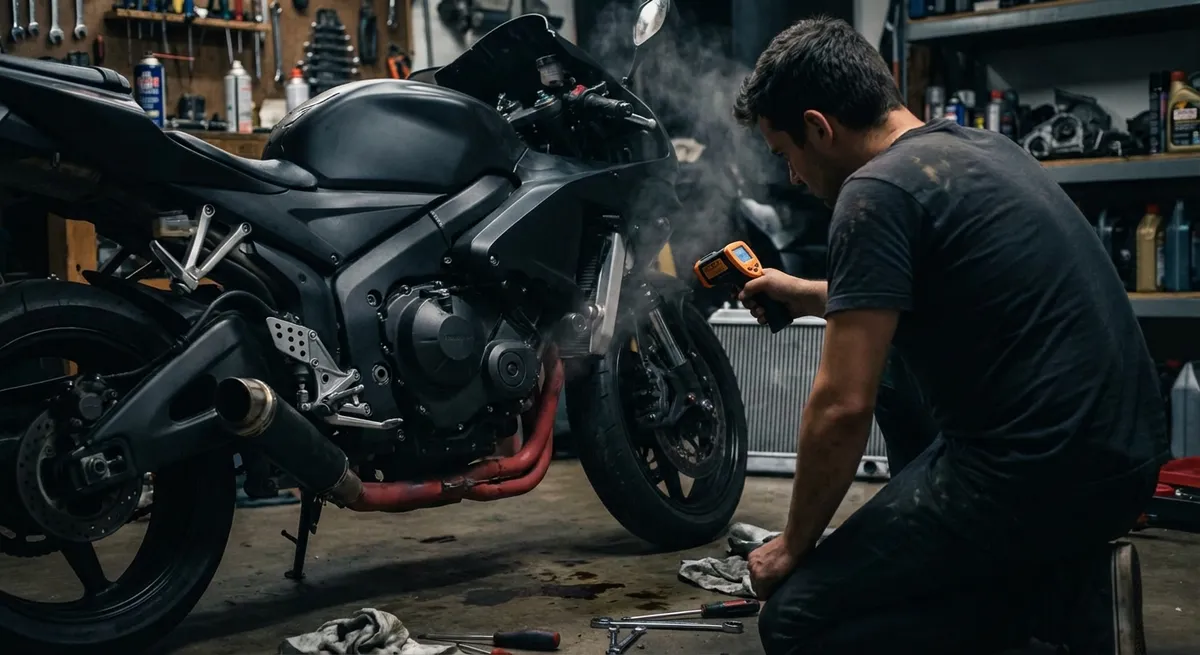
After a spirited descent or track session, use a non-contact thermometer (once stopped safely) to measure rotor temps. You’ll start to develop a personal map of:
Building thermal awareness into your brake maintenance means your lever feel and stopping distances are predictable—even when you’re deep into the friction system’s heat envelope.
4. Electrical and Charging System: Managing Heat in the Hidden Circuitry
Most riders think of heat purely in mechanical terms—pistons, rotors, radiators. The electrical system, though, is full of components whose lifespan and stability are tightly coupled to temperature: stators, regulator/rectifiers, batteries, and connectors.
Technical points to address:
- Regulator/rectifier (R/R) location and design:
- Many OEM R/Rs are mounted in hot, low-airflow zones. A shunt-style regulator dumps excess stator output as heat, making it one of the bike’s hottest electrical components.
- Check for heat discoloration on connectors and harness plugs.
- If relocating or upgrading, mount the R/R where it gets meaningful airflow and away from engine/radiator exhaust heat.
- Stator thermal loading:
- Additional electrical loads (aux lights, heated gear, GPS, chargers) all increase stator workload.
- Use a clamp meter or review spec sheets to ensure your accessories don’t push the charging system near its ceiling.
- Darkened windings or strong burnt odor when you inspect the stator (during clutch or cover service) are a clear early warning.
- Battery temperature and chemistry:
- Lead-acid batteries hate high heat; it accelerates plate corrosion and electrolyte evaporation.
- Lithium iron phosphate (LiFePO₄) can handle heat better in some respects, but sustained high ambient and charging temps still shorten life and stress internal BMS components.
- Verify that your battery is not sitting directly above major exhaust heat or crammed into an unventilated pocket.
- Connector integrity and resistance heating:
- Any slightly loose or corroded high-current connector becomes a localized heater. Resistance causes heat; heat accelerates corrosion and loosening—a runaway loop.
- Inspect main ground points, starter relay terminals, and high-load accessory joints. Look for:
- Green or white corrosion.
- Melted plastic or discoloration.
- Hardened, brittle insulation.
A stator running at continuous high output in hot oil can degrade insulation and shorten life.
Re-terminate or replace compromised connectors instead of just “cleaning and hoping.”
- Charging voltage vs. temperature:
- Excessive charging voltage accelerates gassing and grid corrosion in lead-acid batteries.
- For lithium, overvoltage plus heat stresses the BMS and can trigger protective cutoffs.
Some modern bikes temperature-compensate charging voltage; others don’t. On a hot day with a hot battery:
A quick multimeter check at the battery, after a long ride and fully heat-soaked, tells you how the system behaves in its real operating environment—not just at idle in the garage.
Thermally disciplined electrical maintenance is the difference between a bike that mysteriously dies on a hot day and one that starts, charges, and powers accessories with zero drama for years.
5. Thermal-Driven Inspection Intervals: Tying Maintenance to Real Use
Service manuals assume an “average rider” in “average conditions.” Enthusiasts rarely qualify. If you push the bike harder, lighter, faster, or in harsher climates, your true maintenance trigger isn’t mileage—it’s heat exposure.
Convert your maintenance mindset from distance-based to thermally-informed:
- High-load environments:
- Track days, mountain passes, high-speed touring, heavy two-up + luggage riding—all generate sustained high cylinder head, oil, brake, and stator temperatures.
- Use these events as checkpoints:
- Oil changes after a track weekend, not “in another 2,000 miles.”
- Brake fluid flush or at least inspection after a season of repeated hard descents.
- Cooling system inspection before and after peak summer.
- Stop-and-go heat soaking:
- Minimal ram air through radiators.
- Repeated fan cycling.
- Fuel in the tank and lines heat-soaking between traffic lights.
- Shorter coolant and oil intervals.
- More frequent checks of fan operation, radiator cleanliness, and tank venting.
- Surface temperature checks as a routine:
- Record exhaust header temps cylinder-by-cylinder at idle and after a ride.
- Check caliper and rotor temps after aggressive braking.
- Monitor R/R, stator cover, and battery area temps on long, loaded rides.
Urban commuters in hot cities experience:
This kind of thermal stress points toward:
An inexpensive infrared thermometer turns “I think it’s running hot” into data:
Over time, you’ll have your own “normal operating temperature map” unique to your bike and mods. Deviations from this are early indicators that something’s off—even before symptoms appear.
- Thermal stress logging:
- Date, ambient temp, type of ride (track, city, touring).
- Observed coolant or oil temps (if available).
- Subjective impressions: fan behavior, smell (hot brakes, hot oil), any temporary performance sag.
If you’re data-driven, keep a simple log:
Use this—not just odometer—to adjust maintenance frequency.
Heat is not just a byproduct; it’s a primary input into how you schedule care. Align your maintenance with your thermal reality, and your bike will feel mechanically “fresh” far deeper into its service life.
Conclusion
Every powerful motorcycle is a heat engine first and a toy, tool, or weapon second. If you treat maintenance as a purely time-and-mileage checklist, you leave performance and reliability on the table—especially when you ride hard, loaded, or in extreme climates.
By reframing oil, cooling systems, brakes, electrics, and intervals through a thermal lens, you stop reacting to overheating events and start engineering them out of your riding life. Your reward is a machine that feels mechanically tight and repeatable—lap to lap, pass to pass, summer to summer—because you’ve built heat awareness into every part of your maintenance routine.
Sources
- U.S. Department of Energy – How Heat Affects Motor Oil - Technical overview of how temperature impacts oil viscosity, oxidation, and performance
- Motul Technical Data Sheets - Detailed specifications on motorcycle engine oils, including high-temperature characteristics
- Brembo Braking Systems – Technical Area - Explains how heat influences braking performance, fluid, and rotor behavior
- NGK Spark Plug – Engine Cooling System Fundamentals - Engineering primer on cooling system function, thermostats, and heat transfer
- Electrosport – Motorcycle Charging System Tech - In-depth explanations of stator and regulator/rectifier operation, common failure modes, and thermal stress factors
Key Takeaway
The most important thing to remember from this article is that this information can change how you think about Maintenance.