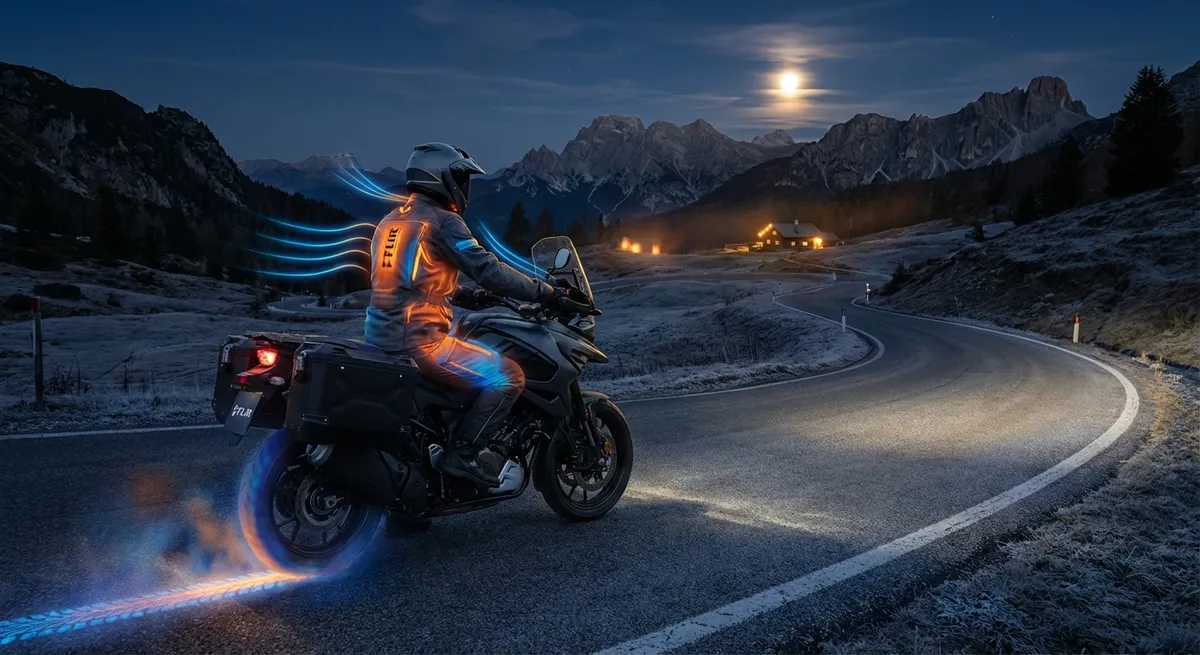
If you ride long enough, you discover that power, suspension, and electronics mean nothing when your body is overheating, freezing, or soaked through. Real-world performance on a motorcycle is capped not by your engine, but by your physiology—and your gear is the interface that decides how long you can ride at your peak. This isn’t just about staying “comfortable.” It’s about thermal management, moisture control, and impact protection working together as a system you can tune, just like suspension clickers or fueling maps.
This is your deep dive into how to engineer your gear setup around heat, not just style.
1. Base Layers: Your Primary Thermal Control Circuit
Before you think about jackets, Gore-Tex, or armor, your base layer decides how efficiently your body can dump or retain heat. Cotton is the thermal equivalent of a blocked radiator: it absorbs sweat, holds it against your skin, and destroys your body’s ability to self-regulate.
A technical base layer (synthetic or merino wool) is engineered to manage moisture as a system. These fabrics wick sweat from the skin into a larger surface area where it can evaporate more quickly. This phase change—liquid to vapor—is the core mechanism of cooling on a bike at speed. The more efficiently your base layer supports that process, the less your body has to work to stabilize core temperature.
Look at fabric weights: ultralight (120–150 g/m²) for hot weather, midweight (180–220 g/m²) for adaptable three-season use. Flatlock seams reduce hotspots under armor and pressure points at elbows, shoulders, and hips during long rides. Compression-style cuts reduce fabric bunching, which not only improves comfort but also creates more predictable armor placement and less friction if you slide.
High-quality merino has another engineering advantage: it can retain insulating power even when damp, and its fiber structure naturally resists odor buildup. On multiday trips, that reduces your required gear volume and lets you rely on one or two well-chosen layers instead of overpacking.
2. Venting and Shell Design: Turning Your Jacket Into a Controlled Airflow System
Most riders think of vents as “open or closed.” In reality, your outer shell is an airflow device, and you should think of it like ducting on a race car. Where the vents are placed, how large they are, and how they interact with interior liners determines whether you get active convection cooling—or just random turbulence and ballooning.
Front intake vents (chest, biceps, thighs) are only half the design. Exhaust vents (upper back, rear shoulders, back of thighs) are what allow low-pressure zones behind you to pull hot air and moisture-laden air out. Without exhaust, your jacket or pants become positive-pressure blimps: air comes in, swirls, warms up, and stays trapped.
Look for gear with:
- Direct-to-body venting: Vents that bypass the waterproof liner and flow straight to base layers for maximum evaporative cooling.
- Anchored vent panels: Stiffened or 3D-mesh-supported vent areas that don’t collapse at speed, maintaining a defined airflow path instead of flutter.
- Zipper orientation and length: Angled vents across the chest or forearm catch more air in a sport or ADV riding position than vertical vents designed for upright touring.
Pair your vent strategy with speed and humidity awareness. At very high ambient temperatures (especially above skin temperature ~33–35°C / 91–95°F), more air isn’t always better. In dry heat, airflow plus sweat equals effective evaporative cooling. In humid conditions, vents still help with convective cooling but your base layers and hydration strategy become more critical, because sweat won’t evaporate as efficiently.
3. Armor Integration: Managing Impact and Heat Without Compromise
Modern armor is no longer just about “hard plastic vs. soft foam.” Materials like viscoelastic impact foam (e.g., D3O-type compositions) and multi-density polymers allow CE Level 1 and Level 2 protection with varying trade-offs in mass, flexibility, and breathability.
From a heat-management perspective, armor behaves like insulation: it traps a boundary layer of warm air over protected zones—exactly where your body already runs hot (shoulders, knees, back). Poorly designed armor integration turns these zones into localized heat sinks.
Key technical points when evaluating armor setups:
- Perforation and channeling: Good armor has vent holes or channels to allow some convective airflow through it. This is critical in the back protector, which covers a large surface area over a major heat-exchange region.
- Stand-off distance: Mesh or spacer fabrics between armor and skin create a micro-air gap. That gap reduces pressure points and gives sweat a place to evaporate instead of saturating a single contact patch.
- Coverage vs. mobility balance: CE Level 2 is thicker and usually hotter. For riders in extreme climates, a highly ventilated CE Level 1 system with better overall airflow may keep you more alert and precise on the bike, which is a safety advantage of its own.
Back protectors built into jackets often sit directly on textile or minimal mesh. Consider swapping to a certified standalone back protector worn as a vest. The harness design can stabilize armor placement, create more consistent airflow channels, and decouple your thermal layer choices from your impact protection.
Finally, remember that armor absorbs energy partly through controlled deformation. That mechanical process plus trapped air means some heat buildup is inevitable; your job is to design the rest of your system (base, mid, and shell) to move that heat away efficiently.
4. Weatherproofing and Breathability: Understanding Membranes, Not Marketing
When brands throw around terms like “waterproof” and “breathable,” they’re usually referring to a membrane—most famously PTFE-based materials like Gore-Tex, or polyurethane-based alternatives. The engineering reality: all these membranes are working the same physics problem—let water vapor escape while blocking liquid water.
Hydrostatic head (mm) tells you how much water pressure a fabric can resist before leaking. For real-world motorcycling, you want a membrane with at least 10,000 mm, and ideally 20,000 mm or more if you ride in sustained heavy rain. But high hydrostatic ratings can come with a breathability trade-off, measured as either MVTR (Moisture Vapor Transmission Rate) or RET (Resistance to Evaporative Heat Transfer). Lower RET = more breathable.
Construction affects performance at least as much as the membrane type:
- Laminated gear (2L/3L): Membrane bonded directly to the outer shell. Water doesn’t soak into the face fabric as deeply, so the garment stays lighter and dries faster. Ideal for serious touring and ADV where all-day rain is realistic.
- Drop liners: Membrane hangs behind the outer shell. Cheaper, often more flexible, but the outer fabric can become waterlogged, adding weight, killing breathability, and making you cold when temps drop.
- Removable waterproof liners: Flexible for mixed conditions, but they trap heat if left installed on warm days and don’t prevent the shell from getting soaked.
A properly engineered rain system also accounts for failure points: zippers, cuffs, necks, and vents. Look for YKK AquaGuard or equivalent, storm flaps that fold away when not needed, and collar designs that can seal tight without creating pressure points on the neck. It’s not just the membrane; it’s the total leak-path engineering that decides whether you stay dry on hour three in a storm.
5. Hands and Feet: Precision Components in the Thermal Chain
Gloves and boots are often treated as afterthoughts, but they are high-value interfaces—both thermally and mechanically. If your hands are numb from cold or slick from sweat, your fine motor control on bars, levers, and switches drops fast. Your feet handle continuous micro-balance inputs on pegs and rear brake/shifter, and they live in a turbulent, wet, debris-rich airflow zone.
Gloves
From an engineering standpoint, a glove must balance:
- Abrasion and scaphoid protection (palm sliders, double layers, high-denier textiles or leather)
- Impact absorption at knuckles and finger joints
- Grip feedback at the bar, especially when wet
- Thermal balance and moisture control
Perforated leather can flow air effectively in hot conditions, but in humid environments, liners that help move sweat away from the palm surface are just as important. In wet and cold weather, a laminated waterproof glove avoids waterlogged outer shells that become heavy and rob heat through conduction. Pay attention to cuff design: a short cuff under a waterproof jacket sleeve minimizes water running down your arm into the glove; a long gauntlet over the sleeve helps shed rain at the cost of some bulk.
Heated gloves or heated liners add an active control layer to your thermal system. They allow you to keep a lighter outer glove with proper feel and simply add wattage when conditions demand, assuming your bike’s electrical system can supply it.
Boots
Your boots are dealing with three main engineering problems: impact/rotation, abrasion, and environmental sealing. For thermal management, the question is how well they allow moisture to exit while blocking external water, and how much insulation they trap.
Look for:
- Reinforced shank and ankle bracing that don’t completely block airflow channels.
- Hydrophobic liners (Gore-Tex or equivalents) that are integrated into the boot’s construction, not just “socks” inside.
- Sole design that doesn’t become a cold sink: multi-density midsoles can reduce conductive heat loss into wet pegs.
In hot weather, a vented touring or ADV boot with partial mesh panels will significantly reduce foot fatigue on long days. In cold or wet conditions, pairing a waterproof boot with technical socks (synthetic or merino) allows you to tune insulation without changing the boot itself—thin, high-wicking socks for mild rain, heavier merino for cold, with the boot as a constant external weather seal.
Conclusion
Your gear is not a fashion statement bolted onto a motorcycle; it’s a thermal, mechanical, and biomechanical system that directly controls how precisely and how long you can ride. When you start thinking like an engineer—base layers as heat exchangers, vents as ducting, armor as energy absorbers with thermal side effects, membranes as controlled barriers—you stop guessing and start tuning.
Build your setup as you would build a bike: spec each component for its job, understand the trade-offs, and evaluate performance in real conditions. The riders who can stay thermally stable, physically protected, and mentally clear the longest are the ones who extract the most from every mile—no matter what the weather decides to throw at them.
Sources
- Gore-Tex: How It Works – Technical overview of waterproof-breathable membrane function and construction types
- D3O Impact Protection Technology – Details on viscoelastic armor materials and how they manage impact energy
- CDC – Heat and Athletes: Hydration & Heat Illness Prevention – Background on thermoregulation, dehydration, and performance implications
- Harvard T.H. Chan School of Public Health – Exercising in the Heat – Research-based explanation of how the body dissipates heat during activity
- MIT – Materials for Extreme Environments – Insight into design trade-offs in advanced protective materials, relevant to modern armor systems
Key Takeaway
The most important thing to remember from this article is that this information can change how you think about Gear & Equipment.