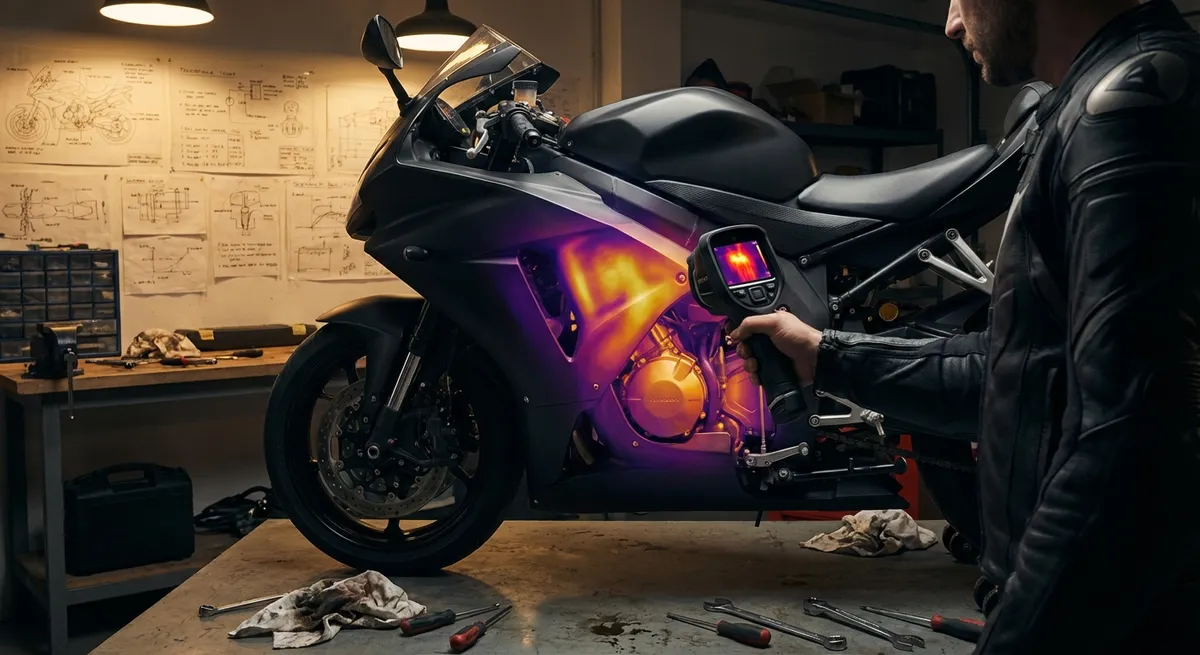
Heat is the silent killer of motorcycles. It cooks oil, warps rotors, fatigues metals, and quietly shortens the life of everything from your clutch plates to your stator windings. If you want a bike that feels tight at 50,000 miles instead of “tired” at 15,000, you don’t just change oil—you manage heat like an engineer.
This is maintenance at the level Moto Ready riders care about: not “check your fluids,” but understanding where your bike gets hot, how that heat flows through components, and what you can do in the garage to keep temperatures in the performance window instead of the failure zone.
Below are five technical maintenance focus areas, all tied to one theme: thermal control. Get these right, and you’re not just servicing your motorcycle—you’re extending its mechanical lifespan with intention.
1. Oil as a Heat-Transfer System, Not Just Lubrication
Engine oil is an active thermal component, not a passive fluid. In most modern motorcycles, oil can carry away 25–40% of the engine’s internal heat load, especially in compact, high-revving designs.
Key technical points to maintain oil as a heat system:
- Viscosity and film strength:
Multi-grade oils like 10W-40 or 5W-40 use polymer modifiers to stay pumpable when cold and retain film thickness when hot. If your engine frequently runs at high RPM or sees track days, an oil with a high High-Temperature High-Shear (HTHS) rating (often found in quality full synthetics) resists film collapse at extreme bearing temperatures. That’s not just about “lubrication”—it’s about avoiding metal-to-metal contact when oil temps spike past 120°C.
- Thermal degradation and oxidation:
Over time, heat breaks down oil molecules and increases oxidation, forming varnish and sludge. You don’t see it until you pull a valve cover or clutch cover—but by then, flow paths can be partially restricted, and hot spots worsen. Following time-based and usage-based intervals (e.g., more frequent changes for repeated short rides or heavy traffic) keeps the oil’s thermal capacity and flow consistency intact.
- Oil cooling architecture:
- A dedicated oil cooler (air- or liquid-cooled)
- A water-to-oil heat exchanger integrated with the cooling system
Many bikes use either:
Keeping those fins clean, hoses intact, and radiating surfaces free of road grime directly affects how quickly oil sheds heat. A clogged oil cooler is a hidden reason engines “feel rough” when hot.
- Maintenance actions with a thermal mindset:
- Use the manufacturer-specified viscosity, but consider a high-quality synthetic if you routinely stress the engine.
- Inspect for discoloration and burnt smell on drained oil—both indicate thermal stress.
- Keep external coolers and radiators clean with gentle water pressure and a soft brush, never bending fins.
Treat your oil as a thermal circuit. When it’s healthy, stable, and flowing correctly, your engine lives in a cooler, less destructive world—especially at sustained high load.
2. Cooling System Discipline: Pressure, Flow, and Air Management
On liquid-cooled motorcycles, the cooling system is not a simple “radiator + coolant” combo. It’s an engineered pressure-flow network, and small maintenance lapses translate into big temperature swings.
Technical aspects that matter:
- Pressure cap as a control component:
The radiator cap raises the system pressure, increasing the boiling point of the coolant. For every ~1 psi of pressure, the boiling point climbs roughly 1.4–1.5°F (~0.8°C). If your cap’s spring is weak or the seal is damaged, the system can’t reach design pressure, and localized boiling can occur in the head or cylinder—hot spots that never show on the dash gauge until it’s too late.
- Coolant condition and mix ratio:
- Depleted corrosion inhibitors
- Internal scale and deposits in water jackets
- Reduced heat transfer efficiency
Ethylene glycol or propylene glycol blends do three key things: alter freezing/boiling points, inhibit corrosion, and stabilize thermal transfer. A typical 50/50 mix works for most environments, but long-interval neglect leads to:
Flushing at the intervals in your service manual isn’t optional if you care about head gasket longevity and stable running temps.
- Flow path integrity:
The thermostat, water pump, and internal passages form a defined circuit. If a thermostat sticks partially closed, the engine may still run “ok” at speed—but heat spikes in traffic and then overcools on the move. A weeping pump seal, rattling impeller, or milky oil (coolant contamination) are thermal red flags, not just “leaks.”
- Airflow management:
Fairings, ducts, and radiator shrouds are designed to control pressure differentials around the radiator—high pressure in front, low pressure behind, maximizing through-flow. Missing side panels, bent radiator mounts, or stuffed-in aftermarket accessories can disturb this airflow and cut cooling performance even when coolant is perfect.
Maintenance with a thermal engineer’s mindset:
- Replace the radiator cap if you see any crusting, corroded spring, or if the bike has age-related issues with overheating.
- Use the specified coolant type—modern aluminum engines need the correct inhibitor package.
- Periodically backflush radiators and check for cold spots with an IR thermometer; cold zones in a hot radiator can indicate internal clogging.
- Make sure fans kick on at the correct temperatures; a failed fan switch or relay turns slow city traffic into a heat-soak test.
3. Brakes as Thermal Machines: Controlling Fade and Component Life
Your brakes convert kinetic energy into heat at staggering rates. From 60 mph to zero, a typical motorcycle can dump tens of thousands of joules into its front rotors in just a couple of seconds. Maintenance here is about more than pad thickness; it’s about keeping the system thermally stable.
What matters:
- Rotor mass and venting:
Heavier or larger-diameter rotors have higher thermal mass, meaning they absorb more energy before temperatures spike. Floating rotors and vented designs help shed heat faster. Warping usually isn’t a “mystical defect”—it’s non-uniform heating followed by uneven cooling, often due to sticky caliper pistons or dragging pads.
- Pad compound and operating window:
Organic, semi-metallic, and sintered pads all have different friction vs. temperature curves. If you’re using a racing pad on the street, you might never get into its optimal heat range—leading to poor cold bite. Conversely, a street pad flogged on mountain passes or track days can overheat, glaze, and fade. Glazing is literally a thermal failure mode: pad material overheats, smears, and loses its designed friction behavior.
- Fluid boiling and hygroscopicity:
DOT 3/4/5.1 fluids (glycol-based) absorb moisture over time, which lowers the boiling point. Under repeated hard braking, fluid can locally boil in the caliper, forming compressible vapor and causing fade or a spongy lever. Regular fluid changes reset the thermal reliability of your braking system.
- Caliper function and heat balance:
Sticking pistons or corroded sliders keep pads in light contact with the rotor, generating unnecessary heat even off-brake. One hot rotor and one cool rotor after a ride tells you your braking thermal balance is off—and your maintenance list just wrote itself.
Practical thermal maintenance:
- Flush brake fluid at least at the manufacturer’s interval, more often if you ride aggressively or in mountains.
- After spirited or downhill riding, feel (carefully, from a distance at first or using an IR thermometer) for rotor temperature balance; big left/right differences indicate caliper issues.
- Inspect pads not only for thickness but for surface condition—shiny, glass-like surfaces are glazing and mean excessive heat or the wrong compound for your use.
- Ensure caliper pistons move freely and retract properly; clean exposed piston surfaces during pad changes.
Your brakes are precision heat reactors. When they’re clean, bled, and properly matched to your riding style, you get consistent lever feel, minimal fade, and rotors that stay true for years.
4. Electrical and Charging System: Heat in the Copper, Not Just the Engine
Modern motorcycles route increasing amounts of power through relatively compact electrical components. Alternators, regulators/rectifiers, wiring harnesses, and connectors all generate heat—sometimes enough to cook insulation and quietly cripple reliability.
Technical factors to track:
- Stator and rotor loading:
High-output stators inside a hot engine case live in brutal conditions. If your battery is weak, sulfated, or constantly undercharged, the stator spends more of its life at maximum output, which means more I²R losses (heat generated by current) in the windings. That accelerates insulation breakdown and eventual stator failure.
- Regulator/rectifier dissipation:
Traditional shunt regulators dump excess power as heat. Mounted in low-airflow zones, they run hot all the time. Heat cycling kills solid-state components. If your bike has recurring regulator issues, upgrading to a better-cooled unit or a MOSFET/series regulator (if appropriate for your model) drastically reduces thermal stress.
- Connector resistance and heat:
Any corrosion or looseness in connectors increases electrical resistance. Resistive joints become localized heaters, sometimes melting plastic housings. You’ll see this at high-current junctions—starter relays, main fuse blocks, ground clusters, and stator/regulator plugs.
- Battery health as a thermal stabilizer:
A healthy battery acts as a buffer in the electrical system. A failing one increases alternator load and can cause overheat-prone voltage swings. Regular testing under load (with a multimeter or at a shop with a proper tester) is a thermal strategy—not just an “it starts, so it’s fine” check.
Thermal-focused electrical maintenance:
- Inspect high-current connectors annually: look for discoloration, softened plastic, or a burnt smell—signs of heat.
- Ensure the regulator/rectifier has unobstructed airflow; avoid covering it with luggage or aftermarket parts.
- Periodically measure charging voltage at the battery with the bike running; abnormal high or low readings can indicate overloaded or failing components that run too hot.
- Replace aging batteries before they become a constant high-load sink on your charging system.
Treat heat in the electrical system as seriously as heat in the engine. Excess temperature in copper and silicon is just as destructive as it is in pistons and valves.
5. Drivetrain and Bearings: Friction Hot Spots You Can Actually Control
Every rotating assembly on your bike—wheel bearings, steering head, swingarm pivot, chain, and sprockets—converts friction into heat. You may not see a temperature gauge for these components, but you can absolutely manage their thermal load through smart maintenance.
Where heat hides:
- Chain and sprockets:
A dry, under-lubricated chain can easily run tens of degrees hotter than a well-lubed one, especially at highway speeds. That extra heat cooks O-rings/X-rings, hardens them, and breaks down internal grease. Misalignment adds lateral stress, increasing friction and heating both chain and sprocket teeth, accelerating wear.
- Wheel bearings:
Correctly greased and torqued wheel bearings run cool and nearly frictionless. Over-tightened axles, improper spacer installation, or contaminated bearings increase rolling resistance. As bearings heat, grease thins and migrates, which can spiral into accelerated wear and eventual failure.
- Steering head and swingarm bearings:
These don’t spin fast, but they hold static and dynamic loads. Lack of fresh grease and improper preload leads to brinelling (indentation on races), which causes micro-motion, fretting, and heat under dynamic load. You’ll feel this as notchy steering, but the root cause is surface damage and localized overheating.
- Clutch and gearbox:
Slipping a clutch heavily (especially under load, like two-up or in the mountains) generates intense heat in friction plates and steels. Heat spots on steels, discoloration, or warped plates are thermal failures caused by either riding style, incorrect free play, or contaminated oil.
Thermal-aware drivetrain maintenance:
- Keep your chain clean, aligned, and lubricated with the correct type of lube for your environment (dry vs. wet). A well-maintained chain runs cooler, lasts longer, and transmits power more efficiently.
- During tire changes, spin the wheel by hand before final torque—feel for any drag or roughness that could indicate bearing issues.
- Periodically service steering head and swingarm bearings with the correct grease; this is high-impact maintenance that most riders skip, yet massively affects feel and longevity.
- Check clutch lever free play and avoid chronic partial engagement; it’s a direct input into how much heat you dump into the clutch pack.
Every watt lost to avoidable friction becomes heat. Every degree of extra heat shortens component life. Your maintenance routine is how you reclaim that margin.
Conclusion
The difference between a bike that feels worn-out at 20,000 miles and one that still feels mechanically precise well past 50,000 often isn’t brand or luck—it’s how the owner has managed heat.
Oil, coolant, brakes, electrics, drivetrain: they are all thermal systems first, mechanical systems second. If you start viewing your maintenance through that lens—how to keep each subsystem inside its designed temperature window—you graduate from “following the schedule” to actively engineering your motorcycle’s longevity.
That’s Moto Ready thinking: not just riding hard, but maintaining smarter—by understanding the physics happening under your seat on every single ride.
Sources
- U.S. Department of Energy – Engine Oil Viscosity – Technical discussion of viscosity, film strength, and efficiency implications
- Pennzoil – How Motor Oil Works – Overview of oil functions including cooling and thermal protection
- Engineering Explained – How a Car’s Cooling System Works (Radiator & Coolant) – Detailed engineering-level breakdown of pressure, coolant, and thermal management (applies directly to motorcycles)
- Brembo – Brake Discs and Pads Technical Info – Explains heat, fade, pad materials, and rotor behavior under thermal load
- Motorcycle Safety Foundation – Motorcycle Components and Maintenance – General but credible technical references on motorcycle systems, including brakes, drivetrains, and maintenance principles
Key Takeaway
The most important thing to remember from this article is that this information can change how you think about Maintenance.