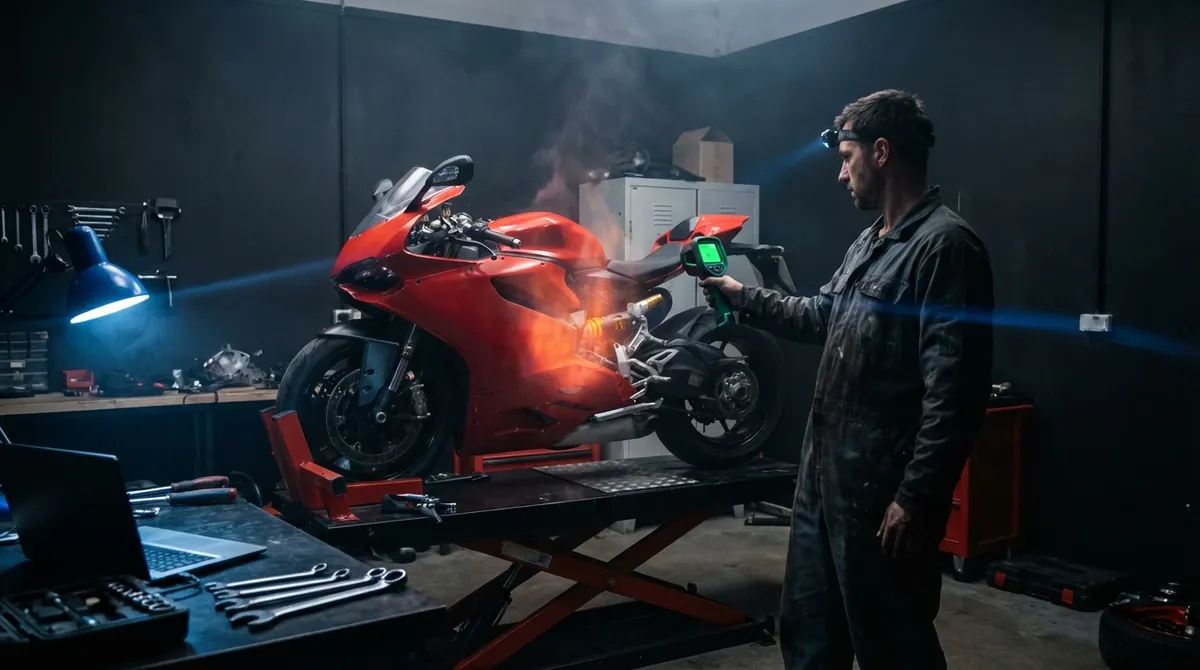
Motorcycles don’t die from mileage; they die from unmanaged heat. The engines, the oil, the brake fluid, the electrical system—everything you care about turns sloppy, vague, or outright dangerous once temperatures drift out of control. If you want sharp throttle response at the end of a mountain run, consistent braking after repeated hard stops, and an engine that still feels tight at 60,000 miles, you don’t start with aesthetics—you start with thermal management.
This is maintenance for riders who actually push their bikes: track days, high-speed touring, aggressive commuting, hot climates. We’re going to treat heat as a critical system variable, not an afterthought. The goal: a motorcycle that stays mechanically precise even when the environment, traffic, and riding style are trying to cook it alive.
Understanding the Heat Map of a Modern Motorcycle
Every modern motorcycle is a compact heat generator wrapped in plastic and metal. To maintain performance, you need a mental “thermal map” of your bike: where heat is created, where it accumulates, and where it must be evacuated.
The primary heat zones:
- Combustion chamber and exhaust ports – Peak temperatures here can exceed 1,500–2,000°F (815–1,093°C) momentarily under load. This is controlled via timing, fueling, and cooling system capacity.
- Cylinder head and block – Aluminum conducts heat well but also expands significantly. Poor cooling here shifts valve clearances, alters ring sealing, and can trigger detonation under load.
- Oil circuit – Oil isn’t just lubrication; it’s a supplementary coolant. High oil temps thin viscosity, accelerate oxidation, and shorten additive life, especially in shared-sump engines (engine + transmission + clutch).
- Braking system – Repeated heavy braking can push rotor temps beyond 500°F (260°C) and boil marginal brake fluid, leading to fade and spongy lever feel.
- Charging system and electronics – Stators, regulators/rectifiers, and ECUs live in hot zones and are often only marginally cooled. High temps accelerate failure and voltage instability.
If you treat maintenance as “keeping things clean and lubricated,” you’ll extend cosmetic life. If you treat maintenance as “controlling heat paths and thermal stability,” you’ll extend mechanical precision. That’s the difference between a bike that feels “loose and tired” at 40,000 miles and one that still feels surgically tight.
Coolant System Discipline: Pressure, Flow, and Real-World Margins
Liquid-cooled engines survive on a narrow balance of pressure, flow, and heat transfer. Most riders only think about “topping off coolant,” but thermal stability comes from system integrity, not just fluid quantity.
Key technical points and practices:
Coolant chemistry and service interval
Modern silicate-free, OAT/HOAT coolants (often in OEM formulations) are engineered to protect aluminum, magnesium, and mixed-metal systems while resisting cavitation erosion. These additives degrade over time—typically 2–4 years depending on the manufacturer. Old coolant doesn’t just cool less efficiently; it loses its ability to protect from corrosion and water pump damage. Always use coolant meeting your manufacturer’s spec (often on the radiator cap or in the manual).
System pressure = higher boiling point
The radiator cap is not a plug; it’s a calibrated pressure valve. Most motorcycle caps are in the 1.1–1.4 bar range. Increasing system pressure raises the boiling point, which is why a weak or failing cap can cause chronic “mystery” overheating or coolant loss under heavy load. Replace the cap at regular intervals or at the first sign of overflow tank anomalies.
Flow is as important as temperature
A thermostat stuck partially closed or a water pump with worn impeller blades can cause poor circulation without obvious overheat lights—especially in cool ambient conditions. Look for: - Slow warmup followed by sudden spikes in coolant temp - Overheating only at low speeds or only at highway speeds These signal circulation issues rather than just airflow problems.
Radiator fin health and airflow
Bent fins, bugs, road grime, and plastic guards with too-tight mesh all reduce heat rejection. Clean radiators gently with low-pressure water and a soft brush. Straighten crushed fins carefully with a fin comb. Avoid stacking accessories (dense guards, auxiliary lights, big bags) in front of primary cooling airflow.
Fan control and electrical integrity
Electric cooling fans are the last defense in traffic, especially on high-compression, high-output engines. A sticky relay, corroded ground, or marginal fan motor can mean your fan only works intermittently—often not noticed until a hot day in stop-and-go traffic. Periodically verify that: - The fan kicks on at the specified temperature (usually 100–110°C / 212–230°F) - The fan draws consistent current (if you have access to a clamp meter) - Connector plugs are clean and free of heat-soaked, brittle insulation
Treat the cooling system as a calibrated pressure-and-flow machine, not just “a radiator with some liquid.”
Oil as a Thermal Component: Shear, Viscosity, and Stability Under Load
On most motorcycles, the engine oil does triple duty: engine lubrication, transmission lubrication, and clutch friction management. All of that happens under extreme shear and high temperature. If you ride hard, your oil isn’t just lubricating—it’s carrying heat away from critical surfaces and acting as a dynamic structural element in your drivetrain.
Technical Point 1: Viscosity stability vs. operating temperature
The correct oil grade (e.g., 10W-40, 5W-30, 15W-50) is chosen around expected operating temps and clearances. Aggressive riding, high ambient temps, and sustained high RPM easily push sump temps above 120°C (248°F), where many oils start to thin significantly.
What to prioritize:
- Use oil weights specified or approved by your manufacturer for your climate. Thicker isn’t always better—too viscous when cold means delayed lubrication at start-up and potentially worse wear.
- Look at the oil’s HTHS (High-Temperature High-Shear) viscosity when available. Higher HTHS generally means better film strength under real-world stress, especially in shared-sump setups.
- For track or desert use, consider oils explicitly rated for high-temperature performance and shear stability, not just “meets minimum JASO MA.”
Technical Point 2: Shear and gearbox brutality
Motorcycle transmissions are constant-mesh gearboxes that chew oil with extreme pressure and shear forces. Over time, multi-grade oils can shear down, effectively behaving like a lower-viscosity grade.
Implications:
- Oil that starts as a 10W-40 may behave more like a 10W-30 after heavy use in a shared sump.
- If your shifting becomes notchy or clunky before the official change interval, that’s often shear breakdown, not a mechanical failure.
- For aggressive use, shorten oil change intervals from “owner’s manual street riding” to “performance riding” schedules—even on modern synthetics.
Technical Point 3: Thermal load and oil cooling
Some bikes rely heavily on oil for heat management—either via dedicated oil coolers or internal passages designed to pull heat from hot spots.
Maintenance that matters:
- Keep oil coolers externally clean and free of debris, just like radiators.
- Ensure proper routing and condition of oil cooler lines—kinks or internal delamination can restrict flow and elevate localized temps.
- If you add aftermarket skid plates or fairings, confirm they don’t block airflow to oil coolers or critical cases.
Your oil isn’t just a wear item. It’s a high-speed thermal working fluid in a brutally demanding environment. Treat it accordingly.
Brake Thermal Integrity: Consistent Stopping in Real Heat
Brakes are simple in theory—kinetic energy becomes heat—but the thermal behavior of your braking system decides whether you stop now or “eventually.” For performance riding, it’s not pad brand hype that saves you; it’s disciplined thermal maintenance.
Technical Point 4: Brake fluid boiling point and replacement strategy
Brake fluid absorbs moisture over time. Water-laden fluid boils dramatically earlier than dry fluid, and boiling fluid means gas bubbles—compressible, vague, and dangerous.
- DOT 3 / DOT 4 / DOT 5.1 (all glycol-based) are hygroscopic: they will absorb atmospheric moisture even through hoses and seals over months and years.
- A typical DOT 4 fluid might start with a dry boiling point > 230–260°C (446–500°F), but with 3–4% water absorbed, its wet boiling point can drop closer to 150–180°C (302–356°F). Track-level or mountain-pass heat can absolutely get you there.
- Replace brake fluid at least every 1–2 years for street-only bikes, and more frequently for track or aggressive mountain use.
- Use fluids that explicitly list both dry and wet boiling points, not just a standard compliance mark.
Technical Point 5: Disc/pad interface and heat rejection
A brake system is only as good as its ability to convert and then shed heat.
What to maintain and monitor:
- Pad material: Organic, semi-metallic, and sintered pads have very different thermal behaviors. Sintered pads typically handle higher temps and maintain friction better when hot, making them preferred for performance use—but they run hotter at the rotor and can be harsher on discs.
- Rotor condition: Blueing, radial cracks around drilled holes, or warping are signs of thermal distress. Measure rotor thickness and runout; don’t just “eyeball it.” Thin rotors overheat faster and can’t reject heat effectively.
- Caliper condition: Sticking pistons or glazed seals keep pads dragging lightly, generating constant low-level heat and boiling fluid in sustained use. A proper caliper strip, clean, and rebuild is one of the most underrated “performance mods” you can do.
Pair fresh, high-quality fluid with clean calipers, rotors at proper spec, and pad compounds chosen for your real riding (not marketing copy), and your braking will stay predictable even after repeated hard stops.
Electrical and Charging Systems: Heat, Resistance, and Reliability
Modern motorcycles run dense electrical systems in confined, hot spaces: stators behind hot engine covers, regulators under seats, ECUs in minimal airflow. Thermal neglect here leads to intermittent faults, charging failures, and strange behavior that riders often misdiagnose as “bad batteries” or “ECU gremlins.”
Key thermal-related maintenance practices:
- Connector integrity: Corrosion and partial contact raise electrical resistance, and raised resistance creates localized heat. Over time, this heat oxidizes connectors further and can melt housings or cause intermittent failures. Periodically:
- Unplug high-load connectors (regulator, main harness plugs, headlight, ignition coil connectors).
- Inspect for discoloration, melted plastic, or verdigris (green corrosion).
- Clean with proper electrical contact cleaner and, where appropriate, apply dielectric grease to seal against moisture.
- Regulator/rectifier cooling: These devices dissipate significant heat when bleeding off excess stator output. Mounting them in dead-air pockets or behind heat-soaked bodywork is asking for failure.
- Ensure the regulator’s heat sink fins are clean.
- If relocating, choose a location with real airflow, not just a visually convenient spot.
- Stator heat load: High RPM and high electrical demand run stators hot. Old, thin oil, dirty cases, or extreme ambient heat all elevate stator temperature.
- Keeping engine oil fresh and at proper level directly assists in stator cooling when it’s engine-side.
- Avoid loading the system with unnecessary high-draw accessories if your charging margin is already slim; heat at maximum output is cumulative damage over time.
Maintaining low electrical resistance and good airflow in these systems is the difference between rock-solid reliability and random “bike died at a gas station” moments.
Building a Heat-Aware Maintenance Routine
If you ride with intent—hard canyon runs, loaded touring, track days—you need a maintenance routine that assumes thermal stress as the default, not the exception. Here’s how to structure it:
- At every oil change:
- Inspect radiator and oil cooler faces for obstructions and bent fins.
- Check coolant reservoir level and look for discoloration or sludge.
- Inspect regulator, stator, and main harness connectors for signs of heat damage.
- Every 6–12 months (or 6,000–8,000 miles for hard use):
- Flush and bleed brake fluid, especially if you’ve done repeated aggressive braking or mountain descents.
- Inspect brake rotors for blueing, cracks, and thickness; check pad condition and taper wear.
- Test cooling fan operation and inspect fan wiring.
- Every coolant interval (2–4 years, or sooner for extreme duty):
- Fully drain and flush the cooling system; refill with appropriate spec coolant.
- Replace the radiator cap as cheap insurance if the bike is aging or used hard.
- Inspect hoses for hardening, bulges, or soft spots near clamps.
- Annually for high-demand riders:
- Consider sending used oil for analysis if you ride in extreme heat or track conditions; monitor viscosity retention and wear metals.
- Inspect and clean grounds and primary charging system connections.
- On bikes with a history of thermal issues, consider strategic heat shielding or re-routing components away from known hot spots.
Thermal stewardship isn’t glamorous, but it’s what separates a bike that just runs from a bike that remains precise under punishment.
Conclusion
Performance isn’t built on peak horsepower numbers or bolt-on parts—it’s built on stability under load. A motorcycle that maintains tight clearances, consistent friction, and predictable response at the end of a hard session is a machine with a disciplined thermal maintenance strategy behind it.
When you think maintenance, stop thinking in terms of simple “wear and tear.” Start thinking in terms of heat paths, fluid integrity, and thermal margins. Own your bike’s heat map. Control it with coolant discipline, oil selection and intervals, brake fluid management, and electrical cleanliness. Do that, and your motorcycle won’t just last longer—it will stay sharp, precise, and trustworthy every time you ask it to work at the edge.
Sources
- [U.S. Department of Energy – Engine Coolants and Their Effects](https://www.energy.gov/eere/vehicles/articles/engine-coolants) – Technical overview of coolant function, heat transfer, and corrosion protection in modern engines
- [Penn State University – Motor Oil Viscosity and Engine Protection](https://extension.psu.edu/understanding-motor-oil-viscosity) – Explains viscosity grades, high-temperature behavior, and how oil protects under load
- [Brembo – Brake Fluid and Braking System Technical Notes](https://www.brembo.com/en/company/news/brake-fluid-5-things-to-know) – Detailed discussion of brake fluid boiling points, degradation, and performance implications
- [Honda Powersports – Motorcycle Maintenance Guidelines](https://powersports.honda.com/discover/honda-care/maintenance) – OEM recommendations on coolant, brake fluid, and general service intervals relevant to real-world riding
- [Kawasaki Motors – Understanding Motorcycle Cooling Systems](https://www.kawasaki-cp.khi.co.jp/tech_info/pdf/eng_20110726.pdf) – Technical reference on liquid-cooling design, system pressure, and radiator function in motorcycles
Key Takeaway
The most important thing to remember from this article is that this information can change how you think about Maintenance.