Most riders talk about “feeling one with the bike” like it’s magic. It isn’t. It’s physics, inputs, and repeatable technique. When you understand how your hands, feet, and body load the chassis, you stop reacting to the ride and start engineering it. This isn’t about going faster for Instagram—it’s about building a riding system that scales from city traffic to mountain passes and track days.
Below are five technical riding principles you can apply on your very next ride. Each one is aimed at turning your inputs into something the bike (and the tires) can actually use.
1. Throttle as a Chassis Tool, Not Just a Speed Control
Most riders treat the throttle like a volume knob: more turn equals more speed. In reality, your right wrist is the primary tool for managing weight transfer and chassis attitude.
When you roll on the throttle gently from neutral or slightly closed, you’re not just accelerating—you’re unloading the front tire and extending the fork. This changes rake and trail slightly, making the bike more stable but less eager to turn. Roll off, and the opposite happens: weight shifts forward, the fork compresses, trail decreases, and the bike becomes more responsive but also more sensitive and less forgiving.
The key is rate of change. Abrupt roll-off mid-corner slams weight onto the front, potentially overwhelming front tire grip and causing a vague or “tucking” sensation. Abrupt roll-on while leaned over can overload the rear tire, especially on cold or worn rubber. Aim for a smooth, linear transition: neutral or very slight maintenance throttle at corner entry, then a steady, deliberate roll-on from the apex out, matched to the corner radius and your available traction.
If your bike has ride modes or adjustable throttle maps, treat them as tools to shape how your input translates to torque at the rear wheel. A softer map in the wet or on gravel doesn’t make you less of a rider—it widens the margin between minor errors and major consequences by smoothing torque delivery.
2. Brake Setup and Technique: Stacking Grip Without Surprises
Brakes are more than “front for stopping, rear for stability.” Done right, braking is a controlled reallocation of grip and geometry.
Under braking, up to 80–90% of your usable grip can shift to the front tire, depending on speed, weight bias, and suspension setup. Your job is to build that load smoothly so the tire has time to deform and generate grip. This is why modern technique emphasizes progressive initial pressure: touch the lever, then ramp, rather than stabbing it. Once the fork is compressed and the tire is loaded, you can apply surprisingly high braking forces—within the limits of your traction, of course.
Two technical concepts to integrate:
- Trail Braking (Street Version): This isn’t about “maximum attack”; it’s about control. You maintain some front brake pressure as you initiate turn-in, then bleed off pressure as lean angle increases. This keeps the front tire loaded just enough to carve the line while letting the fork extend as you approach the apex. Done correctly, you can fine-tune your line mid-corner with delicate changes in brake pressure instead of big steering inputs.
- Rear Brake Modulation: The rear brake is a stability tool. Light application during low-speed maneuvers (U-turns, hairpins, parking lots) helps stabilize the chassis by gently “anchoring” the rear, allowing smoother throttle control. At higher speeds, the rear brake can add a small but useful deceleration component without radically upsetting the geometry—but it must be fine-tuned, not stabbed, especially on ABS-free bikes where rear lock is easy to trigger.
If your bike has adjustable levers, set them so you can operate the front brake with two fingers without over-stretching or having to roll your wrist. The more ergonomic your control setup, the more precise your braking inputs become.
3. Corner Entry: Vision, Lines, and Load Management
Corner entry is where most riders lose control—not because the corner is difficult, but because too many variables change at once: speed, lean, throttle, and line. The solution is to standardize your process.
Vision first: Lift your eyes. Your brain steers toward what you fixate on. You want your primary focus beyond the corner apex, scanning the exit and next hazard, while your peripheral vision tracks the pavement and lane position. Practice deliberately shifting your focal point early—spot entry, then apex, then exit—so your steering input becomes pre-planned, not reactive.
Line selection on the street has a different goal than on track. You’re not minimizing lap time; you’re maximizing visibility and margin. That means:
- Wide entry (within your lane) to see further around the corner.
- Delayed apex so your bike is pointed more down the road by the time maximum lean occurs.
- Smooth, single steering input rather than multiple corrections.
From a load perspective, corner entry should look like this: finish your hardest braking before tip-in, then carry a trace of front brake pressure into the corner if needed (light trail braking), begin to ease off as lean builds, and transition to neutral or gentle roll-on by the time you reach your chosen apex. You’re managing a continuous, predictable shift from front-loaded (braking) to more balanced (mid-corner) to rear-biased (corner exit).
If you frequently feel like the bike “runs wide” at corner exit, it’s usually not “lack of power”—it’s entering too fast, looking too close, or rolling off the throttle mid-corner and making the chassis stand up. Fix the input sequence, and the bike will track like it’s on rails.
4. Mid-Corner Stability: Using Body Position as a Fine Adjustment Tool
Body position is not just about “hanging off” or looking sporty in photos. It’s a way to adjust the combined center of mass of you and the machine, which directly impacts required lean angle and tire load distribution.
Even modest body adjustments can yield real benefits:
- Upper Body: Keeping your chest slightly toward the inside of the corner and your head aligned with the mirror or just inside the bar reduces the lean angle required for a given speed and radius. This gives you more tire margin and improves front-end feel.
- Lower Body: Locking your outer knee lightly into the tank offloads your arms so the bars can float. Any tension in your arms translates into unwanted steering inputs and instability over bumps or mid-corner corrections.
The engineering reality: by shifting your mass toward the inside, you reduce the lean angle the motorcycle itself needs to achieve for the same cornering force. Even a small reduction in lean can move you from the shoulder of the tire back toward its more supported area, where carcass stiffness and profile work better.
Focus on these technical checkpoints mid-corner:
- Are your hands light on the bars, or are you supporting your weight through them?
- Is your outer foot weighting the peg, with your heel lightly engaged, to give the chassis a stable connection?
- Is your head leading the turn slightly, looking through the corner rather than at the ground ahead of your tire?
You’re not trying to mimic race leans on the street; you’re trying to create a neutral, repeatable posture that stabilizes the bike and maximizes your sensory feedback from the contact patches.
5. Traction Intelligence: Reading Grip Before It Reads You
Every modern motorcycle has more performance potential than public roads will ever allow. The limiting factor is traction—specifically, how well you can estimate and preserve it.
Think in terms of a traction budget. Your tires can only handle a finite combined load of acceleration, braking, and cornering at any given moment. If you’re using 80% of available grip to corner and you add a sudden 40% braking demand, you’ve asked for 120%—and that’s when ABS cycles, tires slide, or worse. The game is to balance these forces so you never spike above what the surface and conditions can support.
Technical ways to increase your traction intelligence:
- Tire Temperature & Pressure Awareness: Cold tires have less grip and respond poorly to abrupt inputs. Correct pressure (checked cold) ensures the carcass flexes as designed, generating and maintaining temperature. Overinflation reduces the contact patch and can make the bike feel skittish; underinflation overheats the carcass and reduces stability. Before pushing your pace on a ride, give your tires time—several kilometers of steady, moderate load—to build heat.
- Surface Scanning: Train your eyes to detect texture and color changes: shiny patches (possible oil/water), dusty or gray zones (sand, grit), dark strips (tar snakes), and painted lines or manhole covers. Assume any of these are low-mu (low friction coefficient) zones—avoid strong brake or throttle changes when you’re on them and reduce lean if possible.
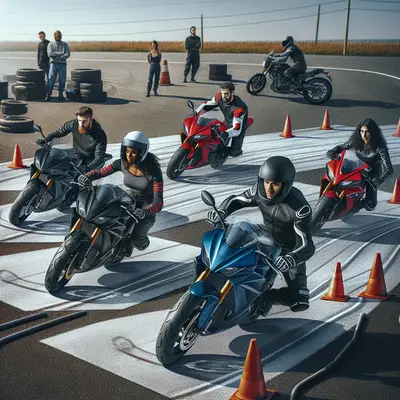
- Feedback Calibration: Learn what impending traction loss feels like on your bike, with your tires. This includes subtle squirm at the rear under acceleration, lightness or chatter at the front under hard braking, or a vague, “floating” sensation mid-corner. Parking-lot drills in safe conditions—gradually increasing lean at low speed, or controlled rear brake applications to feel ABS activation—help you recognize these signals before they surprise you on the road.
Use rider aids (ABS, traction control, cornering ABS if equipped) as sensors, not crutches. If your TC light is constantly flashing on corner exits, that’s feedback: you’re exceeding available grip or using too aggressive a throttle input for the conditions. Adjust your technique so the electronic systems rarely have to save the day; their primary value is extending your safety margin when prediction fails.
Conclusion
Riding well is not about bravery or brand—it’s about inputs, timing, and respect for physics. When you start treating the throttle as a chassis tool, braking as controlled load management, lines as visibility and stability enhancers, body position as a precision adjuster, and traction as a finite budget, the ride transforms. Corners stop being threats and become problems to be solved. Your speed becomes a byproduct of clean technique, not the objective.
Take these five technical principles and apply them deliberately. Pick a single skill per ride—maybe smooth throttle transitions one day, or improved vision and lines the next. The goal isn’t perfection; it’s iteration. Every mile becomes data, and every ride gets you closer to a bike and rider operating as a single, engineered system.
Sources
- [Motorcycle Safety Foundation – Basic and Advanced Riding Tips](https://www.msf-usa.org/ridercourses.aspx) - Foundation-level techniques and advanced concepts from a leading training organization
- [Honda Powersports – Street Riding Tips](https://powersports.honda.com/street/experience/street-riding-tips) - Manufacturer-backed guidance on cornering, braking, and street strategy
- [U.S. NHTSA – Motorcycle Safety](https://www.nhtsa.gov/road-safety/motorcycles) - Government data and recommendations on safe riding practices and risk factors
- [British Superbike School – Trail Braking and Cornering Dynamics](https://www.superbikeschool.co.uk/uk-motorcycle-racing-school/) - Technical explanations of braking and cornering from a performance-riding school
- [Pirelli Motorcycle Tires – Technical Info on Tire Performance](https://www.pirelli.com/tires/en-us/motorcycle/home) - Tire behavior, traction principles, and pressure/temperature effects from a major tire manufacturer
Key Takeaway
The most important thing to remember from this article is that this information can change how you think about Riding Tips.