Most riders obsess over horsepower. The smart ones obsess over what happens after the crankshaft. Your chain, sprockets, clutch, gearbox, and final drive are the unseen power brokers of every ride—quietly deciding whether your throttle inputs become clean drive or expensive shrapnel.
This isn’t generic “lube your chain” talk. This is about engineering-level care of your drivetrain so it runs cooler, lasts longer, shifts cleaner, and survives real-world abuse—track sessions, loaded touring, brutal commuting, and everything in between.
Understanding the Drivetrain as a System
Your drivetrain is a tightly coupled mechanical system: crank → clutch → gearbox → front sprocket → chain/belt/shaft → rear sprocket → wheel. Every weak link amplifies stress somewhere else.
When your chain runs too tight, it transfers shock loads into the countershaft bearing and gearbox output shaft. When it runs too loose, it slaps, hammers sprocket teeth, and creates impact loading that eats cush drives and bearings. A slipping clutch doesn’t just smell bad—it turns energy into heat, cooking plates and glazing friction material, which then demands more slip for the same acceleration, compounding the problem.
Treat the drivetrain as a closed-loop system: alignment, tension, lubrication, modulation (clutch/throttle), and load distribution (final drive ratio, gearing, and rider behavior) all interact. You’re not “just” adjusting a chain; you’re tuning how torque is transmitted through an entire mechanical ecosystem.
Technical Point 1: Chain Tension Isn’t a Guess—It’s a Geometry Problem
Chain slack is not arbitrary; it’s dictated by swingarm geometry and the arc your rear axle travels through.
On most bikes, the chain is tightest when the swingarm, front sprocket, and rear axle are in a straight line. That point rarely occurs at static sag. If you adjust slack based only on how it “looks” on the side stand, you’re playing roulette with your output shaft bearings and countershaft seal.
Key technical details riders should respect:
- Measure slack at the manufacturer’s reference point. Many OEMs specify a particular span of chain and whether to measure on the side stand, center stand, or with the bike unweighted. That spec is tied to a specific geometry assumption.
- Understand the tight-spot rule. Chains rarely wear perfectly evenly. Rotate the rear wheel and find the tightest section of chain—set slack there. If you adjust using a looser section, you will be over-tight at the tightest point.
- Use a consistent measurement method. Typical spec might be 25–35 mm of vertical movement at the midpoint between sprockets. Don’t eyeball; use a ruler or caliper and press up/down with similar force each time.
- Account for load. A heavily loaded touring bike (pillion + luggage) compresses the rear suspension and tightens the chain arc. If you do a lot of two-up or luggage work, set your slack with that configuration in mind, not just solo.
- Respect the consequences. An overly tight chain accelerates wear on:
- Countershaft bearing
- Swingarm pivot bearings
- Output shaft seal
- Chain and sprocket teeth
A loose chain risks derailing under compression, damaging cases or locking the rear wheel.
Chain tension is not feel-based; it’s a geometry-driven, spec-driven adjustment that should be approached like setting valve clearance—precise, consistent, and repeatable.
Technical Point 2: Chain Lubrication Is About Film Strength, Not Shine
Chain lube isn’t cosmetic. You’re building a sacrificial, load-bearing film between steel surfaces subjected to massive boundary lubrication conditions—especially in the front sprocket area where torque multiplication and chain wrap angle are highest.
Some critical technical realities:
- O-ring/X-ring chains are pre-lubed internally. The seals only protect the factory grease in the pin/bushing interface. Your job is to lube the external contact surfaces: roller-to-sprocket tooth and side plates (to fight corrosion and let the chain articulate freely).
- Film strength beats thickness. A thick, goopy spray that flings everywhere but shears under load is inferior to a thinner lube with high-pressure (EP) additives that survives tooth engagement at the countershaft sprocket.
- Best time to lube is right after riding. A warm chain:
- Opens micro-gaps in seals slightly
- Drives off moisture
- Allows lube to flow better and penetrate micro-clearances
Lube it cold in the morning and it mostly sits on the surface.
- Overspray and fling are diagnostic. If your swingarm and wheel are coated in lube, you’re using too much or the wrong type. Heavy fling collects grit, creating a grinding compound that quietly eats rollers and sprocket teeth.
- Front sprocket zone is high priority. That’s where torque is highest and chain speed transition is sharpest. Pull the cover periodically; if that area is packed with greasy concrete, you’re asking for accelerated sprocket and seal wear.
A clean, lightly but uniformly coated chain—clean side plates, visible lube at the roller/tooth interface, minimal fling—is a sign of a drivetrain running in its optimal lubrication regime.
Technical Point 3: Sprocket Geometry and Ratio Are Wear Multipliers
Most riders think of sprockets in terms of gearing only—“one down on the front, two up on the rear.” From a maintenance perspective, tooth count and profile also control stress distribution and wear rate.
Key technical aspects:
- Smaller front sprockets increase articulation angle. Dropping from a 16T to a 15T front sprocket:
- Increases the bend angle of each chain link per tooth engagement
- Raises contact pressure at each roller/sprocket interface
- Speeds up wear of both the chain and the front sprocket
It’s a real trade-off: better acceleration vs reduced drivetrain lifespan.
- Tooth profile matters. Quality sprockets have:
- Hardened teeth with controlled surface finish
- Properly chamfered entry profiles to ease chain engagement
- Accurate pitch to match chain spec
Cheap sprockets often have rough, inconsistent tooth form that drives impact loading and noise.
- Replace chain and sprockets as a set. A worn sprocket with a new chain:
- Mis-meshes roller position in the tooth valley
- Hammers the new chain’s rollers
- Quickly “teaches” the new chain to wear into the old pattern
You’re burning life off brand-new components to match an already-worn geometry.
- Inspect tooth profile the right way. You’re not just looking for “sharpness”; you’re looking for:
- Hooking: teeth leaning in the direction of chain pull
- Thinning at the tip
- Uneven wear across the tooth width, often a sign of misalignment
- Gear ratio versus use case. Track riders and aggressive canyon riders who shorten gearing should accept that they are choosing a higher maintenance cadence. If you change gearing, bake a reduced replacement interval into your maintenance plan.
Sprockets are not passive components—they actively define how gracefully your chain transitions torque. Choose and maintain them like you would braking components, with a clear understanding of trade-offs.
Technical Point 4: Clutch Health Is About Heat, Clearance, and Fluid Management
The clutch is a controlled friction device that lives in a brutal environment—hot oil, repeated high-torque engagements, and frequent abuse in low-speed situations. Preventing premature clutch death is less about babying it and more about understanding how it manages heat and clearance.
For wet multi-plate clutches (most modern bikes):
- Oil selection affects clutch behavior. Automotive oils with friction modifiers can cause clutch slip. Motorcycle-specific oils are blended to maintain friction characteristics compatible with wet clutches under high shear and heat.
- Free play is non-negotiable. At the lever, you need a small amount of free play to ensure:
- The pressure plate fully clamps the stack at rest
- Thermal expansion of plates doesn’t “ride” the clutch partially disengaged
Too little free play = constant micro-slip = heat = glazing and warp.
- Heat cycling is what kills plates. Hard launches, heavy traffic, slow technical off-road with constant feathering—all generate intense localized heat at the friction interface. Symptoms of a heat-abused clutch:
- Increased lever travel before engagement
- Sudden change in engagement point after a hot session
- Burnt smell from oil
That’s the friction material and oil additives breaking down.
- Hydraulic clutch systems require fluid discipline. Old or contaminated clutch fluid:
- Lowers boiling point
- Leads to spongy feel or inconsistent bite when hot
- Can corrode internal seals over time
Clutch fluid deserves the same interval respect as brake fluid.
- Plate and basket inspection is mechanical diagnostics. When in there:
- Check friction plates for glazing and discoloration (blueing = heat)
- Measure plate thickness against service limits
- Check steel plates for warp (runout on a flat surface with feeler gauge)
- Inspect basket fingers for notching from plate impact—those notches cause grabby, inconsistent engagement
A clutch that engages predictably and survives abuse is not luck; it’s the outcome of systematic free play checks, correct oil, prompt fluid service, and understanding what your usage pattern does to plate temperature.
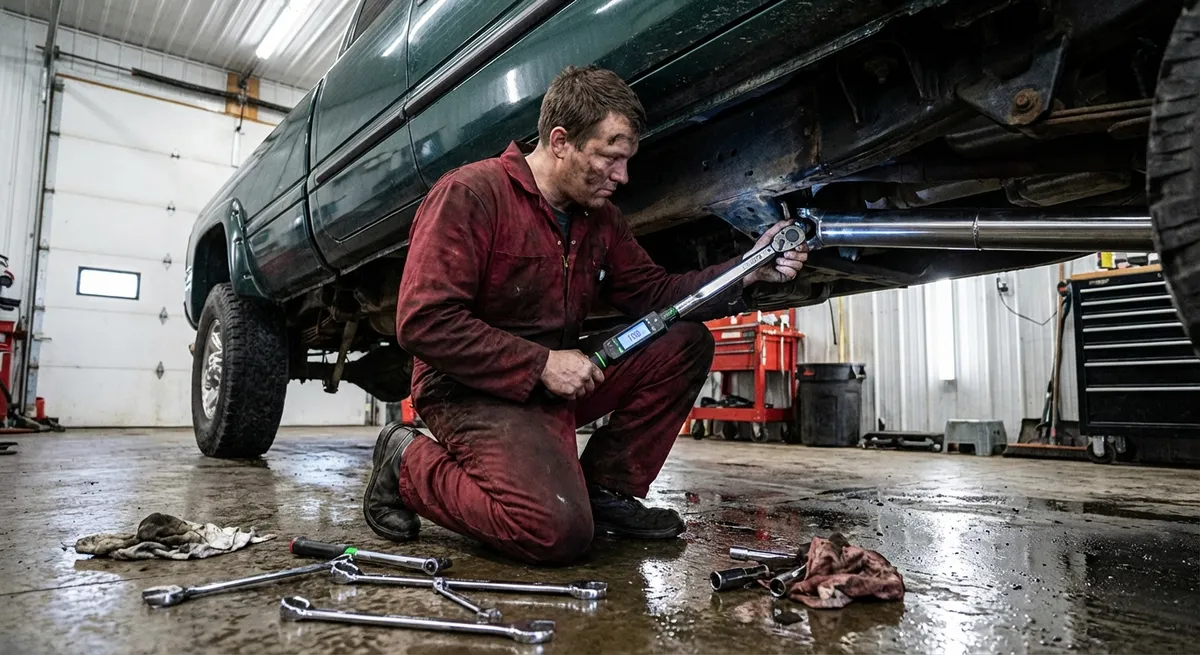
Technical Point 5: Alignment and Axle Torque Are Silent Drivetrain Killers
Chain adjustment isn’t complete when slack “looks right.” Misalignment and incorrect axle torque can quietly dismantle everything you’ve done correctly.
Important technical details:
- Swingarm marks are approximate, not gospel. Those little hash marks near the axle blocks are manufacturing approximations. For precise alignment:
- Use a chain alignment tool that references the chain’s run
- Or measure from the swingarm pivot to the rear axle on both sides with calipers or a precise tape
Even a small misalignment angle loads chain side plates asymmetrically and accelerates wear.
- Axle torque isn’t just “tight enough.” Under-tightened:
- Allows axle creep under load
- Lets adjusters move, changing chain tension mid-ride
- Distorts bearings
- Can compress spacers and change internal bearing preload
Over-tightened:
Both conditions can cause heat buildup and premature bearing failure.
- Check for lateral chain tracking. With the wheel spinning on a stand:
- The chain should run centrally on the sprocket
- If it consistently favors one side, you may have an alignment or sprocket face issue
- Cush drive integrity affects shock loading. Worn cush drive rubbers:
- Increase driveline lash
- Hammer the gearbox and chain during on-off throttle transitions
If you feel clunks in the rear under abrupt throttle, inspect the cush drive. Cheap to fix, expensive to ignore.
- Bearing drag is diagnostic. With the chain removed:
- Spin the rear wheel and feel for roughness, noise, or excessive resistance
A smooth, free-spinning wheel indicates healthy bearings and correct torque. Anything else is a drivetrain red flag.
Alignment and proper torque don’t show up as shiny parts or Instagram content—but they are the reason your bike feels planted, quiet, and mechanically “tight” under real load.
Conclusion
A strong drivetrain isn’t an accident; it’s engineered in your garage every time you wrench on your chain, sprockets, clutch, and rear wheel. When you treat tension as geometry, lube as tribology, sprockets as precision gear interfaces, the clutch as a thermal device, and alignment/torque as structural fundamentals, you stop “maintaining” and start tuning a torque-transmission system.
The reward is obvious the first time you roll on from low RPM and feel clean, silent drive with no lash, no chatter, no hesitation—just pure, linear torque from crankshaft to contact patch. That’s what a disciplined drivetrain delivers: confidence, longevity, and performance you can trust at any lean angle, any load, any speed.
Sources
- [DID Chain – Technical Information](https://www.didchain.com/technical-information) – Manufacturer data on chain construction, lubrication, and wear characteristics
- [Regina Chain – Maintenance Guidelines](https://www.reginachain.net/eng/use-and-maintenance) – Detailed recommendations on chain tension, alignment, and service intervals
- [Motul – Motorcycle Chain Care Guide](https://www.motul.com/us/en-US/lubricants/guide/motorcycle/chain) – Practical guidance on chain cleaning and lubrication best practices
- [Yamaha Motor – Owner’s Manual Library](https://www.yamahamotorsports.com/motorsports/owners-manuals) – OEM specifications for chain slack, torque settings, and clutch adjustments across various models
- [Kawasaki Service Information](https://www.kawasaki.com/en-us/owner-center/owners-manuals) – Factory maintenance procedures and tolerances for drivetrains and clutches
Key Takeaway
The most important thing to remember from this article is that this information can change how you think about Maintenance.