You don’t feel torque with a torque wrench.
You feel it 200 miles from home when a rear-set is still rock solid, your bars are dead straight, and your chain hasn’t walked your wheel out of alignment. That’s torque fidelity: a bike that stays assembled exactly the way you built it—no surprises, no mystery rattles, no “how did that back out?” moments.
This is maintenance at the fastener level. We’re not talking generic “check your bolts.” We’re talking preload, friction coefficients, thread engagement, and why two riders can both “tighten it good” and get completely different results. If you want a motorcycle that feels engineered, not just assembled, this is the discipline that holds it together.
Below are five technical points that serious riders and garage obsessives can use to keep their bikes mechanically honest over thousands of miles.
1. Understand the Physics of Torque, Not Just the Number
Torque isn’t magic—it’s just a rotational force that stretches a bolt like a spring. That stretch is what clamps parts together. You’re not “tightening the bolt,” you’re preloading a fastener system.
Key concepts:
- Torque vs. clamping force:
What matters is clamping force (the squeeze between parts), not the torque itself. Torque is just a way to approximate how much stretch (and thus clamp) you’re putting into the bolt.
- Friction dominates the equation:
- A dry, gritty thread at 40 N·m can have less clamp than a properly lubricated, torqued 30 N·m fastener.
- Using anti-seize or oil without adjusting torque can easily over-stretch or snap a smaller bolt.
- Torque specs assume a condition:
- “Dry threads”
- “Lightly oiled threads”
- “Clean, no grease”
Roughly 85–90% of your torque is wasted overcoming friction in the threads and under the bolt head; only ~10–15% actually becomes bolt stretch. That means:
Factory service manuals often specify:
If you change that condition (e.g., you add Loctite or anti-seize), torque-to-clamp correlation changes. When in doubt, follow exact manual guidance, not internet wisdom.
- Elastic vs. plastic deformation:
- It may still “feel” tight.
- It has lost consistent clamping performance and should be replaced.
You want fasteners working in their elastic range (stretch that returns) not plastic range (permanent stretch). When you yield a bolt:
For critical components—brakes, triples, axle pinch, caliper mounts—use a calibrated torque wrench, clean threads, and the correct condition (dry vs. lubed) specified by the manufacturer. Guesswork here is engineering by accident.
2. Thread Engagement and Material Pairing: Why “It Feels Tight” Isn’t Enough
A bolt isn’t strong in isolation. Its strength is shared with the material it threads into—often aluminum on modern motorcycles. Over-torque here doesn’t just risk the bolt; it risks stripping the parent material, especially in engine covers, cases, and triple clamps.
Technical points to dial in:
- Minimum thread engagement:
- Aim for at least 1× bolt diameter thread engagement (e.g., 8 mm of thread engagement for an M8).
- Target 1.5× bolt diameter or more. Aluminum’s shear strength is lower, so you need more engaged length.
- Recognize “soft” locations:
- Engine cover bolts
- Valve cover bolts
- Transmission/side cases
- Triple clamp pinch bolts
- Bar clamps and risers
- Helicoils and inserts aren’t a failure—they’re an upgrade:
- A properly installed stainless helicoil or solid insert often yields stronger, more durable threads than the original cast aluminum.
- On critical threads (e.g., frequently removed covers), this can be a pre-emptive reliability upgrade, not just a repair.
- Avoid mixed fasteners:
For steel bolts into steel:
For steel into aluminum:
Watch your torque discipline especially on:
If you’ve got a marginal aluminum thread that’s been abused:
Don’t mix bolt grades or materials in highly-stressed multi-bolt joints (like caliper mounts or triple clamps). Uneven stiffness and different stretch behavior can load one bolt far more than the others, even at identical torque values.
When you treat thread engagement and base material as part of the fastener system, you stop “tightening bolts” and start engineering joints that last.
3. Threadlockers, Anti-Seize, and Lubes: Chemical Control of Friction and Movement
Chemical products around fasteners are not generic “goo.” Each one adjusts friction and micro-movement in a specific way. Using them correctly is one of the cleanest ways to build a bike that stays tight without over-torqueing everything.
Break it down like this:
- Threadlockers (Loctite and equivalents):
- Low strength (purple): Great for small, delicate hardware you may frequently remove (switchgear screws, some bodywork).
- Medium strength (blue): Ideal for most motorcycle fasteners that see vibration but need regular service:
- Caliper bolts (where specified)
- Rear set hardware
- Brake rotor bolts (if spec’d)
- High strength (red): Use only where the service manual calls for it or where disassembly is rare and you accept heat + force on removal.
- Clean threads with brake cleaner or alcohol first.
- Let cure (usually 12–24 hours) before heavy use.
- Anti-seize compounds:
- Dissimilar metals meet (steel bolts into aluminum heads, exhaust studs).
- High heat and corrosion risk exist (exhaust systems, O2 sensor threads).
Always:
Use sparingly where:
But: anti-seize dramatically reduces friction. If the manual does not account for anti-seize in its torque spec, you can often reduce torque by ~20–30% as a conservative rule, or follow the exact guidance from the compound manufacturer.
- General lubricants (light oil, assembly lube):
- Engine internals, axles, pivot points, and some internal engine case bolts may call for oiled threads.
- Again, torque values are paired with a specific lubrication assumption—match it.
The mindset shift: you’re not just keeping bolts from falling out; you’re managing friction so torque translates into predictable, repeatable clamping force.
4. Fastener Sequencing and Patterns: Controlling Distortion and Stress
The order in which you tighten bolts can warp components, preload bearings incorrectly, and twist assemblies into a stressed state that eats parts over time. Good sequencing is free performance and longevity.
Key patterns and practices:
- Crisscross / star patterns:
- Brake rotors
- Engine covers with many bolts
- Cylinder heads
- Wheels (if applicable)
- Start all fasteners finger-tight.
- Snug in a crisscross pattern to ~30–40% of final torque.
- Repeat the pattern to ~70–80%.
- Final pass to full torque.
- Incremental torque on clamps:
- Alternate side to side.
- Bring both sides up in stages.
- This prevents bending or twisting the fork legs or clamping surfaces.
- Center-outward technique:
- Start torqueing bolts near the center and work outward in a spiral or cross pattern.
- This reduces distortion and helps seals/gaskets load evenly.
- Recheck critical joints after heat cycles:
- Newly installed exhaust systems
- Head-stud-equipped engines (if specified by the manual)
- Some aftermarket rear sets and clip-ons
Use for:
Process:
Triple clamps, bar clamps, and axle pinch bolts should never be tightened fully on one side first.
For large covers or surfaces:
For:
After one or two full heat cycles and a few rides, recheck torque. Thermal expansion, gasket compression, and micro-settling can relax joints.
A motorcycle that feels “neutral and precise” often owes as much to correct sequencing as it does to torque numbers.
5. Building a Real-World Torque Strategy for Your Bike
You don’t need to torque every single 5 mm fairing screw like you’re in a cleanroom. You do need a system that prioritizes high-consequence hardware, uses the right tools, and is realistic for how you ride.
Build a torque discipline like this:
- Tier your fasteners by consequence:
- Tier 1 (Critical): Brakes, fork pinch bolts, axle nuts, chain adjusters, handlebar clamps, steering stem, suspension linkage, engine mounts.
- Tier 2 (Important): Rear sets, levers, controls, exhaust mounts, subframe, major bodywork that affects airflow or wiring.
- Tier 3 (Low risk): Cosmetic panels, small brackets, non-structural accessories.
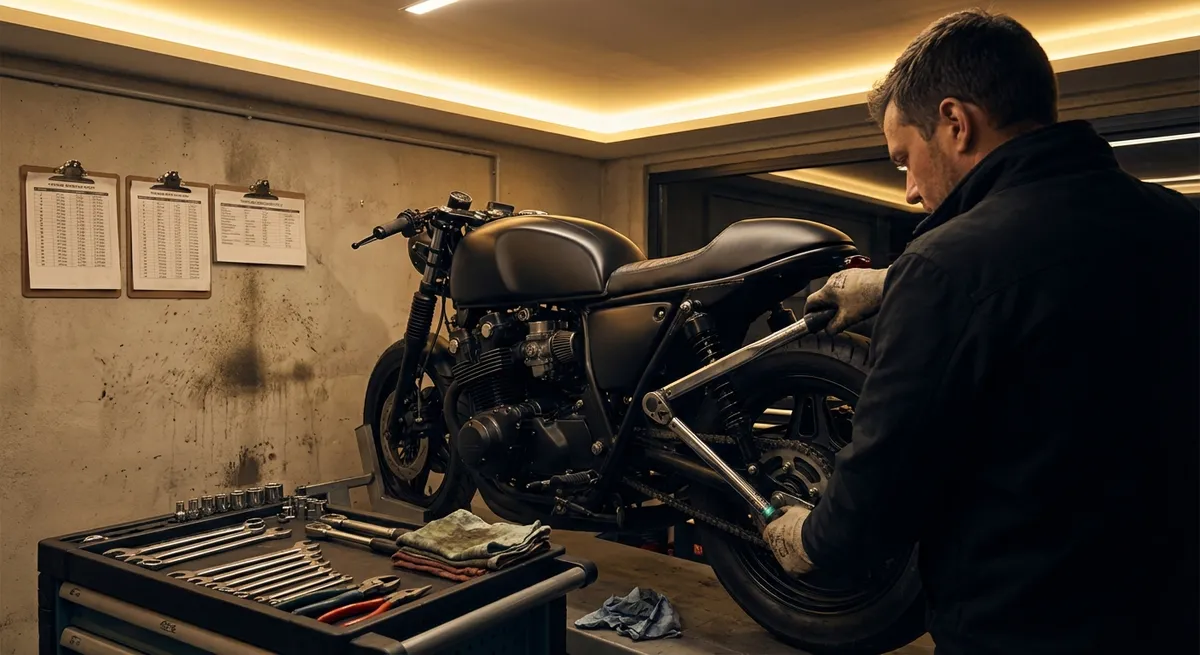
Torque Tier 1 by the book with a wrench. Tier 2 with a mix of torque wrench and calibrated feel. Tier 3 by hand feel and common sense.
- Invest in the right tools:
- 1/4" drive torque wrench for small fasteners (4–20 N·m range).
- 3/8" drive torque wrench for chassis and mid-size hardware (~10–80 N·m).
- Quality hex and Torx bits that don’t cam out and damage heads.
- Record your “bike-specific” hot spots:
- Fasteners that love to walk loose under vibration.
- Places that corrode more quickly (front axles, exhaust clamps, rear subframe bolts).
- “Check rear set hardware every 2,000 miles.”
- “Front rotor bolts needed blue Loctite; stable since.”
- Pair torque checks with other maintenance intervals:
- Every oil change: sample a small list—axles, caliper mounts, bar clamps, engine mounts.
- Every chain adjustment: rear axle torque, chain adjuster locknuts, rear caliper bracket/security.
- Every tire change: triple clamp pinch, axle pinch, bar alignment, brake hardware.
Every bike has:
Keep a simple log or note:
This turns “tightening stuff” into a repeatable protocol. Over months and years, that’s how you end up with a bike that always feels like it was just assembled by someone who cares—because it was.
Conclusion
A tight bike isn’t about paranoia; it’s about precision. When torque, friction, thread engagement, and sequencing are all under control, the machine disappears and the ride comes into focus. No buzzing mirrors from loose hardware, no wandering front end because a pinch bolt was under-torqued, no mystery clanks when you hit a sharp bump.
You’re not just maintaining a motorcycle—you’re preserving an engineered structure under dynamic load. That structure only works if every joint, clamp, and fastener is doing its exact share of the work.
Make torque fidelity part of your maintenance ritual, and your bike will stop slowly un-building itself and start riding like the unified system its designers intended.
Sources
- [Loctite – Threadlocker Selection Guide](https://www.henkel-adhesives.com/us/en/products/industrial-adhesives/threadlockers.html) – Official guidance on threadlocker types, strength levels, and proper use
- [Yamaha Motorcycle Owner’s Manuals](https://www.yamahamotorsports.com/motorsports/pages/owner-s-manuals) – Real-world examples of OEM torque specs, lubrication conditions, and fastener guidance
- [Kawasaki Service Information – Torque and Fasteners (Example Service Manual)](https://www.kawasaki-techinfo.net/searchOM.php?view_lang=EN) – Factory service documentation showing torque patterns, sequences, and special notes for critical joints
- [Fastenal Engineering – Torque-Tension Relationship](https://www.fastenal.com/en/83/torque-tension) – Technical explanation of how torque translates into clamping force and the role of friction
- [MIT – Materials Selection and Design (Bolted Joints Overview)](https://web.mit.edu/course/3/3.225/www/Handout5.PDF) – Educational resource covering bolt preload, joint design, and elastic vs. plastic fastener behavior
Key Takeaway
The most important thing to remember from this article is that this information can change how you think about Maintenance.