Most riders treat tools like an afterthought—until something fails 60 miles from home. Your tool kit is not a random pile of sockets; it’s a mechanical interface between your hands and the bike’s tolerances. Built right, it turns roadside problems into controlled procedures instead of panic.
This isn’t a “here’s a cheap Amazon roll” guide. This is about designing a tool kit as a precision system: tuned to your bike, your torque values, your field-repair priorities, and the realities of working on hot metal at the side of the road.
Point 1: Build Around Fasteners, Not “General Tools”
Start by reverse-engineering your motorcycle, not your toolbox.
Pull your fairings, seat, and tank (if reasonable), and actually log what you use. Every time you grab a tool, write down:
- Fastener type (hex, Torx, Phillips, JIS, external hex, etc.)
- Size
- Location on the bike
- Whether it’s critical (controls, brakes, chassis) or convenience (bodywork, accessories)
Most modern bikes are dominated by:
- Metric hex (4–10 mm)
- Torx (T25–T50, especially on Euro bikes)
- Flanged hex heads (8, 10, 12, 14 mm)
- Pozidriv or JIS screws on Japanese bikes (carbs, switchgear, older models)
Now design the kit around coverage with minimal redundancy:
- Use a compact 1/4" drive system for 8–12 mm sockets, plus hex/Torx bits.
- Add a single 3/8" drive or breaker option if your bike has axle nuts or large pinch bolts.
- Carry combination wrenches only for sizes that are actually used and accessible where sockets won’t fit (often 8, 10, 12 mm).
The goal: every fastener on the bike should be confidently serviceable with no more than two tool choices. If you discover a fastener you can’t address away from home, you don’t need more tools—you need to rethink the bike’s hardware or your kit architecture.
Point 2: Torque Strategy for the Real World (Not the Workshop Bench)
You won’t carry a 1/2" digital torque wrench on a weekend blast. But that doesn’t mean torque becomes a guess. It means you design a field torque strategy.
First step: categorize fasteners by torque sensitivity and consequence.
Must-hit-torque (critical + precise)
- Caliper mounting bolts - Axle pinch bolts - Triple clamp pinch bolts - Handlebar clamp bolts - Brake disc bolts (if you ever need to touch them away from home—ideally you don’t)
Critical but tolerant
- Axle nuts - Rear sprocket nuts - Engine mount bolts (usually workshop-only)
Non-critical / convenience
- Fairings, seats, luggage racks, levers (to a point), mirrors
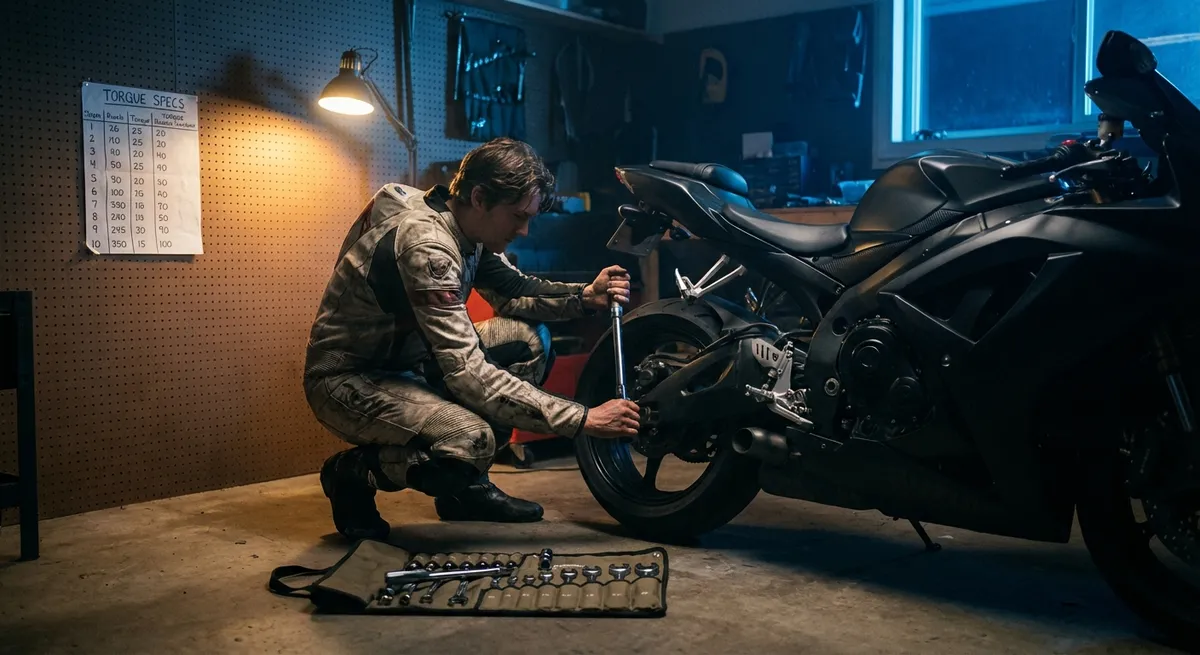
In the garage, use a proper torque wrench and learn the feel of specific values:
- 6–9 N·m: Small cover bolts, lever clamps – feels like “two fingers on a small wrench.”
- 18–25 N·m: Pinch bolts, mid-size hardware – “firm wrist pressure with a 3/8" ratchet.”
- 60–90 N·m: Axle nuts – “full hand, moderate body bracing, short breaker.”
Practice torquing a given fastener to spec, then loosening and re-tightening by feel, and verify with the torque wrench. You’re training your nervous system to recognize elastic deformation in metal.
For the road:
- Use short-handled tools for smaller fasteners to avoid over-torque.
- For axles, carry either:
- A compact torque adapter that you can use with a multi-tool handle, or
- A known “index method” (e.g., tighten to contact, then 1/8–1/6 turn with a fixed-length wrench that you’ve calibrated at home).
Torque isn’t about numbers on the roadside. It’s about repeatable feel that’s been calibrated in your garage.
Point 3: Leverage, Ergonomics, and Heat Management
Tool design isn’t just what it can turn; it’s how you can use it on a hot, loaded bike.
Think in terms of:
- Primary Drive Tools: 1/4" ratchet, T-handle, or a sliding T-bar. These give you control and speed.
- High-Leverage Tools: A compact breaker bar or a box-end wrench that can be doubled with another wrench for extra leverage (wrench-on-wrench method—use sparingly).
- Fine-Control Tools: Small L-keys and stubby bits for tight areas and delicate components (electronics, controls).
Key ergonomic principles:
- Short handles for finesse, long handles for force. If you find yourself choking up on a long ratchet to avoid over-tightening, that ratchet is the wrong tool for that fastener.
- Knurling and grip texture matter. In rain, oil, or sweat, you need positive control. Choose tools with non-slip surfaces or add friction tape to key handles.
- Swivel and wobble extensions are not gimmicks; they allow straight-line force on misaligned access paths so you’re not side-loading bolts and risking cross-threading.
Heat management is overlooked until you’re stranded:
- Pack mechanic’s gloves rated for moderate heat; touching a header or engine case bare-handed can end the repair before it starts.
- Include at least one long screwdriver or pry tool that can act as a “reach stick” to move hot components or redirect cables without skin contact.
- Consider a small silicone mat or pad that can be placed over hot components to rest tools or hands on; it doubles as a ground mat to keep small parts visible.
Your tools should let you work like a mechanic, not a contortionist fighting thermal hazards.
Point 4: Fastener Interfaces and Why JIS, Torx, and Hex Quality Matter
Many riders blame “soft screws” when the real culprit is poor tool-to-fastener geometry.
JIS vs Phillips
Japanese bikes (especially carb-era and older) often use JIS (Japanese Industrial Standard) crosshead screws, not standard Phillips. A Phillips driver in a JIS screw:
- Seats shallower
- Cams out under load
- Rounds the head long before the tool slips free
Result: stripped screws on float bowls, switch housings, and master cylinders.
Solution:
- Carry at least one JIS 2 and JIS 3 driver, or a quality JIS bit that fits in your bit driver.
- If you can’t get JIS, use “vessel-type” or JIS-compatible bits designed for Japanese hardware.
Hex and Torx Quality
Cheap hex and Torx bits introduce rounding, especially in high-torque or loctited locations (e.g., brake rotor bolts, engine covers). Look for:
- Precisely machined tips with sharp edges, not chamfered away half the engagement depth.
- Hardened, high-quality steel (e.g., S2) that resists twisting and deformation.
Field rule:
If a bit visibly twists, discard it. It’s become a cutting tool against your fastener instead of a drive key.
Anti-Cam-Out Technique
When you’re dealing with stubborn fasteners:
- Use direct axial load: push straight into the screw with strong hand pressure while turning with the other hand.
- Stabilize the tool by bracing your forearm against the bike frame or bodywork.
- Use manual drivers instead of powered tools for initial breakaway, especially on older or corroded hardware.
Correct tool geometry and loading prevent damage before you ever need an extractor.
Point 5: Electrical, Tire, and Repair Kits as Integrated Systems
A real-world tool kit isn’t just mechanical. It’s an ecosystem that covers electrical integrity, rolling capability, and temporary structural repair.
Electrical Core
At a minimum, include:
- Compact multimeter (voltage + continuity): essential for diagnosing no-start, charging issues, and blown fuses.
- Assorted fuses matching your bike’s ratings.
- Quality crimp connectors and a small ratcheting crimper or at least a reliable manual crimp tool.
- Short lengths of primary wire (16–18 AWG) and a couple of inline connectors or Posi-Locks.
Aim to be able to:
- Bypass a failed switch (e.g., side stand, clutch safety).
- Repair a broken accessory feed (heated grips, GPS, aux lights).
- Confirm charging system function at the roadside (battery vs stator vs regulator/rectifier symptoms).
Tire and Inflation
Tires are your only contact patch with reality. Your kit should allow:
- Puncture repair: cord plugs for tubeless; patches and tire irons for tube-type.
- Compact inflator:
- 12V pump (preferred), or
- CO₂ cartridges (with enough volume for your tire size, not just one or two).
Critical detail: practice at home. Actually plug a scrap tire or a worn-out tube. Understand how much force is needed to ream the hole, insert the plug, and how long your pump takes to hit usable pressure (e.g., 28–32 psi).
Structural / Temporary Fix
Add a micro “fabrication” layer:
- High-quality duct tape (wrapped around a tool handle to save space).
- Safety wire with a small pair of pliers.
- Zip ties of various sizes.
- Small epoxy or metal-repair putty (for non-pressurized, non-critical cracks and leaks).
These don’t replace proper workshop repairs, but they buy you controlled failure modes—brackets stabilized, wiring harnesses secured, non-critical leaks slowed—so you can ride out instead of call for rescue.
Design this subsystem the same way as the mechanical tools: around likely failures on your bike, not a generic “maybe someday” scenario.
Conclusion
A serious motorcycle tool kit isn’t defined by how many pieces it has; it’s defined by how precisely it interfaces with your machine, your riding, and your failure modes.
Treat every socket, bit, and driver as part of a designed system:
- Mapped to your fasteners
- Calibrated to your torque needs
- Ergonomically usable in the real environment—heat, rain, roadside gravel
- Integrated with electrical diagnostics, tire repair, and temporary structural fixes
Build it deliberately, test it at home, refine it after every service, and treat it as seriously as your tire choice or brake setup. When something goes wrong far from the garage, you won’t be improvising with junk—you’ll be executing a plan.
Sources
- [Snap-on Torque Fundamentals](https://www.snapon.com/EN/US/Diagnostics/Support/Knowledge/Torque-Wrench-Fundamentals) - Overview of torque principles, accuracy, and proper use of torque tools
- [Vessel JIS Screwdriver Information](https://www.vesseltools.com/handtools/screwdrivers/jis-screwdrivers) - Technical details on JIS vs Phillips profiles and why correct drivers matter on Japanese motorcycles
- [Park Tool: Using Hex and Torx Tools](https://www.parktool.com/en-us/blog/repair-help/using-hex-and-torx-wrenches) - In-depth guidance on correct use of hex and Torx tools, applicable to motorcycle fasteners
- [NHTSA Motorcycle Tire Safety Brochure](https://www.nhtsa.gov/sites/nhtsa.gov/files/811609.pdf) - Official guidance on tire inspection, maintenance, and puncture considerations
- [Fluke Multimeter Safety and Use Guide](https://www.fluke.com/en-us/learn/blog/electrical/multimeter-safety-basics) - Authoritative information on safely using multimeters for electrical troubleshooting
Key Takeaway
The most important thing to remember from this article is that this information can change how you think about Gear & Equipment.