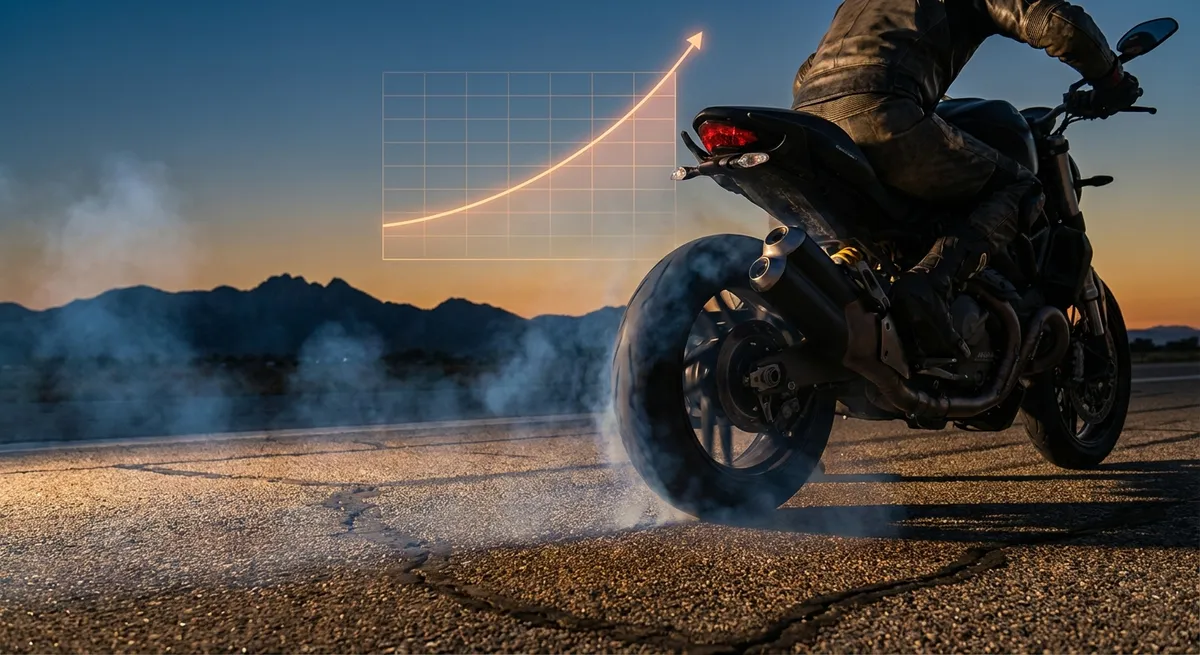
Most motorcycle reviews worship peak horsepower and spec-sheet bragging rights. But the bike that thrills you on a 50–80 mph pass, that slingshots out of a tight corner, that feels “angry” or “effortless” in the midrange—that bike is engineered around how it delivers torque in the real world, not just what it posts on a dyno chart at 12,000 rpm.
This is a review mindset shift: instead of just asking “How fast is it?” you start asking “Where is the thrust, how is it delivered, and what does that make me feel?” When you review motorcycles through that lens, spec sheets stop being the finish line and become the starting point.
Below are five technical points that will change how you evaluate any motorcycle’s performance the moment you ride it.
1. Translating Torque and Gearing Into Real Thrust
Torque at the crank is useless trivia until you translate it to force at the tire contact patch. That’s where subjective “pull” actually comes from.
When you ride a motorcycle for review, don’t just notice that it “pulls hard.” Break down why:
- Gear ratios: A bike with shorter gearing (numerically higher final drive ratio) will feel more urgent at any given speed in the same gear, even if peak power matches a taller-geared competitor. Check the spread: is 1st gear a stump-puller and 2nd a usable corner gear, or is everything stretched for top-speed marketing?
- Torque curve shape: An engine with a wide, flat torque plateau between 4,000–9,000 rpm will feel more “always ready” than a peaky motor that only wakes up above 9,500. Midrange density matters more than peak value.
- Real-world thrust windows: Evaluate acceleration in specific speed bands riders actually care about:
- Urban gap-closing: 20–50 mph
- Highway pass: 50–80 mph
- Backroad drive: 40–100 mph roll-on in 3rd/4th
The technical way to feel this: ride a familiar stretch of road and commit to using just one gear through a series of corners. A flexible engine with smart gearing will still let you modulate speed and line cleanly via throttle alone. A weak midrange or overly tall gearing will force you to downshift constantly to get anything resembling urgency.
When you describe a bike to other riders, say things like: “At 50 mph in 4th, a 10% twist gives you real, immediate drive,” or “Below 7,000 rpm it’s sleepy, you have to drop two gears to get honest thrust.”
2. Evaluating Engine Character Beyond Smooth vs. Vibratory
Enthusiast riders don’t just want “smooth.” They want character that’s engineered, not accidental—a specific blend of firing order, crank layout, and counterbalancing that produces a distinct feel at the bars and pegs.
When reviewing a motorcycle, dissect engine character in technical language:
- Firing order and crank layout:
- 180° parallel twin: freer-revving, higher-frequency vibes, likes to be spun.
- 270° parallel twin / V-twins: stronger low and midrange pulses, “tractor” feel, easier to modulate at small throttle openings.
- Inline-four: silky at cruise, rush near redline; quality of its intake honk and engine braking tuning matter hugely.
- Vibration quality and bandwidth:
- Low-frequency pulses through the pegs can communicate grip and engine load.
- Buzz through the bars at a narrow rpm band is fatiguing and indicates a resonance or balancing compromise.
- Evaluate specific ranges: e.g., “At 4,500–6,000 rpm in top gear, there’s a fine buzz at the bars that would bother long-distance commuters.”
- Engine braking calibration:
- Ride the bike aggressively downhill and roll off from mid-throttle without touching the brakes.
- Strong, abrupt engine braking can unsettle chassis and traction; weak, overly muted engine braking can feel numb.
- Modern ride-by-wire bikes often let the OEM tune engine braking—comment on whether it matches the bike’s mission.
Engine character is the bridge between numbers and emotion. The more precisely you describe how the pulses, vibrations, and intake/exhaust notes are delivered across the rev range, the more valuable your review is to serious riders.
3. Corner Exit Behavior: Throttle, Chassis, and Geometry Working Together
Corner exit is where a motorcycle’s entire engineering package either clicks or falls apart. When you review a bike, your job is to detect how chassis geometry, suspension setup, and engine response couple under throttle.
Key things to analyze:
- Throttle response at initial opening:
- Test in a mid-gear, mid-rpm corner. Come in with neutral throttle, pick the bike up slightly, and gently roll on.
- Is throttle mapping linear? Do the first few degrees cause a jerk, or is there a predictable, measurable increase in drive?
- Ride-by-wire bikes: note if “Sport” mode spikes early throttle percentage, making hairpins choppy.
- Squat and geometry shift under drive:
- As you accelerate, the rear squats, altering rake and trail.
- A good setup gives you added stability while still allowing steering correction mid-exit.
- Pay attention: does the bike stand up aggressively when you roll on, forcing you wide? Or does it hold line with mild bar input?
- Traction feedback:
- On a bike with good chassis communication, you can feel tire load rise as you add throttle. That subtle “loading up” is what lets you approach the tire’s limit with confidence.
- If you get a vague, disconnected feeling—no sense of how much grip remains—the combination of suspension valving, tire choice, and geometry is not communicating well.
When you write it up, talk like an engineer-rider hybrid: “As you roll from 20% to 40% throttle at 6,000 rpm in 3rd, the rear settles predictably and the bike holds a tight radius; you can feed in more throttle earlier than you’d expect given the tire size and weight.”
4. Brake System Performance: Heat, Modulation, and Real Stopping Power
Brake feel is easy to oversimplify as “strong” or “mushy,” but serious riders want a technical evaluation: how the system behaves cold, hot, and under repeated high-load use.
When you review, pay attention to:
- Initial bite vs. progression:
- High initial bite with poor progression is impressive on a single stop but tiring and risky on bumpy roads.
- A great system gives moderate initial engagement and then builds braking force predictably with lever travel.
- Note: “Brembo” or “radial” on the spec sheet tells you very little compared to actual feel and master cylinder sizing.
- Thermal performance:
- Find a downhill stretch or repeat 60–0 mph hard stops.
- Good systems maintain lever travel and bite consistency even when hot.
- If lever travel grows or friction fades, point it out—especially on heavier bikes or machines marketed for sporty riding.
- Rear brake tuning:
- Many OEMs under-spec or under-tune the rear brake to avoid lockup liability.
- A rear with decent bite and modulation is a significant asset for low-speed control and line tightening mid-corner.
- Critically assess: is the rear essentially ornamental, or is it a usable tool?
When you share your impressions, tie them to use cases: “On steep mountain descents, the front system shrugs off repeated hard braking with no fade, but the rear is so underpowered it’s basically a stabilizer, not a real speed controller.”
5. Stability vs. Agility: How Geometry and Mass Distribution Actually Feel
Spec sheets love listing rake, trail, and wheelbase, but those numbers are only meaningful when translated into subjective stability vs. agility on the road.
In your review rides, deliberately probe both ends of that spectrum:
- Low-speed agility:
- Do figure-8s in a tight space, slow U-turns, and parking-lot slaloms.
- A bike with good mass centralization and reasonable steering lock will feel lighter than its spec weight.
- Note how much bar input is required and whether the bike resists turn-in at walking pace.
- High-speed stability:
- At highway speeds, gently weave, make quick lane changes, and feel for any headshake or nervousness.
- On fast, flowing corners, test how committed the bike feels leaned over at speed—does it track like on rails or twitch with every mid-corner correction?
- Transition behaviour:
- On a twisty road, focus on left-right transitions (chicanes, S-bends).
- Bikes with high polar moment of inertia (heavy mass far from the center) resist rapid transitions, even if static weight isn’t huge.
- Lighter wheels and centralized mass show up here as a “flickability” that feels natural instead of nervous.
When you write, talk in cause-and-effect terms: “Despite a relatively long wheelbase, the steep rake and short trail, combined with light wheels, make the bike eager to tip in; however, mid-corner stability remains solid up to triple-digit speeds.”
Conclusion
The best motorcycle reviews don’t just say a bike is “fast,” “comfortable,” or “fun.” They decode why it feels that way by interrogating how torque, gearing, engine character, chassis dynamics, brakes, and geometry interact in real riding.
When you start framing every review around real-world acceleration, corner exit behavior, braking under heat, and the stability–agility tradeoff, your impressions become immediately useful to serious riders. You’re no longer repeating marketing copy; you’re reverse-engineering the bike’s engineering in the language of seat-of-the-pants physics.
Next time you ride a motorcycle you’re evaluating, don’t just open the throttle and smile—pay attention to how it pulls, where it pulls, and what that tells you about the machine underneath you.
Sources
- Yamaha Motor – Understanding Motorcycle Performance – Technical articles from Yamaha’s engineers on power delivery, chassis design, and performance tuning.
- Kawasaki Motors – Technology Overview – Official breakdowns of engine, chassis, and brake technologies that influence real-world riding behavior.
- SAE International – Motorcycle Dynamics Papers – Engineering papers on stability, handling, and braking performance.
- NHTSA Motorcycle Safety Research – Offers data and analysis relevant to braking, stability, and control under real-world conditions.
- Cycle World – Technical Features and Reviews – In-depth motorcycle reviews and technical breakdowns that connect spec-sheet data to on-road behavior.
Key Takeaway
The most important thing to remember from this article is that this information can change how you think about Motorcycle Reviews.