Most riders obsess over horsepower and lean angle. Fewer obsess over whether their rear axle nut is slowly walking loose, or if their caliper bolts were last torqued by “feel” instead of by spec. But if the bike can’t hold torque, it can’t hold a line, and it definitely can’t hold your trust.
This is where real maintenance lives: in the invisible battle between fasteners, load cycles, heat, and vibration. If you understand torque integrity, you stop being just a rider who “does oil changes” and become the kind of rider whose bike feels mechanically honest at any speed.
Below are five technical pillars for a motorcycle that stays tight, true, and trustworthy.
1. Torque as a System: More Than Just “Tight Enough”
Most riders think torque is just “how tight the bolt is.” Technically, torque is the rotational force that creates clamping force between surfaces. The bolt isn’t holding the parts together; the bolt is stretching, acting like a spring, and the tension in that stretch generates the clamp.
Manufacturers publish torque specs not as suggestions, but as the engineered point where:
- The bolt is stretched enough to maintain clamping force under load and heat cycling
- The threads are not overstressed or fatigued prematurely
- The joined parts aren’t being crushed or distorted
Under-torqued: the bolt doesn’t stretch enough, clamp is weak, vibration can loosen the joint, and the interface can fret or move under load (think loose triple clamps, wandering alignment, mushy braking feel).
Over-torqued: the bolt is stretched closer to its yield point, threads or shank can be damaged, aluminum housings can deform (like fork pinch areas or caliper mounts), and torque readings become unreliable because the threads are already compromised.
Technical takeaway: torque is about achieving a precise, repeatable clamp load. The wrench is just the language; the actual conversation is happening in the metal.
2. Fastener Classes, Friction, and Why “Dry vs. Lubed” Matters
A 40 Nm spec in the manual isn’t a universal truth. It assumes a certain bolt grade, thread condition, and friction scenario. Change the friction, change the clamp load for the same torque reading.
Key variables that serious riders should understand:
- Bolt grade / class
- Common metric classes: 8.8, 10.9, 12.9 – the higher the number, the higher tensile strength and yield strength.
- Many chassis and brake components use 10.9 or higher; substituting generic 8.8 hardware is a structural downgrade, even if it “fits.”
- Surface condition
- Dry, clean threads = baseline friction assumed in most service manuals.
- Oily, anti-seize, or thread-locked threads significantly reduce friction, which means at the same torque you can end up with much higher clamp load (and risk overstretching or pulling threads).
- Thread engagement depth
- As a rule of thumb for steel bolts into steel: at least 1x bolt diameter of full thread engagement (e.g., 8 mm diameter bolt → ~8 mm or more of full threads in the mating part).
- For steel bolts into aluminum, more is better—1.5x the diameter is a safer target to prevent stripping and thread pull-out.
Practical rule: never lubricate or apply threadlocker to a fastener unless the procedure or manual explicitly calls for it. If you change the friction condition from what the published torque spec assumed, you’ve changed the clamp load and made the spec inaccurate.
3. High-Value Torque Zones: The Fasteners That Define How the Bike Feels
Some fasteners are purely structural; others directly shape how the motorcycle behaves under braking, cornering, or load transfer. If you want a bike that feels laser-precise, commit to disciplined torque practices in these “high-value” zones:
Steering and Chassis Geometry
- Steering stem nut and upper/lower triple clamp pinch bolts
- Incorrect torque here changes bearing preload and structural rigidity.
- Too tight: notchy steering, self-centering feel, vague mid-corner corrections.
- Too loose: headshake, vague feedback, wandering on braking bumps.
- Fork pinch bolts (axle and triple clamps)
- Uneven torque can twist the fork legs, increasing stiction and asymmetry.
- Proper sequence and even torque reduce binding, improving compliance and feedback.
Braking System
- Caliper mounting bolts
- Under-torque: caliper movement, pad knock-back, inconsistent lever feel.
- Over-torque or galling in aluminum: distorted mounts, misaligned caliper, uneven pad wear.
- Brake disc (rotor) bolts
- These see intense thermal cycling. Uniform torque is critical for controlling disc runout and minimizing pulsing under braking.
Rear End and Drive
- Rear axle nut
- Defines chain alignment and wheel position. Incorrect torque combined with poor alignment can accelerate tire wear and destabilize the bike under throttle.
- Sprocket carrier / final drive fasteners
- Carry drive torque. Looseness here creates lash, clunking, and micro-impacts through the driveline that chew up cush rubbers and bearings.
If you only had time to do a “torque audit” on a used bike you just bought, start with those zones. That’s where mechanical discipline immediately translates into better feel and confidence.
4. Threadlockers, Washers, and Real Anti-Vibration Strategy
Vibration and load cycling will eventually win against any poorly engineered joint. Threadlockers, washers, and joint design are your tools to fight that entropy—but only if used correctly.
Threadlockers (e.g., Loctite-Type Products)
- Blue (medium strength): For fasteners you expect to remove with hand tools (common for brake discs, lever perches, some fairing stays per OEM spec).
- Red (high strength): For high-criticality or rarely serviced joints, often requiring heat for removal. Use only where the manufacturer calls for it.
Critical detail: torque specs are generally tested with or without threadlocker as specified in the manual. Adding high-strength threadlocker where it isn’t specified can change friction and complicate future service—especially in aluminum.
Washers and Joint Hardware
- Flat washers: Distribute load, protect surfaces, and help keep clamp load stable, especially in softer materials like aluminum.
- Spring/lock washers: Less common in modern critical joints; threadlockers and proper torque generally do a better job.
- Nord-Lock / wedge-lock style washers: Used in some high-vibration or racing contexts; they resist loosening by geometry rather than friction alone.
Anti-Vibration Strategy
You’re not stopping vibration; you’re designing joints that tolerate it without loosening:
- Wide, rigid contact areas → better load distribution
- Correct bolt length and engagement → better fatigue resistance
- Proper torque + appropriate threadlocking method → stable clamping force over time
Look at your motorcycle like a mechanical map of vibration pathways; joints at the ends of those paths (like rearsets, bars, fairing stays, and instrument brackets) are where thoughtful hardware choices make a difference in long-term solidity.
5. Building a Torque Discipline: Routines, Tools, and Data
If you treat torque like an exact science—and it is—you’ll need more than “good intentions” and a single click wrench.
Tools That Actually Matter
- Quality torque wrenches
- 1/4" drive: low-range work (controls, small fasteners, some engine covers).
- 3/8" drive: mid-range chassis work (calipers, pinch bolts, many engine fasteners).
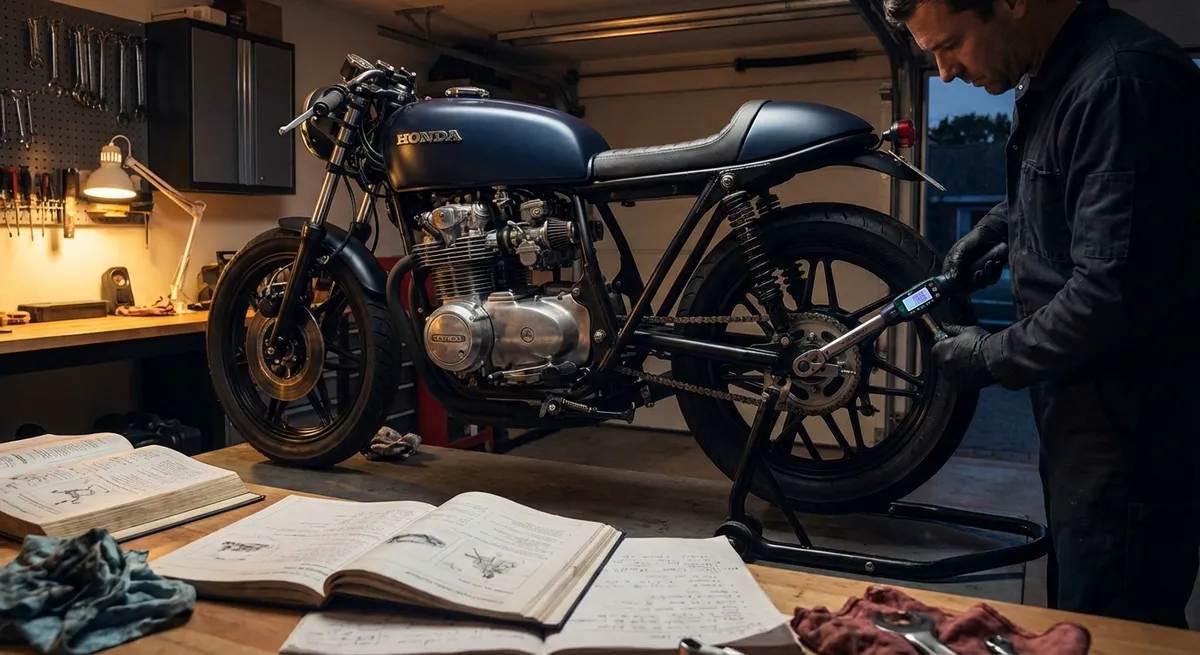
- 1/2" drive: high-torque jobs (axle nuts, some frame and swingarm bolts).
- Store at minimum setting, don’t use as a breaker bar, and calibrate periodically (ideally every 1–2 years if used heavily).
- Torque-angle method (where specified)
- Some modern engines and head bolts use “torque + angle” (e.g., 30 Nm then +90°).
- This method is more accurate at achieving bolt stretch than torque alone, because it reduces the impact of thread friction variability.
Routine and Documentation
- Keep a torque log for major services: date, mileage, fastener zones checked, and anomalies found.
- After any major disassembly (front end work, engine removal, brake system overhaul), perform:
- Initial torque pass
- Short shakedown ride
- Re-torque check of critical fasteners once everything has heat-cycled and settled
When to Replace Fasteners
Bolts are not immortal:
- Replace single-use / yield bolts (commonly head bolts and some structural fasteners) whenever the manual specifies.
- Replace any bolt that shows:
- Necking (visible thinning of the shank)
- Damaged threads or galling
- Significant corrosion in critical areas
If you’re building a machine you truly trust, fasteners aren’t “hardware store consumables”—they’re structural components with a life cycle.
Conclusion
Power is easy to measure. Torque integrity is harder to see—but you feel it every time the bike tracks dead-stable over a mid-corner bump, every time the brake lever feels identical lap after lap, every time nothing rattles, squeaks, or shifts under you.
A motorcycle that holds torque is a motorcycle that holds faith with its rider. When you treat fasteners, friction, and clamp load as real engineering problems—when you bring discipline to torque, not just habit—you stop riding a pile of parts and start riding a single, coherent machine.
Build that kind of machine, and the trust you have in it won’t be emotional. It will be mechanical.
Sources
- [Loctite Engineering Fundamentals: Threaded Fastener Theory](https://www.loctiteproducts.com/en/know-how/fix-stuff/threaded-fastener-fundamentals.html) – Overview of how fasteners create clamping force and why threadlockers are used
- [Yamaha Motorcycle Service Manual Example (YZF-R3)](https://www.yamahamotorsports.com/motorsports/pages/owners-manuals) – Factory torque specs, threadlocker usage, and tightening sequences for a modern motorcycle
- [Fastenal Technical Reference Guide](https://www.fastenal.com/content/feds/pdf/Article%20-%20Technical%20Reference%20Guide.pdf) – Detailed information on bolt grades, torque-tension relationships, and joint design
- [NASA Fastener Design Manual](https://ntrs.nasa.gov/citations/19900009424) – Authoritative engineering reference on fastener behavior, preload, and reliability in demanding applications
- [U.S. Department of Transportation: Motorcycle Safety Information](https://www.nhtsa.gov/road-safety/motorcycles) – Federal safety guidance emphasizing proper maintenance for safe motorcycle operation
Key Takeaway
The most important thing to remember from this article is that this information can change how you think about Maintenance.