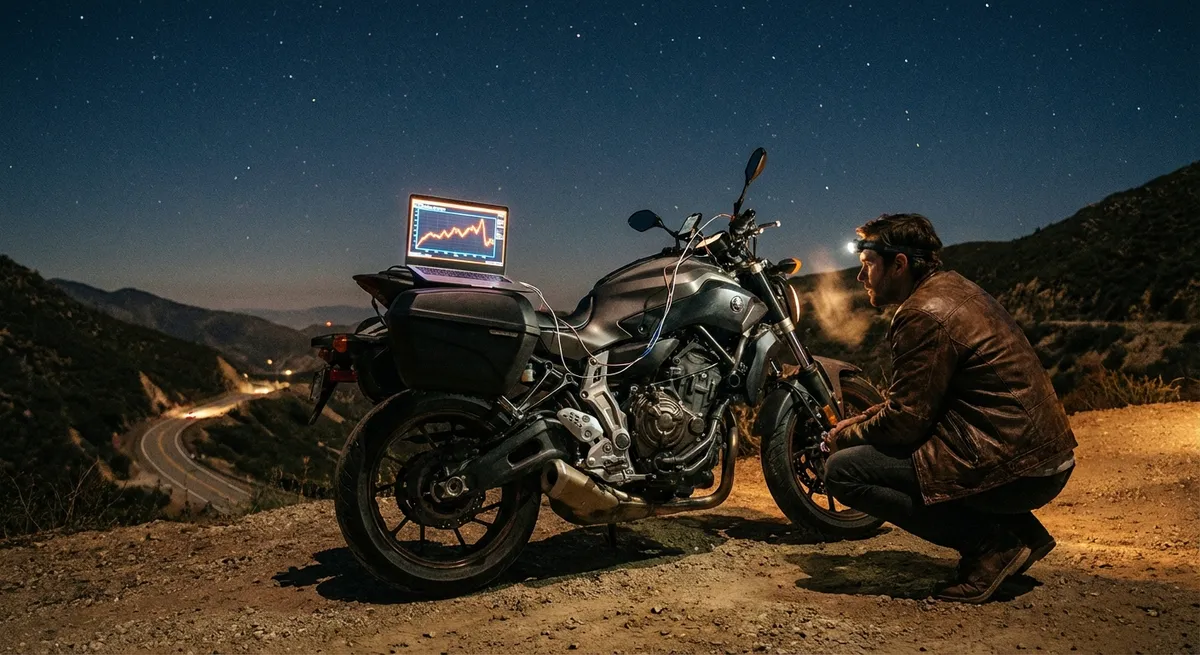
A spec sheet can tell you horsepower, weight, and wheelbase, but it can’t tell you how a bike wants to be ridden. That’s where serious motorcycle reviewing begins. At Moto Ready, we’re not interested in brochure copy or “felt fast” impressions—we care about measurable behavior, repeatable feedback, and how a motorcycle translates engineering into rider confidence on real roads. This isn’t about chasing lap-time fantasies on glass-smooth tracks; it’s about understanding what a machine is actually doing under you at 30 mph in traffic, 60 mph on backroads, and 90+ when the road opens up and you’re fully committed.
This article breaks down five technical pillars we use when evaluating motorcycles. If you’re the rider who feels subtle chassis flex in a fast sweeper, who can tell tire compound by the way it scrubs at lean, or who rewatches data logs to understand why a corner felt “off,” this is written for you.
1. Torque Delivery: The Real Story Behind the Dyno Curve
Manufacturers love to publish peak horsepower numbers, but what you ride every day is torque delivery across the usable rev range. When we review a bike, we focus on the shape of the torque curve, not just the headline peak.
We look at how early the engine builds meaningful torque and how consistently it carries it through the midrange. A broad, flat torque curve with minimal dips is worth far more than an impressive peak 1,500 rpm past where you normally shift. On the road, that translates into fewer downshifts, smoother passes, and the ability to drive out of a corner without hunting for the perfect gear.
We also pay attention to throttle-to-rear-wheel translation: how much lag exists between throttle opening and measured torque at the wheel, and whether the response is linear or “lumpy.” Ride-by-wire systems can be mapped to feel either too digital (light switch behavior) or overly damped (laggy, rubber-band response). When we ride, we’re consciously matching perceived grunt with logged rpm and speed changes to see if the subjective feeling aligns with objective torque behavior.
Parallel twins, V-twins, inline-fours, and triples all create different torque signatures: firing intervals affect traction feel, engine braking, and how comfortable you are using throttle mid-corner. Inline-fours often reward revs and precise gear selection; big twins give you a meatier, lower-rpm punch but can feel abrupt off a closed throttle. Our reviews call this out explicitly so you know if a bike will demand active riding or deliver lazy, effortless thrust.
2. Chassis Feedback: Reading Flex, Damping, and Geometry in Real Time
Chassis behavior is where average bikes are separated from machines that feel telepathic. A spec sheet might list rake, trail, and wheelbase, but the interaction between frame stiffness, suspension valving, and geometry determines whether the bike talks to you or argues with you mid-corner.
On test rides, we deliberately load the bike in different scenarios: trail braking into medium-speed bends, rapid S-transitions, and mid-corner line corrections. We’re looking for how quickly the chassis settles after an input, how much it resists or accepts corrections, and whether the feedback from the contact patch is crisp or muted. A good chassis gives you a clear sense of front tire loading—enough information to approach the edge of grip without constant micro-panicking.
Flex is not a dirty word. An ultra-rigid chassis can feel brilliant at 10/10ths on a perfect surface and awful everywhere else. We look for controlled, tuned flex that absorbs surface irregularities while keeping the geometry predictable. You should feel texture in the bars and pegs, not random jolts that suggest the suspension is packing down or the frame is twisting unpredictably.
We also analyze the dynamic geometry changes under braking and acceleration. Steep geometry with soft front damping might give razor-sharp turn-in, then go vague as the bike dives and reduces trail. Conversely, a more relaxed rake with firmer damping can feel slow initially but rock-solid once loaded. In a Moto Ready review, when we say a bike “tightens its line under throttle” or “stands up under front brake trail,” we’re describing real, repeatable geometry behavior, not just rider impression.
3. Brake System Behavior: Beyond Stopping Distance
Brakes aren’t just about how fast the bike stops—they’re about how controllable that deceleration is over imperfect tarmac. In testing, we care about initial bite, lever progression, heat management, and ABS strategy more than just the hardware brand stamped on the calipers.
Initial bite defines how the first few millimeters of lever travel feel. Too aggressive, and the bike becomes tiring in traffic and risky in low-traction conditions. Too soft, and you end up over-squeezing, which then suddenly bites and upsets the chassis. We want a ramp that starts gentle, builds predictably, and allows precise modulation with two fingers, even when the road is dusty or damp.
ABS tuning is a major differentiator. Some systems intervene early and blunt the stopping experience; others allow a small, controlled slip before stepping in. We pay attention to how ABS pulses—does it cause long on/off cycles that extend stopping distances and destabilize the chassis, or does it use fast, fine modulation that preserves feel at the lever and pedal? On the rear, we’re particularly sensitive to whether ABS kills your ability to drag the rear lightly for corner stabilization.
Fade testing is a separate part of the review. We do repeated high-speed stops to determine whether lever travel increases, if pad material overheats, or if the fluid boils. For sporty and touring machines, we expect consistent performance over multiple aggressive stops. If the lever feel goes mushy or the stopping force drops noticeably, that gets called out directly—because real-world mountain descents and track days will expose those weaknesses immediately.
4. Electronics Integration: When Rider Aids Enhance, Not Replace Skill
Modern motorcycles are computers with wheels, but how those systems are integrated determines whether they’re partners or intrusions. We don’t score bikes just for having quickshifters, traction control, wheelie control, or cornering ABS—we evaluate how cohesive and transparent those systems feel in real riding.
Traction control is a great example. Entry-level systems often behave like digital kill switches: detect slip, cut power, then reapply harshly. Advanced systems, especially IMU-based, modulate torque more smoothly, letting you feel a gentle check instead of a violent interruption. When we ride, we deliberately test traction control across modes, in low-grip situations and at varying lean angles, to map out where it helps and where it hinders.
Ride modes are another critical piece. In a well-executed package, each mode recalibrates throttle response, power delivery, and intervention levels in a way that feels logical and predictable. Rain mode should soften throttle and increase intervention without making the bike feel dead. Sport mode should sharpen response, but not so much that small wrist movements create unwanted chain lash or chassis pitch. We explicitly describe how each mode changes behavior so you can choose based on your own style and environment.
Quickshifters and auto-blippers are tested for both load sensitivity and low-rpm behavior. A good unit shifts cleanly at part-throttle and full-throttle, up and down, without demanding a specific high-rpm window. If the system feels rough below, say, 4,000 rpm, or needs an exaggerated boot movement, we’ll tell you. We’re also critical of dashboards and UI: can you change key settings on the move with gloved hands, or does the interface bury crucial functions under menu-labyrinth nonsense?
5. Thermal and Ergonomic Dynamics: How a Bike Feels After an Hour, Not a Lap
Many reviews focus on how a bike feels for the first 10 minutes. We care a lot more about the 60–120 minute mark when heat soak, posture strain, and cumulative vibration begin to reveal the real engineering compromises.
Engine heat management is one of the most underrated technical aspects. We look at how effectively the bike sheds heat at low speeds, how much radiant heat hits your legs and core, and whether fan operation improves or worsens rider comfort. Inline-fours with high-compression and compact radiators can cook your inner thighs in summer traffic; large twins often blast one side more than the other depending on exhaust routing. If you commute or tour, those details matter more than 5 extra horsepower.
Ergonomics is more than seat height and bar width. We’re evaluating rider triangle dynamics: how the bike loads your wrists under braking, how much it opens or closes your hips, and whether the footpeg position allows aggressive riding without destroying your knees. During longer rides, we note specific times when discomfort appears: a seat that feels okay for 20 minutes but becomes a pressure point nightmare at 90 minutes is a design failure, not a minor quirk.
We also observe vibration frequencies and where they manifest. Some bikes have minor buzz through the bars that’s annoying but manageable; others hit resonant frequencies at highway cruise that numb fingers or feet. We test different rpm bands at sustained speeds to see where the bike is happiest and where it becomes tiring. Combined with wind management—how clean or turbulent the airflow is around your helmet and torso—this shapes our assessment of how suitable a bike really is for commuting, weekend blasts, or full-day rides.
When we call out a bike as a “two-hour weapon” versus an “all-day machine,” that verdict is built on these thermal and ergonomic measurements, not just a seat-of-the-pants guess.
Conclusion
A serious motorcycle review should not read like recycled marketing, and it shouldn’t be reduced to a list of subjective likes and dislikes. When we test a bike at Moto Ready, we’re dissecting torque delivery, chassis dynamics, brake behavior, electronic integration, and long-duration comfort with the same level of scrutiny an engineer would apply to a prototype. The goal isn’t to chase perfection—it’s to map a machine’s true operating envelope so you can decide if its character, strengths, and compromises align with how you ride.
When you read our reviews, look for these five pillars. They’re the backbone of how we translate raw mechanics into rider reality—and how we separate bikes you’ll remember forever from the ones you’ll forget before the fuel tank is empty.
Sources
- [U.S. Department of Transportation – Motorcycle Safety](https://www.nhtsa.gov/road-safety/motorcycles) - Technical and safety-focused information on motorcycle braking, stability, and rider factors
- [SAE International – Powertrain and Chassis Technical Papers](https://www.sae.org/standards/browse/?subcommittees=PT,CHASSIS) - Engineering research on torque delivery, chassis dynamics, and vehicle control systems
- [BMW Motorrad – Dynamic ESA and Riding Modes Explained](https://www.bmw-motorrad.com/en/experience/stories/technology/dynamic-esa.html) - Official technical overview of modern motorcycle suspension and riding mode integration
- [Kawasaki – IMU-Based Rider Support Systems](https://www.kawasaki.eu/en/technology-detail/Overview?Uid=0270W1kMWltkWl5ZXVsNXA4LX1JfX1QMCg5dWQoOCw0) - Describes real-world implementation of traction control, cornering ABS, and electronic aids
- [Motorcycle Consumer News Archive via University of Illinois](https://www.library.illinois.edu/sshel/motorcycle-consumer-news-digital-collection/) - In-depth, data-driven historical reviews that emphasize technical evaluation over marketing claims
Key Takeaway
The most important thing to remember from this article is that this information can change how you think about Motorcycle Reviews.